Rox Does Yoga

Yoga, Wellness, and Life

Pose of the Month: Hero Pose May 17, 2011

Filed under: Pose of the Month,yoga — R. H. Ward @ 6:17 pm
Tags: , ,

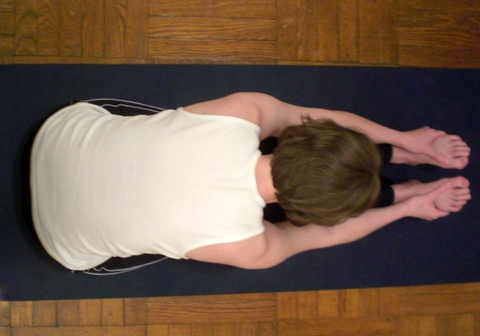
Hero Pose - SeatedPose Name:

Hero Pose

Sanskrit Name:

Virasana / Supta Virasana

Steps:

  1. Begin by kneeling on the floor.
  2. Spread the feet just wide enough apart that your tush can fit between your heels. Keep the inner knees close together, and the tops of the feet flat on the floor. Try to bring your tush to rest on the floor.
  3. If your tush doesn’t hit the floor, just sit up straight and breathe into the pose. Don’t force your tush down – opening the hips is more important than getting down to the floor.
  4. If you feel discomfort in your knees, you can place a pillow or block under your bottom for support. If you feel discomfort in your feet, you can try rolling up the edges of your mat under your feet for more support.
  5. If you can sit in the pose comfortably with your bottom on the floor, you can begin to bend backward. Use your hands for support on the floor. Engage abdominal muscles to avoid overextending your back. If you’re flexible, you may be able to come down on your elbows or even flat on your back.
  6. Work on relaxing into the pose, remembering to breathe.
  7. Come back up to a seated kneeling position. Gently bring your legs around to a cross-legged position.

Benefits:

Hero pose works to stretch and open the knees, hips, and feet. The pose can improve digestion and relieve gas and the symptoms of menopause. The more advanced version adds a deep backbend, which is beneficial for spine health: when done properly, the pose can be helpful for sciatica and lower-back pain. Backbends are heart-opening poses, which decrease depression, improve functioning of the lungs, and improve posture.

Contraindications:

Contraindications include heart problems. Students with knee or ankle problems may want to modify or avoid this pose. Those with back problems should avoid the backbending variation.

My Experience of Hero Pose:

Hero pose has been a favorite of mine for a long time. I liked the challenge of the pose and the stretch through hips and thighs. Over the years it’s been exciting to make progress in this pose – being able to sit my tush on the floor, to increase the backbend I was capable of, and eventually to lie on the floor with my arms extended. It was very satisfying to finally find a sense of ease in this challenging pose, to be able to lie back comfortably and just enjoy the stretch without being limited by pain or pressure. However, with my current schedule, I’ve had less time for yoga, which has led me to focus the time I do have on standing poses and meditation. I began to practice hero pose less frequently, and so I lost some of that flexibility that allowed me to relax deeply into the pose. My knees started to bother me, and I’ve had to work more gently and thoughtfully with the pose than I used to. It’s become a goal of mine to regain that former flexibility and ease and to maintain it as I get older.

Hero Pose - Reclining Version


Pose of the Month: Plank Pose May 14, 2011

Filed under: Pose of the Month,yoga — R. H. Ward @ 1:02 pm
Tags: ,

Pose Name:

Plank Pose

Sanskrit Name:

I could not identify a Sanskrit name for this specific pose.

Steps:

Plank pose is most frequently practiced during sun salutation (surya namaskar). For brevity, my instructions below begin with downward dog.

  1. Begin in downward-facing dog pose.
  2. Shift your weight forward so that your shoulders are directly over your hands. Arms are straight; legs are straight, with toes curled under. Look straight down at your hands and keep your fingers spread wide.
  3. Keep your tailbone tucked and your body straight. Activate the core muscles in your abdomen to help hold you up.
  4. Keep your breathing deep and even. Focusing on your steady breath will help you stay strong in this pose.
  5. Slowly lower down to rest on your belly.

Benefits:

Plank pose works arm muscles and tones core muscles. It builds heat and energy in the body while building strength.

Contraindications:

Plank may be difficult for students with wrist problems or carpal tunnel syndrome. These students can instead practice dolphin plank, which puts less pressure on wrists by resting the forearms on the floor.

My Experience of Plank Pose:

I have always hated plank pose. It makes me feel weak and helpless. I’ve been practicing yoga for over eight years – I do plank all the time and I work out with weights, but no matter how much muscle I build or how strong I think I am, plank is always really difficult for me to hold. Whenever it becomes too much and I have to drop my knees to rest, it feels like a failure.

I think I need to change my attitude towards plank pose. So far, I’ve always approached plank with the idea that if I just worked harder, I would be strong enough to do the pose well. I think I need to let go of that idea and learn to appreciate my plank for what it is: a challenging pose that makes me work. When my arms shake in plank, that doesn’t mean that I’m weak, and needing to drop my knees doesn’t make me a failure. If I can approach plank with a feeling of acceptance about where I am with the pose, my experience of the pose (and hopefully my enjoyment of it) will improve.

Plank Pose


Pose of the Month: Tree Pose May 12, 2011

Filed under: Pose of the Month,yoga — R. H. Ward @ 12:28 pm
Tags: ,

Tree Pose - FrontPose Name:

Tree Pose

Sanskrit Name:

Vrksasana

Steps:

  1. Begin in mountain pose (tadasana) with hands in prayer.
  2. Shift your weight onto your right foot, and slowly lift your left foot off the ground.
  3. Place the left foot against the right leg: against the thigh or against the calf, but not against the knee. If you feel wobbly, it’s okay to place the left foot at the right ankle and rest your toes on the floor for stability.
  4. Press your left knee out to the side.
  5. Let your gaze rest on an unmoving spot in front of you.
  6. When you feel steady, you can lift your arms up.
  7. Remember to breathe!
  8. Slowly lower your arms down and your left leg to the floor. Shake out your legs.
  9. Repeat on the other side.

Benefits:

Tree pose improves balance. It also works the muscles in both the standing leg and the bent leg, as well as in the arms if arms are extended overhead. Can be beneficial for those with sciatica and flat feet.

Contraindications:

People with balance disorders should take care and practice tree pose near a wall for stability and support. Headache and low blood pressure are also contraindications. Those with high blood pressure should not raise the arms overhead.

My Experience of Tree Pose:

I love tree pose for several reasons. It’s a pose that I can do well, and it feels good to do the pose. At the same time, tree pose is always challenging, depending on what my balance is like on that particular day. In tree pose, I have to rely on both physical and mental balance, and if either are off that day, it makes the pose more difficult. However, when I am physically and mentally balanced, I get into tree pose and feel like I can stay there all day. I love how practicing tree pose makes me focus my mind. It’s a pose that always makes me feel peaceful and centered, balanced and strong.


Pose of the Month: Paschimottanasana (Seated Forward Bend) April 20, 2011

Filed under: Pose of the Month,yoga — R. H. Ward @ 8:21 pm
Tags: ,

Pose name:

Seated Forward Bend

Sanskrit name:

Paschimottanasana

Steps:

  1. Begin by sitting up straight with legs extended straight out in front of you.
  2. Raise your arms over your head and stretch up, then slowly fold forward over your legs.
  3. Let your hands fall naturally onto your legs – you don’t have to reach your feet.
  4. Relax into the pose: feel the stretch up the backs of your legs. Keep your feet flexed and active. Keep breathing as you surrender into the pose.
  5. To move deeper into the pose, try lengthening the spine on each inhale, and sinking deeper into the fold on each exhale.
  6. To come out of the pose, slowly slide the hands up the legs until you are sitting up straight again.

Benefits:

This pose stretches the hamstrings and calves, helping to lengthen and strengthen tight muscles, as well as the spine, arms, and shoulders. Forward bending can be beneficial for digestion and the internal organs. Forward bends also help to calm the mind and relieve stress.

Contraindications:

Students with back injuries should use caution. Pregnant students should take care in any forward bend.


Pose of the Month: Big Toe Pose, Gorilla Pose April 18, 2011

Filed under: Pose of the Month,yoga — R. H. Ward @ 9:38 pm
Tags: ,

Pose name:

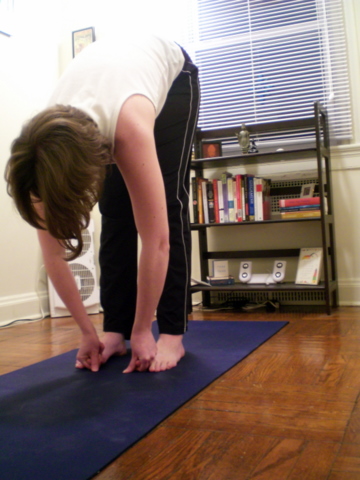
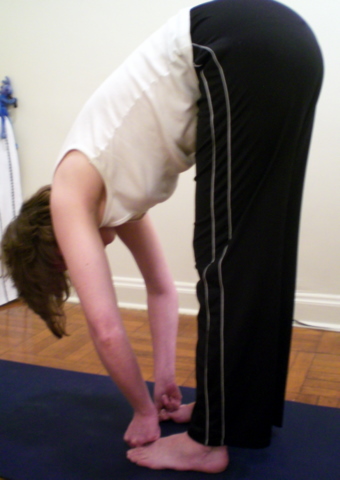
Big Toe Pose (standing forward bend with toe lock), Gorilla Pose

Sanskrit name:

Padangusthasana, Padahastasana

Steps:

  1. Begin by standing in tadasana (mountain pose).
  2. Bend forward, hinging from the hips and keeping a flat back, until your hands can touch your feet. It’s okay to bend your knees if you need to.
  3. Wrap the thumb and first two fingers of each hand around your big toes and squeeze.
  4. Rise up until your elbows are straight; straighten your back, and feel your belly hollow out, as if your belly button were reaching back to touch your spine.
  5. Gently lower forward, gripping the toes and dropping the elbows out to the sides.
  6. If your legs aren’t straight or your hamstrings are tight, keep your front torso long and your back straight, and work on trying to straighten the legs; if your legs are straight, you can deepen into the pose and bring your head towards your knees.
  7. Hold the pose and breathe.
  8. Raise up a little, unhook your fingers, and slide your whole hand underneath your foot, so that each foot is palm-to-palm with each hand. It’s okay to bend your knees if you need to.
  9. Continue trying to straighten your legs, or, if your legs are straight, deepening into the pose.
  10. Hold the pose and breathe.
  11. To come out, release your hands and rest them on the floor for a moment until you feel stable. Bring your hands to your hips; come halfway up to straighten your back, and slowly lift back up to standing.
  12. Take a small backbend if it would feel good: bend back from the heart, not from the waist. Return to tadasana.

Benefits:

This pose stretches the hamstrings and calves, helping to lengthen and strengthen tight muscles. Forward bending can be beneficial for digestion and the internal organs. Forward bends also help to calm the mind. The Gorilla Pose variation can improve circulation in wrists and hands.

Contraindications:

Students with back injuries (particularly lower back injuries) should use caution. Pregnant students should take care in any forward bend. Those with low blood pressure should come out of this pose slowly and carefully to avoid getting dizzy.


mid-month check-in April 11, 2011

Filed under: checking in,Pose of the Month,yoga — R. H. Ward @ 3:22 pm
Tags: , ,

It’s been three weeks since our first teacher training weekend, and there’s a week and a half until the next one. How am I doing?

  • I’ve read most of The Royal Path (I’m on page 109, so I really just have one more short chapter to go, since the glossary doesn’t count)
  • I covered all the yamas and three of the niyamas, with two niyamas to go (and I read the sutras on those niyamas this morning)
  • I’ve been blogging like a fiend and posting almost every day (I even scheduled a post for Saturday, when I was out of town!)
  • I made it to yoga class twice the first week, twice the second week, and once last week, and I’ve taught twice in class

The thing giving me the most trouble right now is the Pose of the Month. I’m finding it really frustrating, I feel resistant to it, and I admit I haven’t been doing it. It’s not being asked to do a certain pose every day that’s the problem – at first I was enjoying focusing on a specific pose, and after a few days of practice I noticed my body was improving and I was able to go deeper into the pose. I also understand that practicing the pose will help me to understand it better and therefore be better able to communicate how to do the pose to my future students. The part I’m having trouble with is being aware of and examining my feelings while I’m in the pose. This is surprisingly hard.

These particular poses (forward bends: I chose a standing forward bend and paschimottanasana, seated forward bend) do not inspire a lot of strong feeling in me. They’re enjoyable poses; they feel good and I like doing them, but I don’t have any particular feelings around them. When we got the assignment, N gave the example of a woman in a previous class who hated paschimottanasana because when she bent forward, her stomach got in her way, reminding her that she was overweight. That’s gold right there. There are other poses that I do have strong feelings about: I don’t like chair pose because it’s uncomfortable, I do like tree pose and warrior 2 because I feel strong and confident when I do them. I like dancer pose because it’s challenging and I feel accomplished when I do it. With forward bends, though, I don’t feel anything really. Good pose, good to do, I get a good stretch, end of story. So I feel kind of like I’m being asked to make something up. Seriously, I don’t feel anything earth-shattering here. What I feel is kind of annoyed that I have to analyze my feelings about this pose, which is perfectly nice but not really noteworthy.

But then I started to second-guess myself. Maybe I’m supposed to be feeling something that I’m not. What do other people feel in this pose? N and J always describe paschimottanasana as a pose of surrender, when I learned it as a much more active pose. So I started trying to practice it in a surrendery way, but I couldn’t tell if I was doing it right. And this hooked right in to my worry that I’m not doing meditation right. There will be a longer post on meditation later, I’m sure (so save your comments about that), but I’m really struggling with quieting my mind, and when I’m doing these poses, instead of noticing what I feel while I’m in the pose, I spend the whole pose thinking about the fact that I’m doing the pose and wondering what I should be feeling right now. Not the most useful thing ever.

So I started to feel resistant to the Pose of the Month, because doing the pose was no longer the pleasure it was before. It’s hard enough to fit yoga time into my schedule, but when yoga time isn’t enjoyable, when I have to spend all my yoga time analyzing my yoga, then yoga time becomes and chore and I don’t want to fit the yoga time in. So I haven’t done the Pose of the Month since probably Wednesday. I’m trying to be gentle with myself about this while still trying to enforce the fact that this is a requirement I need to fulfill. I don’t want to get to a place where I think, “I haven’t done the pose in five days, so what’s one more day?” I still need to practice the darn pose.

But if the weather’s nice tonight, then I’m skipping yoga and going jogging. (Hey, at least I’m not skipping yoga to eat cheese puffs on the couch.)


Teaching a seated twist! April 5, 2011

Filed under: Pose of the Month,teacher training,yoga — R. H. Ward @ 8:54 am
Tags: , ,

Last night in yoga class, there were three of us teacher trainees there, and we all got to teach. (I don’t think I’m going to get to relax and enjoy a yoga class for the next 9.5 months, but hey, it makes sense that I actually have to work for my almost-a-year of complimentary yoga classes.) Julia did a balance pose, Nancy did a backbend, and I did a seated twist.

Seated twist.(Hey, check it out, I added an item of visual interest to my post! Thanks to F, special guest photographer, who somehow managed to climb halfway up the wall to get this shot. I went back and added a photo to my Tree Pose post too!)
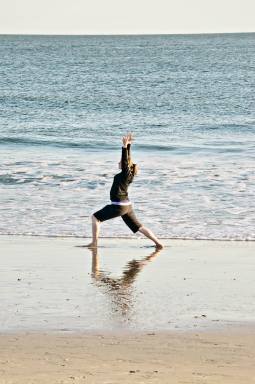
So here’s the seated twist I chose to teach. And of course, J asked us not to do the pose ourselves, just to talk through it. I understand why he wants us to do it that way, but what I discovered is that this is a difficult pose to tell someone how to get into.

OK, so first, you start out sitting up straight with your legs out in front of you. Easy. Now you’ve got to get the leg bend. What I said was something like, “Bring up your left knee, and then let it drop off to the side, and press your left foot against your right thigh.” That’s how I personally do it, but based on the class response, it might not be the best way ever to tell someone else how to do it (I then followed up that clear and accessible bit of instruction with, “Look, Julia’s got it!”). Not totally sure what the best way would be. Maybe, “Bend the left knee and slide your foot up your right leg”? Or just, “Bend your left knee and place your foot against your right thigh”? But then you miss the bit where the left leg is parallel to the floor, not up.

Anyway, hopefully now we’ve got the leg bent, so next is the twist. What I said was, “Raise your left arm – no, just to shoulder height – and now twist toward your left leg. Let your left arm lead you into the twist, and when you’re at the limit of the twist, drop your left hand to the floor. Bring your right hand to your left knee, and look over your left shoulder” (I’m not looking over my shoulder in the photo, but you should be when you try this at home). In retrospect, I should have brought the right hand to the knee first, then done the twist, because I think the hand on the knee gives you some leverage and helps keep your back straight, which people were having some trouble with. I also might have offered some guidance on where the left hand should drop behind you – i.e., right behind your tush – because having the hand too far back possibly caused people to be leaning back too much. A few people were confused about the whole darn thing and J had to go fix one woman, which I was a little embarrassed about.

Things I neglected to mention: keeping your right foot flexed and right leg active instead of just letting it lay there, and using the breath to deepen into the pose (breathe in and lengthen your spine, breathe out and move a little deeper into the twist). I also neglected to count my breaths as a way of telling how long they’d been in the pose so I just had to guess.

And then, you untwist and do it on the other side, which hopefully is less confusing because you just did it once. It seemed to be less confusing on the other side in class.

Overall, I don’t think I did the best job ever teaching this pose, but it helped to deconstruct it a bit here to see what I can do better next time. (I don’t know that I’ll always post here after every time I teach anything, because that would be a lot considering I’m trying to get to class twice a week. Maybe I’ll post for every new pose I get to teach? Or every interesting and out of the ordinary teaching event? We’ll see.)


First Week Round-Up March 27, 2011

Filed under: checking in,Pose of the Month — R. H. Ward @ 8:00 pm
Tags: , ,

I thought it might be useful (for me, at least, I don’t know about for you) to check in periodically and see how I’m keeping up with my teacher training workload, and how it’s balancing out with the rest of my life.  TT began just over a week ago, so how did I do during my first week?

  • I’ve read about half of The Royal Path.  (It’s short and easy, I’m trying to stretch it out.)
  • I’ve started on the yoga sutras and have considered the first two yamas carefully (and there’s one more post in the queue on ahimsa and satya, too).  On schedule with this (especially since the next two are pretty easy – maybe I’ll make it through three this week).
  • I blogged Monday, Tuesday, Wednesday, Saturday, and Sunday (a total of seven posts), so I’m keeping up with my rough goal of doing this five days a week or so.
  • I made it to yoga class at the studio twice, Monday and Thursday evenings.
  • I practiced my Poses of the Month (forward bends) almost every day and started keeping a journal about it.
  • My husband hasn’t throttled me yet.

I will start posting about classes and actual yoga at some point.  This week I had the weekend sessions to post about, plus some introductory things like the books.  Also, ahimsa is kind of a big topic.  I do see myself posting about the actual yoga I’m doing and the people I’m now doing it with.

The forward bends are interesting so far.  The idea here is to practice these poses every day, paying attention to how I feel in the pose, and see where it leads.  Right now I’m feeling really scatter-brained and unable to focus – hopefully that will improve over the course of the TT.  I will probably hold off on any big posts about the Poses of the Month until later on in the month when I’ve observed more.

I did, however, discover something interesting about my practice of paschimottanasana (seated forward bend).  N & J teach this as a pose of surrender.  They instruct their students to relax into the pose, let themselves go, just focus on the breath.  I’ve been having a lot of trouble with this, and I figured out why: I learned this as a much more active pose!  With my old teacher Gene, we focused on keeping a flat back, finding a strong grip/catch on the legs or feet, lengthening the spine on inhales and moving deeper into the pose on exhales.  So, for the two years I practiced with Gene and ever since then, I’ve practiced this pose in a very active way.  No wonder I’ve had issues with the way N & J teach it as a more passive pose.  Neither method is “right” or “wrong”, just different.  This month I’ll try to practice it N & J’s way and see what happens.

I haven’t been shirking my normal life, either, although there are definitely some bumps in the road to work out.  F is really understanding of me needing to spend extra time on yoga practice and homework, and therefore sacrificing some of our time together, but we’re still working out how we’ll handle things that we usually split evenly, like cooking and dishes, when I’ll be out the door to yoga two nights a week and needing to spend time on homework on other nights.  F also raised a concern about Facebook/computer time – if we’re sacrificing time together, then maybe we should be making some Facebook sacrifices too and not wasting time that we could be spending together.  He definitely makes a good point.  On the whole, though, I think we managed this week pretty well: got our taxes done, looked at some houses (we’re thinking about buying), had a nice dinner with my parents, vacuumed, cooked meals, even made it to church this morning.  I hope we’re able to continue fitting the TT commitment into our lives in a healthy way.


Weekend session # 1: Saturday March 21, 2011

On Saturday we attended the morning hatha yoga class (butt = kicked), had lunch together, and then started on the Yoga Sutras of Patanjali (puh-TAN-juh-lee, apparently, I’ve been saying it wrong all these years).  The Yoga Sutras are probably 3000 years old and contain the ancient wisdom of Indian gurus on which modern yoga is based.  A natural place to start! Each sutra is a brief saying, as concise as possible to make it easy to memorize. The word sutra actually means “a stitch or thread” (where the modern suture comes from), with the sense that each sutra is a single thread of meaning.  There are almost 200 sutras total, but get this: in all of these sutras, there are only a few that are about the physical practice of yoga.  Like, fewer than five, out of almost 200.  This is because the physical practice of yoga is intended to be secondary to the mental, emotional, spiritual practice.  We do the physical practice to make our bodies healthy and well, so they won’t distract us when we sit in meditation.  This is largely counter to the way yoga is practiced in the US (think power yoga at the gym).

We’ll be working with the Sutras over the entire course of our training, but right now we’re starting with Book 2, verses 29-45 (in the Sri Swami Satchidananda translation), which is the part on yamas and niyamas.  The yamas are five practices of self-restraint:

  • Ahimsa: non-violence, non-harming
  • Satya: truthfulness
  • Asteya: non-stealing
  • Brahmacharya: control of sensual cravings
  • Aparigraha: non-possessiveness, non-greed

The niyamas are a set of five observances:

  • Shaucha: purity of body and mind
  • Santosha: contentment, satisfaction
  • Tapas: discipline, austerity
  • Svadhyaya: self-study
  • Ishvara pranidhana: surrender, devotion, faith

You got all that, right?  Don’t worry, I sat in a lecture all afternoon on Saturday and I’m looking at my notes right now and I’m not sure I get it all either.  But not to worry, over the next month I’ll be posting on each of these in detail!

After Saturday’s lecture, we broke up into groups of four and did a little teaching practice.  Each group chose a yoga pose, and one person acted as a teacher while the others were students.  The teacher had to give instructions on how to do the pose, without demonstrating the pose herself, and the students had to do the pose exactly according to the teacher’s instructions.  Then we switched so that each person had a turn as the teacher.   Being the teacher was much harder than you’d think, especially if you’re the sort of person who talks with her hands.  I caught myself with my arms going up into tree pose completely unconsciously.  It was difficult to describe exactly how to do a pose without reminding myself by doing it.  It’s honestly hard to be in a yoga setting and to stay still.  It was also interesting to see how each person’s instructions differed.  I started teaching tree pose, and my instructions were pretty basic since I was the first.  Michael followed me almost exactly, Trish added some new points, and then Joanna added some more information.  Also, as soon as I finished teaching and took on a student role, just doing the pose I remembered all these things I should have included in my instructions on how to do it.  We also taught seated forward bend, which was interesting for me because the others are most used to how N & J teach this pose, and so their instructions mimicked that, while the little yoga instructor in my head is my old teacher Gene, who taught it differently, and so I described it the way Gene would. Neither way was wrong, just different ways to verbalize how to complete this particular set of actions in doing this pose.

Mostly, the purpose of the exercise was to start getting us used to the sounds of our own voices.  It also got us on our feet and moving around after an afternoon of lecture, which was nice, and also got me at least thinking about the essence of what a pose is, what’s most important about that pose, what does a beginner student most need to know in order to do the pose correctly.  Which was a good thing to start thinking about, considering…

Our homework assignments!  Each month we’ll need to do posture write-ups.  This month we’re doing two, on forward bends.  We choose two types of forward bends, and then we write:

  1. Step-by-step instructions on how to practice this posture, in our own words, written as if for a beginner – the bare essentials, in bullet points
  2. The benefits of doing this posture
  3. Contraindications for this posture and who should not do this posture
  4. My own experience with this posture (based on my practice this month, when I should be doing the two postures every day and paying attention to how I feel in the pose and my mental experience of the pose)

Our other homework assignment is to read Book 2, verses 29-45 of the Sutras and to write a reflection paper on the yamas and niyamas as they relate to me in my life.  Since there are ten total yamas and niyamas, and five weeks until our next weekend seminar, I’m thinking that a good way to space this out might be to do two of them per week – which will make this a perfect topic for this blog!

Yes, you, my dear readers, will be keeping me honest with my homework assignments.  Not exactly what I imagined when I conceived of this blog, but a nice side benefit.  After all, this blog exists to document my teacher training journey: my reflections, concerns, joys and troubles along the way.  And if said reflections can then be channeled into homework assignments that I can hand in, so much the better.

Overall, I think the first weekend seminar of the TT was really excellent.  I’m looking forward to yoga class tonight (I’m hoping to get to the studio not just once a week, but 2-3 times), and I’m actually excited about the readings and homework.  Whee!