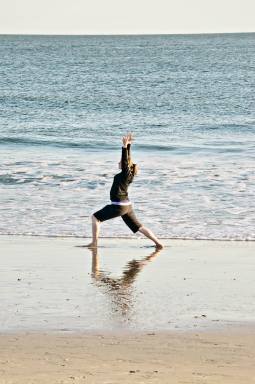
Rox Does Yoga

Yoga, Wellness, and Life

Four Paths: Raja Yoga July 31, 2011

Filed under: bhagavad gita,yoga lifestyle,yoga philosophy — R. H. Ward @ 12:22 pm
Tags:

In the Bhagavad Gita, Krishna describes the four paths of yoga:

Each of these paths has the potential to lead a yogi to enlightenment, so you choose your path based on your temperament and personality. Choosing the wrong path will make it much more difficult to make progress, because essentially you’re fighting your nature. This month, my assignment is to consider the four paths and decide which one appeals to me the most.

Today I’ll talk about Raja Yoga, the path of meditation. Also know as “the royal path”, this is the path described in the Yoga Sutras and by Swami Rama in his book The Royal Path. Raja yoga is often called the eightfold path, since it is comprised of eight steps:

  1. yamas: moral restraints
  2. niyamas: moral practices
  3. asana: posture
  4. pranayama: control of the breath
  5. pratyahara: withdrawal and control of the senses
  6. dharana: concentration
  7. dhyana: meditation
  8. samadhi: enlightenment

We’ve already talked about most of these steps here on this blog, and most of them will appear in all four of the yoga paths at some point – for example, no matter what path you’re following, you’re going to do some yoga postures and you’re going to meditate. The difference is that someone drawn to Raja yoga will make meditation her main spiritual practice and the focus of her efforts. A Raja yogi is someone who would really enjoy a weeklong meditation retreat: eating meals in silence, getting up early to spend hours meditating. You can learn more about Raja yoga in chapter 6 of the Bhagavad Gita.

Although I’ve really been enjoying my meditation practice, and I’m glad to be devoting time to it every day, I don’t think that Raja yoga is my path. I’m getting better at calming my mind, but such a quiet, still practice I don’t think would be ideal for me spiritually. However, I’m really looking forward to spending more time exploring meditation as a part of whatever path I choose.


Four Paths: Jnana Yoga July 28, 2011

Filed under: bhagavad gita,yoga lifestyle,yoga philosophy — R. H. Ward @ 2:06 pm
Tags:

In the Bhagavad Gita, Krishna describes the four paths of yoga:

Each of these paths has the potential to lead a yogi to enlightenment, so you choose your path based on your temperament and personality. Choosing the wrong path will make it much more difficult to make progress, because essentially you’re fighting your nature. This month, my assignment is to consider the four paths and decide which one appeals to me the most.

Today I’ll talk about Jnana yoga (pronounced Yah-Nah), the path of knowledge. This is the most difficult path but can be the shortest. A yogi drawn to the Jnana path naturally gravitates towards contemplation, thinking about spiritual questions, and studying spiritual books. The Jnana yogi is often solitary, quiet, and introspective, and may be interested in renouncing the world for spiritual study and reflection. The Jnana yogi is less interested in the Divine in the person of a figure like Jesus or Krishna, and more interested in the idea of the Divine, in unmanifested form or as universal consciousness or energy.

To progress along the path, the Jnana yogi uses reason and discrimination to distinguish between what is real and what is unreal, what changes and what remains unchanging. The Jnana yogi practices mental collectedness and concentration, not allowing anything to distract from the spiritual path. To that end, you stop looking for personal gain from the results of your actions, instead doing your duty simply because it’s what’s required, and you make enlightenment your top priority, refraining from actions that aren’t relevant to this quest. For more on Jnana yoga, take a look at books 4 and 7 of the Bhagavad Gita.

At first it seemed like maybe Jnana yoga would be my path. There are a lot of appealing things about it: I love to read and I’m good at studying, for one. But the more I think about it, the more this path doesn’t seem to go with my nature. I’m smart, but I’ve never been a big thinker – I never enjoyed philosophy classes or philosophical debates, and while I can be quiet and introspective, I don’t think I’d call myself contemplative. I think this path requires more discipline in study than I think would work for me – there are many things I can be disciplined about, but for me, reading has always been for the love of it, and I wouldn’t want to turn that into work. It’s a path that is a little more removed from the world than I think I can be. In many ways it’s a path I wish I could follow, but I don’t think it’s the right one for me.

Stay tuned for more on the other three paths!


Yoga philosophy in practice: dealing with shadows of the past July 14, 2011

Filed under: reflections,yoga lifestyle — R. H. Ward @ 1:32 pm
Tags: , , ,

The other day I was confronted by a photo of an old boyfriend/crush. One of my Facebook friends still keeps in touch with this guy, and had posted a group picture from a recent event. I have to tell you, he looked good. He got taller since high school, for one thing, and he’s obviously been working out (it’s summer, so no shirt in the photo). He grew into a nice-looking man. I found myself feeling a little regretful and wanting to post a comment on the picture where he would see it.

This sort of thing happens to us all the time, whether it’s somebody popping up online or whether you run into him at the grocery store (of course while wearing your grungiest sweatpants and with spinach in your teeth). Or maybe it’s not an old flame but a former friend who did you wrong, or that girl who always beat you at everything from classroom grades to homecoming court. When people we had strong feelings about in the past resurface in our lives, it can bring up a lot of those old feelings. How do we respond when these situations arise?

First, I try to practice satya, or truthfulness. When I saw that photo, why did I feel regretful? Where did the impulse to contact him come from? Well, thinking back, he was the one who broke things off with me. Part of me wants him to see how well I’m doing, see how great I look, maybe feel a little regretful himself. See what you missed, Mr. Blast-from-the-Past! But that’s kind of vengeful, isn’t it? And when I examine that impulse to get in touch with him, I have to question what the motivation is. Hello, happily married now! I obviously don’t want to date him again. From what I’ve seen, it looks like he grew up into a genuinely interesting person, someone I would have liked to have had as a friend, but if I try to think about it realistically, that would be pretty weird. There are plenty of other genuinely interesting people out there whom I’m also not friends with, and it would probably be better all the way around if I tried to meet some of them if I want a new friend. Plus, I mean, I really like my life. My life isn’t missing anything by the lack of this person’s presence.

Now I’ve examined my feelings and I see that, although the feelings themselves are a valid response to the situation, there’s no need to act on them or reach out to this person. The next step is to practice non-attachment. I’ve recognized that I still have some feelings bound up in my past relationship with this person, and maybe it’s time to let that go. I’ll never truly know how he felt about me back in the day or what, if anything, he thinks of me now. That’s okay. I might selfishly wish to know that, but I accept that I never will. I need to try to let go of my attachment to the things that occurred in the past. At the time, I wasn’t happy with the outcome, and I would have liked to change it, but looking back, the things that happened all those years ago led me to becoming who I am today. If things had gone differently in the past, I might not have ended up where I am now, and that would truly be something to regret.

Once we let go of the past, we can try to let go of our attachment to results as well. For me, I don’t ever expect to contact this guy or to hear from him. That’s a part of my life that’s over, and I do wish him well. Instead of feeling regretful when I see a picture of him on Facebook, instead I can decide that I’ll be glad to see him looking happy and enjoying his own life. Namaste, dude. Maybe you’re in a similar situation, but after examining things you decide you will reach out and contact the person. At that point, you can let go of the results too. Maybe he or she will write you back, and maybe they won’t, but you did what you needed to do and now you can move on. Employing some yogic philosophy can help us deal with these situations more maturely and come away feeling more satisfied, not just with the situation itself, but with our own behavior too.


Practicing Patience, Patient Practice July 8, 2011

Filed under: reflections,yoga lifestyle,yoga philosophy — R. H. Ward @ 2:29 pm
Tags: ,

The other day in the car at rush hour, I was stuck at a red light behind a guy in a jeep. His mind clearly wasn’t on the the road. First he vigorously dug around on the floor on both the passenger side and all over the backseat, all while letting his car inch forward bit by bit as cars progressed through the light, barely glancing ahead as he did so. Then he leaned out the window to fix his hair in the side mirror. When the light turned green, he was all ready to move forward, only to throw his hands up in frustration when it changed to red before he made it through the intersection. When he did finally make it through, he stomped on the gas going up the hill… only to have to stop at the next light. Watching him, I couldn’t help but realize that I know I act like that all the time, but how silly it looks to see it! I had a much better experience in traffic that day than the guy in the jeep did, partly because I was entertained and horrified by his antics, and partly because I spent the time practicing patience.

I have always had a really difficult time being patient. As a kid, if I wasn’t good enough at something to do it right the very first time, I just wasn’t interested. Patience? Practice? Nah. Everything to do with reading and books and school came naturally to me, so that’s what I did and that’s what I got better at, and I decided sports were stupid. I could have been good at sports too if I’d wanted to be, if I’d practiced hard, but I wasn’t interested in being patient. I didn’t understand that good things come to those who wait; I wanted good things right now.

Many of the different texts I’ve read so far in yoga teacher training have emphasized being patient, slowing down, using time more mindfully. Mr. Easwaran includes a whole chapter on slowing down in Passage Meditation, because going slower allows us to think through our choices before we decide, helps us remember to be kinder to others. All the pranayama breathing techniques I learned last month emphasize that the breath should be slow and deep and even; the breath and the mind are closely related, so if you slow down the breath, you calm the mind too. Calm minds generally make better decisions, and calm people are often more content.

In the yoga sutras about the yamas and niyamas, we read about asteya (non-stealing), which includes being generous with our time. If we stop rushing around and leave when we need to leave to get to our destination on time, we’re going to have a much more pleasant experience. Don’t be distracted thinking about the next thing, but focus your attention on what’s going on right now. Sometimes what’s going on right now may be boring, but if we’re patient, we may learn something useful.

It’s important, too, to practice patience in yoga class. We can only do what our bodies are able to do that day. Sometimes I can get my leg straight in revolved triangle, and sometimes I can’t. Sometimes I feel strong enough to hold side plank pose comfortably; sometimes, no matter how I modify it, I wobble around. When we see someone demonstrate an exciting new pose, of course we want to try it right away, but our bodies might not be ready for that pose, or it might be hard to get the hang of it on the first try. We have to be mindful of our limits as we practice, be patient with ourselves, and not force our bodies into postures that could harm us. A patient practice is a healthy practice.


Being the Best July 6, 2011

Filed under: reflections,yoga,yoga lifestyle — R. H. Ward @ 10:07 pm
Tags: ,

One thing I’ve been thinking about a lot lately is what it means to be the best. Ever since I was a little kid, I’ve had a thing about being the best – maybe it’s because my generation was always told we could do anything, maybe it’s because as a child I learned quickly in school and got used to being praised. Whatever it was, it meant that whenever I was good at something, I wanted to be better, wanted to conquer it (or at least to feel like I could conquer it if I weren’t so busy conquering other things). In middle school when I got straight As in everything but science, in which I got a B+, instead of accepting that as good enough, I studied hard and pulled the grade up. In high school, I took geometry and algebra II at the same time so I could catch up and do AP calculus my senior year. In college I did exhaustive library research for all my papers, filling my dorm room with stacks of inter-library loan books. In everything I’ve chosen to pursue, I’ve always challenged myself to excel, to be the best.

Of course when it comes to yoga I do this too. A slow hatha practice wasn’t enough for me, I had to push myself in a tough vinyasa sequence. If there was a complicated, difficult pose, I was going to work hard until I could do it. A beginners class was fine for beginners, but I was an advanced student. When I decided to do my teacher training, this focus came up there too. Of course I would want to teach advanced classes, being that I was so advanced myself.

Through the teacher training program and even just in practicing at EEY, I’ve experienced a major attitude shift in my personal practice. When I signed up for teacher training, I thought that the classical hatha program wasn’t exactly what I’d wanted, and I was a little sad that I wouldn’t get to do the more vigorous vinyasa practice that I liked, but that didn’t mean I couldn’t still teach vinyasa after I was certified. What I’ve found is that a classical hatha class challenges me in completely different ways than a vinyasa class does.A few weeks ago, I went to a vinyasa class at a different studio for the first time since starting the TT program, and it was too fast for me: I missed having time to linger in each pose and really appreciate how my body stretched. I built up a sweat, sure, but I didn’t feel my muscles burning the way I do in hatha class. Having to hold the pose a little longer works the muscles differently.

The TT program has also made me more humble. I’ve realized that a lot of poses are hard for me such that the most basic pose is all I can manage, and I can’t even think about the more challenging variations; there are many ways in which I could be stronger, more flexible. There’s a lot to learn for everyone in a beginners yoga class, no matter what level you’re at, and I’m finding that I really enjoy beginner yoga class because it helps me stay strong on the basics. I’m learning that I don’t have to be the best at yoga – that there’s not even a “best”, only what my body is capable of doing today.

What I’ve really learned is how much yoga is a part of my full life, not just a workout. I crave my yoga time not just because it feels good physically, but because it keeps me calm and centered. I don’t need to do fancy poses or wrap my leg around my head because it’s not about that. I don’t know if I realized that as much before I started TT. I wanted to be a yoga teacher because I love yoga so much and I really want to share yoga with everybody, but I noticed that teaching advanced vinyasa classes doesn’t so much jive with the “sharing yoga with everybody” mission. Sharing yoga with everybody means teaching beginner classes, period. I’ve always said too that I want to teach yoga to older people, but older people often have physical problems that mean they need the most basic level of beginner yoga. There was a disconnect in what I saw as my mission, and I can see that now. I’m really excited about teaching yoga to people who’ve never done it before, and I’m much less interested in teaching advanced level classes. I’ll teach ’em, of course, but I’m psyched about working with beginners. Being “the best” teacher doesn’t have anything to do with how flexible I am compared with others. To be the best yoga teacher I can be, I just have to share my passion.


Books: Passage Meditation, by Eknath Easwaran July 5, 2011

Filed under: books,meditation,yoga lifestyle — R. H. Ward @ 3:29 pm
Tags: , ,

Eknath Easwaran’s book Passage Meditation: Bringing the Deep Wisdom of the Heart into Daily Life is a kind, thoughtful guide to meditation for beginners and more experienced practitioners alike. Mr. Easwaran takes the tone of a helpful friend and mentor; the book is an easy read that makes meditation seem doable.

Mr. Easwaran starts by discussing the many benefits of meditation, describing how he came to meditation in the first place as a busy young professor at a university in India. He then details his method for meditation: in essence, to find a passage from spiritual literature that appeals to you and touches you deeply, to memorize that passage, and then to repeat it, word by word, in your mind during your meditation practice. Remembering each word of the passage gives your mind something to focus on. In addition, Mr. Easwaran believes that we are what we think about, and if you spend time thinking about an inspiring passage, that passage will become part of your consciousness, enabling you to become a better person.

You could probably start practicing this simple passage meditation technique just based on my description above, but Mr. Easwaran’s book is so finely written and so pleasant to read that I recommend it strongly.  The rest of the book discusses the benefits of a personal mantra in daily life and of slowing down instead of racing through each day; Easwaran also talks about improving concentration and training the senses (pratyahara), and other just good ideas for spiritual practice, such as putting others first and finding companions to practice with.

Not since reading Thich Nhat Hanh’s Peace is Every Step have I been able to recommend a book of spiritual instruction so highly. I loved this book. It is appropriate for any spiritual seeker regardless of religious tradition, as Mr. Easwaran is conscientious about using inclusive language and making his meditation techniques accessible to all. Mr. Easwaran is well read in the religious scriptures of many traditions and recommends spiritual passages from writers as diverse as St. Teresa of Avila to the Buddha. I highly look forward to reading more of Mr. Easwaran’s work.


Pratyahara and Non-Attachment July 3, 2011

One thing I’ve been thinking a lot about lately is pratyahara, the drawing-in of the senses. When we practice pratyahara, we refuse to let our senses make our decisions for us. So often, our senses will identify something they like and want more of it. That pizza tastes good! I like watching this show! It’s comfortable to relax on the couch! and so we eat more pizza, we watch two more episodes of Doctor Who, and we curl up on the couch for four hours. The problem is not in any one of those things in themselves. It’s fine to eat pizza sometimes, and Doctor Who is probably my favorite show. The issue arises when I’m not making my decision for myself but rather letting my senses make the decision. Two or three slices of pizza is great, but I don’t need to eat the whole pie, and I don’t need to order another pizza tomorrow. When I let myself binge out on something, I’m not consciously making that decision but rather allowing my senses to overdose on things that I like. Practicing pratyahara means that maybe I have some pizza today, but not every day, and I have a side salad or maybe go jogging afterwards; it means that I watch one episode of Doctor Who, but then I get up off the couch and start my evening routine so I can be in bed on time and get a good night’s sleep. If I make decisions consciously, then I will be taking better care of myself.

Non-attachment goes hand in hand with pratyahara. When our senses get used to having their way all the time, they begin to crave the things they like. When I haven’t had any pizza for a few days, I start to feel it. I WANT pizza. If somebody in my office gets pizza for lunch, the smell wafts over and I get all jittery and want it so badly. If I let my senses be in charge, I’d be running for the elevator, walking down to my favorite pizza shop, and trying to justify it because after all I did get the veggie slice. Practicing non-attachment, though, allows me to separate myself from that craving. I take a minute and think, do I really need pizza today? The craving doesn’t run my life, I do not NEED a slice of pizza right now, and I have a perfectly good lunch in the fridge waiting for me.

When we practice non-attachment with the objects in our lives, we can still enjoy things, still go shopping, still have stuff, but all those things don’t run our lives. We’re able to clean out our closets and take the old clothes to Goodwill. We’re able to lend out our books without stressing out about when or if we’ll get them back. If a vase gets broken, oh well, there are plenty more vases. If your husband eats the ice cream you were saving for Saturday, it’s not a big deal. Any one of those things could be upsetting or frustrating, but if you’re practicing non-attachment, you can come at the situation more calmly, with a little bit of distance that allows you to see things more clearly. Your husband didn’t know you were saving that ice cream; whoever broke the vase feels terribly about it. Having a little distance allows you to choose how you’ll react, so that rather than just yelling, you can choose to treat the other person with kindness and make a bad situation better instead of worse.

What are some ways you know to take control of your senses, rather than letting them rule over you? How do you cultivate non-attachment in your daily life?


Ayurveda: what’s it all about? June 14, 2011

Filed under: yoga lifestyle — R. H. Ward @ 1:49 pm
Tags: , , , ,

One of my assignments this month was to complete an ayurvedic questionnaire and explore the results. My first response was, wait, back up, what’s ayurveda?

Ayurveda is an alternative form of medicine traditional in India, with a history going back thousands of years. It’s a system of healthful, mindful living based on the concept of balancing three elemental energies called doshas: vata (air/wind), pitta (fire/water), and kapha (water/earth). Ayurveda holds that each person has different levels of these three doshas, and poor health comes from an imbalance in the doshas. Balancing the doshas, in a unique way for each individual, will lead to better health. This balance can be accomplished by focusing on diet (to improve metabolic system, digestion, and excretion), exercise, yoga, meditation, and even massage. In balancing the doshas and living in moderation, it’s thought that the body, mind, and spirit will also come into balance, improving the health of the whole person.

Each person has a unique distribution of the three doshas. Each person has some of each, but often one or two doshas are more abundant; by examining your physical attributes and personality (for example, in a quiz like this one), you can find out which is your dominant dosha. Your dosha levels can fluctuate, affecting mood and health, which is why it can be helpful to bring them back into alignment and balance! I took N’s ayurvedic questionnaire and came up almost equal in vata and pitta, with a very low level of kapha by comparison.

Vata, the air or wind element, is characterized physically by a thin, delicate body type with low body fat. A vata person is sensitive, jumpy or unable to sit still, easily overwhelmed, flighty, often runs late, easily confused. A vata dominant person who is well-balanced will demonstrate the most positive traits of this type: sharp, quick thinking, creative, while an unbalanced vata person could experience gas, bloating, lack of focus, spaciness, dry skin, nervousness, sleeplessness, and worry. A vata should avoid low-fat, raw, or cold foods in favor of warm, heavier foods.

The pitta element combines fire and water. Physically, a pitta type is medium-framed and well-proportioned; personality traits include being focused, organized, “type A”, workaholic. A pitta person tends to need to eat regularly and gets cranky when she misses a meal. When balanced, pittas are productive, organized, energetic, enthusiastic; unbalanced, pittas become agitated, irritable, and overly competitive and may experience diarrhea, rashes, and perspiration. Pittas should avoid overly spicy foods and red meat, choosing sweeter foods.

Finally, kaphas are earth and water types: physically larger or big-boned, not necessarily overweight but able to gain weight easily, and can be powerful athletes when in shape. Kaphas are grounded, stable, solid, slower moving, sensual. Balanced kaphas are reliable, dependable, calm, even-tempered, and peacemakers, while unbalanced kaphas can be lethargic, depressed, dull and sluggish, congested, and overweight. Kaphas should avoid fatty and heavy foods, dairy, and red meat, and choose lighter grains and proteins.

I think my results are pretty accurate. There were a few questions I could have answered differently, but doing so wouldn’t have changed the overall balance. I have a lot of vata and pitta characteristics. At my best I have the quickness and creativity of vata and the focus, organization, and productivity of the pitta. At my worst, I get the vata’s spaciness, dry skin, nervousness, lack of focus, and worry, and the pitta’s irritability and rashes. I definitely have the pitta need to eat regular meals (as F’s family can attest; I’ve started packing snacks for myself when we visit because they just don’t seem to eat on a schedule!). The food recommendations for vata and pitta are a little contradictory (the above is just a summary) but on both lists I see things that really appeal to me and that I’ve been naturally drawn to: lighter proteins, creamy soups, mashed sweet potatoes (vata), and fresh lime, dark leafy greens, sweet vegetables (pitta). My yoga teacher N is an ayurvedic practitioner, and I’m considering having a session with her to look at these things more closely.

Interestingly, I made F take the questionnaire with me, and he came up almost completely balanced among the three doshas. Looking at the descriptions, F has many characteristics of each dosha: he’s stronger in vata and kapha than pitta, but all three were within four points of each other. I’m not entirely sure what to make of that. Apparently I have a well-balanced husband.


Hangover Sequence May 27, 2011

Filed under: yoga,yoga lifestyle — R. H. Ward @ 2:30 pm
Tags: , , , ,

In honor of the Memorial Day holiday weekend, I present you with a sequence of yoga poses designed to help with hangovers! (Or, if you prefer, to help with headache pain and remove toxins from the body.)

  • begin in child’s pose (briefly! and don’t just stay there!)
  • rabbit pose to start the warm-up
  • come up to all fours for some cat/dog tilt (also called cat/cow)
  • thread-the-needle side stretches
  • step forward and up to standing (yes, really, it will do you good)
  • 2 rounds of half sun salutes
  • 2 classic sun salutations (nice and slow now!)
  • standing sequence: warrior 1, warrior 2, radiant warrior, triangle pose, revolved triangle
  • standing sequence, other side
  • tree pose for balance
  • come to the floor for cobbler pose and paschimottanasana
  • marichyasana and janu sirsasana with a twist (these seated twists will wring the toxins out of your internal organs)
  • if time allows, take another seated twist (for example, adding a twist to a simple cross-legged pose)
  • inversion: legs-up-the-wall (no need to get complicated here, your head’s throbbing enough already)
  • sivasana (and maybe a nap)

I hope this sequence helps you have a terrific weekend! I’ll be trying it out on at least a few friends, so I’ll let you know how it goes!

If you’d like to read more about how yoga can help a hangover and learn why I chose these particular poses for this sequence, check out this article in the New York Times and this post at Elysium Yoga.


Veg-Adventures: No Hot Dogs for Me May 24, 2011

Filed under: reflections,yoga lifestyle — R. H. Ward @ 1:02 pm
Tags:

I survived my first visit as a vegetarian to a hot dog joint. I was in Arizona for a wedding, and one of the wedding events was a trip to a Mexican hot dog place because the groom was dying for a “Sonora Dog”. (In retrospect, my whole AZ trip would have been less problematic and possibly more fun if I hadn’t converted to a meatless diet a few weeks earlier, but c’est la vie.)

This hot dog event actually wasn’t too bad for me – I’m a hot dog purist, so the Sonora Dog, covered with cheese and lord knows what all, didn’t really entice me. What was hard was not being able to participate in what the rest of my group was doing, the group experience of eating this particular food. I got two cheese quesadillas and heaped salsa on them. I found out later from the bride that I could have requested other filling inserts, like avocado and onions, but as it was, I ate what I ate and it was fine. I did get to drink horchata, which is one of my absolute favorite beverages, so that was great. Overall I focused on enjoying how happy my friends and family were to be eating this crazy food, because it makes me happy when the people I care about are happy.

The overall experience reminded me that there are just going to be times when, because of my choice not to eat meat, I’ll feel left out. That’s inevitable, but it’s also okay. Everybody feels left out sometimes. I made this choice for a reason, and a little discomfort doesn’t change that. I can appreciate my friends’ fun without resentment and without guilting them about it. And on future occasions, I can cook good food without meat and have friends over, or when it’s my turn to pick I can suggest vegetarian restaurants where we can all enjoy the meal.