Rox Does Yoga

Yoga, Wellness, and Life

April Yoga Weekend: Friday night practice on sun salutations April 27, 2011

Filed under: teacher training,yoga — R. H. Ward @ 3:05 pm
Tags: , ,

On Friday night I found out that this month is… Asana Month! Last month was intensive study on the yamas and niyamas, and this month will be intensive study on poses. Really excited about this, but on the other hand, I do wish this month was something more bookish that could be easily done in a plane, train, or automobile. F and I have a LOT of travel going on in May, which will make time on the mat more difficult to come by. I predict much grumping and whining in my future (but then, that’s pretty much the norm).

After group sharing on Friday, N gave us a handout that covered general guidelines for asana practice (I’ll come back to this in a later post), guidelines for sequencing a yoga class, and notes on each type of yoga posture: sun salutations, backbends, standing postures, twists, etc. On Friday night, we went through sun salutations in detail, papers  and notebooks open next to our mats, practicing and taking notes and practicing some more. I felt so pumped up – yes, this is exactly what I want to be doing! It was really exciting, doing poses and talking through them and asking questions about nitpicky details of alignment.

I’ve been doing sun salutations for over eight years (longer if you count Paul and Caroline teaching me a sun salutation after our college production of Children of Eden). Sun salutations always follow the same basic format – reaching up, folding forward, stepping/jumping back, backbend, downward-facing dog, stepping up, and rising back up – but there are variations in how some teachers teach sun salutations. It seems like something so basic to most people’s yoga practice, but I’ve always wondered about those variations. (For those who aren’t familiar with sun salutations, here’s the Wikipedia page about sun salutations, and I’ve linked a few videos below.)

N & J recommend teaching the “classic” form of sun salutation for a beginner class. This form takes out some of the more difficult elements. Instead of jumping or hopping back, you step one leg back into a lunge, hold for a few breaths, then step the other foot back to plank position. You then lower gently down to the belly (rather than doing a chaturanga push up), and take Sphinx or Cobra pose (rather than upward-facing dog). Press back to down-dog as usual, then step one foot forward to do the lunge on the other side, before stepping both feet up to the hands and completing the sequence.

Other common variations are Sun Salutations A and B. In A, you step or jump both feet all the way back, skipping the lunge, and typically you do chaturanga and upward dog. Sun Salutation B starts with chair pose and also includes Warrior 1.  (Here are videos of an incredibly flexible guy doing Sun Salutation A and  Sun Salutation B.)

I’m more used to doing Sun Salutation A, so it was actually a little challenging for me when I started attending classes at this studio and doing the “classic” sun salutation. The lunges were really hard when I wasn’t used to them! Now, though, I can appreciate it more. In the past, doing A, I was used to moving on every inhale and exhale, while with the classic version, each pose can be held for a few breaths, which can allow for a deeper experience of the pose while still building heat in the body. I find that slowing my sun salutations down this way can also help me to improve my alignment in tiny ways, creating a better experience.

Friday night’s class was useful because we were able to analyze each step of the different Sun Salutation sequences, looking at every option and modification for each step. After having practiced yoga for many years, it was useful to look at this basic sequence from a beginner’s perspective, examining what could be challenging or painful, and seeing how the poses could be interpreted by beginners.


Yoga on a Monday April 26, 2011

Filed under: reflections,yoga — R. H. Ward @ 1:15 pm
Tags: ,

Yesterday, I felt a little sick, but took a tylenol and decided to go to yoga class anyway. I’m really glad I did, because it was the best practice I’d had in a while.

It was a small class – just seven of us, with J teaching. Three of us were more experienced yoga students; four were closer to beginners, and as I was practicing I reserved a corner of my mind to pay attention to how J gave the instructions for each pose, what he said or pointed out to help the less experienced students through the postures. I noted the little moments when J said something outside his usual wording, indicating that those words were a gentle nudge aimed at someone in particular. I was pleased that I remembered to start cultivating that awareness throughout the practice.

I did a little stretching before class started, and found that my legs were loose enough that I could press my forehead to my knees in paschimottanasana; that was my first clue that it was going to be a good practice. I felt strong all through the class. J had us do some poses, like Pigeon, that I hadn’t done in one of his classes before, and it felt good. My low and high lunges during sun salutations were nice and strong, and it occurred to me that just a month or two ago, the sun salutation lunges were killing me because I wasn’t used to them. During the standing poses, when I felt my thighs burning, I consciously whispered “tapas” to myself, lowered a little deeper into the pose, and lengthened my breath. I was able to straighten my right knee in Revolved Triangle (not my left knee, not quite, but I got closer than usual). We did Camel as our backbend, and it felt so good that afterward I lowered back into Hero pose and was able to comfortably get my tush on the floor. J saw me doing Hero (everyone else was doing Child’s pose) and gave me a tip about trying to pull my knees closer together to get a different stretch, so I tried that. At the end of class, I felt ready to do a headstand, which I hadn’t done in a while. I pulled my mat over to the wall, prepared myself, and was able to gracefully lift my legs straight up. J gave me some pointers on lifting my legs away from the wall, so I worked on that, and was able to hold my headstand a good long while.

I wish I could say that my sivasana was perfect and undistracted, but not really. (I can even tell you my train of thought: Hey, I haven’t seen Katrina in a while. I should call her next time I’m in Boston and we should go dancing, it seems like she goes dancing all the time from her Facebook page. I miss going dancing with Kris, too, she should come along, but I bet she’s busy planning her wedding. I’m glad Carlos came to MY wedding. I wish Bobbi and Jon had been able to come to my wedding too, or that I’d been able to go to theirs. I’m so happy they’re having a baby – Hey, sivasana here! My eyes keep flickering, I should get Sarah T to make me an eye pillow, I need to check her prices on etsy – Sivasana!) So yes, I felt some distractions, but I was able to (1) catch myself and come back to sivasana and my breath, and (2) follow my own train of thought. I feel like this is a little bit useful because at least I’m aware enough of the distraction to see where my thoughts are going and where they’ve been, and awareness is a good thing.

Overall, it was a really excellent practice, and afterward I felt relaxed and languid and peaceful and content. I wanted to remember this practice, to look back over it as something special. In the midst of everything going on in my life right now, all the stress I’ve been feeling lately, I needed this practice to remind me that I really love this thing, that there’s a reason I believe in this so much.


April Yoga Weekend: Friday’s group sharing April 25, 2011

Filed under: reflections,teacher training,yoga — R. H. Ward @ 2:19 pm
Tags: , ,

So, Friday night’s teacher training session began with group sharing. What did studying the yamas and niyamas bring up for each of us? We all also had the chance to practice teaching last month, and N & J wanted to see how we were feeling about that. It was really interesting, and also really reassuring, to hear how each of my classmates is doing with the workload. We’re all struggling in different ways, but studying the yamas and niyamas affected each of us. Also, we all have conflicted feelings about the difficulties of actual teaching, which I’ll get into more later.

My sharing moment was interesting. In response to another student, J gave us a speech about how we shouldn’t discuss what we’re doing and feeling in teacher training with people in our regular lives; he feels it’s best not to talk to others about your spiritual practice, because other people might misjudge or misunderstand and it could cause difficulty in your personal life. When he finished, I piped up with, “Well, actually, I started a blog!” I explained that I’m a writer and that’s how I process my experiences best, and that with the TT commitment I wouldn’t have much time to write, so I wanted to channel my writing energy into something that would be helpful for yoga. I described how useful the blog has been for exploring my feelings on the yamas and niyamas, and how committing to regular blog posts has forced me to examine events and emotions I might not otherwise have thought twice about. And I told everyone how wonderfully supportive all of you, dear readers, have been. J looked at me skeptically and said he hopes that works out for me. It was a little awkward, and not exactly how I had envisioned telling them about this project.

I do firmly believe that starting this blog was the right choice for me. I think best on the page, so writing everything out has been incredibly useful for processing all that I’m learning, and for keeping track of my progress. I think the blog is also a good choice for me professionally: I don’t have a lot of by-lines or articles to my name, so when I do want to freelance as a writer in the future, I’ll have this blog to use as an example of what I can do, and it may lead to more and better writing gigs. And finally, I’m really glad I started it because of all the feedback I’ve gotten from readers out there, who have found my words helpful or inspiring, and that really means a lot.

It’s interesting to me how the teacher training process has made me examine all my choices carefully, even choices that seemed easy or obvious, even choices that I’d thought carefully about before. I think too that I’m incredibly lucky in my friends and family and in the abundant support I’ve received. Not everyone is so lucky; becoming a yoga teacher isn’t as obvious a career or lifestyle choice as, say, becoming an accountant, and I’m sure there are many yoga teachers out there who met with difficulty or derision as they embarked on this path. The fact that writing a blog seemed such a natural choice for me possibly says less about me than it does about all of you, and about my parents, who may have loved for me to be a doctor, but who love more the person that I’ve become. They were nothing less than delighted when I told them I’d signed up for teacher training, because I’d wanted to do it for so long. At every new turn, they listen and do their best to understand, and they may think I’m crazy sometimes, but they also know how much thought and work I put into this decision, and they respect that and support my choices. (Not to mention my amazing husband, who is quite frequently too good to be true.) So I do think that I am lucky, incredibly lucky and blessed. If I feel able to write freely about myself and my experiences, that writing at least in part stems from all the support I’ve received, and I’m so very grateful for that.


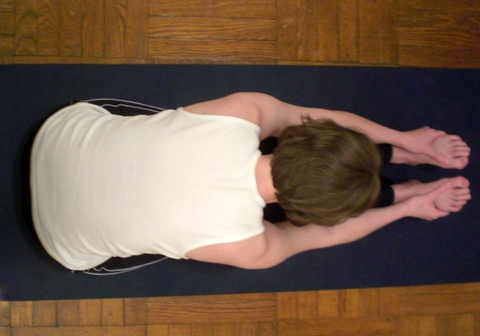
Pose of the Month: Paschimottanasana (Seated Forward Bend) April 20, 2011

Filed under: Pose of the Month,yoga — R. H. Ward @ 8:21 pm
Tags: ,

Pose name:

Seated Forward Bend

Sanskrit name:

Paschimottanasana

Steps:

  1. Begin by sitting up straight with legs extended straight out in front of you.
  2. Raise your arms over your head and stretch up, then slowly fold forward over your legs.
  3. Let your hands fall naturally onto your legs – you don’t have to reach your feet.
  4. Relax into the pose: feel the stretch up the backs of your legs. Keep your feet flexed and active. Keep breathing as you surrender into the pose.
  5. To move deeper into the pose, try lengthening the spine on each inhale, and sinking deeper into the fold on each exhale.
  6. To come out of the pose, slowly slide the hands up the legs until you are sitting up straight again.

Benefits:

This pose stretches the hamstrings and calves, helping to lengthen and strengthen tight muscles, as well as the spine, arms, and shoulders. Forward bending can be beneficial for digestion and the internal organs. Forward bends also help to calm the mind and relieve stress.

Contraindications:

Students with back injuries should use caution. Pregnant students should take care in any forward bend.


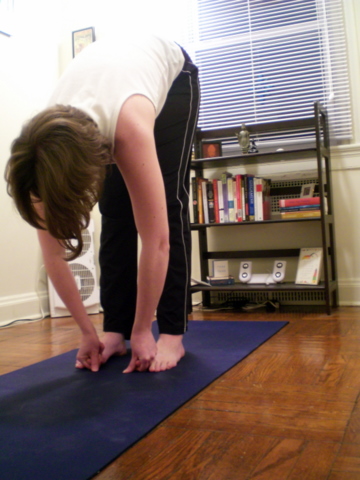
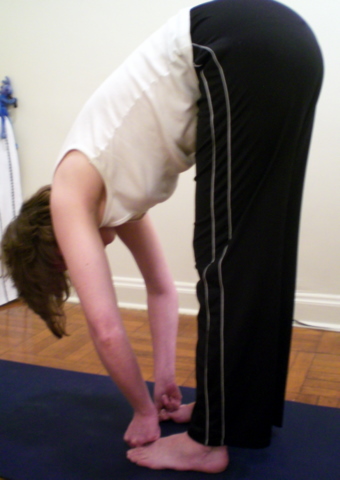
Pose of the Month: Big Toe Pose, Gorilla Pose April 18, 2011

Filed under: Pose of the Month,yoga — R. H. Ward @ 9:38 pm
Tags: ,

Pose name:

Big Toe Pose (standing forward bend with toe lock), Gorilla Pose

Sanskrit name:

Padangusthasana, Padahastasana

Steps:

  1. Begin by standing in tadasana (mountain pose).
  2. Bend forward, hinging from the hips and keeping a flat back, until your hands can touch your feet. It’s okay to bend your knees if you need to.
  3. Wrap the thumb and first two fingers of each hand around your big toes and squeeze.
  4. Rise up until your elbows are straight; straighten your back, and feel your belly hollow out, as if your belly button were reaching back to touch your spine.
  5. Gently lower forward, gripping the toes and dropping the elbows out to the sides.
  6. If your legs aren’t straight or your hamstrings are tight, keep your front torso long and your back straight, and work on trying to straighten the legs; if your legs are straight, you can deepen into the pose and bring your head towards your knees.
  7. Hold the pose and breathe.
  8. Raise up a little, unhook your fingers, and slide your whole hand underneath your foot, so that each foot is palm-to-palm with each hand. It’s okay to bend your knees if you need to.
  9. Continue trying to straighten your legs, or, if your legs are straight, deepening into the pose.
  10. Hold the pose and breathe.
  11. To come out, release your hands and rest them on the floor for a moment until you feel stable. Bring your hands to your hips; come halfway up to straighten your back, and slowly lift back up to standing.
  12. Take a small backbend if it would feel good: bend back from the heart, not from the waist. Return to tadasana.

Benefits:

This pose stretches the hamstrings and calves, helping to lengthen and strengthen tight muscles. Forward bending can be beneficial for digestion and the internal organs. Forward bends also help to calm the mind. The Gorilla Pose variation can improve circulation in wrists and hands.

Contraindications:

Students with back injuries (particularly lower back injuries) should use caution. Pregnant students should take care in any forward bend. Those with low blood pressure should come out of this pose slowly and carefully to avoid getting dizzy.


mid-month check-in April 11, 2011

Filed under: checking in,Pose of the Month,yoga — R. H. Ward @ 3:22 pm
Tags: , ,

It’s been three weeks since our first teacher training weekend, and there’s a week and a half until the next one. How am I doing?

  • I’ve read most of The Royal Path (I’m on page 109, so I really just have one more short chapter to go, since the glossary doesn’t count)
  • I covered all the yamas and three of the niyamas, with two niyamas to go (and I read the sutras on those niyamas this morning)
  • I’ve been blogging like a fiend and posting almost every day (I even scheduled a post for Saturday, when I was out of town!)
  • I made it to yoga class twice the first week, twice the second week, and once last week, and I’ve taught twice in class

The thing giving me the most trouble right now is the Pose of the Month. I’m finding it really frustrating, I feel resistant to it, and I admit I haven’t been doing it. It’s not being asked to do a certain pose every day that’s the problem – at first I was enjoying focusing on a specific pose, and after a few days of practice I noticed my body was improving and I was able to go deeper into the pose. I also understand that practicing the pose will help me to understand it better and therefore be better able to communicate how to do the pose to my future students. The part I’m having trouble with is being aware of and examining my feelings while I’m in the pose. This is surprisingly hard.

These particular poses (forward bends: I chose a standing forward bend and paschimottanasana, seated forward bend) do not inspire a lot of strong feeling in me. They’re enjoyable poses; they feel good and I like doing them, but I don’t have any particular feelings around them. When we got the assignment, N gave the example of a woman in a previous class who hated paschimottanasana because when she bent forward, her stomach got in her way, reminding her that she was overweight. That’s gold right there. There are other poses that I do have strong feelings about: I don’t like chair pose because it’s uncomfortable, I do like tree pose and warrior 2 because I feel strong and confident when I do them. I like dancer pose because it’s challenging and I feel accomplished when I do it. With forward bends, though, I don’t feel anything really. Good pose, good to do, I get a good stretch, end of story. So I feel kind of like I’m being asked to make something up. Seriously, I don’t feel anything earth-shattering here. What I feel is kind of annoyed that I have to analyze my feelings about this pose, which is perfectly nice but not really noteworthy.

But then I started to second-guess myself. Maybe I’m supposed to be feeling something that I’m not. What do other people feel in this pose? N and J always describe paschimottanasana as a pose of surrender, when I learned it as a much more active pose. So I started trying to practice it in a surrendery way, but I couldn’t tell if I was doing it right. And this hooked right in to my worry that I’m not doing meditation right. There will be a longer post on meditation later, I’m sure (so save your comments about that), but I’m really struggling with quieting my mind, and when I’m doing these poses, instead of noticing what I feel while I’m in the pose, I spend the whole pose thinking about the fact that I’m doing the pose and wondering what I should be feeling right now. Not the most useful thing ever.

So I started to feel resistant to the Pose of the Month, because doing the pose was no longer the pleasure it was before. It’s hard enough to fit yoga time into my schedule, but when yoga time isn’t enjoyable, when I have to spend all my yoga time analyzing my yoga, then yoga time becomes and chore and I don’t want to fit the yoga time in. So I haven’t done the Pose of the Month since probably Wednesday. I’m trying to be gentle with myself about this while still trying to enforce the fact that this is a requirement I need to fulfill. I don’t want to get to a place where I think, “I haven’t done the pose in five days, so what’s one more day?” I still need to practice the darn pose.

But if the weather’s nice tonight, then I’m skipping yoga and going jogging. (Hey, at least I’m not skipping yoga to eat cheese puffs on the couch.)


Niyamas: Tapas April 9, 2011

Filed under: yoga,yoga lifestyle,yoga philosophy — R. H. Ward @ 1:54 pm
Tags: , ,

The third niyama, tapas, is a tricky one. Along with svadhaya and isvara pranidhana, the fourth and fifth niyamas, tapas shows up in several places in the yoga sutras, so we know it’s really important, but the translation is hard. Tapas means “to burn”. It can mean “austerity”, or a “purifying flame”, or “self-discipline”, or “self-restraint”. So what is it, and how do we practice it?

When J makes us hold a challenging pose for a long time in yoga class, he’ll come over to me and whisper “tapas” to me while I struggle (he has seriously done this at least twice now). Tapas means to feel the burn of the pose, and instead of giving up, to grit my teeth and stick it out (and to not punch J who is just trying to encourage me). Tapas is a purifying burn because when I hold the pose, when I stick it out, I become stronger. Tapas is both the burn itself and the self-discipline to stay there and experience the burning.

Both Satchidananda and Devi have useful things to say about tapas (although I had to cross-reference to the other mentions of tapas in the sutras to get a fuller understanding). Satchidananda says that anything that causes us pain will make us stronger and give us steady minds. Rather than running from pain, he encourages us to welcome pain, to suffer through it, because we’ll emerge on the other side purified and strong. He gives the example of washing cloth. When a shirt is dirty, do we just spray some perfume on it and then fold it up again? No, we wash it. In the US we have machines to do this for us, but whether you’re using technology or river water and a rock, the shirt gets soaked, spun around, scrubbed, thrashed, and beaten. Then we squeeze it out, leave it to dry under the hot sun, or put it in a clothes dryer, where it tumbles around under high heat. Then we take it out, lay it on a table, and press it flat with a hot iron. All of this can’t be fun for the shirt, but afterward, the shirt is purified, free of dirt and wrinkles, and fit for us to wear. So it is with tapas.

We can make a practice of tapas with all the worst people in our lives. Satchidananda says that when someone insults you or frustrates you, the best response is just to smile and accept it. Try to bring love and compassion to the challenge, and as well as the understanding that you’ll be stronger afterward. And Satchidananda says we should even try to thank the person who causes the pain: “Thank you for causing me so much frustration today. I know you just want to make me stronger. Bring your friends next time.”

The other day a friend asked me which yama I’d use to deal with a frustrating person. She had done her best to help this person, going out of her way to do so, but what she had to offer him wasn’t what he wanted, so he just got annoyed. My friend felt like her sincere and generously given help was thrown back in her face, and she spent the rest of the day seething about it. I told her I’d try to practice ahimsa, which is still a good thing to practice, but now I’m thinking this is a job for tapas. “Yes, annoyed guy, I see that my help wasn’t enough for you. That’s fine. I’ll still try to give you what you need.” What an incredibly hard thing to do! Thank goodness we have so many chances to practice, right?

So tapas is the burn of our muscles as we work physically, as well as the flame we feel internally in tough situations. Tapas is also our self-discipline to persevere with the exercise, our self-restraint in not yelling at the other person. With tapas, we can turn the everyday annoyances of our lives into opportunities to respond to others with love and compassion, or at least serenity. With tapas we can reflect to ourselves that, no matter how maddening this person seems to me right now, he deserves my compassion for whatever he’s suffering in his life today. What I like about tapas is that it forces us to see the silver lining, even if it’s just “if I get through this, I’ll be a stronger person.” With tapas we can turn frustration into opportunity.


Niyamas: Santosha April 8, 2011

Filed under: yoga,yoga philosophy — R. H. Ward @ 1:54 pm
Tags: , ,

The second niyama is santosha: contentment or satisfaction. This is a pretty easy one; we can all understand why it’s good to be content. Santosha means looking inside yourself for your happiness instead of to external things, and being satisfied with where you are and what you have no matter what’s going on around you.

One of my dear friends has a motto: “It is what it is.” Good or bad, every situation or problem is the way it is: you can’t change it. It’s raining; your boss is in a bad mood; the coffee shop is closed for renovations. We can’t control these things. So my friend reminds herself, “It is what it is,” and accepts the situation, which allows her to move forward and make better decisions. Over the years I’ve seen her make it through many a tough time with grace, kindness, and humor.

Another friend has a similar approach: she reminds herself that she’s only responsible for her own actions. When the boss is being a jerk or the coffee shop is closed, we can’t change that – the only thing we can control is the way that we ourselves act. So do we yell at our boss, cause a big scene? Or do we find a way to respond with serenity? After all, we don’t know what happened to the boss this morning. Maybe his kid is sick and he’s acting angry because he’s worried. That’s no excuse for taking it out on us, but when we try to see things from his perspective, we can react with compassion. We’re not responsible for his bad behavior, but just because he’s behaving badly, that doesn’t mean that we have to do the same.

Practicing santosha helps us to stay calm and balanced. There’s no reason for these external things to affect us: we are who we are no matter what’s going on. It is what it is. I can’t control the world, but I can control how I respond to the world. I am enough in myself to be content.


Yoga News: Yoga Teacher Agents, Yoga Fights Heart Disease April 7, 2011

Filed under: yoga — R. H. Ward @ 8:02 pm
Tags: , , ,

Here’s an interesting yoga-related article from the NYT: An Agent Pursues a Cut of the Yoga Boom

I know the NYT has been problematic for some people lately, so here’s a brief summary: This woman started a business as an agent for yoga teachers, the same way that movie stars, athletes, and rock stars have agents. Last year her agency arranged more than 100 gigs (for example, speaking engagements, modeling shoots, or workshops), and it already has that many on the books for the first quarter of this year, so it looks like the business is taking off. She currently handles bookings and “strategy” (not sure what that means) for 45 high-profile yoga teachers, including Leslie Kaminoff, whose yoga anatomy book I’ll be reading later this year.

On one hand, I could see this being a useful service, freeing up valuable time for the big name yoga teachers to just go teach yoga and not worry about the administrative stuff of handling the events (and, as Kaminoff pointed out in the article, not knowing how much to charge). On the other hand, do we really want yoga to be a “rock star” type profession? Do we want to feed into that culture? Do we even want “big name” yoga teachers? (I personally have never met or studied with any of the “big names”, although after a year of reading Yoga Journal magazine religiously I can now at least recognize most of the names.) I always wonder how much value these people can really deliver at the workshops and events they do.

In other news, yoga is good for your heart! I actually found this article through my job. A new study has shown that when patients suffering from atrial fibrillation (a chronic heart condition) participated in a supervised yoga program,  their arrhythmia improved and they also experienced fewer symptoms of anxiety and depression. Yoga made them both healthier and happier! Obviously *we* all know the health benefits that come with yoga, but it’s nice to see that serious medical studies are being done to prove it statistically!


Yoga and injuries April 6, 2011

Filed under: yoga — R. H. Ward @ 2:24 pm
Tags: ,

Some folks have sent me interesting yoga links lately, so I thought I’d share. Today we’ll talk about injuries!

Bend, don’t break: How to stay injury-free in yoga: This article looks like it was originally published a year ago, but it’s still interesting. I like the idea of differentiating between “impact injuries” (those that happen quickly and dramatically) and “cumulative injuries” (the ones that happen gradually over time). I’ve had some of both, and there are two that I’m currently struggling with.

  • My latest “impact injury” happened during a yoga class back in December, the day before New Year’s Eve. I liked the teacher who usually taught the class, but that day there was a sub I’d never met before. He had us do “fire hydrant pose”, where you’re on all fours and, yes, lift a leg out to the side. I’d never encountered this pose before and was having a little trouble getting the hang of it, and the teacher adjusted my right leg, pulling it up and into the pose and then holding it there. My right hip hasn’t been the same since. I had a lot of pain and soreness and lack of flexibility in the hip in the weeks right after the injury, and even today, going into triangle pose on my right side makes me gasp. At this point, stretching the hip feels like a good thing, so I keep doing it, and hopefully it’ll continue to improve, but it’s still troublesome for me.
  • I did something to my neck that seems part impact injury and part cumulative. When I write in a journal, I like to lie on the bed on my right side, ideally with a pillow under my right arm, and write with my left hand. On my honeymoon last fall, I was journaling a lot to capture all the special moments of the trip, and this positioning seems to have put a strain on the left side of my neck – maybe I was tensing my neck or something? Then we also had wimpy pillows at the jungle lodge where we were staying, and I slept on it funny, which made the injury worse. There were times during the trip when I couldn’t turn my head to the left at all; since then, the pain’s come and gone, but a sudden motion (like having to look quickly over my left shoulder to change lanes on the highway) can still be problematic. I’ve been trying all kinds of things to solve the problem: one pillow, two pillows, starting with two pillows and getting rid of one midway through the night (it was great fun the time I flung a pillow and knocked over my water glass), plus any variety of yoga stretches. What’s helped the most are a series of neck warm-ups I learned in African dance class, so I like to do those as part of my daily yoga practice. The dance class ran for the month of February, and by the time it ended, I had almost eliminated the neck pain. Now, though, I’m doing much of my practice at the studio, so I haven’t been doing the exercises every day. I need to get back to this.

Of course, I’ve also had problems with my wrists and knees. I would guess that anybody seriously pursuing yoga (or working all day in an office, or both) has also had some sort of problem in these areas. My wrists were bad enough at one point that I went to the doctor, who didn’t have much to say other than to keep wearing the wrist brace I got at Walgreens. It’s just a generic carpal tunnel brace, but it did help. I now have one for each wrist that I keep around just in case, plus a pair of more flexible wrist supports that I’ll use from time to time. Now that I’m stepping up my practice with teacher training, I’ve been considering getting these wrist support gloves, but they’re a little pricey and I haven’t experienced any actual pain from my new yoga schedule. I know, that’s a cop-out answer, if I’ve had pain before I should be trying to prevent pain in the future. But I haven’t been practicing a lot of wrist-intensive poses lately, either (handstand or handstand prep, crow, wheel: the sorts of poses where a high percentage of your body weight is resting on your hands). If I start practicing these sorts of poses more often, then I will look into getting the gloves, but for now I think I’m okay. I do wish that, in the Swenson article linked above, they’d given more detail on how to avoid and/or deal with wrist injuries.

I had some worries about my left knee recently too, but mostly that was in the winter: when I wasn’t walking or running or dancing. Once my dance class started up in February, and then it got warm enough for me to go jogging occasionally, it started feeling better, and I haven’t had any pain now for quite a while. This seems to me to agree with the article, that some cross-training can be good for strengthening the muscles around problematic joints. (I’ve also had issues in the past with twisting this knee, so I’ve been careful of that lately and I think that helps too.)

What yoga injuries have you experienced, and what insights can you share into resolving them?

(And keep the links coming when you see ’em!)