Rox Does Yoga

Yoga, Wellness, and Life

Subbing at the yoga center! September 28, 2011

Filed under: reflections,yoga — R. H. Ward @ 1:37 pm
Tags: ,

Last night N wasn’t feeling well, so she sent out a call for subs for the evening classes. I volunteered to sub for the 6:15 class. This marks the first time that people paid money for yoga taught by me! I was nervous during the afternoon, but when I thought about it, I was less nervous about actually teaching yoga than I was about the logistical things like filling out the paperwork properly and using the credit card machine and the stereo.

I arrived around 6pm and N showed me what to do: how to log the students who come in, where to put the money, how to run credit cards, how to work the stereo, and she helped me pick out music for the class. Six people came to class: one of them also teaches at EEY, a few were more experienced students I knew, and one person was brand-new. It was a smaller class, so I rolled out my mat and taught while doing poses myself, which is what N & J usually do. At my home classes I walk around more and I’m working on making adjustments to people, but last night I just wanted to give them a standard EEY class.

Overall I was pretty happy with the class I taught. Usually at home I teach a one-hour class, but classes at EEY are an hour and fifteen minutes, so I did feel like my timing was a little off: I felt like I moved faster through the standing poses than I should have and ended up with more time at the end than I wanted, so it felt like I was stretching out the seated poses. A couple of extra sun salutations would have helped a lot, I think, but we still did good seated stuff too: camel and bridge and cobbler and forward fold plus some twists. I don’t think I shorted the standing stuff, though: I was definitely sweating a bit by the end of the standing poses and some of the students seemed to be puffing a little too. (I reminded everyone to lengthen and calm the breath while we stood in mountain pose, and I immediately heard breaths calming and lengthening! It really works when you say that!)

One thing I did mess up is that I started the standing poses with the right leg stepped back, and then stepped my left leg back to mirror what the students were doing, only then I forgot I had done that and was verbally cuing the poses on the wrong side (i.e., “lift your left hand” because I was lifting my left hand, when the students were all lifting their right hands). No one seemed to get off track, though. When we started on the other side, I realized what I had done and started cuing poses as front/back instead of left/right to keep myself from getting mixed up again.

I ended class with a guided relaxation that I thought went well. I really worked on slowing it down and waiting a few breaths between lines. The class started a little late because someone needed to pay with a credit card; we ended right on time just after 7:30pm, so I guess I cut it a little short, but by that point everyone had savasanaed and was ready to go.

Since it was my first time really teaching a full class, I couldn’t help thinking, “oh god oh god they hate me”, which I am sure is not true, but it’s impossible not to think it. I had some very experienced people in the class and some who were brand new, and so I taught to the middle as best I could – I worry that the class may have been boring for some people. I hope it wasn’t, but I taught the best class I could teach, and that’s all that’s in my power to do. Teaching yoga isn’t about me: I’m not going to get feedback on my teaching at the studio the way I do from students at my home classes, because that’s not what the purpose is! The students who go to the studio are there for themselves, the same way I am when I attend classes there, and I gave them the best class I could. I know I can do better next time, but I feel good about my teaching last night and satisfied with what I did.

 

Yoga vs. Emotions September 27, 2011

Filed under: reflections,yoga lifestyle — R. H. Ward @ 1:17 pm
Tags:

In the yoga sutras, Patanjali tells us that when negative thoughts arise, positive ones should be thought of instead. Patanjali is trying to help us break the negative cycles of emotion that we all get caught in from time to time, but of course this instruction is easier said than done! This month, we’ll spend some time examining yogic strategies to overcome negative emotions.

First, let’s take a minute to consider the dominant emotions in our lives. This will be different for everyone. What strong emotions do you feel frequently? Are there any well-worn emotional paths in your mind that you find yourself going down over and over again? What emotions typically come up for you when faced with stress or unexpected difficulties – how do you react to such situations? When strong emotions come up, how do you cope with them? These questions may be difficult to answer, but spend a few minutes thinking it over. Be honest, too – don’t just think about how you wish you reacted or what you’d like to be, but think about who you actually are. It’s all in the interest of greater self-knowledge!

For me, the dominant emotions in my life tend to be anger, fear/worry, joy, and love. (Don’t forget to include the positive emotions too!) I’ll often experience all of these emotions in a short period of time: for example, walking home from work, I might worry over a future event, fearing an adverse reaction, and then invent a scenario where the worst happens and get angry at the imagined poor treatment. I do this all time (seriously, I’ve concocted whole tearful deathbed conversations when no one in my family is deathly ill and had arguments with the schoolteachers of children I don’t even have yet). When I catch myself at it, I try to turn my mind around. Pretty soon, I’m looking up at the blue sky and feeling joy about what a beautiful day it is, and then I arrive at home, where my husband is waiting to greet me, and I feel a powerful surge of love (that is, before he sends me out to mow the lawn). Of course I often experience other emotions, both positive and negative (like sadness, laziness, compassion, laughter, nervousness, relief, or many others), but these tend to be the ones that dominate my life.

When stress and unexpected difficulties arise, my instinct is usually to go on the defensive. I have to work really hard to push this instinct down, because I can come off as nasty and abrasive. I’m trying to learn to keep calm and focus on communicating about the problem – often it’s not as bad as it seemed at first! Sometimes problems come up that we can’t do anything about, and in those instances, it’s best to find a way to let go and let what happens happen. For example, my train is often late. A year or two ago when faced with a late train I would’ve been manic, worrying about being late to work or making up missed time, stressing out about getting home late. Lately, though, I find myself just sort of shrugging. The train’s late – nothing I can do to make it go faster, so why worry? The other day when my train was late I noticed a woman getting visibly upset, talking on her cell phone, obviously worrying. It made me glad I don’t put myself through that anymore – I don’t need any extra stress in my life!

When strong negative emotions come up, my usual instinct is to push them down or hide them. I don’t want to be perceived as an “angry person”, so I just won’t acknowledge that I’m angry! Yep, that really works well. I can’t do anything to move past the emotion if I don’t acknowledge I’m experiencing it. Or I might explode – doesn’t the other person see how stressed I am? Neither reaction is a productive way to handle the emotion. Deep breathing and cultivating a better consciousness of my emotions helps me to catch these strong negative emotions before I have an instinctive reaction, which allows me to choose how I handle the situation rather than letting my instincts choose for me.

What are your dominant emotions, and how do you handle them?


Books: Better Sex Through Yoga, by Jacquie Noelle Greaux with Jennifer Langheld September 26, 2011

Filed under: books,yoga,yoga lifestyle — R. H. Ward @ 1:30 pm
Tags: ,

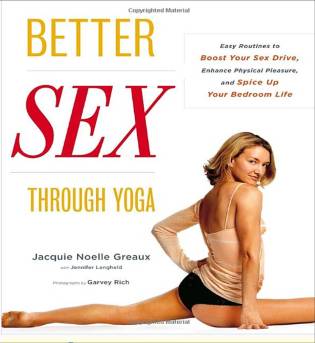
Better Sex Through Yoga, by Jacquie Noelle GreauxIn Better Sex Through Yoga, Jacquie Noelle Greaux and Jennifer Langheld discuss in detail how yoga can make your sex life better by boosting your sex drive and enhancing physical pleasure. For those who already practice yoga, this concept is a no-brainer: yoga makes you physically stronger and more flexible, it improves your stamina and muscle control, gives you more energy, and helps you develop a thorough knowledge of how your own body works, all of which can lead to improved physical performance in the bedroom. Further, yoga practice often leads to increased self-confidence and a more open and compassionate heart, and yoga is proven to relieve stress, so practicing yoga can help with the emotional and spiritual side of sex as well.

In the first few chapters, Greaux and Langheld discuss all of these benefits, going into detail about why both yoga and sex are good for you and how practicing one can benefit the other. In chapter 3, they embark on a yoga primer for those who’ve never practiced it before, including coverage of yoga breathing and the chakras.

The bulk of the book is in chapter 4, which offers a detailed breakdown of each pose Greaux and Langheld use in the Better Sex Through Yoga program. There’s a brief description of each pose, detailed instructions on how to perform the pose, notes on which chakras benefit, which areas of the body are worked, and which sexual positions work the same muscles, followed by a “hot tip” for improving your posture in the pose and/or your sexual use of the pose. In addition to yoga poses, Greaux and Langheld also pull from pilates and dance moves to provide a full body workout. Duo-assisted poses are offered, as well as poses you can do at your desk at work. There are photographs of each and every pose, often demonstrating step by step how to accomplish the pose.

In chapters 5 and 6, the individual poses are pulled together into a series of routines. There are three core routines and eight quickie routines, which offers the reader some flexibility in her yoga practice depending on how much time she has available. The routines vary widely, and there are routines specially designed for being stuck in a chair at the office, calming down after a stressful day, or stretching out quickly before joining a partner in the bedroom. Chapter 7 ties it all together by giving a list of sexual positions, with an illustration and a description for each telling how your yoga practice will deepen your sexual satisfaction.

I have some conflicted feelings about this book, so I’ll get the negative stuff out of the way first. Greaux and Langheld obviously have a target audience in mind: straight women (lesbians could certainly use this book to improve their sex lives too, but they’re clearly not the target audience), women who probably work in offices, and who are already in fairly good physical shape and are already physically active. I think this book would be difficult to use for someone who was overweight or someone limited in their flexibility. That’s not to say that yoga wouldn’t help those people, or that those people can’t have hot sex, just that the book seems geared toward women who resemble Greaux herself, as Greaux models all the poses (there’s a male model as well, credited in the back of the book as the “Living Male Work of Art” – he’s good at yoga poses but I’d almost rather see him on a naughty birthday card). You can see Greaux on the book’s cover, doing a split. Photographs of less flexible people might have been more helpful for those who are true yoga beginners.

The routines are definitely intended to be vinyasa style: each routine includes a lot of poses, with instructions that you should work up to practicing for 30-45 minutes. They expect you to move fast through these routines, and that’s not necessarily what beginners can or should do, unless they’re already very used to exercise. From my perspective as a yoga teacher, I didn’t appreciate how the routines would bounce you up and down: you do some standing poses, then some seated poses, then you stand up again, then you get back down to the floor. That sort of thing is more difficult for beginners or those with limited mobility, and it’s also contrary to my understanding of the purpose of practicing yoga (but then again, practicing yoga to prepare the mind and body for meditation is different from practicing yoga to prepare the body for hot sex, so really there is a different purpose here). Finally, the writing style is really sensationalist – I think they must have had a rule in place to make sure they used the word “sexy” at least twice per page. That’s the sort of thing that drives me nuts.

But, all that aside, the content here is really very good. The section on poses is great because it’s quite thorough and it does tell you exactly what part of the body you’re working in each pose and how that helps you in bed. The authors don’t shy away from detail. In some cases the authors have altered the traditional pose, but it’s clear to me (as a yoga teacher, anyway) why they’ve done it and what the sexual benefit of doing the pose a different way would be. They’ve incorporated moves from pilates and dance, but the ones I’ve tried so far are easy and clearly have some bedroom benefits. The routines get you up and down and up and down, but they’re otherwise well structured to be full body workouts. Finally, the “sexy secretary” sections, which modify poses so they can be done from a desk chair, are brilliant. I’ll be photocopying these and surreptitiously doing them at the office.

The sexysexy language, while troubling, is the maple syrup on the vegetables: the real message here is the idea that yoga isn’t just good for your sex life, it’s good for you as a person. The authors don’t leave out the emotional, mental, and spiritual benefits of doing yoga. In fact, when they list the reasons why yoga improves your sex life, the very first thing on the list is compassion, the ability to love and be loved. The language used sounds shallow, but the core message is not, and I really think the authors want to reach a wide range of readers and improve their lives. I liked the book a lot and would recommend it to anyone with a working knowledge of yoga who can take the sexysexy talk with a grain of salt and move on to the practical stuff.


What it means to be a writer, what it means to be a yogi September 23, 2011

Filed under: reflections,yoga lifestyle — R. H. Ward @ 1:28 pm
Tags:

I guess I probably knew this would happen. A few of my yoga classmates saw my blog post the other day and contacted me about it. Some wanted to explain better why they were upset or to dispute some of the inflammatory language in my post (language that had bothered me too and that I’ve now removed). One person voiced a concern that a personal conversation was now in a public forum – she had thought our yoga class was a safe space and didn’t want to worry about saying personal things and having them be published online.

My first thought was that I’d never take someone else’s own personal story and use it here without permission. But haven’t I done that already? In these two past posts, for example, I summarize information about people I know. But in those contexts, I was using that person’s example to demonstrate a positive quality, telling how much I admire that person – I wouldn’t use someone’s story for anything negative. Except that I kind of did already, this week, in that post. True, I didn’t name any names, I omitted many details, I didn’t quote anything directly. I tried to describe the conversation in the most general way possible and then move on to my reaction to it, which was the purpose of the post, but I still used that conversation. And maybe I shouldn’t have.

N & J told us during our first teacher training session that this would be a safe space for us to share anything we needed to. I never worried before about violating that space because it was only my own experience I was writing about: this blog was intended as a way for me to explore the topics we discuss in class and deepen my understanding. But once I start to pull my classmates into the blog, that changes things. My friends and family outside of yoga know me, love me, and choose to hang out with me anyway, knowing that they could find themselves in a book someday, but my yoga classmates didn’t sign up for that. They’re just here to do yoga and learn.

As a writer, I make the decision to violate my own privacy all the time, but it’s my choice what to share and what I keep private. When I write about others, they don’t get that choice. So now, while I’m not going to delete the previous post, I’m also going to make a real effort not to blog my classmates’ experience again, or at least not without express permission, and if I ever do get a chance to turn this blog into a book, the same holds true. They deserve to learn in the safe space they signed up for. As a writer, I don’t want to limit myself, but as a yogi, I need to treat others with compassion. Finding a balance between the two is something I need to learn to negotiate.


Home Yoga Class, September 21 September 22, 2011

Filed under: yoga — R. H. Ward @ 3:34 pm
Tags: , ,

Last night’s yoga class was possibly my best yet. (I really like this thing where every class I teach is my best one yet. If I keep this up, pretty soon I’ll be a yoga superstar.) I taught a sequence I came up with a few weeks ago that focuses on breath and on thighs, with the idea that poses that are tough on the thighs are an opportunity to lengthen and deepen the breath. Everyone seemed to enjoy the class even though it was hard work.

I started out by teaching ujjayi breathing (which apparently I did only partially successfully, since I ended up really confusing my husband, so I’m planning to go over it again next week in case anyone else was confused and didn’t say so). Then we went through the following sequence of postures:

  • child’s pose
  • thread the needle
  • downward dog shifting to plank
  • locust
  • lifting to plank and back to downward dog
  • forward fold
  • 4 half salutes
  • 2 classic sun salutations (low lunge the first time, high lunge the second time)
  • chair pose (everyone was so excited!)
  • standing sequence:
    • warrior 1
    • warrior 2
    • radiant warrior
    • side angle pose
    • triangle
  • standing sequence on the other side
  • crane pose, transitioning directly to eagle pose
  • camel
  • hero
  • cobbler
  • seated forward fold
  • bridge pose
  • savasana

Everyone commented that it was both a challenging class and a really good class. I was glad that it was challenging both for my beginner and for my more experienced students.


Friday Night Teaching Practice September 21, 2011

Filed under: teacher training — R. H. Ward @ 1:46 pm
Tags: ,

Friday night’s teaching practice session was good for me, but ended up being a little controversial among the group as a whole. We began when N told us that she and J had talked it over and created a list of what each of us ought to practice, so we’d go through and take turns teaching when called upon. I was really excited when I heard this: I’ve been wanting to challenge myself, and it sounded like fun to hear “Teach Pose X. Go!” and then have to go teach it on the spot.

Practice started off well, and my turn came when we got to balance poses. I was asked to teach Dancer (Natarajasana), Eagle (Garudasana), and seated forward fold. I hadn’t taught either of those balance poses before at the yoga center, so I was psyched, and thought I’d try moving from one directly to the other. Dancer pose went fine, but Eagle got a little complicated because we couldn’t figure out the correct arm position. Turns out that, if the left leg is over the right, then the right arm is over the left. Which I’m still not sure is totally clear in my mind. But we had a little debate about it and laughed and then I tried teaching it again on the other side and it went more smoothly. I taught forward fold next and that was easy. After I was done teaching, I got good comments from my classmates on my teacher voice again and on my sense of humor, and N complimented me on a few things I said (encouraging students that, in a balance pose, it’s okay to fall out, just come right back up again – which she said is important in a beginner class when people might be nervous).

As we got toward the end of our practice class, I did notice that we were almost out of poses to teach and some people hadn’t taught yet. But those people included some who I knew were pretty experienced teachers, so I just inwardly shrugged and moved on, figuring that N & J wanted to give the rest of us more time to practice teaching. Class ended with a really nice guided relaxation taught by Trish. (You can tell that it was a good guided relaxation because I relaxed but didn’t fall asleep, and it was 10:30 at night, way past my bedtime!)

After we were all dismissed for the night, I headed out the door to find a group of my fellow trainees were upset that not everyone had been called on to teach. When N had described the teaching practice session, it had seemed like she’d meant all of us would teach what we most needed to practice (although thinking back I can’t remember if she said the word “all” or not), and so the people who taught felt like the people who didn’t teach were privileged in some way, like they didn’t need to practice, or like the people who were called on to teach were being singled out as bad teachers who needed more practice. Some people felt hurt and angry over this.

It might be surprising that a group of aspiring yoga teachers would get upset over something like this, but yoga teachers are regular people too and we get our feelings hurt like anyone else, and issues of talent and ranking are tricky to handle in any venue. I didn’t feel angry or upset, but I certainly don’t blame the people who did.

For me, like I said, I did notice toward the end of class that some people weren’t called on to teach, but it didn’t bother me: two of those people I know to be very good teachers who have already subbed and taught full classes at the studio, and the others usually attend N’s classes – maybe she already feels familiar with their teaching abilities and just wanted to see more from the rest of us. And the more I thought about it, the more I realized that I would have felt hurt and disappointed if I hadn’t been called on to teach. I learned a lot by screwing up Eagle pose! I want to take advantage of every single teaching opportunity I can get, because I want to be a good yoga teacher. For me it’s not important to compare myself to others in our class, because we all have different levels of yoga experience and teaching experience. I want to learn from my classmates, and watch them grow, and steal good stuff from their teaching vocabulary, but I’m trying really hard not to compare my teaching to anyone else’s. For me, I want to take full advantage of this training course that I’ve paid for and looked forward to for so long, and put in the work I need to do to become a good teacher. I hope that my friends who were upset on Friday night were able to think this over and come to the same conclusion.


September Teacher Training Weekend Summary September 20, 2011

Filed under: teacher training,yoga — R. H. Ward @ 1:53 pm
Tags: ,

This month, our scheduled teacher training weekend was complicated by the Haverford Music Festival. The yoga center is a Havertown local business so N and J wanted to participate in the festival (which could attract new yoga students), but we couldn’t reschedule our TT weekend either, so we crammed it all in: teacher training 6-11 PM on Friday and 9:00-10:30 AM on Saturday morning, then some of us helped to set up our table at the festival, and we all took shifts working at the table during the day. It was a good weekend, but a very full one.

On Friday night, we had our usual monthly check-in, then a lecture on yoga and emotions. We did some activities on this topic, and I got to work in a pair first with Sarah and then with Tonny, which was interesting and fun. After that we learned about the four primitive urges or fountains (which I’ll discuss in a future post), and then we had teaching practice (also a future post). A long night.

On Saturday morning we gathered to watch a video of a lecture by Swami Rama at the Himalayan Institute. The topic of the lecture was finding inner peace in a troubled world, and Swami Rama talked about the four primitive urges/fountains in the video, so it coordinated well with our lecture the night before. While Swami Rama seems to respect women highly, he also seems to think that a woman’s main job is to raise the children – which he acknowledges as the most important job in the world, but still. I may change my mind when I have a child, but I think working outside the home is important for women as well. Overall, though, the video was informative, and Swami Rama was definitely an interesting and charismatic guy – there are more videos of him on youtube that I’d like to check out sometime when I get a chance.

After the video, we were off to the festival. We helped set up by carrying boxes and tables and chairs from the studio over to our designated spot on the street, then we all took one-hour shifts to staff the table all day. We talked to people about yoga, handed out copies of the current yoga class schedule and passes for a free class, got people to enter a raffle for a free ten-class card, and I even sold a lavender neck pillow. It was fun and different to talk to people about yoga, and handing out the free class passes felt like I was giving out candy because people were so excited.

Our homework this month is to write up an intermediate level sequence of postures, which shouldn’t be a problem at all. Otherwise, no other homework except preparing for our presentations next month. My topic is yoga and sex – not in a Tantric way or a creepy way, but in a helpful practical way. I ordered two books online a few weeks ago and started reading one this morning – I’m halfway through the second chapter and so far, while the writing isn’t spectacular, the content is really good, matches up with what I think, and confirms what I’d been suspecting. I’m really excited to read further and look at the specific poses they discuss. So, dear readers, you can look forward to lots of information this month about how yoga can improve your sex life!


The Bhavas September 19, 2011

Filed under: yoga,yoga lifestyle,yoga philosophy — R. H. Ward @ 1:39 pm
Tags: ,

The Bhavas are four spiritual attitudes to cultivate as a student of yoga, or really as a student of anything! The Bhavas are:

  • Duty (Dharma)
  • Knowledge (Jnana)
  • Detachment (Vairaigya)
  • Self-Reliance (Aiswarya)

Duty, or Dharma, is an important concept in the Yoga Sutras as well as in the Bhagavad Gita. The idea here is to know your duty, understand what you have to do, and then perform that duty with a neutral attitude, without regard to whether you like or dislike the task. Some examples are going to yoga class regularly even when you don’t feel like it, studying and doing your homework for school, making phone calls at the office, or taking out the trash. Regardless of whether you enjoy taking out the trash, pickup is on Tuesday morning, so it’s your duty to take it out on Monday night with no complaining! To cultivate your sense of duty, try doing meditative yoga asanas, like a series of sun salutations or half-salutes.

Knowledge, or Jnana, goes hand in hand with duty. We should strive to know ourselves at every level: body, thoughts, speech, and emotions. Knowing yourself will help you to better know and understand your duty as well. To cultivate self-knowledge, work on concentration exercises (like, for example, counting meditation), and yoga asanas that require concentration, like balance poses. Pranayama breathing exercises (like these) are also helpful here – pranayama helps you learn your breathing patterns and how to calm your emotions using your breath.

Detachment, or Vairaigya, means living in the world without being of the world. We work not to get caught up in the trivial details of the world around, instead keeping a sense of our true Self, which remains unchanging. This also feeds back into duty – we do the right thing because it’s right, and with detachment from the results, without thought of reward. Overall, cultivating detachment in our lives usually means cultivating an attitude of humility and surrender. Yoga asanas that can help with this include forward bends and twists. These postures encourage us to surrender and relax into the pose: if you’re tensing your muscles and pushing hard, it’s more difficult to succeed with forward bends and twists, but if you let go and surrender to the pose without trying to push, you’ll often find that you can bend just a little bit farther, twist just a little bit deeper.

Self-Reliance, or Aiswarya, can also be referred to as willpower or self-confidence. It’s that deep inner sense that you can do what you need to do. Self-reliance comes from knowing yourself well and having a attitude of humility. Maybe we could also call it integrity! Backbends are yoga asanas that will help with this bhava. Backbends can be scary because you’re dropping your head backwards, unable to see anything coming toward you, so doing backbends develops confidence and strength. Backbends also work to open up the chest, heart, and shoulders, which helps posture – if you’re standing with chest open, shoulders back, you’ll project a much more positive, confident attitude than you would by hunching over!

For me, the bhavas are interesting and helpful to keep in mind as I follow the path of karma yoga, which requires following my dharma with a sense of service and without regard for reward. But the bhavas are useful for any yogic path, or for people following a different path entirely: the characteristics described by the bhavas are useful to cultivate no matter what your faith, religion, or spiritual path!


Aversions September 16, 2011

Filed under: reflections,yoga,yoga lifestyle — R. H. Ward @ 1:52 pm
Tags: ,

For our homework this month, we were instructed to make a list of our likes and dislikes, attachments and aversions. The purpose of this exercise isn’t to see if we like ice cream or whatever – we’re intended to look critically at ourselves, at the attachments and aversions that hold us back in our spiritual practice. Attachment and aversion are actually two of the kleshas, or obstacles to achieving enlightenment; when one is focused on enjoying pleasant experiences or avoiding unpleasant ones, then that person won’t be focused on meditation. Pleasant things come and go, and so do unpleasant things, but the true Self remains unchanging and unaffected by momentary events. Plus, even if you’re not worried about spirituality, it’s a good idea to examine your attachments and aversions: what’s really so great about this? what bothers me so much about that? The answers could be surprising!

Earlier this week I posted my list of attachments (here and here). Here’s my list of aversions, with some commentary about each one.

Broccoli

This is going to sound silly, but I hate the taste of broccoli. I read once that some people either have an extra enzyme or are missing an enzyme, and this makes certain foods (like broccoli) taste very differently than they do for most people. I am clearly one of those with weird taste buds, because I can’t find anything pleasant about broccoli. Further, I was forced to eat broccoli as a kid, and that experience has made a simple dislike deepen into true aversion (when I was 12 or so, I actually vomited after having to eat broccoli, and after that my mother never made me eat it again). So my experience with broccoli is both physical and psychological. I know that broccoli has a lot of nutritional value, but I just cannot bring myself to eat it, and I’ll actively and obsessively pick it out of any food I’m served.

Cold Weather

I hate being cold. The books we’ve been reading for teacher training all say that to the true yogi, heat and cold are the same, but I just can’t imagine getting to that point. Part of the problem is surely the lack of sunlight during the winter months – I feel cold and uncomfortable, and then without sunlight I just get depressed. I’ve started taking vitamin D supplements for this and it really does help. However, I really just don’t like being cold.

My Job

There are many things that I appreciate about my job. I’m paid well, I work with great people, my work is respected by my colleagues and I’m good at it, and my company gives back to the community, values its employees, and does provide a valuable service in the world. I’m grateful to even have a job at all in this economy, let alone a job as good as mine. However, I just don’t enjoy the work, and I never have in the five years I’ve worked here. I know that everybody hates their job sometimes and that I need to make the best of what I’ve got, but that’s just hard to do on Sunday nights and Monday mornings when I’m dreading going back to the office. When I imagine spending another five years in this job, I just feel bleak. I try to combat this by taking one day at a time instead of focusing on the long term, by focusing on all the wonderful non-job things in my life, and by trying to do my best at each task at the office regardless of how much I enjoy it.


Pose of the Month: Legs Up The Wall September 15, 2011

Filed under: Pose of the Month,yoga — R. H. Ward @ 1:32 pm
Tags:

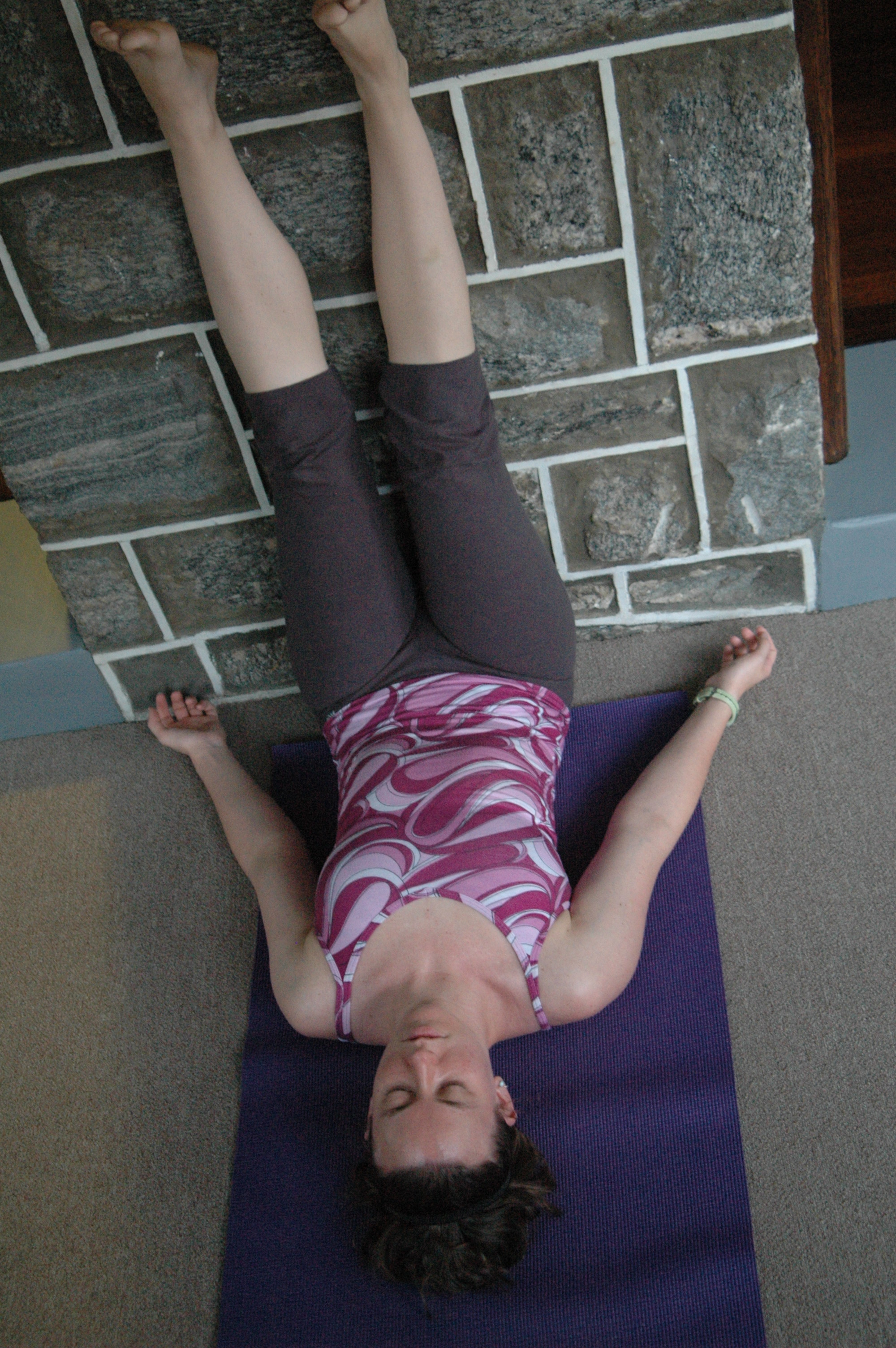
Legs Up The Wall 1Pose Name:

Legs Up The Wall

Sanskrit Name:

none

Steps:

  1. Move your mat to be perpendicular to a wall. Lie on your back on the mat.
  2. Draw your knees in and drop your legs over to one side.
  3. Skootch your tush up as close to the wall as you can.
  4. Lift and extend your legs, letting the backs of the legs rest against the wall.
  5. Rest your arms flat on the floor. Close your eyes. Relax here for a few minutes, letting the breath grow deep and even.
  6. To come out, drop the legs off to one side and skootch backwards until you’re able to roll up to a seated position.

Benefits:

This relaxing pose bestows the benefits of any inverted pose – inversions alter the flow of blood in the body, calming the mind, helping with depression, and stimulating the thyroid gland. Placing the body in an inverted pose also works the internal organs and the abdomen, aiding digestion. However, legs-up-the-wall doesn’t require the strength or stamina needed for other inversions like headstand or shoulderstand. Most students can accomplish this pose.

Contraindications:

Inversions are contraindicated for headache and high blood pressure. Some sources say not to practice inversions while menstruating.

My Experience with Legs Up The Wall:

When I was taking vinyasa yoga classes, I had never heard of this pose, so I only began practicing it in the past few years. I love how relaxing the pose feels, how I’m able to let my mind rest. I also love the simplicity of it – I’m able to achieve this pose no matter how I feel that day. As a teacher, my only frustration with legs-up-the-wall is that my front porch doesn’t have enough wall space for all the students in my little class to be able to do this pose at once!

Legs Up The Wall 2