Rox Does Yoga

Yoga, Wellness, and Life

Niyamas: Saucha April 5, 2011

Filed under: reflections,yoga lifestyle,yoga philosophy — R. H. Ward @ 7:47 pm
Tags: , ,

Today we move from the five yamas (restrictions or restraints) to the five niyamas (observances).  (I’m hoping that when I’ve finished with the niyamas, I will have formed Voltron.)

The first niyama is saucha: “purity” or “simplicity”. Saucha involves keeping the body clean, because that’s important for keeping both body and mind healthy. One shouldn’t be prideful about her appearance, but paying attention to cleanliness and hygiene is part of life. We should also practice mindfulness about what we put into our bodies (for example, choosing an apple over a Big Mac), since the food we put into our bodies affects our internal cleanliness. Saucha is also about purity of mind. We need to make mindful and discriminating choices about everything we take in: not only food, but also books, TV, movies, and the company we keep, because these things have an affect on the purity of our minds. For example, I decided a long time ago that I can’t watch horror movies. Although horror movies are exciting in the short term, the bloody violent images get emblazoned on my brain and I have nightmares for days – but horror movies are cool and lots of people like them, so I kept watching them and kept having nightmares. Finally I decided it wasn’t worth it and said goodbye to Freddy and Jason. I’ll still freak myself out over things I saw a long time ago, because I can’t erase those pictures from my mind, but I’m much happier not adding new horrible things to the gallery.

Satchidananda and Devi have pretty different translations of the sutras on saucha (2.40-2.41):

Satchidananda: By purification arises disgust for one’s own body and for contact with other bodies.  Moreover, one gains purity of sattva, cheerfulness of mind, one-pointedness, mastery over the senses, and fitness for Self-realization. (142, 145)

Devi: Through simplicity and continual refinement (Saucha), the body, thoughts, and emotions become clear reflections of the Self within. Saucha reveals our joyful nature, and the yearning for knowing the Self blossoms. (206)

Satchidananda’s version sounds a little crazy. He states that our bodies are dirty: always excreting waste, even through our pores, and never truly being clean no matter how often we wash. He says that when we realize this, we lose our attachment to the body and our desire to join our dirty bodies with other people’s dirty bodies (see, I knew Voltron had a place in this post somewhere) and we are able to focus more closely on spiritual practice. Satchidananda then goes on to say that once you understand the body, the heart and mind become purified as well, making us ready for meditation and Self-realization. For this one, I’m glad that I’m also reading Devi, since her commentary really provides a nice counterpoint to Satchidananda’s and helps me make sense of what he says.

For Devi, saucha is about simplicity as well as purity. When we eliminate needless complication from our lives, we can distill down to the pure essence of who we are, who and what we love, and what we want to do. Devi also talks about purity of heart. She notes that nurses kindly take care of sick people, no matter what bodily discharges are involved, because they have the purity of heart to serve others with patience. This is such an interesting counterpoint to what Satchidananda says about bodies being dirty. People like Mother Teresa, Florence Nightingale, and the nurses at your local hospital know exactly how disgusting the body can be, but they’re able to rise above it with compassion. Satchidananda’s description makes me think of an OCD monk, so I find Devi’s real-world example very moving. Of course that’s what purity is really about! I think too of a mother with a young child: whether it’s a baby with a dirty diaper or an older child with a stomach bug, the mother cleans up the mess. It’s simple because it’s really about love.


Teaching a seated twist!

Filed under: Pose of the Month,teacher training,yoga — R. H. Ward @ 8:54 am
Tags: , ,

Last night in yoga class, there were three of us teacher trainees there, and we all got to teach. (I don’t think I’m going to get to relax and enjoy a yoga class for the next 9.5 months, but hey, it makes sense that I actually have to work for my almost-a-year of complimentary yoga classes.) Julia did a balance pose, Nancy did a backbend, and I did a seated twist.

Seated twist.(Hey, check it out, I added an item of visual interest to my post! Thanks to F, special guest photographer, who somehow managed to climb halfway up the wall to get this shot. I went back and added a photo to my Tree Pose post too!)

So here’s the seated twist I chose to teach. And of course, J asked us not to do the pose ourselves, just to talk through it. I understand why he wants us to do it that way, but what I discovered is that this is a difficult pose to tell someone how to get into.

OK, so first, you start out sitting up straight with your legs out in front of you. Easy. Now you’ve got to get the leg bend. What I said was something like, “Bring up your left knee, and then let it drop off to the side, and press your left foot against your right thigh.” That’s how I personally do it, but based on the class response, it might not be the best way ever to tell someone else how to do it (I then followed up that clear and accessible bit of instruction with, “Look, Julia’s got it!”). Not totally sure what the best way would be. Maybe, “Bend the left knee and slide your foot up your right leg”? Or just, “Bend your left knee and place your foot against your right thigh”? But then you miss the bit where the left leg is parallel to the floor, not up.

Anyway, hopefully now we’ve got the leg bent, so next is the twist. What I said was, “Raise your left arm – no, just to shoulder height – and now twist toward your left leg. Let your left arm lead you into the twist, and when you’re at the limit of the twist, drop your left hand to the floor. Bring your right hand to your left knee, and look over your left shoulder” (I’m not looking over my shoulder in the photo, but you should be when you try this at home). In retrospect, I should have brought the right hand to the knee first, then done the twist, because I think the hand on the knee gives you some leverage and helps keep your back straight, which people were having some trouble with. I also might have offered some guidance on where the left hand should drop behind you – i.e., right behind your tush – because having the hand too far back possibly caused people to be leaning back too much. A few people were confused about the whole darn thing and J had to go fix one woman, which I was a little embarrassed about.

Things I neglected to mention: keeping your right foot flexed and right leg active instead of just letting it lay there, and using the breath to deepen into the pose (breathe in and lengthen your spine, breathe out and move a little deeper into the twist). I also neglected to count my breaths as a way of telling how long they’d been in the pose so I just had to guess.

And then, you untwist and do it on the other side, which hopefully is less confusing because you just did it once. It seemed to be less confusing on the other side in class.

Overall, I don’t think I did the best job ever teaching this pose, but it helped to deconstruct it a bit here to see what I can do better next time. (I don’t know that I’ll always post here after every time I teach anything, because that would be a lot considering I’m trying to get to class twice a week. Maybe I’ll post for every new pose I get to teach? Or every interesting and out of the ordinary teaching event? We’ll see.)


The Yamas: Aparigraha April 4, 2011

Filed under: reflections,yoga lifestyle,yoga philosophy — R. H. Ward @ 12:38 pm
Tags: , ,

The last of the yamas is aparigraha: non-greed, non-possessiveness. Devi defines aparigraha as “acknowledging abundance”. Especially here in the US, we have an abundance of material goods, and they’re nice to have. When we take what we have for granted, then we just get caught up in getting more and more things. I know that for myself, it’s sometimes really useful to look around my closet and say, “I do not need those cute green shoes I saw in the sale flier. Look at all the super-cute shoes I already own! Hey, I haven’t worn these in a while.” And then I plan an outfit around those shoes instead and I get excited to wear them. And because I didn’t buy shoes I didn’t need, I have some extra cash to spend on a date night with my husband, or on giving to charity, or something else nice.

When I do buy more shoes, even if they’re shoes that are practical and that I will wear for a long time (for example, I recently bought plain nude-colored heels that I can wear with my brown business suit and also with a lot of my office clothes), I still feel a little guilty over the expense, and then there’s yet another box of shoes in my closet, causing clutter, which I find very stressful when it gets out of hand. There’s all this great stuff in my closet, stuff that I “loved” when I bought it, but now it’s taking up space and it’s all jammed together and I can’t find anything. Time to clean house and practice non-attachment: keep the things I love and wear often, and get rid of the things I don’t so that someone else can use them.

Both Satchidananda and Devi mention fear and anxiety if you’re not practicing aparigraha. When we hoard things away, just the sheer weight of all our stuff becomes stressful. We have all these gadgets and closets full of clothes and fancy cars and computers, but do they really add joy to our lives? Often having so many things just adds anxiety: more to do just to maintain the stuff, more to worry about (Did I leave the GPS in the car? Where did I put my iPod?). And there are always more things out there to acquire. On the other hand, if we strive to live more simply, to be not attached to our stuff, then when the stuff goes away we don’t get upset. Devi writes:

Life’s ebb and flow brings things into our life and then out again. Even the slightest hesitation of holding impedes the flow. Our belief system has the ability to hinder or expand this flow of abundance. If you believe that material and spiritual blessings are infinite, a cornucopia awaits you. (202)

The danger doesn’t lie in having possessions, but in our attachment to them. We need to remember that we already have everything we need right now.

I lost some weight recently, and it’s been on my mind that I need to get some new clothes that fit me better. To an extent, this is a good thing: I only have two pairs of business pants that I can wear, and they’re both black, so I could use some khakis. But then I get caught up in it, and start worrying about when I can go to the mall, and do I have this or that coupon and when does the coupon expire, and it’s just stressful. Hey: I’ve got some pants. I have two pairs! And I can wear jeans to work, too. I already went through the “I lost weight and oh noes none of my jeans fit” marathon shopping trip last fall so I have two excellent pairs of jeans. And soon it will be warm enough outside to wear skirts all the time! I don’t have to stress about finding a new pair of khakis. At some point, I’ll be out with a friend and we’ll go past a store and oh hey, let’s try some stuff on, and the khakis will come to me.

I also get possessive about books and DVDs. I’ve gotten better about books – borrowing from friends or going to the library – but it’s been a struggle the whole time because I REALLY like books. I still feel pangs when I think about a certain book or series of books that I loved but oh, I can’t go over to my shelf and pick it up right now because I got it from the library. Boohoo. I can go back to the library and get it again if I really want to reread it or reference it. I like to own my favorite movies, too, but now we have Netflix – we can get DVDs or do the streaming thing – and we also have On Demand, and so I can watch my favorite movies pretty much anytime even without owning a physical object. This is taking some getting used to. I still kind of want the Back to the Future trilogy on DVD, and I have a strong aversion to getting rid of my Indiana Jones set. But what Indiana Jones and Marty McFly gave me as a kid – that sense of adventure, that curiosity and excitement – is always going to be mine, whether or not there’s a little box gathering dust on a shelf to remind me about it.


The Yamas: Brahmacharya April 3, 2011

Filed under: reflections,yoga philosophy — R. H. Ward @ 8:44 pm
Tags: , , ,

The fourth yama, brahmacharya, means to have control of your sensual cravings. Yep, this is the one about sex. (So far, this is the most difficult yama for me to write about. Interesting.)

Satchidananda translates the sutra like this: “By one established in continence, vigor is gained.” (137)
Devi’s version is a little different: “Devoted to living a balanced and moderate life, the scope of one’s life force becomes boundless.” (193)

In the past, brahmacharya was interpreted as necessitating celibacy. Satchidananda talks about continence, meaning “self-restraint or abstinence”, and tells us that our sexual energy can give us great power to use in our meditation (i.e., “vigor”), which is why monks practice a celibate lifestyle. However, he states that each person should practice brahmacharya as best suits his or her stage in life. Over time, each person passes through different stages: being young and a student; becoming an adult and perhaps marrying and supporting a family; eventually growing more interested in spiritual pursuits as age comes. Most of us are in that second stage – we’re adults, householder yogis, yogis who live in the world, and so for us, brahmacharya isn’t about abstinence, but about spending sexual energy in an appropriate manner.

Devi talks about brahmacharya in terms of moderation and balance. These are important words to keep in mind. We should try to practice moderation with all things that give us pleasure – not just sex, but food and drink, going to the gym, watching TV, everything. When we go overboard with these activities, we tire ourselves out, maybe make ourselves sick. That disturbs our mood and makes it harder to do our work or be kind to others. If we’re being moderate in our activities, then they fill us with energy, not the opposite.

I think for me, it’s very easy to binge out on things I like. If one cookie is good, ten cookies will be better; if one episode of Buffy was pretty awesome, then clearly I should spend all day Sunday watching seven more episodes. This is something I do struggle with. Instead of packing the whole bag of chocolates to take to work, I will pack five chocolates in my lunch – if I brought the whole bag, I’d eat ’em all, arguing with myself with every bite, causing a great deal of stress, plus guilt and shame once the bag was empty (and probably an upset stomach and a headache). So I’ll just bring a few, and then they’re a nice treat, not something that weighs me down. A day of marathon TV watching can be fun, but you can’t do it every weekend. Go hiking, visit your mom, go to a museum, cook a new recipe, and when that rainy day comes around, you can enjoy all the Lord of the Rings extended edition movies back to back, guilt free.

But back to the sex, because I know that’s what you’re really interested in. Satchidananda argues that making love should be saved for one’s marital partner. Don’t be out there sharing your sweet energy with anyone who wanders by – save it for someone special, and when you release your energy together, it’ll be a celebration of everything that’s great in your relationship. Satchidananda notes there there are many different kinds of love, not just sexual love; he says, “If people want to know each other before marriage, they can become friends. That is how our ancestors lived” (140). Even from my modern feminist perspective, I have to admit he has a point there.

On the topic of sex, Devi recommends the following approach: “Your only desire is to pleasure the other person, and their only desire is to pleasure you. Each is fulfilled and satisfied, and when we are satisfied, we are moderate and balanced” (200). I think this links back to asteya, too – if you’re all “me, me, me” when making love, aren’t you taking the other person’s energy and love without giving back? I like her idea of approaching the act with generosity, not demanding gratification. If you go into the bedroom just wanting your own pleasure, nothing will ever be enough to satisfy you, but if both partners come together just wanting to be generous to each other, they’ll both be happy afterward.


Today’s yoga: teaching tree pose April 2, 2011

Filed under: teacher training,yoga — R. H. Ward @ 3:29 pm
Tags: , ,

Today J made me teach a pose in yoga class! Before class, as everyone was coming in and getting settled, I was waiting on my mat and J looked at me and said, “Want to teach today?” I said, “No,” but J told me to be ready to teach a balance pose.

The whole first half of class was a struggle for me then, thinking about what balance pose I wanted to teach, trying not to overthink it (I’ve done balance poses hundreds of times, heard balance poses taught hundreds of times, I know this), and trying to actually pay attention to class and be in the moment.  Really difficult.  Plus (and I know everyone must think this sometimes) it felt like J was making the class extra-challenging on purpose.  And then I was scoping out the other students in the class (there were 12 of us) to see if anyone looked likely to have difficulty doing a balance pose, and which of my TT classmates were there (Sarah and Trish were there), and then I reminded myself that I trust all my classmates and we’re doing this together and it’s fine.  And then, oh wait, I’m supposed to be paying attention to Warrior 2 right now.

Tree pose.I was torn on which pose to teach.  My first thought was Tree Pose, because it’s my favorite and because I know it well and my group practiced teaching it in training a few weeks ago.  Then I thought I should challenge myself and do Hand-To-Big-Toe Pose, because that one is challenging for me just by itself before I even think about anyone else.  I started running through the steps of Hand-To-Big-Toe Pose in my head, but then I wasn’t sure if I could do it well, and I couldn’t remember if I’d done that pose at this studio and then I worried that they don’t teach that one here or if they do they call it something else, and then I couldn’t think of any other balance poses except Dancer which I know I don’t want to try to teach.  So I ended up doing Tree, and it went okay.  J said I did well, and I checked with Sarah after class to see if she could hear me in the back of the room and she said she could.  It was still hard, though, even though it’s the easiest balance pose for me to teach – I’ve heard it taught so many times before and yet, doing it myself, I didn’t know where to work in that your gaze should find an unmoving spot to rest, and I didn’t mention the neat little trick I learned at the anusara studio last summer because I figured I should keep it simple.  Here is basically what I said:
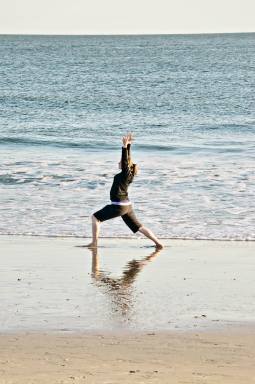
Bring your hands to a prayer, and start shifting your weight over to your left foot.  When you feel good and grounded, you can begin to lift your right foot off the floor.  You can press your right foot against your left leg at the ankle, or at the calf, or you can bring the foot all the way up to your thigh.  Start to press your right knee out to the side.  Now when you feel good and steady, you can bring your hands up into the branches of your tree.

And that’s pretty much the basic instructions.  I’m fine with that.  I also remembered to breathe, myself, and to count my breaths so that I didn’t leave everybody hanging for too long or take them out too soon. And I did not remember to worry about my hair or about straightening my clothing, which I take to be a good thing.

J had me come up to the front of the room and teach from his mat, and he stood by my mat like a regular student.  While I taught the right side, I did the pose myself while talking through it; then J whispered to me that for the left side I should just talk and not do the pose myself, which is harder, but which gives you more of a chance to look around and see how everyone’s doing.  Everyone was doing pretty well.  And then I was done and J and I switched back and he told me I did a good job, and I spent the rest of the class alternately analyzing how I’d done and trying to stop analyzing.


The yamas: Asteya April 1, 2011

Filed under: reflections,yoga philosophy — R. H. Ward @ 3:27 pm
Tags: , ,

The third yama is asteya, or non-stealing. This yama encompasses every sort of theft: taking someone else’s possessions, but also stealing their ideas, claiming another person’s work as your own, or accepting bribes and inappropriate gifts. Swami Satchidananda says that just by breathing, we are stealing: the air we breathe belongs to nature, so we should accept each breath with reverence and use it to serve others. The implication is that we should do the same with any wealth or money or goods that come to us: don’t take it for granted, and don’t hoard it away just for yourself, but be grateful for it and then use it for the good of other people. Patanjali writes, “To one established in non-stealing, all wealth comes.” If you use what wealth you have so kindly, it’s understandable that others will return your kindness and wealth will come back to you.

Similarly, Devi defines asteya not as “non-stealing” but as “generosity”. Devi says, “When we don the attitude of caretakers instead of owners, we enjoy things when they come and let them go with ease. It is nature’s rhythm: all things come and all things go” (189).When we can be generous, with our possessions, our money, and our time, then others are more likely to be generous to us in return, but more importantly, we feel happier.

Satchidananda talks about being greedy, wanting to do a little and get a lot. He says, “Many people go to the office and just sit around, use the phone to make their own appointments all day, take free supplies from the supply room, and accept their paycheck at the end of the week. Aren’t they stealing that money?” (133).  Having worked as a summer office temp, I’m not quite ready to give that one a whole-hearted yes – sometimes there just isn’t that much to do at your job. But I see his point: you should do the work that’s given to you to do, do your best to help others in the workplace, find work to keep yourself busy. There’s always something that needs to be done even if it’s not your favorite sort of work to do.

Devi talks about taking someone’s time. If you schedule an appointment with someone, you should arrive in a timely way. Being late steals the other person’s time – you don’t know what she needed to do to rearrange her schedule to meet you here.

I think the time issue is probably where asteya hits closest to home for me. I am not careful enough with my time: I dawdle along too much, try to get one more thing done before I leave, and then I need to rush to get out the door. I almost miss my train, or I drive too fast to make it to my appointment on time. It doesn’t do me any good to get all stressed and flustered, frustrated by the traffic, worried that I’ll be late. It doesn’t do the person I’m meeting any good, either, when I arrive in that state. It’s better for both of us if I can take my time and arrive in a pleasant mood. I want to be more generous with my time for the other person’s sake, and more importantly for my own sake.

Satchidananda also talks about the idea of stealing resources, stealing from the environment. This is something I’ve been trying to work on as well. In our culture, we throw so much away, and I think in this context, creating waste is tantamount to stealing from the earth. Good things have been taken from the earth, and we’re putting back junk. Nobody can fix this problem on her own, but we can all do things to try and make it a little better. My apartment complex doesn’t participate in a recycling program, but rather than saying “oh well”, I save all my recyclables anyway and lug them to my mother’s house a few times a month. I don’t buy bottled water; I have a metal canteen that I refill from the tap. That saves a lot of waste, and it’s healthier for me (I used to refill the plastic bottles, but after a while chemicals leach out of the plastic into the water I’m drinking, which doesn’t happen with a clean metal or glass bottle).

A few years ago, I decided I wasn’t doing enough and made a new year’s resolution to give $25 to charity every month. I could always afford $25, right? It went brilliantly. I never ran out of charities where I could give a meaningful gift: when you’re paying attention, things just suggest themselves. A friend is running in a 5K to benefit cancer research, or another friend mentions how hard it is when her father is ill, or how much she loves the dog she rescued from the shelter. Ding! There’s one more place doing good work that I can help. And during the past few years, sadly, there’s always been an earthquake or natural disaster happening somewhere, and even when there’s no current disaster, Doctors Without Borders is ready to go whenever something happens. That first year, giving just $25 a month was so easy that I usually gave more, so the second year I started giving $50. And my company has a matching gift policy, too, so every single gift I made was doubled. I started to love filling out the matching gift form every month! Instead of getting spent on a latte or a shirt, my money has been out there saving whales, books, arboretums, historic preservation, little children with cleft palates, poetry, the right to choose, and the right to marry; it’s been funding breast cancer research, MS research, Crohn’s and colitis research, leukemia research, AIDS research, and probably some other research too. Taking part in this practice has really made me feel better about my lifestyle and the energy I’m putting back into the world, which seems like what asteya and generosity are all about.


And now for something completely different March 29, 2011

Filed under: Miscellaneous,yoga lifestyle — R. H. Ward @ 8:35 pm
Tags: , ,

Since my blog’s been kind of a downer lately, today let’s talk about clothes!

I’ve gotten kind of picky about what I want to wear to yoga class. I hate doing yoga in loose-fitting clothes; I feel like a baggy t-shirt is always hanging in my face during down dog and riding up somewhere I don’t want it to. Same thing with pants, if they’re too baggy, they get in my way when I’m practicing. And I don’t like long pants, because then my legs get too warm in a vigorous practice, but I also can’t stand shorts (ever). So here’s what I like to wear for yoga. (FYI, gentlemen, you might want to stop reading here.)

Pants:

Capri/cropped pants, close fitting but not too tight (to avoid the dreaded “camel toe” look), preferably with some flare at the bottom so I can easily fold them up over my knee during practice if needed. Elastic waist – no tie, no zipper, and none of that fold-over fabric thing that’s so popular with the kids these days, since that’s just more fabric to get in my way when I’m bending.

Right now I have four pairs of yoga pants that meet all these requirements. Two of them came from Target a year and a half ago; I looked at Target more recently but everything I tried on was of really thin material and resulted in camel toe. I got one new pair two weeks ago at Old Navy that I love (they even have pockets!). The ON website is down right now so I can’t link ’em but they were in their new GoGA collection (Go Go Active or something like that). I also got a pretty solid pair at Marshalls this past weekend. First I went to REI, felt ill at the thought of spending $55 on yoga pants, and then went to Marshalls, where I found a pair for $14.99 that seem like they’ll be quite serviceable. They also have a cute pattern on the waistband (which does not fold over).

Tops:

Spaghetti strap tank top with a built-in bra. Because, okay, I hate sports bras. I find them really constricting and uncomfortable, and I honestly do not have enough bulk up front to really need one. When I’m jogging, a sports bra is a necessary evil (although there’s enough room in mine to store my iPod in there (and I even have a big old-school video iPod), and because that thing is way supportive the iPod doesn’t bounce at all!), but when I’m doing yoga, it’s just another layer of fabric. Which is important, actually, because if the room is chilly I don’t want my girls pointing at everyone. I actually feel a little conflicted about this. It’s yoga and I want to wear clothes that are comfortable, which would mean no bra, but I feel like it’s discourteous to be braless and potentially make my fellow yogis feel uncomfortable about the view. Considering my future as a yoga teacher, I feel like it’s possibly not professional to be braless in my workplace? I’ve only had one yoga teacher ever who went noticeably braless, which I was mostly cool with at the time (several years ago), but she was wearing a white tank which I thought was not too classy and was kind of distracting.Thoughts?

So it seems like the best solution for me will be tanks with built-in bras. I’ve been shopping for these a lot lately, and it’s surprisingly difficult to find one that is thick enough to be serviceable in a cold room and that also has spaghetti straps (because one of the other things I dislike about sports bras is the racer back). I have two really good tank tops right now that totally do the job, and are stretchy and comfy and also long enough to overlap the top of my pants and thus avoid getting a draft on my back while in a bendy pose. One of them I inherited from my friend Patty, and one of them is this PrAna top (the pink pattern is really cute in person), which is currently on clearance at REI for way cheaper than you can typically purchase a PrAna top. I know the usual price of PrAna tops because I did some top-shopping at REI this weekend too and didn’t buy anything because while yeah, they make nice stuff, I refuse to spend $48 on a freakin’ tank top. (Marshalls was a bust, no pun intended, in the tank department.) So right now I have two excellent tanks and a bunch of Old Navy basic cotton tanks that I have to wear with a sports bra. Hoping to find more of the built-in kind and phase out the ON tanks eventually. Or maybe look for a sports bra with spaghetti straps instead of a racer back, although I kind of want to stop purchasing sports bras altogether until my running bra falls apart, which shouldn’t be for a while as that thing has structural integrity like you wouldn’t believe.

So, dear readers, what do you find comfortable to wear for yoga? And where do you buy it?


Let’s explore that annoyance March 28, 2011

Filed under: reflections,yoga lifestyle — R. H. Ward @ 9:38 pm
Tags: ,

So, the carpet + dog hair + sticky mat issue at the yoga studio (which I mentioned last week) really is driving me nuts.  In the interest of exploring my reactions, getting to know my brain better, and nurturing my yoga lifestyle, I thought to myself, what exactly is it about this situation that’s so maddening? Well, first, I just got this nice new yoga mat, and it happens to be super sticky, so it’s getting all gunked up with hair and crud. Now I cannot use my nice new yoga mat at home, because my father in law is deathly allergic to dogs and we try not to bring animal hair into our home, plus I don’t want to transport this gunk to my floors at home, so I am still using my old mat at home and I only get to use the nice new mat at the studio, where I look at it and don’t feel excited about my nice mat, only annoyed about the ick issue.  I tried the lint roller but it’s just not sufficient for the level of stickiness combined with the level of gunk. So I feel annoyed, and further, I feel indignant – like, why can’t you have hardwood instead of carpet, how often do you vacuum this carpet anyway, why do bring your stupid dogs to the studio – at which point I get derailed, because that isn’t fair, they are nice dogs, N & J are entitled to run their business however they want, there may be any number of reasons why the studio is carpeted, and everyone leaves their shoes by the door so they are at least trying to keep the floor clean. So really what I am feeling is helpless, because I am experiencing a problem and I have no way to resolve that problem (the mat is gross, I can’t effectively clean it, and I can’t change the place where I bring the mat).

But, you know, that’s not really true either. I could vacuum the heck out of the mat when I got it home. I could take that sucker in the shower and hose it off. That would just involve a lot more time than I’m willing to invest in bi-weekly mat care. OK, then, if I cleaned it really well once then I could switch and take the old mat to the studio and use the nice one at home. Which I don’t really want to do either, because (1) the time to spend to get the thing actually clean, and (2) I don’t want to be limited to not using my good mat for the majority of my yoga practice. But I do have options – I just don’t want to explore any of these options. So now I am at the point where I need to either find another option (like buying a second nice mat to use at home) or accepting that the current situation is not going to change for the duration of this program. This should make me feel better: at least now I have considered all my options and concluded that I am not helpless, it is my choice to perpetuate the current situation, and there is a specific time when the problem will end.  But if I choose this last option, that of acceptance, then I need to be at peace about the cleanliness of the mat. Period. I’ll lint-roll it periodically to keep from getting gunk on my feet, but other than that, peace. So why does that seem like the hardest option of all?


I’m having an Ahimsa Moment

Filed under: reflections,yoga lifestyle — R. H. Ward @ 9:35 pm
Tags: ,

Today I had a lot of “Ahimsa Moments.”  Here are some examples:

I hate this stupid weather, it’s too cold out – Ahimsa.
Why is the train so crowded? Oh no, don’t sit next to me… – Ahimsa.
Great, every person on this elevator needs to stop on a different floor, we’re getting a grand freakin’ tour of the building – Ahimsa.
Man, why is it so cold in here today? – Ahimsa.
Yes, Figure 1 is on the first page, but if you’d looked at pages 2 and 3 you’d have found Figures 2 and 3 and not had to ask me this stupid question – Ahimsa.
I’m sending you the art to review. Not like I think you’ll actually review it any time this week. – Ahimsa.
WHY is it so COLD in here?! – Ahimsa.
All these emails, I never get anything done! – Ahimsa.
We’re all here waiting for the train, you don’t need to push – hey, watch it, jerkface – Ahimsa!
Yes, I’m eating pizza for dinner, so there. – Ahimsa.
ACK, I always leave everything to the last minute! – Ahimsa.
I hate getting stuck behind a bus, I’m going to be late! – Ahiiiiiiiiiiiiiiiiiiiiimsa.
I HATE this stupid carpet, it’s like a dog hair magnet, why can’t they have hardwood floors like any other yoga studio – Ahimsa.
Thanks, dude, if you’re going to come in late to class at least shut the door behind you – Ahimsa, ahimsa, ahimsa.

And that’s just a quick survey.  I got cheesed off by so many more trivial things today I can’t even count them all.  And now that I’m trying to pay more attention to my thought patterns, it seems like I’m getting annoyed or frustrated or mad even more than usual.  I know that’s not true (it’s just that noticing it calls more attention to it), but it’s actually still a little scary: this is how my brain usually works, and I experience this level of frustration on a daily basis. I’m not sure how to effect a change. I want to change. I’m hoping that for now, noticing the pattern and calling myself on it will be enough to start.


Practical Experiments in Ahimsa and Satya

Filed under: reflections,yoga lifestyle,yoga philosophy — R. H. Ward @ 12:58 pm
Tags: , ,

Nischala Devi writes the following:

We may stubbornly hold the belief that others cause our problems and inconveniences.  In those situations we may appoint ourselves as their teachers to show them the correct way to act. From that attitude our egos enlarge, leaving us with less room for insight.  If you routinely feel it is the other person’s fault, take another look, this time from a different perspective.  (171)

Reading this really hit home for me because I had a difficult situation last week in my job. Because of all the thinking I’ve been doing on ahimsa and satya, this situation really stuck out to me as an example of how I can change my thinking, how consciously practicing satya and ahimsa (truthfulness and non-violence) can help me to be a calmer person (and a better colleague!).

I work as an editor and project manager, compiling large complex medical books.  I received the page proofs of a chapter that had been very difficult to assemble: the author constantly changing the artwork, which had an adverse affect on the artist’s time to draw the rest of the book; the book’s editor hiring a photographer to reshoot all the surgical images without telling me, sending me many new photos to process after I thought the chapter was done.  Now all that was over and the chapter was in proofs, but because of this history, I already had a negative feeling when I approached the proof.  It wasn’t the proof’s fault, but I still felt negative.

My colleague on this book project, a production manager I’ll call Ed, had sent a note the day before explaining that the author had cut one of the photos from the chapter, causing the rest of the figures to be renumbered.  I thought, Oh, this chapter, always troublesome! So when I opened up the proof, I was ready to find something wrong, and of course I did.  The renumbered figures didn’t match up.  I pulled out the original chapter text and photos and drawings, and went through one by one, double-checking everything and working myself up.  Doesn’t Ed know how to renumber figures?  What kind of production manager is he? I worked for an hour, discovered the problem, wrote a bunch of notes on how to correct it, and then sent it off to Ed and our page designer.

Only then did I notice that Ed had sent an email 20 minutes earlier.  He explained that he’d forgotten to mention that the author had moved a few other figures around.  Of course that accounted for the problem I’d discovered.  Then I got  angry at Ed – if he hadn’t been so neglectful, I wouldn’t have wasted an hour of my time!  I was so angry!  Then I took a closer look at the email he sent the previous day, where he told us about the first figure being renumbered.  He had attached a document showing the new figure numbers for all the images; like Ed had said, he’d neglected to mark on the cover sheet about these other figures being moved, but he’d  numbered all the images themselves in their new order, showing all the changes from the author including the other figures that were moved.  If I had looked at this document, instead of going back to my originals, I would have seen the change, but it never even occurred to me to look at Ed’s document.  He knows how to do his job – why didn’t I trust him?  I’d been too caught up in my own story about how this chapter was troublesome and I was the only organized person in the world.  I had been too focused on being right, being righteous, being in control.  I wasn’t looking at the truth, just making up a story about what I thought the truth would be.

Then, if I hadn’t gotten so worked up about solving the problem, I would have seen Ed’s email before I sent off my own email.  I acted hastily, and then looked like a dummy in front of both Ed and the page designer, because here I was, acting like a savior, going into detail about a problem that Ed had already noticed and pointed out.  I think this had a lot to do with why I got so very angry: my own behavior made me look silly.  Then too, I didn’t have any real reason to be angry with Ed.  He forgot to mention something.  Who doesn’t do that sometimes?  As soon as he noticed the problem, he let us know.  It wasn’t his fault I’d gotten worked up and spent an hour analyzing things.  There was nothing wrong with Ed’s behavior, only with mine.  Which just made me angrier.

I left work for the day and went to the train station.  I was standing there, feeling tense, feeling angry, when up comes my friend Sue.  She’s taking a painting class, and she told me about the project she assigned herself, to go paint her son’s boat once a month for practice.  At the end of this year she’ll have 12 paintings, all of the same boat, but all different because of the seasons, the light, different angles of viewing the boat, and Sue’s own improving technique.  So we talked about painting, and about boats, and Sue is such a sweet gentle person that I couldn’t stay angry while I was talking to her.  So I let the anger go, and listened to my friend.