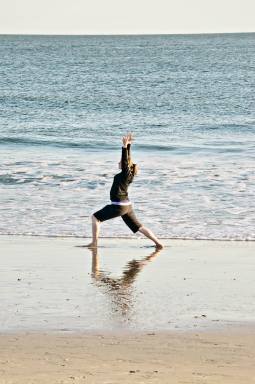
Rox Does Yoga

Yoga, Wellness, and Life

yama/niyama redux / I-should-be-better syndrome June 20, 2011

I’ve been thinking a lot about the yamas and niyamas lately. Remember those? My first big assignment as part of my yoga teacher training was to read and think about the yamas, a set of five practices of self-restraint, and the niyamas, a set of five observances. After spending March and April reflecting on these things, I thought they’d be pretty ingrained in me. I was hoping I’d naturally remind myself to practice them throughout the day, and that I’d start to see my thought patterns changing.

Well, as you all know, I’ve done a lot of stuff during the past month or so, but consciously practicing the yamas and niyamas has not exactly been up there on the list. I think I still work on ahimsa pretty consciously (and I figure, if I’m only doing one of them, that’s the right one), but paying attention to and trying to improve my thoughts and my behavior is important for every single day, not just days when I’m supposed to be studying it. This is kind of the yogic equivalent of the ten commandments here. Don’t harm others, be truthful and generous, be moderate and balanced; be pure and simple, content, and disciplined; study hard and well, practice devotion. Be mindful. If I’m not paying attention, how can I say I’m being mindful?

Thinking back, I can say that even without being fully cognizant of the yamas and niyamas, I think I did a pretty good job of following them. I think I’ve been better about practicing non-violence in my words and in my thoughts. I’ve had the opportunity to be generous with my time and my support, and I think I’ve done a good job of that. I’ve studied hard and worked hard in my yoga practice. I’ve been very accepting and content with where I am in my life right now (although admittedly my life is pretty spectacular at present).

My husband F, with his usual impeccable sense of timing, sent me this great link the other day: Six Ways to Deal With I-Should-Be-Better Syndrome. This fits right in with thinking about the yamas and niyamas.

I’ve actually posted about my own experiences with I-Should-Be-Better Syndrome before, and I already try to do many of the things Amy Johnson recommends in her blog post: striving to be honest and truthful (practicing satya) and breathing (which, I’ve learned this month, is something we could all benefit from being more aware of). I also like her awareness that this is a universal issue – in Buddhism and in yoga, you work to feel compassion for everybody, every living creature, even that nasty parking attendant, even yourself, and if we understand that everyone is striving to be better, that it’s not just us, then that helps us to love everybody a little bit more, including ourselves.

I like Johnson’s practical, no-nonsense approach to this very emotional and personal issue. It’s hard to admit that you think you should be better, because really, you don’t want anyone to notice that you’re not already super-great. We feel shame when we get into I-Should-Be-Better mode, and it’s natural to try to hide shame. But being honest with yourself about these feelings is the first step to moving past them and feeling more content, more satisfied, and more peaceful, and that’s what the yamas and niyamas are all about.


mid-month check-in on pranayama practice June 9, 2011

Filed under: breath,checking in,reflections — R. H. Ward @ 1:38 pm
Tags: ,

It’s been over two weeks since my last teacher training weekend, and my next one is in just over two weeks. So how am I doing with the daily pranayama practice?

I think I’ve been doing okay. I have practiced my diaphragmatic breathing, three-part breathing, and alternate nostril breathing for 14 days out of the past 18 days. Sometimes I practice in the morning, sometimes in the evening, sometimes somewhere random like at my desk at work, in my parked car, or on the train (I can do regular breathing no problem in random places, it’s just the alternate nostril breathing that looks a little crazy to passersby and that I try to be careful of). I’ve been keeping my journal and tracking the time of day (or location if needed) and how many of each type of breath, plus any thoughts that come to me during the practice. Here are some reflections so far:

May 25: I’m starting to see correlations with the left and right dominant nostril that match up with what I’ve been taught (that when the left nostril is dominant, the body’s energy is calming, soothing, lethargic; when right nostril is dominant, body’s energy is vigorous, energetic, warmed up). I got to work yesterday and was tired – left nostril was dominant. Busy all evening, energy high, and it’s time for bed – right nostril was dominant. Woke up at 3:30 in the morning and couldn’t get back to sleep – right dominant. Woke up with the alarm and didn’t want to get out of bed – left dominant. Just observing the patterns for now and trying a little to influence them with alternate nostril breathing.

May 26: The distinct movements of the three-part breath are becoming easier, more automatic (after three days of practice).

May 27: I’ve been doing three-part breathing at odd times, like on the train or in the car, not just when I’m sitting quietly at home.

May 31: I’ve noticed that diaphragmatic breathing makes me yawn – the breath just doesn’t feel deep enough to fill up my lungs completely. This is in contrast to what my teachers and the book say, that diaphragmatic breathing is best. In my experience, three-part breathing is a better, deeper, more filling breath. Am I missing something?

June 1: I noticed that diaphragmatic breathing is more comfortable and feels deeper when I’m lying on my back (practicing at bedtime). Three-part breath is more uncomfortable to practice while lying down.

June 5: Almost halfway through my month of breathing. Starting to feel some calmness during three-part breath, but diaphragmatic breath is still uncomfortable and alternate nostril breathing is unpleasant because one nostril is always too clogged. The alternate-nostril technique doesn’t seem to improve the clogged-up nostril but rather seems to make it worse (this has been an issue for the past few days, maybe allergies? I’m breathing fine and clearly when I can use both nostrils). Also, note that it’s hard to practice pranayama while wearing jeans.

Overall, though, much like with my posture write-ups, I find it difficult to write about what I’m feeling during a practice. With the pranayama, I’m often thinking about how clogged my nose is, or I’m thinking about how many more breaths I need to do, and that just makes me feel agitated. Or I’m thinking about something else entirely (which happens during my yoga practice too), and then I realize I’m doing it and then I feel bad. But what’s the root, baseline feeling? Is this one of those things where, just by observing a situation, you change what’s happening and make it different? Particles are like that in physics. Maybe brains behave the same way.


thoughts on doing posture write-ups June 7, 2011

Filed under: reflections,yoga — R. H. Ward @ 12:52 pm
Tags: ,

This month we’re supposed to do posture write-ups on any two standing poses. So far, I’ve chosen the poses I want to write about: wide-legged standing forward fold, and ardha chandrasana. Both of these poses are very challenging for me in different ways. However, I’m still struggling with the idea of observing and discussing my own experience of the pose.

The first month, with the forward folds, writing about my own experience was really difficult for me. Last month, we had to write up our most and least favorite poses, so it was much easier because we were picking poses that we actually had feelings about. Now we’re back to “pick any pose in this category”, and when I think about the regular poses that I do well (for example, triangle pose, or warrior 1), I can’t for the life of me think of what I feel in these poses. When I try to pay attention when I’m doing the pose, I have no problem noticing how my body feels, but I don’t see anything specific related to that particular pose going on in my mind. Other than anatomic things (like having to be careful of my knee in triangle pose), I feel pretty much the same no matter what pose I’m doing. Calm, strong, distracted, tired: it just depends on my mood that day. No particular pose really stirs up anything specific for me. Having to do this exercise is really frustrating, it feels fake to me, I feel very resistant to it, and I will go out on a limb and say I kind of hate it.

So, this month, I am picking two poses that are challenging for me, because if a pose is physically challenging, I can talk about that and be excused from talking about my stupid monkey brain and how it’s not doing anything useful. However, this is still problematic because I just decided a few days ago which poses I would write up, and so I haven’t been practicing them all month, so I still might not have anything good to write about. I did the “I don’t have anything to write about so I’m writing about that” thing the first month and I don’t know if I can get away with it again, although in a sense, if that’s still where I’m at with this, then that’s a valid place to be. I’ll be interested to see what comments I get back from last month’s assignment, maybe that’ll help.