
Pose Name:
Plank Pose
Sanskrit Name:
I could not identify a Sanskrit name for this specific pose.
Steps:
Plank pose is most frequently practiced during sun salutation (surya namaskar). For brevity, my instructions below begin with downward dog.
- Begin in downward-facing dog pose.
- Shift your weight forward so that your shoulders are directly over your hands. Arms are straight; legs are straight, with toes curled under. Look straight down at your hands and keep your fingers spread wide.
- Keep your tailbone tucked and your body straight. Activate the core muscles in your abdomen to help hold you up.
- Keep your breathing deep and even. Focusing on your steady breath will help you stay strong in this pose.
- Slowly lower down to rest on your belly.
Benefits:
Plank pose works arm muscles and tones core muscles. It builds heat and energy in the body while building strength.
Contraindications:
Plank may be difficult for students with wrist problems or carpal tunnel syndrome. These students can instead practice dolphin plank, which puts less pressure on wrists by resting the forearms on the floor.
My Experience of Plank Pose:
I have always hated plank pose. It makes me feel weak and helpless. I’ve been practicing yoga for over eight years – I do plank all the time and I work out with weights, but no matter how much muscle I build or how strong I think I am, plank is always really difficult for me to hold. Whenever it becomes too much and I have to drop my knees to rest, it feels like a failure.
I think I need to change my attitude towards plank pose. So far, I’ve always approached plank with the idea that if I just worked harder, I would be strong enough to do the pose well. I think I need to let go of that idea and learn to appreciate my plank for what it is: a challenging pose that makes me work. When my arms shake in plank, that doesn’t mean that I’m weak, and needing to drop my knees doesn’t make me a failure. If I can approach plank with a feeling of acceptance about where I am with the pose, my experience of the pose (and hopefully my enjoyment of it) will improve.


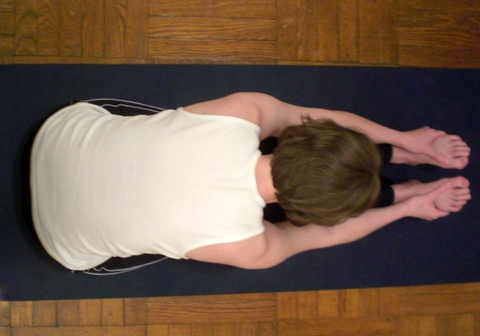
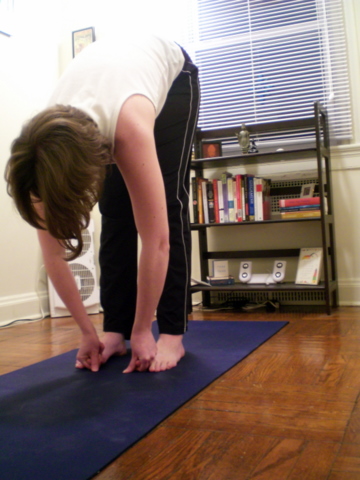
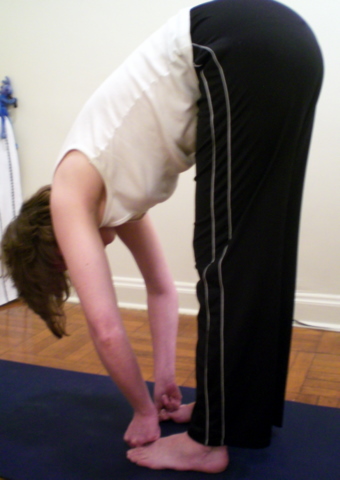
 (Hey, check it out, I added an item of visual interest to my post! Thanks to F, special guest photographer, who somehow managed to climb halfway up the wall to get this shot. I went back and added a photo to my Tree Pose post too!)
 I was torn on which pose to teach. My first thought was Tree Pose, because it’s my favorite and because I know it well and my group practiced teaching it in training a few weeks ago. Then I thought I should challenge myself and do Hand-To-Big-Toe Pose, because that one is challenging for me just by itself before I even think about anyone else. I started running through the steps of Hand-To-Big-Toe Pose in my head, but then I wasn’t sure if I could do it well, and I couldn’t remember if I’d done that pose at this studio and then I worried that they don’t teach that one here or if they do they call it something else, and then I couldn’t think of any other balance poses except Dancer which I know I don’t want to try to teach. So I ended up doing Tree, and it went okay. J said I did well, and I checked with Sarah after class to see if she could hear me in the back of the room and she said she could. It was still hard, though, even though it’s the easiest balance pose for me to teach – I’ve heard it taught so many times before and yet, doing it myself, I didn’t know where to work in that your gaze should find an unmoving spot to rest, and I didn’t mention the neat little trick I learned at the anusara studio last summer because I figured I should keep it simple. Here is basically what I said:


 Rox Does Yoga
