Rox Does Yoga

Yoga, Wellness, and Life

Books: Sexy Yoga: 40 Poses for Mind-Blowing Sex & Greater Intimacy, by Ellen Barrett October 6, 2011

Filed under: books,yoga,yoga lifestyle — R. H. Ward @ 2:31 pm
Tags: ,

Sexy Yoga, by Ellen BarrettIn this book, Ellen Barrett uses yoga to help couples access the poses of the Kama Sutra. Both yoga and the Kama Sutra originated in ancient India, and Barrett relates each to the other to show how, with yoga practice, the difficult sexual poses of the Kama Sutra can be achievable (and pleasurable!). The book contains over 100 black and white photographs, illustrating both the yoga asanas and the Kama Sutra poses.

Barrett begins the book with an introduction describing the origins of both yoga and the Kama Sutra and how they relate. She covers yoga breathing, the chakras, and auras. The second section, “Glowing Solo”, is a guide to the yoga poses Barrett feels will be most helpful in opening the body for enhanced sexual pleasure. For each pose, Barrett provides instructions on how to get into the pose, how long to stay there, the benefits of the pose, ways to modify it, a meditation to consider while practicing the pose, and a photograph of what the pose looks like.

In the third section, “Divine Duets”, Barrett provides a guide to yoga asanas for couples – using yoga poses to mimic their counterparts from the Kama Sutra to give couples a workout and a good stretch before heading to the bedroom in section 4, “Sacred Sex”. In this last section, the models in the photographs take off their clothes to demonstrate the Kama Sutra poses hands-on.

Sexy Yoga would be a great book to keep in the bedroom for quick reference or inspiration at bedtime. However, with its large photographs, Sexy Yoga is not a book you can read on the train. Even throughout the introduction, photographs of bare nipples and buttocks abound – great for a bedroom guide but not for reading in a public place. Overall it’s not the sort of book that people will use by reading it cover to cover; readers will likely want to flip through looking at the photos to get ideas, only reading more deeply when something catches the eye.

Where Better Sex Through Yoga is in essence a yoga book with sex in it, Sexy Yoga is ultimately a Kama Sutra sex manual with some yoga in it. This isn’t necessarily a bad thing. The combination of yoga and the Kama Sutra does make sense: for example, a man doing camel pose and a woman doing cow tilt combine to create the Kama Sutra’s congress of the cow. By practicing yoga asanas, one can build the strength and flexibility to be better able to utilize the Kama Sutra pose and get more enjoyment out of it in the bedroom. However, readers should note that this book is by no means a complete guide to yoga, as Barrett really only gives coverage of 20 solo yoga asanas, and recommends that the asanas be practiced in the order she presents them. Better Sex Through Yoga gives a wider variety both of poses and of routines/sequences. However, the poses discussed in Sexy Yoga are covered thoroughly and well, including modifications for those with physical limitations. This feature makes the book more accessible than BSTY, which generally assumes its reader to be physically fit. Barrett’s sections on pose benefits are more in-depth than those in BSTY, and the meditations for each pose are a nice touch. Barrett does give attention to the spiritual and emotional aspects of yoga, and acknowledges the Kama Sutra as a sacred text.

One downside of Sexy Yoga is the fact that the author seems to scrimp on some of the yogic content, leading to inaccuracies. For example, Barrett describes hatha yoga as having three parts: asana, pranayama, and pratyahara, which she mistranslates as “meditation”. It wouldn’t have taken too much more effort to list the eight parts of classical hatha yoga correctly and then say that she’d focus on three of them. Also, Barrett conflates several pranayama techniques together into one, which she calls ujjayi breathing. I just don’t see a need for presenting this material inaccurately. In BSTY, the authors leave a lot out, but the material they do present is given accurately and correctly. Still, while Barrett’s omissions may annoy experienced yoga practitioners, they won’t hurt a beginner.

On the whole, Barrett’s Sexy Yoga is a fun and frisky guide for couples who want to bring some Kama Sutra adventure and yoga strength and flexibility to the bedroom.

 

Meditation Update October 4, 2011

Filed under: books,meditation — R. H. Ward @ 3:46 pm
Tags:

I’m still meditating almost every morning. I generally do some pranayama breathing first, usually alternate nostril breathing, which I’ve really grown to love (to my surprise). Then I do a little meditation. On a busy morning, I’ll take just a few minutes and do a counting meditation; when I have more time, I’ll do passage meditation, or a meditation on sound that I learned from a book. I’m still trying to move forward with meditation reading, although that’s hard to do with all my other yoga work, but the book I’m reading now is The Joy of Living by Yongey Mingyur Rinpoche, a Tibetan monk. I’ve been reading it at bedtime since probably February (which gives you an idea of how sleepy I am when I go to bed, I’m making very little progress!). Rinpoche has a very kind writing style, and I like his ideas about meditation.

Rinpoche writes, “If you’ve ever flown in an airplane, you’ve probably witnessed that above any clouds, mist, or rain, the sky is always open and clear. It looks so ordinary. In the same way, Buddha nature is always open and clear even when thoughts and emotions obscure it” (139). By “Buddha nature”, he means your true Self, your spirit. It remains unchanging, no matter what stormy emotions drift by. Once you get past all the clouds, you see the same peaceful Self that was there all along.

But there’s no use feeling guilty about all those emotional stormclouds. Rinpoche tells us, “It’s impossible to keep your mind from generating thoughts, feelings, and sensations. Thinking is the mind’s dominant function, just as it’s the natural function of the sun to produce light and warmth…. We can’t stop our thoughts any more than we can stop waves in the ocean” (131). I like that idea, that our thoughts are like waves in the ocean. We can’t stop the waves, but maybe we can change their intensity: the difference between a hurricane and the calm after the storm.

About meditation, Rinpoche tells us not to criticize ourselves when we find ourselves getting distracted. It’s easy to berate ourselves – I was supposed to be meditating, but I’m sitting here worrying over the grocery list! – but that condemnation isn’t necessary or helpful. The fact that you caught yourself wandering off is enough to bring you back to your meditation in the present moment. As Rinpoche says, “Your intention to meditate as you engage in practice is the crucial factor” (141). I like this kind, gentle perspective on meditation. Reading these lines has helped me and I hope has helped you too! Next time I’ll share the listening meditation technique I learned from this book.


Books: Better Sex Through Yoga, by Jacquie Noelle Greaux with Jennifer Langheld September 26, 2011

Filed under: books,yoga,yoga lifestyle — R. H. Ward @ 1:30 pm
Tags: ,

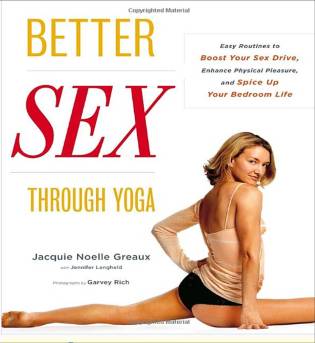
Better Sex Through Yoga, by Jacquie Noelle GreauxIn Better Sex Through Yoga, Jacquie Noelle Greaux and Jennifer Langheld discuss in detail how yoga can make your sex life better by boosting your sex drive and enhancing physical pleasure. For those who already practice yoga, this concept is a no-brainer: yoga makes you physically stronger and more flexible, it improves your stamina and muscle control, gives you more energy, and helps you develop a thorough knowledge of how your own body works, all of which can lead to improved physical performance in the bedroom. Further, yoga practice often leads to increased self-confidence and a more open and compassionate heart, and yoga is proven to relieve stress, so practicing yoga can help with the emotional and spiritual side of sex as well.

In the first few chapters, Greaux and Langheld discuss all of these benefits, going into detail about why both yoga and sex are good for you and how practicing one can benefit the other. In chapter 3, they embark on a yoga primer for those who’ve never practiced it before, including coverage of yoga breathing and the chakras.

The bulk of the book is in chapter 4, which offers a detailed breakdown of each pose Greaux and Langheld use in the Better Sex Through Yoga program. There’s a brief description of each pose, detailed instructions on how to perform the pose, notes on which chakras benefit, which areas of the body are worked, and which sexual positions work the same muscles, followed by a “hot tip” for improving your posture in the pose and/or your sexual use of the pose. In addition to yoga poses, Greaux and Langheld also pull from pilates and dance moves to provide a full body workout. Duo-assisted poses are offered, as well as poses you can do at your desk at work. There are photographs of each and every pose, often demonstrating step by step how to accomplish the pose.

In chapters 5 and 6, the individual poses are pulled together into a series of routines. There are three core routines and eight quickie routines, which offers the reader some flexibility in her yoga practice depending on how much time she has available. The routines vary widely, and there are routines specially designed for being stuck in a chair at the office, calming down after a stressful day, or stretching out quickly before joining a partner in the bedroom. Chapter 7 ties it all together by giving a list of sexual positions, with an illustration and a description for each telling how your yoga practice will deepen your sexual satisfaction.

I have some conflicted feelings about this book, so I’ll get the negative stuff out of the way first. Greaux and Langheld obviously have a target audience in mind: straight women (lesbians could certainly use this book to improve their sex lives too, but they’re clearly not the target audience), women who probably work in offices, and who are already in fairly good physical shape and are already physically active. I think this book would be difficult to use for someone who was overweight or someone limited in their flexibility. That’s not to say that yoga wouldn’t help those people, or that those people can’t have hot sex, just that the book seems geared toward women who resemble Greaux herself, as Greaux models all the poses (there’s a male model as well, credited in the back of the book as the “Living Male Work of Art” – he’s good at yoga poses but I’d almost rather see him on a naughty birthday card). You can see Greaux on the book’s cover, doing a split. Photographs of less flexible people might have been more helpful for those who are true yoga beginners.

The routines are definitely intended to be vinyasa style: each routine includes a lot of poses, with instructions that you should work up to practicing for 30-45 minutes. They expect you to move fast through these routines, and that’s not necessarily what beginners can or should do, unless they’re already very used to exercise. From my perspective as a yoga teacher, I didn’t appreciate how the routines would bounce you up and down: you do some standing poses, then some seated poses, then you stand up again, then you get back down to the floor. That sort of thing is more difficult for beginners or those with limited mobility, and it’s also contrary to my understanding of the purpose of practicing yoga (but then again, practicing yoga to prepare the mind and body for meditation is different from practicing yoga to prepare the body for hot sex, so really there is a different purpose here). Finally, the writing style is really sensationalist – I think they must have had a rule in place to make sure they used the word “sexy” at least twice per page. That’s the sort of thing that drives me nuts.

But, all that aside, the content here is really very good. The section on poses is great because it’s quite thorough and it does tell you exactly what part of the body you’re working in each pose and how that helps you in bed. The authors don’t shy away from detail. In some cases the authors have altered the traditional pose, but it’s clear to me (as a yoga teacher, anyway) why they’ve done it and what the sexual benefit of doing the pose a different way would be. They’ve incorporated moves from pilates and dance, but the ones I’ve tried so far are easy and clearly have some bedroom benefits. The routines get you up and down and up and down, but they’re otherwise well structured to be full body workouts. Finally, the “sexy secretary” sections, which modify poses so they can be done from a desk chair, are brilliant. I’ll be photocopying these and surreptitiously doing them at the office.

The sexysexy language, while troubling, is the maple syrup on the vegetables: the real message here is the idea that yoga isn’t just good for your sex life, it’s good for you as a person. The authors don’t leave out the emotional, mental, and spiritual benefits of doing yoga. In fact, when they list the reasons why yoga improves your sex life, the very first thing on the list is compassion, the ability to love and be loved. The language used sounds shallow, but the core message is not, and I really think the authors want to reach a wide range of readers and improve their lives. I liked the book a lot and would recommend it to anyone with a working knowledge of yoga who can take the sexysexy talk with a grain of salt and move on to the practical stuff.


Books: Bhagavad Gita September 9, 2011

Filed under: bhagavad gita,books,yoga philosophy — R. H. Ward @ 2:06 pm
Tags:

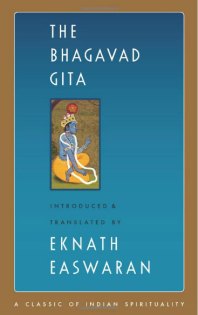
The Bhagavad Gita, translated by Eknath EaswaranThe Bhagavad Gita is one of India’s best known scriptures. It tells the story of Arjuna, a warrior on the eve of battle who has lost heart and become uncertain as to his duty. Arjuna turns to his spiritual guide, Krishna, for answers to all the key questions of life, questions about wisdom and service and spirituality. The battle that Arjuna is about to fight is the perfect metaphor for life and the interior battle we all fight to live a life that is meaningful and fulfilling. The Gita, in essence, is a manual for how to live.

For my yoga teacher training, we were asked to read a translation of the Bhagavad Gita by Eknath Easwaran. On the back cover, Easwaran’s version is described as “reliable” and “readable”, and this is definitely true. Easwaran opens the book with an introduction to the Gita, setting the scene, and then each chapter of the Gita opens with a brief introduction that explicates the content of that chapter. This makes the story easy to follow, and really helps in understanding the context of Arjuna’s and Krishna’s conversation. The endmatter of the book includes a section of notes (typically, helpful insights on issues of translation), as well as a glossary of Sanskrit terms and an index. Easwaran’s version really focuses on making the Gita accessible for the reader, so this version is a great place to start if you’re reading the Gita for the first time.

I had read the Bhagavad Gita previously, in Stephen Mitchell’s translation. Mitchell is known as a translator of ancient poetry – he’s done the epic of Gilgamesh and the Tao Te Ching, among others. The great thing about Mitchell’s work is that he finds a way to take this ancient poetry written in another language and capture not just the meaning but the beauty of the language. Easwaran’s translation of the Gita is verse, but Mitchell’s translation is poetry. The last time I read it, I was looking mostly at the poetry; I decided to read it again, and this time, it was really enjoyable to read the book in a different context, looking more at the content, the instructions for how to live. Definitely got more out of it this time.

When we were assigned to read the Bhagavad Gita for class, I chose to read both versions back to back. I didn’t try to do a line-by-line comparison (that would defeat the purpose of reading it at all, really). Instead, I re-read the Mitchell translation, and then read the Easwaran translation, in the hope that reading both versions would deepen my understanding. I think it did, but I also felt a little burnt out by the time I got to the end of the Easwaran version. I definitely want to reread both versions again, but next time I’ll space them out more.


Books: The Secret Power of Yoga: A Woman’s Guide to the Heart and Spirit of the Yoga Sutras, by Nischala Joy Devi September 7, 2011

Filed under: books,yoga philosophy — R. H. Ward @ 4:13 pm
Tags: ,

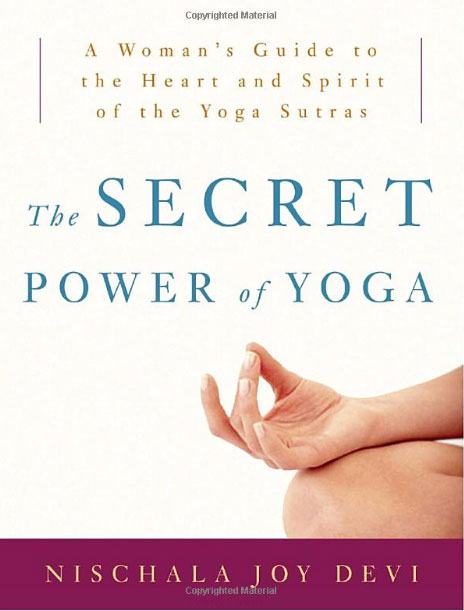
The Secret Power of Yoga: A Woman's Guide to the Heart and Spirit of the Yoga SutrasNischala Joy Devi’s interpretation of the yoga sutras offers a different take from most traditional translations. Devi set out to write a book that explicates the yoga sutras from a heart-centered, more “feminine” perspective. She realized that most of the existing translations of the sutras were written by men, and she noticed many of her female students commenting that the sutras didn’t seem to relate to them. Devi set out to complete a more accessible text for women. She sought for her book to embrace both thoughts and feelings (rather than separating thoughts from feelings, which is often done in Western culture). She generally uses the terms “consciousness” and “heart” where the customary translation would read “mind” and “thoughts”.

Overall, I think Devi’s technique was effective.The first time I read the sutras was in this translation, and it was difficult for me; I’m not sure how I would have fared with a more traditional translation. At least with Devi’s version I felt as if the book was intended for ME.  For the most part, Devi uses real life examples that made sense in relation to how to practice the sutras in a real woman’s busy life.

On this reread, I was also simultaneously reading Sri Swami Satchidananda’s translation of the sutras; Satchidananda was Devi’s spiritual teacher, so it was very interesting to see where the two of them interpret the sutras differently and where they have a similar approach. In many instances, Satchidananda and Devi say much the same thing, but Devi couches her language in ways that feel more familiar and welcoming for a modern woman. Part of me wants to call this “the sutras – lite”, but it’s not light at all, it’s just a different take that… well, doesn’t feel quite so difficult, even though it’s the same material.

One thing I would have really liked in this book is a glossary; Devi naturally uses a lot of Sanskrit terms. The first time I read the book, it took me several months to complete it, and reading it over such a long period of time, I definitely got my dharmas and dharanas and dhyanas crossed. There is an index, which is helpful, but rather than looking up where the word first appeared and then going there to refresh myself about the definition, it might have been more effective just to have a glossary. (Satchidananda’s translation does include a glossary.)

Overall, I recommend this book for women who are looking to deepen the spiritual side of their yoga practice or meditation. I also recommend it for men who, like me, don’t connect so much with the mind/thoughts rhetoric in spiritual books.


Books: The Yoga Sutras of Patanjali, trans. and commentary by Sri Swami Satchidananda September 2, 2011

Filed under: books,yoga philosophy — R. H. Ward @ 1:23 pm
Tags: ,

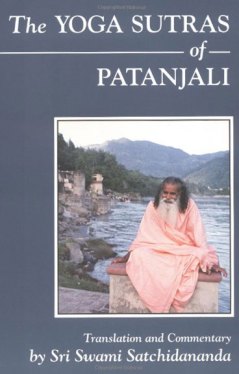
The Yoga Sutras of PatanjaliThe Yoga Sutras, the key text in the study of yoga, is an ancient text dating back at least 2000 years. The sutras were compiled by the sage Patanjali (pah-TAN-ja-lee). Patanjali didn’t invent the concept of yoga, but he made a system of it by bringing together all the existing teachings and traditions and giving them a structure for students to follow. The word “sutra” means “thread” – the text is a collection of almost 200 brief “threads” of wisdom. Patanjali used as few words as possible in each sutra with the idea that students would be learning from an established teacher, who would expound upon each sutra in turn. Sri Swami Satchidananda takes on that role in this translation of the sutras and the accompanying commentary.

The sutras are traditionally grouped into four books: Book One, Contemplation; Book Two, Practice; Book Three, Accomplishments; and Book Four, Absoluteness. For most students, just reading Books One and Two is sufficient – the last two books contain the more esoteric teachings. For my teacher training we actually started by jumping right in with Book Two, the practical teachings, and this certainly isn’t a bad idea. For Patanjali, the physical practice of yoga is simply a means of calming the mind, and the vast majority of the sutras are about the mind; it can be a little easier for the modern student to begin with the practical sutras in Book Two before working on the contemplative sutras in Book One.

This version of the sutras follows a helpful format: for each sutra, the original Sanskrit is given, along with the Sanskrit transliteration, the literal translation, and finally a translation set in readable English prose. This structure could appeal both to the serious Sanskrit student as well as to the beginning student (who can just skip right to the English). After each sutra follows commentary from Swami Satchidananda. At first I found the commentary to be rather dry, but after journeying through the whole book I came to enjoy his tone and appreciate his stories. Satchidananda’s translations of the sutras are very straightforward, and his commentary really elucidates each sutra and gets to the heart of what Patanjali is saying.

Overall, this is a good translation of the Yoga Sutras for beginning students, and for those who have studied the sutras before, Satchidananda’s commentary is a worthwhile reason to choose this edition for a re-read.


Books: Passage Meditation, by Eknath Easwaran July 5, 2011

Filed under: books,meditation,yoga lifestyle — R. H. Ward @ 3:29 pm
Tags: , ,

Eknath Easwaran’s book Passage Meditation: Bringing the Deep Wisdom of the Heart into Daily Life is a kind, thoughtful guide to meditation for beginners and more experienced practitioners alike. Mr. Easwaran takes the tone of a helpful friend and mentor; the book is an easy read that makes meditation seem doable.

Mr. Easwaran starts by discussing the many benefits of meditation, describing how he came to meditation in the first place as a busy young professor at a university in India. He then details his method for meditation: in essence, to find a passage from spiritual literature that appeals to you and touches you deeply, to memorize that passage, and then to repeat it, word by word, in your mind during your meditation practice. Remembering each word of the passage gives your mind something to focus on. In addition, Mr. Easwaran believes that we are what we think about, and if you spend time thinking about an inspiring passage, that passage will become part of your consciousness, enabling you to become a better person.

You could probably start practicing this simple passage meditation technique just based on my description above, but Mr. Easwaran’s book is so finely written and so pleasant to read that I recommend it strongly.  The rest of the book discusses the benefits of a personal mantra in daily life and of slowing down instead of racing through each day; Easwaran also talks about improving concentration and training the senses (pratyahara), and other just good ideas for spiritual practice, such as putting others first and finding companions to practice with.

Not since reading Thich Nhat Hanh’s Peace is Every Step have I been able to recommend a book of spiritual instruction so highly. I loved this book. It is appropriate for any spiritual seeker regardless of religious tradition, as Mr. Easwaran is conscientious about using inclusive language and making his meditation techniques accessible to all. Mr. Easwaran is well read in the religious scriptures of many traditions and recommends spiritual passages from writers as diverse as St. Teresa of Avila to the Buddha. I highly look forward to reading more of Mr. Easwaran’s work.


books: Moola Bandha: The Master Key, by Swami Buddhananda June 25, 2011

Filed under: books — R. H. Ward @ 1:58 pm
Tags: , , ,

Moola Bandha: The Master Key, by Swami BuddhanandaMoola Bandha: The Master Key describes a system of muscle exercises and locks that lead to a release of pranic energy in the body and ultimately to spiritual enlightenment. Swami Buddhananda defines a “bandha” as a bind, restraint, or lock. The idea is that “by locking or contracting certain muscles on the physical level a subtle process of ‘unlocking’ goes on simultaneously on mental and pranic levels” (2). By working with bandhas in conjunction with pranayama breathing exercises, a variety of physical benefits are said to occur, calming the heart rate and blood pressure, harmonizing the function of bodily systems, and creating a sense of relaxation. Bandha practice is also said to improve flow of pranic energy in the body, activating the chakras and leading to the release of kundalini energy and to heightened states of consciousness.

The most important of these muscle locks or bandhas is moola bandha, or perineal contraction, the subject of this book. “Moola” means root or foundation, and moola bandha refers to the contraction of the muscles at the “root” of the spine/trunk at the perineum. The physical contraction of moola bandha is useful in treating problems of the lower abdomen such as digestive or sexual disorders. However, moola bandha also involves a spiritual/psychic contraction of the mooladhara chakra. This has the effect of activating our latent sexual energy and channeling it upward for spiritual awakening.

The first half of the book gives background on bandhas and moola bandha in particular, as well as on mooladhara chakra and kundalini energy; it situates moola bandha in the context of ancient scripture, discusses physical aspects and pranic effects of moola bandha, and describes how moola bandha can be used in a therapeutic context. Thus prepared, the reader can move on to the second half of the book, which details several practices of moola bandha, including specific instructions and illustrations. This provides the real meat of the book – everything that came before is simply building to this point. The section on practices opens with techniques appropriate for any beginner, then moves on to gradually more advanced techniques as the aspirant progresses in her practice. Attention is paid to the anatomic differences between men and women as applied to the practice of moola bandha, making this book a good resource for truly any spiritual seeker.

(From a personal standpoint, I realized while reading this book that I won’t be making any forward progress on my spiritual journey, at least not through moola bandha, until I can get over my inner 12-year-old boy. This book is about clenching all the muscles in pelvic region! The author uses words like “heighten”, “sensitivity”, “stimulation”, and “contraction” all on the same page (65). Kundalini energy is depicted as a big snake. The beginner practices instruct one to focus on the genitals – really focus your awareness intensely, breathing into the genitals – and then to contract and relax the genitals rhythmically. After this practice, one is intended to go on to meditation. Meditation! After sitting and focusing intently on the genitals, contracting them rhythmically, who’s going to be in the mood for meditation next? (The short answer here is: probably not me.) On the other hand, improved muscle control in the genital region can’t really ever be a bad thing, so I figure I’ll try out the exercises. Whether it leads me to becoming a calmer, more enlightened person or not, my husband won’t be complaining.)


Soaring on Two Wings June 13, 2011

Filed under: books,reflections,yoga philosophy — R. H. Ward @ 2:27 pm
Tags:

A few months back, I was doing some yoga reading and came across the idea of having “two wings” to support you in your practice. In the February 2011 issue of Yoga Journal, Stacey Mietus writes about re-learning yoga after a serious injury (page 20). Mietus had been practicing yoga in a competitive way, always trying aggressively to improve her postures, but after hurting her neck she had to find a new approach. She quotes as an inspiration B.K.S. Iyengar, who wrote, “A bird cannot fly with one wing. In the same way, we need the two wings of practice and renunciation to soar.” Mietus had been practicing hard, but to keep herself healthy, she had to learn to balance with renunciation: not comparing herself with others, not judging herself when her body needed to rest. Her injury forced her to back off and take a new, gentler approach; now she strives to practice with both wings to stay balanced.

I read Mietus’s story in Yoga Journal while riding the train home from work. Later that same day, I settled down with the book The Joy of Living by Tibetan Buddhist monk Yongey Mingur Rinpoche for a little bedtime reading, and I was surprised to see Rinpoche bring up the very same idea of flying on two wings! He uses the concept in relation to Buddhist practice and study. The teachings of Buddha are often grouped into two categories: teachings on wisdom, and teachings on practice. Rinpoche tells us that Buddha himself compared these two categories to the wings of a bird, because you need both in order to fly.  Without wisdom, you can’t practice properly; without practice, you may be wise but the wisdom does you no good.

Although yoga isn’t a Buddhist practice, Rinpoche’s description of the two wings in Buddhism has much in common with Mietus’s experience with yoga. Rather than putting all her energy into simply practicing hard, she needed to examine her yoga practice and approach it with more wisdom to avoid hurting herself.

Reading about the two wings in two disparate books on the same day really struck me – clearly this is something I ought to be thinking about! I like to practice yoga in a physically challenging way, but unless I am mindful in my practice, my yoga becomes only a workout without satisfying me in a spiritual way. On the other hand, right now my life is so busy that I spend a lot of time thinking and writing about yoga but don’t have much time to actually practice yoga on my mat. I crave both the mindfulness and knowledge as well as the physical practice, and I’m happiest when I have these in balance. Similarly, I often read books like Rinpoche’s about Buddhism, but until I sit down and practice meditation, the knowledge I gain from the book won’t do me any good. The practice and the knowledge go hand in hand.

In our busy world, it’s often difficult to strike a balance. What are the two wings that sustain you, and how do you keep them balanced?


books: Science of Breath: A Practical Guide, by Swami Rama, et al. June 12, 2011

Filed under: books,breath — R. H. Ward @ 6:49 pm
Tags: , ,

Science of Breath, by Swami Rama, et al.This slim book provides a practical introduction to the yogic concept of breath and how to utilize it to link body and mind. With chapters written by Swami Rama and by medical doctors, the book explores both Eastern and Western perspectives for a well-rounded view of the topic, helping the reader to understand first the mechanics of how and why we breathe before delving into the yogic breathing techniques.

The Foreword, Introduction, and Chapter 1 give background on the breath and explore the rationale behind focusing on breathing. Prana, or life energy, is defined and discussed, and the authors describe the benefits of developing a deeper awareness of our breath.

In Chapter 2, Dr. Alan Hymes explains the physical mechanics of breathing: what respiration is and why we do it, how the lungs oxygenate the blood, which muscles are involved in inhalation and exhalation, and how those muscles work. Hymes also explicates the differences between diaphragmatic breathing, thoracic/chest breathing, and clavicular/shallow breathing. The chapter reveals how breathing, a seemingly simple process, is actually a complex and vitally important function for the body.

Chapter 3 by Dr. Rudolph Ballantine details the anatomy of the nose, nasal cavity, and sinuses, and how these areas shape the air currents we breathe and the odors we smell. Ballantine gives strategies for keeping the nose healthy and functioning properly, including nasal wash (neti pot) and alternate nostril breathing (nadi shodhanam).

Chapter 4, written by Swami Rama, expands upon how to regulate the breath and use it to control energy in the body. Rama likens the mind to a kite on a string: when the string is held skillfully, you can guide the kite where you want it to go, but until you learn to control the string, the kite will flap around directionlessly. Like a kite’s string, pranayama is a tool we can learn to use to control the mind. Rama states that there’s a reciprocal relationship between breath and mind. We’ve all observed that a certain mood (for example, anger, fear, or passion) can result in a change on one’s breathing pattern; the converse is also true, that consciously changing one’s breathing can affect one’s state of mind. Rama explains, “By consciously making the breath deep, even, and regular, we will experience a noticeable release of tension and an increased sense of relaxation and tranquility” (84). Rama goes on to offer a series of breathing techniques that one can use to achieve this result.

Overall, this is a useful book for anyone interested in pranayama and meditation. The photos and diagrams throughout the book are quite useful for understanding the medical anatomic concepts and the physical yoga positions described. The medically focused chapters on respiration and nasal function are particularly helpful for readers more used to Western science than Eastern philosophy, making the book a good stepping stone towards further reading, but the book is highly worthwhile in its own right as a comprehensive discussion of the function of breath.