Rox Does Yoga

Yoga, Wellness, and Life

Revelation # 56: Yogis are not missionaries September 8, 2011

Filed under: reflections,yoga,yoga lifestyle,yoga philosophy — R. H. Ward @ 4:46 pm
Tags:

At last month’s yoga teacher training weekend, one concept really struck me and has stuck with me. It’s the idea that yogis aren’t missionaries. Now, nobody ever said that they were, but I was raised Catholic – my childhood religion classes were filled with stories of missionaries, going out into the wild to educate and spread the good news of Jesus. Such people were held up as heroes for us to emulate. Coming from this background, the concept of spreading the word and converting others to your faith is very familiar to me.

Which is why it blew my mind when I realized that yogis aren’t missionaries. It’s a concept that just doesn’t fit in with the yoga worldview. Sure, if you seek out a yogi based on a sincere desire to learn, the yogi will teach you, but he’s not going out looking for students. That’s not his job.

Yogis don’t preach or proselytize because they believe that each person has the responsibility for his or her own spiritual development. In the Yoga Sutras and in the Bhagavad Gita, it’s made clear that your responsibility is to yourself first; you should take action primarily to preserve your own calm mind. Consider the parakarmas: this wisdom, straight from Yoga Sutra I.33, is intended to help you in your relationships with others – to help you treat others better, yes, but mostly to help you live in the world and still keep your serenity. According to the scriptures, your job is to take care of yourself and your own spiritual development. It’s not your job to worry about anyone else’s. The yogi knows that he’s on a good path, but he also knows that there are other paths that people can follow, and that’s up to them. The yogi isn’t responsible for saving the world; instead, he leads by example, practicing kindness and service, demonstrating the goodness he wants to see in the world.

Understanding this has been a big realization for me. I feel that I’ve found a good spiritual path for myself in yoga, but I don’t have to go out and shout about it. There’s no onus on me to try to convince anyone else that this is a good spiritual path. My path may not be for everyone. What’s more, as J has said all along, my spiritual practice is private; it’s my own and not anyone else’s business. This too is different from how I grew up: in Catholicism, demonstrating your faith in community is important. For me as a yogini, community is still important – the community of yoga classes that I attend and the classes I will someday teach, as well as the community I find in my local Unitarian Universalist church – but ultimately my spiritual practice is personal.

I want to be a yoga teacher, which means sharing my yoga and my spirit with my students. But being a teacher doesn’t mean being a missionary. I believe yoga has the power to heal both bodies and minds, but I don’t have to go out and advertise that or force that belief on anyone – as long as I work hard and put myself out there as a teacher, people who need yoga will find their way to me.

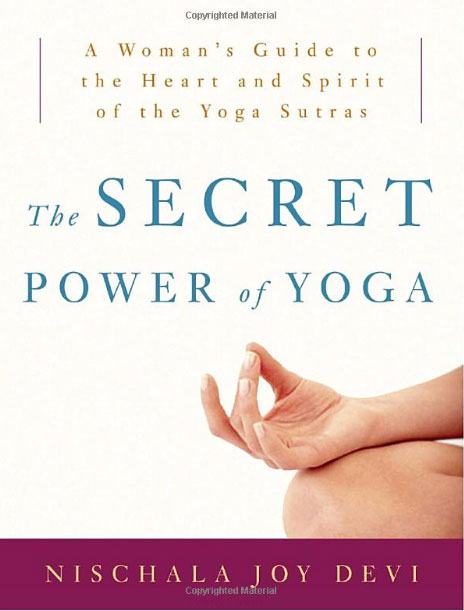
 

Books: The Secret Power of Yoga: A Woman’s Guide to the Heart and Spirit of the Yoga Sutras, by Nischala Joy Devi September 7, 2011

Filed under: books,yoga philosophy — R. H. Ward @ 4:13 pm
Tags: ,

The Secret Power of Yoga: A Woman's Guide to the Heart and Spirit of the Yoga SutrasNischala Joy Devi’s interpretation of the yoga sutras offers a different take from most traditional translations. Devi set out to write a book that explicates the yoga sutras from a heart-centered, more “feminine” perspective. She realized that most of the existing translations of the sutras were written by men, and she noticed many of her female students commenting that the sutras didn’t seem to relate to them. Devi set out to complete a more accessible text for women. She sought for her book to embrace both thoughts and feelings (rather than separating thoughts from feelings, which is often done in Western culture). She generally uses the terms “consciousness” and “heart” where the customary translation would read “mind” and “thoughts”.

Overall, I think Devi’s technique was effective.The first time I read the sutras was in this translation, and it was difficult for me; I’m not sure how I would have fared with a more traditional translation. At least with Devi’s version I felt as if the book was intended for ME.  For the most part, Devi uses real life examples that made sense in relation to how to practice the sutras in a real woman’s busy life.

On this reread, I was also simultaneously reading Sri Swami Satchidananda’s translation of the sutras; Satchidananda was Devi’s spiritual teacher, so it was very interesting to see where the two of them interpret the sutras differently and where they have a similar approach. In many instances, Satchidananda and Devi say much the same thing, but Devi couches her language in ways that feel more familiar and welcoming for a modern woman. Part of me wants to call this “the sutras – lite”, but it’s not light at all, it’s just a different take that… well, doesn’t feel quite so difficult, even though it’s the same material.

One thing I would have really liked in this book is a glossary; Devi naturally uses a lot of Sanskrit terms. The first time I read the book, it took me several months to complete it, and reading it over such a long period of time, I definitely got my dharmas and dharanas and dhyanas crossed. There is an index, which is helpful, but rather than looking up where the word first appeared and then going there to refresh myself about the definition, it might have been more effective just to have a glossary. (Satchidananda’s translation does include a glossary.)

Overall, I recommend this book for women who are looking to deepen the spiritual side of their yoga practice or meditation. I also recommend it for men who, like me, don’t connect so much with the mind/thoughts rhetoric in spiritual books.


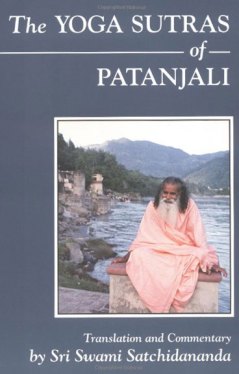
Books: The Yoga Sutras of Patanjali, trans. and commentary by Sri Swami Satchidananda September 2, 2011

Filed under: books,yoga philosophy — R. H. Ward @ 1:23 pm
Tags: ,

The Yoga Sutras of PatanjaliThe Yoga Sutras, the key text in the study of yoga, is an ancient text dating back at least 2000 years. The sutras were compiled by the sage Patanjali (pah-TAN-ja-lee). Patanjali didn’t invent the concept of yoga, but he made a system of it by bringing together all the existing teachings and traditions and giving them a structure for students to follow. The word “sutra” means “thread” – the text is a collection of almost 200 brief “threads” of wisdom. Patanjali used as few words as possible in each sutra with the idea that students would be learning from an established teacher, who would expound upon each sutra in turn. Sri Swami Satchidananda takes on that role in this translation of the sutras and the accompanying commentary.

The sutras are traditionally grouped into four books: Book One, Contemplation; Book Two, Practice; Book Three, Accomplishments; and Book Four, Absoluteness. For most students, just reading Books One and Two is sufficient – the last two books contain the more esoteric teachings. For my teacher training we actually started by jumping right in with Book Two, the practical teachings, and this certainly isn’t a bad idea. For Patanjali, the physical practice of yoga is simply a means of calming the mind, and the vast majority of the sutras are about the mind; it can be a little easier for the modern student to begin with the practical sutras in Book Two before working on the contemplative sutras in Book One.

This version of the sutras follows a helpful format: for each sutra, the original Sanskrit is given, along with the Sanskrit transliteration, the literal translation, and finally a translation set in readable English prose. This structure could appeal both to the serious Sanskrit student as well as to the beginning student (who can just skip right to the English). After each sutra follows commentary from Swami Satchidananda. At first I found the commentary to be rather dry, but after journeying through the whole book I came to enjoy his tone and appreciate his stories. Satchidananda’s translations of the sutras are very straightforward, and his commentary really elucidates each sutra and gets to the heart of what Patanjali is saying.

Overall, this is a good translation of the Yoga Sutras for beginning students, and for those who have studied the sutras before, Satchidananda’s commentary is a worthwhile reason to choose this edition for a re-read.


The Parakarmas, part 2: celebrating the good, staying impartial to the bad September 1, 2011

Filed under: yoga philosophy — R. H. Ward @ 1:19 pm
Tags: , ,

The parakarmas, discussed in Sutra I.33, are four attitudes that, if we practice them, will help us in our relationships with other people. Swami Satchidananda says that if you’re going to remember just one of the yoga sutras, it should be this one, for the power it has to help us keep a serene mind.

The sutra reads as follows:

By cultivating attitudes of friendliness toward the happy, compassion for the unhappy, delight in the virtuous, and disregard toward the wicked, the mind retains its undisturbed calmness. (page 54)

Nischala Devi translates it just a little differently, with a little less judgment on the “wicked”:

To preserve openness of heart and calmness of mind, nurture these attitudes: kindness to those who are happy, compassion for those who are less fortunate, honor for those who embody noble qualities, and equanimity to those whose actions oppose your values. (page 77)

Yesterday we discussed the first two parakarmas (friendliness toward the happy, compassion for the unhappy). The last two are a little trickier.

  • Delight in the virtuous / honor for the noble

This attitude can be summed up as “celebrating the good in others”. I have a friend who goes to Nicaragua every year to volunteer in an orphanage for disabled children. I know a woman who overcame great personal hardship to raise her son, her daughter who has a serious heart condition, and her youngest child, a small boy who also has a serious health problems whom she adopted from China. I know a perfectly ordinary guy with a job and a kid who feels so passionately about cancer research that he organizes a huge fundraiser every year as a volunteer, putting in hours of his time and energy to help others. Everybody knows someone like this, and we all wonder how on earth such people exist: come on, can they really be that nice? But we’re just looking at the whole picture, without the benefit of the context of the little moments that brought that person here. In each individual moment, that person was just trying to make the best choice she could, the same way that we all do. The sum of those choices may be a larger-than-life story that doesn’t seem real, but at the center is a regular, fallible person doing their best. Don’t envy that person (because you don’t know what he had to go through to become who he is), and don’t gossip or try to pull that person down. Instead, admire him, or use her as an example for your own conduct. Such people deserve our respect for all the love and goodwill and service they put into the world, and they deserve to be celebrated – we need more of them!

  • Disregard toward the wicked / equanimity to those whose actions oppose your values

Devi’s translation is a little more politically correct than Satchidananda’s, but it comes to the same thing: don’t let it upset you. (Don’t let the bastards get you down!) There will always be people who seem wicked or wrong, people who have values different from our own. Some people are just like that; maybe you or I used to be like that too. Maybe it’s something as simple as someone driving like a jerk on the highway – we don’t know what made that person act that way, so all we can do is hope he’ll do better tomorrow. Or maybe it’s someone you must interact with (a distant relative, a coworker) whose views are just totally different from yours: these are the most difficult people, because what do you say? Nothing you can do will convince this person to change his mind. If you want to preserve your own serenity, the best course of action is just to let it go: don’t get angry, don’t argue, and don’t let it upset you. Be as polite as possible, and when the situation has passed, put that person out of your mind. Don’t spend the next two days arguing about it in your head – that’s not going to change the other person, but it does change you. Why choose to get upset and keep rehashing angry words? Let it go.

N & J described this attitude as “remaining impartial to the faults and imperfections of others”. I like this rephrasing a lot because it reminds us to keep this attitude not just with nasty Uncle Larry or with Susan in marketing, but also with the people closest to us. I’m not perfect and I’m never going to be, but it’s easy to forget that my friends and loved ones aren’t perfect either. I may have high expectations for them – and we often expect the best from the people we love, don’t we? – but they have faults and imperfections too, and they make mistakes. If we can remain impartial when those mistakes happen, we’ll be able to be kinder to the person in that moment, and we’ll be better able to preserve our own calmness of mind without getting angry or disappointed.


The Parakarmas, part 1: friendliness and compassion August 31, 2011

Filed under: yoga philosophy — R. H. Ward @ 1:19 pm
Tags: , , ,

The parakarmas, discussed in Sutra I.33, are four attitudes that, if we practice them, will help us in our relationships with other people. Swami Satchidananda says that if you’re going to remember just one of the yoga sutras, it should be this one, for the power it has to help us keep a serene mind.

The sutra reads as follows:

By cultivating attitudes of friendliness toward the happy, compassion for the unhappy, delight in the virtuous, and disregard toward the wicked, the mind retains its undisturbed calmness. (page 54)

Nischala Devi translates it just a little differently, with a little less judgment on the “wicked”:

To preserve openness of heart and calmness of mind, nurture these attitudes: kindness to those who are happy, compassion for those who are less fortunate, honor for those who embody noble qualities, and equanimity to those whose actions oppose your values. (page 77)

Let’s take a look at each attitude in turn.

  • Friendliness/kindness toward the happy

Why wouldn’t we be happy to see other people being happy? Maybe the other person has something we don’t have and we’re jealous, or maybe we’ve just had a bad day and the happy person’s good spirits get on our nerves. But feeling jealous or annoyed won’t do anything to the other person – all it does it disturb you. You can’t have a calm mind or a peaceful heart when you’re full of jealousy. For your own sake, then, when you see a happy person, cultivate a feeling of friendliness towards him or her. Even if you’re having a bad day, don’t get annoyed; think to yourself, “I’ve been happy like that before, and I will be again.”

  • Compassion for the unhappy/those who are less fortunate

I don’t like to talk about politics, but I feel like this is a very hot topic in the USA right now. Many, many people in our country are suffering under a poor economy, have lost their jobs, can’t find work, can’t afford their homes, can’t support their families, can’t afford medical care. And yet with so many suffering, our political leaders talk about how not enough Americans are paying income tax and how we should raise taxes on those people while preserving tax cuts for the very rich. This is more than wrong-headed thinking; it’s not compassionate. I found Warren Buffett’s recent article in the New York Times to be a really interesting example of compassion.

Swami Satchidananda points out that there’s often an impulse to blame the suffering person: he must have done something to deserve this. If you’re homeless, just get a job! That girl shouldn’t have been having sex, so of course she’s in trouble now that she has a baby. But if we are truly practicing yoga, we must live in the present moment. It doesn’t matter what happened in the past; this person is suffering now and deserves our compassion. As yogis, we must also strive to understand others, to truly put ourselves in their shoes. There may be all kind of circumstances that prevent someone from finding a job (including a bad economy!), and without knowing that specific person’s story, we can’t judge. Imagine how you yourself would feel in that situation and how you would want to be treated. All we can do is to treat people compassionately, with mercy, and work to help and serve as best we can.

Swami Satchidananda also reminds us that the purpose of these attitudes, these parakarmas, is to preserve your own serenity. Being cruel to others hurts you too! But if you know that you were compassionate, that you tried to help, your own mind is set at ease. If nothing else, living with compassion eases your own heart.

Tomorrow: the other two parakarmas!


Dealing with ups and downs August 30, 2011

I’ve been trying for a while to wrap my head around a concept mentioned in Eknath Easwaran’s book Passage Meditation, and I think I’ve finally figured it out. Mr. Easwaran  talks about excitement and emotional ups and downs, and how a true yogi will work to eliminate these. Of course we all want to get rid of the lows we experience in our moods, but getting rid of the highs too will help us to be more balanced, calm, and peaceful. Mr. Easwaran explains it as follows:

You will find excitement played up everywhere today… and everywhere today you will find depressed people. Hardly anyone sees a connection. Hardly anyone realizes that the old truth “What goes up must come down” applies to the mind too…. In other words, excitement makes us vulnerable to depression. When I say this, you may think that I am trying to wrap a wet blanket around you. But actually, when we reduce the pendulum swings of the mind, we enter a calm state of awareness that allows us to enjoy the present moment most fully…. Learn to prevent low moods altogether by repeating your mantram when you first feel yourself becoming excited…. bring yourself back to the present moment so you can avoid disappointment if future events take an unexpected turn…. free yourself from the tyranny of strong likes and dislikes – all those preferences, aversions, fixed opinions, and habits that make us soar when things go our way and crash when they do not.” (86-87)

That was a long quote, condensed down from a much longer passage, but I thought Mr. Easwaran explains his point well. Also, thinking about strong attachments and aversions is part of our assignment this month, so this passage is interesting in that light as well. I read this passage probably two months ago now, but set it aside at the time because we were busy moving. It’s been in the back of my mind since then.

I tend to get excited easily, about big things and silly things both. I just like things. Getting excited about stuff seems like a part of who I am. Do I need to give that up to make spiritual progress? I can see Mr. Easwaran’s point about the high highs making us vulnerable to the low lows – I definitely have my low lows, probably more than a more stoic person might have. For example, my husband is much more even keeled than I am – he plugs along pretty contentedly while I bounce around, up and down. That’s not to say he doesn’t have low moments like anyone else, but it takes a lot to shake him up, whereas I can go from the heights of joy to the depths of self-loathing in the space of ten minutes. I’ve worked really hard to get a semblance of control over that, but maybe if I work on controlling my up times too, I’ll be more balanced overall. But when I think about this, something in me gets upset – I like liking things, and I like who I am. Swami Satchidananda would say that “who I am” is just a construct built by my ego and I should let go of it anyway, but still, I wasn’t sure how to feel about this or what to do.

However, I think that, from Mr. Easwaran’s perspective, he would acknowledge a difference between “excitement” and “enthusiasm”. Excitement gets you all juiced up for something that could never come close to what you’ve built it up to be, so you feel let down afterwards. Then you go seeking more and bigger things to get excited about, but none of them ever truly fulfill you. Enthusiasm, I think, is different. When you’re enthusiastic about something, you know what it is and what you’ll get from it, so you can feel happy and pumped up about it without feeling let down afterwards. I think that what I am is (for the most part, anyway) enthusiastic, not excitable.

Here’s a classic example. I love using my EZ Pass to go through toll plazas on the highway. I’ve had my EZ Pass for at least five years, yet I still yell “Go EZ Pass!” as I coast past the toll booth. It never fails to delight me. And that’s not the sort of excitement Mr. Easwaran is talking about, that’s taking genuine joy in my world. I get excited when I go out for a nice dinner with my husband, but afterwards I don’t feel sad that it’s over; instead I spend the train ride home talking about what a nice time we had and how good the food was and how happy I am. I dance to the theme song for Doctor Who every time the credits roll (every. single. time.) because I always love that show no matter what happens. If we go out for a walk in the park, I get all excited like a puppy and start chanting “The park the park the park!” but I’m still happy the whole way home afterwards. I even get excited when it rains because it means I get to wear my yellow raincoat.

These are all things I feel genuinely enthusiastic and happy about. They’re not going to disappoint me later; they are experiences that I find satisfying in my everyday life. I could certainly do a better job of controlling mood swings, and doing so would help not just me but my husband and family. But I don’t think I need to change my core, my enthusiastic personality. Part of the point of yoga is being fully present in the moment, and if I’m doing the Doctor Who dance or singing about my EZ Pass, I can pretty much guarantee that I’m right there in the present moment.


Nine Obstacles to Mental Clarity August 24, 2011

Filed under: yoga lifestyle,yoga philosophy — R. H. Ward @ 2:25 pm
Tags: ,

Today we’ll talk about the nine obstacles to mental clarity. These are also obstacles to practicing yoga or to succeeding in anything else that requires hard work and practice. The nine obstacles are:

  1. Lack of effort
  2. Fatigue or disease
  3. Dullness, inertia (tamas)
  4. Doubt
  5. Carelessness
  6. Laziness
  7. Inability to turn the mind inward
  8. Distorted thinking
  9. Lack of perseverance

The first and last obstacles are of particular interest. Lack of effort is in many ways the most powerful obstacle and the key to all of them: if you don’t put any effort into your practice, you can’t possibly make progress. In addition, a lack of effort opens the door for the other obstacles to come in: if you’re working hard, you’ll be focused on your work, but if you’re not putting in any effort, you’re more likely to become lazy and careless. If you can avoid experiencing a lack of effort – if you strive to put your best effort into all you do – it will be easier to avoid the other obstacles as well.

The last obstacle, lack of perseverance, is also important. J defined “perseverance” as “practicing for an extended period of time without break”. While this concept can be applied to an individual practice or yoga class (powering through a full hour instead of copping out after 20 minutes), it shouldn’t be understood to mean practicing for hours and hours on end, day after day, which wouldn’t be healthy. Instead think about perseverance as the willpower to go do the work regularly, to do it without break, every day if you can. Practicing yoga once a month at random won’t help you very much, but if you practice every Tuesday or twice a week or every morning, you’ll see yourself making progress. Lack of perseverance goes hand in hand with lack of effort: to get anything accomplished you need to show up and try!

Another of the obstacles I want to talk about is laziness. In our lecture J gave us a definition for laziness that’s stuck with me: “laziness” is “the inability to take action even though there’s a longing for action in the mind”. Most of us have experienced this. You know you should go clean the bathroom but you think you’ll just sit down for a minute, and oh, Pawn Stars is on and you haven’t seen this one. Or it’s some movie, like Ferris Buehler’s Day Off, that you’ve seen a dozen times and don’t really care about seeing again, but you get sucked in and you stay on the couch even through the commercials and there goes your whole Saturday afternoon. You know you don’t really care about the movie, and that if you did care you could rent it or get it on Netflix with no commercials, but you sit there anyway. In class, we asked J, how do you fight laziness? And he said, um, get up. So even the big sage guy doesn’t have a magical answer. You know you need to get up, so turn off the TV, let Ferris go about his crazy day, and get back to your own life.

To me, the thing that seems so insidious about the nine obstacles is the way they feed on each other. Say you’re feeling lazy, so you shorten your yoga practice or do it carelessly, maybe you skip it entirely – there’s lack of effort and lack of perseverance. Let it go and a pattern develops: the longer you sit around, the easier it is to keep sitting around, and inertia sets in. Soon you begin to doubt your purpose, whether there’s any point to this yoga stuff, even though you know you feel better and stronger when you do yoga. And without your regular practice you lose the ability you’d been building to focus and turn the mind inward, becoming even more distracted by what’s on TV. The nine obstacles draw you in, drag you down, and keep you there.

That’s an overblown worst-case scenario, but we all deal with these obstacles every day, not just in yoga but in our jobs and other work, and over time they can keep us from achieving our goals. However, by identifying the obstacles and knowing their tricks, we can fight against them. The next time I’m tempted to watch just one more episode of Pawn Stars, I’ll remember: this is laziness! I don’t want to be lazy! And I’ll turn off the TV.

So what do the nine obstacles look like in your life? Which one is hardest for you, and what do you do to fight it?


The Gunas August 10, 2011

Filed under: bhagavad gita,yoga philosophy — R. H. Ward @ 1:42 pm
Tags:

Throughout the Bhagavad Gita, Krishna talks about three gunas and the effects they have on each individual. The word “guna” means “strand” or “quality”; the gunas are qualities that influence and control our actions and even our personalities. Having a working understanding of the three gunas – sattva, rajas, and tamas – can help us to better understand ourselves, our motivations, and our spiritual path.

The first and highest of the gunas, sattva, denotes peacefulness, calm, contentment, and balance. Ideally, after meditation or after yoga asana practice, you’ll be feeling sattvic: the goal of these practices is to bring about a sattvic state. Sattvic foods include fresh fruits and vegetables, whole grains, nuts, beans, and seeds, dairy products, and sweet spices like cinnamon or cardamom.

The second guna, rajas, denotes activity, energy, sensuality, desires, attachments, and enjoyments. Being in a rajasic state can be good for getting a lot done at the office because you’re full of energy and drive. Feeling rajasic can be pleasant, but to make progress on our spiritual path, we need to strive for a sattvic state. Rajasic foods include caffeine, meats, heavy foods, and very spicy foods. From an ayurvedic standpoint, the vata dosha is most rajasic.

The final guna is tamas, which denotes laziness, lethargy, confusion, and ignorance. We all feel tamasic sometimes, but it’s not a state anyone really wants to be in. Tamasic foods include fast foods, old or leftover foods, canned or boxed foods, and foods with lots of preservatives. In ayurveda, kapha is the most tamasic dosha – spicy rajasic foods can help to get kaphas moving!

The three gunas act together to influence our thoughts, words, and actions. In understanding the gunas, we can come to understand our motivations and why we do what we do. Try using the gunas as a system of measuring your mental state. The gunas fluctuate depending on each person and each day, but at any given time one guna is dominant over the others. Which guna is affecting you most right now?

As yogis, when we’re aware of the gunas, we can use that knowledge and our discrimination to make choices that will lead us to a sattvic state. When you first wake up in the morning, you may feel sleepy and tamasic, so what do you do to get yourself moving? If you have six cups of coffee, that will lead to a rajasic state; if instead you do your yoga practice followed by a healthy breakfast, that’s more likely to lead to a sattvic state. (And if you roll over and go back to sleep, you’re giving in to the tamas and you won’t get anything done!) Paying attention to our moods, and to the effect our choices have on our moods, will lead us to make healthier choices, choices that make us happier.

As a yoga teacher, it’s important to be aware of the gunas too. The purpose of yoga class is to bring the students to a sattvic state. This is why most yoga classes begin with a series of active rajasic poses, then lead students to more calming poses and finally to relax in savasana. If the yoga teacher is aware of the gunas, she’ll be careful to preserve the sattvic state of her students at the end of class: talking in a soft voice, making slow movements, and turning the lights up gradually. Loud voices, bright lights, and being rushed out of the room can spoil that yoga high!


Four Paths: Karma Yoga August 5, 2011

In the Bhagavad Gita, Krishna describes the four paths of yoga:

Each of these paths has the potential to lead a yogi to enlightenment, so you choose your path based on your temperament and personality. Choosing the wrong path will make it much more difficult to make progress, because essentially you’re fighting your nature. This month, my assignment is to consider the four paths and decide which one appeals to me the most.

Karma yoga, the path of action, is the path that called out to me right away during our class discussion at the last teacher training session. The nice thing about Karma yoga is that it’s all about action – you don’t have to give up your life in the world or retreat into secluded study or meditation. You still have to read and study and meditate, of course, but your main focus is your secular life. The difference between a Karma yogi and some regular guy, however, is that the Karma yogi seeks to perform the actions of her life with an attitude of selfless service, with no attachment to the results of her actions.

In Karma yoga, you perform your actions because it’s your duty, because it’s the right thing to do – no more and no less. You don’t get caught up in expecting a reward for your efforts. If you receive a reward, that’s nice, but the point is to do the action for its own sake. It’s not that the Karma yogi doesn’t care about what happens: to the contrary, she cares very much and works hard at her work, but she recognizes that she has no control over the results of her actions, so she just does her best and then lets go. She takes an attitude of service, making each action an offering to the Divine. This way, doing the work actually becomes your spiritual practice. (Chapter 3 of the Bhagavad Gita discusses Karma yoga in more detail.)

There are four steps to Karma yoga:

  1. Know your duty, know your life’s purpose (your dharma), and accept it fully
  2. Concentrate and be fully present as you perform your duty
  3. Do the work with excellence, as best you can
  4. Give up any attachment to the results of your actions

For me, this path is very, very appealing. I have always felt like I wanted to do more, to serve more, that there was something I owed to the world in gratitude for the wonderful life that I have. For years I secretly wanted to join the Peace Corps but was too afraid to take the risk. I can’t even talk about the Peace Corps; I get teary. I’m teary just typing about it. The concept of Karma yoga fulfills that need to serve by making everything a form of service. I don’t need to go far away to make my life meaningful or helpful or useful. I can do that right here.

I also like how neatly Karma yoga fits together as a system for running your life. If every action is service, is an offering to the Divine, then you’re pretty much going to stop being a jerk to people, aren’t you? The yamas and niyamas become even more practical guidelines for living. You start wanting to eliminate negativity and nastiness from every action you put out into the world; there’s an inherent kindness to it. I often feel that I am not very kind, and I’d like to be. As a system, it also puts emphasis on personal excellence – doing your best, striving to perform your work in the best possible way – and that resonates with me too because I’ve tried to live my life that way.

The hardest thing for me to imagine is acting without attachment to the results of my actions. And obviously that’s kind of a biggie. But that’s something I feel I need in my life, too. How comforting it would be to stop worrying over things that are beyond my control! To be able to let go of that suffering, and just reside in the fact that I did the best I could do. I’ve been telling myself this for years. Of course, it’s still incredibly hard for me to just do that, but isn’t that the point? To work at it, and to make the work the offering?

I’m getting a little emotional here, but that’s clearly indicative of something. Yesterday, I was thinking about Bhakti yoga and thinking that maybe that might be a good option for me, but Karma yoga is something I really feel passionately about, and something I’ve been trying to practice without even knowing I was doing it. There are many aspects of the other paths that do appeal to me, and there’s no reason I can’t take those things and use them on my journey, but my main path is going to be Karma yoga.


Four Paths: Bhakti Yoga August 4, 2011

Filed under: bhagavad gita,yoga lifestyle,yoga philosophy — R. H. Ward @ 2:20 pm
Tags:

In the Bhagavad Gita, Krishna describes the four paths of yoga:

  • Karma Yoga: the path of action
  • Raja Yoga: the path of meditation
  • Jnana Yoga: the path of wisdom/knowledge
  • Bhakti Yoga: the path of love/devotion

Each of these paths has the potential to lead a yogi to enlightenment, so you choose your path based on your temperament and personality. Choosing the wrong path will make it much more difficult to make progress, because essentially you’re fighting your nature. This month, my assignment is to consider the four paths and decide which one appeals to me the most.

Today I’ll talk about Bhakti Yoga, the path of love and devotion. This is the most emotional path, for yogis who tend to think with their hearts; the Bhakti path encourages yogis to channel those emotions toward the Divine. Unlike Jnana yogis, the Bhakti yogi is happiest worshipping the Divine in a manifested form, such as Jesus, Mary, or Krishna, because it feels like a more personal connection.

Bhakti yogis are assisted in their spiritual practice by a variety of techniques:

  • chanting (such as kirtan music, or the many call-and-response chants in the Catholic liturgy, or even a rosary)
  • imagining or meditating on attributes of the Divine (the holes in Jesus’s hands and feet; Mary’s blue robes; the face of Krishna)
  • rituals (like lighting candles)
  • kneeling or prostration before the image of the Divine (Christians keep those big crosses around for a reason!)

These sorts of actions create a sacred atmosphere that a Bhakti yogi appreciates – they bring the participant into a meditative state where she can feel close to the Divine. The Bhakti yogi is always cultivating that longing to be with the Divine, striving to make her life an offering to her deity. You can read more about Bhakti yoga in chapters 9 and 12 of the Bhagavad Gita.

I was raised Catholic, and the rituals of the church do hold some appeal for me. I love to sing: I sang in church choirs growing up, and raising my voice in song does make me feel closer to my spirit. Sometimes I even feel moved to sing while I’m practicing yoga (it’s really fun, actually), or after my meditation (I learned a great song at my Unitarian church about breathing in peace and breathing out love, it’s perfect). I like having my little shelf set up at home with my little Buddhas all lined up; that’s where I meditate, and I feel like having them around is like having a tiny little support group cheering me on. I can relate to the feeling in Bhakti yoga that the Divine is a personal friend who loves you back. The more I think about this path, the more I think it’s an option for me. However, it’s not the path that called out to me right away (and if you’re keeping track, you’ll have it figured out by now). Next time, I’ll do some reflecting on karma yoga and see how I feel about it.