Rox Does Yoga

Yoga, Wellness, and Life

Yoga Class with N June 8, 2011

Filed under: yoga — R. H. Ward @ 10:11 am
Tags:

Last night my neck was feeling back to normal (meaning: tight and full of stress and tension, but no more than usual), so I headed to the yoga center and had a great practice in N’s class. Tuesday night’s class is on the schedule as an “All Levels” class, but N seemed to know everyone in the room and she definitely taught a challenging class, the sort of class where downward dog really is a resting pose and a relief. It’s been a long time since I was so sweaty in a yoga class that I couldn’t hold on to my own slippery leg and was wiping my face on my pants. Definitely need to remember to bring a towel to N’s classes in the future!

N’s class was different from J’s typical class, maybe because I usually catch J’s class when it really is an “All Levels” class. J almost always structures his classes the same way, typically does basic sun salutations with lunges, and always has us hold the poses a long time. N’s class was more of a vinyasa flow; we did vinyasa-style sun salutations, moving on each inhale and exhale rather than holding each pose for a few breaths. I knew I was in for something different when one of the first poses we did was crow. We came back and did arm balances several times over the course of the class. I didn’t always practice an arm balance – I did crow once, but sometimes I just hung out in a squat or did leg stretches – but the other women in the room were doing crow, side crow, tripod, handstand, all kinds of cool stuff.

At one point N linked several balance poses together so we were on one foot for a while without coming down. I can’t remember the exact sequence we did, but the poses included ardha chandrasana (half moon), standing split, crane, dancer, tree, and two ardha chandrasana variations: one in which the raised arm was behind the back in a twist/bind; one in which the raised hand held the raised foot, almost like in dancer pose but with the other hand on the floor. This last I could not do at all. The balance chain was overall really tough on me and I had to keep coming back to standing split, which was the easiest of the forward-bending balances (with both hands on the floor), and after each balance chain I really needed to stretch out the standing leg. I think the fact that this sequence was so rough for me means that I need to go to N’s classes more often. N also had us do a different inversion sequence: starting in plow, lifting one leg at a time up to shoulder stand, and then working into lotus in shoulder stand, rolling out that way, and doing a lotus fish. Pretty intense stuff. I don’t do lotus so I just played with cobbler pose a bit in my shoulder stand.

To come from J’s class, which is slower paced and tends to have many beginning students, to N’s class, fast-paced, with an all-female group of students who were doing advanced arm balances like side crow and handstand and who could handle the difficult balance and inversion sequences, was really kind of inspiring. You don’t always see women doing those sorts of challenging poses, especially not ones relying on arm strength. This class was an amazing workout and I felt like I was really able to relax in my savasana, which doesn’t always happen in J’s classes. I think I may stick with N’s Tuesday class for a while rather than J’s Monday class – not because of the headstand, although that’s part of it, but because N’s classes have different things to teach me and it will be a different way to challenge myself. I do still plan to talk to J, but I think I’ll spend some time with N for a while.


thoughts on doing posture write-ups June 7, 2011

Filed under: reflections,yoga — R. H. Ward @ 12:52 pm
Tags: ,

This month we’re supposed to do posture write-ups on any two standing poses. So far, I’ve chosen the poses I want to write about: wide-legged standing forward fold, and ardha chandrasana. Both of these poses are very challenging for me in different ways. However, I’m still struggling with the idea of observing and discussing my own experience of the pose.

The first month, with the forward folds, writing about my own experience was really difficult for me. Last month, we had to write up our most and least favorite poses, so it was much easier because we were picking poses that we actually had feelings about. Now we’re back to “pick any pose in this category”, and when I think about the regular poses that I do well (for example, triangle pose, or warrior 1), I can’t for the life of me think of what I feel in these poses. When I try to pay attention when I’m doing the pose, I have no problem noticing how my body feels, but I don’t see anything specific related to that particular pose going on in my mind. Other than anatomic things (like having to be careful of my knee in triangle pose), I feel pretty much the same no matter what pose I’m doing. Calm, strong, distracted, tired: it just depends on my mood that day. No particular pose really stirs up anything specific for me. Having to do this exercise is really frustrating, it feels fake to me, I feel very resistant to it, and I will go out on a limb and say I kind of hate it.

So, this month, I am picking two poses that are challenging for me, because if a pose is physically challenging, I can talk about that and be excused from talking about my stupid monkey brain and how it’s not doing anything useful. However, this is still problematic because I just decided a few days ago which poses I would write up, and so I haven’t been practicing them all month, so I still might not have anything good to write about. I did the “I don’t have anything to write about so I’m writing about that” thing the first month and I don’t know if I can get away with it again, although in a sense, if that’s still where I’m at with this, then that’s a valid place to be. I’ll be interested to see what comments I get back from last month’s assignment, maybe that’ll help.


Pranayama: Ujjayi Breathing June 6, 2011

Filed under: breath,yoga — R. H. Ward @ 9:02 pm
Tags: ,

If you’ve taken a few yoga classes, you’ve probably heard of ujjayi breathing. If you haven’t heard the term, you might recognize it as that sort of loud, raspy, almost a little embarrassing breathing noise that your yoga teacher makes. Why, you may ask, do yoga teachers breathe funny like that? I’ll tell you how to try a few breaths at home, and then once you’ve got the noise down, I’ll tell you more about it and why it can be beneficial.

To begin ujjayi breathing, take a deep breath in through your nose. Now open your mouth and exhale while whispering the word “Ha”. Make the “Ha” last the length of your exhale; don’t vocalize the “Ha” or say it out loud, just whisper it. Do this a few times and notice how your throat constricts when you do it. Then shut your mouth. Keep thinking “Ha” and see if you can still make the same noise, with the same throat constriction, while exhaling only through your nose. Engage your abdominal muscles to help press all the air out. Got it? Now try to make the noise as you inhale through the nose too. If it helps, think “Sa” on your inhale. See if you can feel the cool air on the roof of your mouth as you inhale and exhale.

Ujjayi breathing sounds funny when you do it, but once you get past feeling self-conscious about the sound, you can use this technique as a tool to improve your yoga practice. Ujjayi means “victory”. It’s a warming breath that creates heat in the body. I feel like the throat constriction helps me to get a deeper, fuller breath. When you combine ujjayi with diaphragmatic breathing, you can powerfully cleanse stale air from the bottom of your lungs and get fresh oxygen moving through your system.

Use ujjayi breath during yoga class to help build up heat as you practice. We already know that focusing on the breath can help us to stay strong and hold poses longer; the ujjayi breath helps with that by being a nice deep breath, and having a nice deep breath makes it easier to keep the breathing slow and steady. Believe it or not, the sound helps too. Hearing yourself breathe a slow, deep, steady breath can be soothing to the mind and can help you focus.

This is why your yoga teacher breathes so loudly: she’s using the sound to calm the students and remind them to breathe. Imagine it: there you are, trying to hold your plank or high lunge or whatever pose it is that challenges you most, and you’re wobbling away, your arms or legs are shaking and you want to be done with it already. Your teacher comes over to you and makes some minor adjustment to your posture (or maybe she just adjusts the guy next to you), and of course she’s breathing loudly, slowly and evenly. Without noticing that it’s happening, you try to deepen your breath to match hers; maybe you were even holding your breath, but now you’re breathing deeply, and maybe you wobble a little less, or feel a little burst of strength to carry you through the pose.

Ujjayi breath is a breath of heat and energy and victory. Engaging ujjayi breath always make me feel determined to keep holding the pose. It’s good for tapas! Practice it whenever you can, even off your mat (if there’s no one around to look at you like you’re a crazy person), and you may find it helps with whatever you’re dealing with.


Headstand Drama June 5, 2011

Filed under: yoga — R. H. Ward @ 3:34 pm
Tags: , , ,

Yesterday I went to the 10:30 morning yoga class. Class was good and I was feeling great until we got to inversions. I decided to do a headstand (which I rarely do at the yoga center, only when I’m feeling particularly strong and confident). I did my headstand, held for a few minutes, and came down, and then J came over to me. He explained that I had my elbows too wide in the headstand – the elbows shouldn’t be wider than the shoulders, so I should bring them in closer together. He also said I should bring my feet close together, as that would make it easier to balance. Then he told me to try it again.

I had some difficulty lifting back up into headstand – I’d already done it once and was a little tired. Also, the new arm position felt unnatural. J helped me lift my ankles. As soon as I was vertical in the pose, I knew it wasn’t right for me: I felt very uncomfortable and my neck really hurt, which is a major problem in a headstand. Thinking back now, I think that with the new arm position I wasn’t able to press strongly enough through my arms, putting all the pressure on my head and thus my neck. Either the new position made it physically difficult for me to press strongly, or I wasn’t confident enough with it to press strongly, but either way it was a problem. I wanted to come down out of the pose right away, but J was in front of me holding my ankles, so if I had dropped down I would have kicked him in the face. I panicked and didn’t say anything because I was afraid I’d (A) cry or (B) shout, so I just kept my mouth shut. I tried to press down through my arms to alleviate the pressure on my neck, but I don’t think it helped much, and I tried to follow J’s instructions about lifting my hips and keeping my feet together. I have no idea how I did with this. The base for my headstand was so uncertain and uncomfortable that I don’t know how well I held up at all. As soon as J moved aside, I dropped down. I tried to do a few neck stretches, but I was really shaken. Then it was time for sivasana.

I spent most of sivasana alternately being really angry and upset and trying to calm myself down. I felt angry foremost at J for making me do this modification that turned out to be so painful and so scary. But I knew I couldn’t be too angry with him – he’s a yoga teacher, not a mind reader. Also, he knows I’m an experienced student and should be able to trust me not to do something that hurts (while I on the other hand should be able to trust him not to hurt me, but this is a circular argument). I was angry most of all at myself for not being better able to respond to the situation. I know that I can have trouble with my neck in headstand and I could have been more careful; I could have told him I didn’t want to do the pose again; or I could have said something when it hurt, even if it resulted in me crying or shouting. Sticking it out through a tough pose is one thing, but when a pose actually causes pain, you’re supposed to come out of it or modify it right away. I felt angry that I let that situation happen, even though there didn’t seem to be anything else I could do at the time (short of kicking my teacher in the face).

I got myself mostly calmed down by the time we got to meditation. After class, I tried to wait to talk to J, but there was a new student in the class and he always likes to check in with new students after class. I used the rest room, and when I came back upstairs, everyone else was gone except J and the new student, who were talking in the back room, so I left too. I spent the afternoon with my parents and managed to put the bad feelings out of my mind.

I woke up this morning with a really, really sore neck. I still feel upset with J, and with myself. I think I do need to talk to him about this because I don’t want this to affect our working relationship (considering we’re stuck with each other until December) and plus he just deserves to know. Also, I want to talk about the pose itself and why he felt it necessary to modify my headstand in that way. Would keeping my elbows wide eventually lead to some other sort of injury? Right now I’m torn between wanting to practice playing with the new arm position in a safe way at home (after the current soreness heals, of course), wanting to ignore what he told me and keep doing it the old way, and wanting never to do a headstand again. Choosing the last option would mean giving in to the fear that I feel about the pose now, and that’s not a good idea. I also really, really don’t want to have to confront J. I could go to one of N’s classes instead this week but I feel like that would be avoiding the issue.

So, dear readers, what do you think? Tips on practicing headstand safely? Authoritative suggestions on correct arm positioning? Ideas on how to approach J?


Pranayama: Alternate Nostril Breathing June 3, 2011

Filed under: breath — R. H. Ward @ 6:35 pm
Tags: ,

Have you ever noticed how one nostril sometimes seems more open than the other as you breathe through your nose? This truly happens to everyone. Take a few breaths through your nose and notice which nostril seems more open right now and which seems more clogged. The difference may be very slight, but it should be present (if your nose is healthy and not affected by allergies or a cold). The ancient yogis believed that whichever nostril was active could affect your mood and your energy level, and they developed a technique to affect the flow of breath in the nostrils, thus influencing mood and energy. This may sound like New Agey hokum, and I don’t blame you if you think that. But this technique, alternate nostril breathing, can be done easily at home with nothing but your nose and one hand, only takes a few minutes, can’t hurt anything and could maybe do some good. I figure, why not, so if you’d like to learn more, read on!

According to yogic theory, prana, or life energy, travels through the body via channels called nadis. There are thousands of nadis carrying prana to all parts of the body, but the three most important nadis are called pingala, ida, and sushumna. These three energy channels all travel up the back to the head. Pingala nadi starts at the base of the spine, cross-crosses up the back, and emerges at the right nostril; ida nadi does the same and emerges at the left nostril. Sushumna nadi travels directly up the length of the spine and is engaged when both nostrils are equally open.

The ancient yogis observed that when the right nostril is active, the body feels more energetic, and when the left nostril is active, the body feels more lethargic. This is because either the pingala or ida nadi is more open, channeling prana in different ways. The goal is to balance the flow of breath in the nostrils and activate the sushumna nadi, which brings pure energy to the body, perfect for meditation. Alternate nostril breathing (also called nadi shodhanam) works to bring about this balance.

Sit up straight in a comfortable position. You’ll use your right hand to alternately open and close each nostril: thumb against the right nostril, third finger against the left nostril. (You can either curl up the first and second fingers or rest them on your forehead if that’s comfortable.)

Being by inhaling deeply through both nostrils. Close your right nostril with your thumb and slowly exhale through your left nostril. Inhale through the left nostril, then hold the breath a moment while you switch fingers, opening the right side and pressing the left nostril closed with the ring finger. Exhale slowly on the right side, then inhale on the right side. You’ve now completed one round of alternate nostril breathing: one exhale and one inhale on each side. Do at least six rounds total, preferably nine rounds.

As you do the exercise, pay attention to keeping the breath long and smooth, and try to keep thoughts focused on the breath. If one nostril feels a little clogged, don’t panic; just take a slow deep breath. You have plenty of air, and you can always stop if you need to.

After practicing alternate nostril breathing, don’t expect to feel anything special. Nothing’s going to happen right now. Any results will be too subtle to see right away. That’s why my assignment for this month is to practice this exercise every day, all month long: because this will give me an opportunity to see the breath at work for a longer period of time. I’ll keep you posted on what I experience as the month goes on!


Teaching Practice by the Pond June 2, 2011

Filed under: reflections,teacher training — R. H. Ward @ 1:27 pm
Tags:

Pond House Yoga 2For Memorial Day, F and I rented a house in Rhode Island with some friends, to get away for the weekend. The house was in a fairly secluded area, right next to a pond, and it had tons of bedrooms and a big kitchen and plenty of space for all of us. Before the trip, I had asked our friends if they’d mind being yoga guinea pigs, and several people wrote back and said yes, they’d love to, and in fact if I hadn’t asked they would have made me teach them some yoga! So on Sunday morning, we gathered up mats (and beach towels for the mat-less) and tromped down to the pond, where we had a nice flat grassy patch to practice on. It was warm out and not too buggy. With five students, it would have been too cramped to practice in the house, and the view over the pond was really nice.

My friends have varied levels of yoga experience. One person has practiced quite a bit of yoga; two had done at least some yoga before but not recently or only with a DVD. And the two easygoing guys had never done any yoga. I was really excited because this group simulated a normal beginners class really well in terms of experience level, making it a really good teaching practice opportunity for me. J tells us that, with a beginners class, you need to teach to the middle. You can’t spend all your time working with the more advanced students, because the new students will be lost, but you also can’t spend all your time helping the newbies, because everyone else will get bored. The answer is to teach to the middle. The more advanced students will be fine and will modify as needed to go deeper; the new students can keep up better when you teach to the middle, and you can help them when you get a minute. So that’s what I tried to do.

I taught the hangover sequence I posted last week. With that sequence I was trying to choose poses that would help hangover symptoms but would also be poses that anyone new to yoga could do without too much trouble. I think the sequence worked really well (the only thing I had to change was legs-up-the-wall, which, having no walls, we couldn’t do, but we did bridge instead and it was fine). It was challenging but not too challenging; everyone caught on to what was expected in a pose pretty quickly. Mostly I just talked through the poses and didn’t demonstrate unless it was something easy to do (like tree pose – I was standing there anyway, might as well demonstrate the foot position while I talked). I also demonstrated leg positions for the seated twists, since I haven’t yet figured out the best way to describe those just with words. But overall I talked. I like to think that I described the poses reasonably well, but I think it also helped that there was one more experienced yogini in the class that people could glance over to as an example. There were a lot of things that I thought of afterward that I would have liked to have said or talked about, but on the whole I think I covered the bases pretty well.

It was interesting to watch my friends and see them as students and try to respond to what they needed. One guy hadn’t done yoga before and wasn’t very flexible, but he got the idea just fine and I never once had to adjust him in a posture. He did great, and he says he’s going to try some yoga at home now. It was actually a bit harder working with the two girls who had done just a little yoga before, which I didn’t expect, but which makes sense when you think about it. I was teaching classical hatha style, making them hold the poses for a while, which some people found really challenging. J tells us that, when teaching, we should get them into the pose, shut up and let them have an experience, and then get them out of the pose; mostly I tried to do that, although when people were holding for a while and starting to wobble, I’d say “Two more breaths here” just to give them hope (that always helps me). A few times I’d explain something and someone would ask a question, which I thought was super-helpful: if you ask, then I can give you an answer that will help you in the pose, and if you ask, then I know what I need to do to explain it better next time.

Overall the whole experience was really, really fun, and received rave reviews from my “students”. Although there was some fly swatting going on, and some loud neighbors calling their kids during sivasana, everybody loved the peacefulness of being outside looking out over the pond. And everyone seemed to feel happy and more energetic afterward. It was a really, really great experience! My only sadness was missing out on practicing yoga myself, but getting to share in this awesome group practice more than made up for it.

Pond House Yoga 1(Photos by F, who did not participate in the class.)


Pranayama: Three-Part Breathing May 31, 2011

Filed under: breath — R. H. Ward @ 9:49 pm
Tags: ,

A few days ago I posted about diaphragmatic breathing. The next breathing technique I have to practice this month is called three-part breathing. Three-part breathing works to completely fill and then completely empty the lungs, which is beneficial for removing toxins from the body. Because the three-part breath is so slow and deep, it’s also a helpful technique to learn for combating anxiety, anger, or stress.

Three-part breathing uses a long, deep inhale to fill the lungs to capacity. First, you activate the diaphragm to fill the bottom of the lungs (i.e., a diaphragmatic breath), then you continue to inhale, using the chest muscles to fill the ribcage, and finally the top of the chest rises as the lungs are completely filled with air. So the three-part breath consists, in order, of the diaphragmatic breath, the chest or thoracic breath, and the shallow or clavicular breath. Externally, the three-part breath can be observed as each section of the lungs fills up: first the belly puffs out, then the sides of the ribcage expand, and finally the top of the chest and even the shoulders rise as the lungs fill to the top.

On the inhale, we fill the lungs from bottom to top; exhaling, we empty the lungs in reverse order, from top to bottom: first the chest and shoulders drop, then the ribs contract, and finally the belly sucks in as the last bit of air is released from the lungs. (Note that all inhalation and exhalation should be through the nose, not the mouth.)

To try practicing three-part breathing at home, first work on isolating the three distinct movements and get familiar with what each movement feels like. Place your hand on your belly, then ribs, then chest, to feel how they rise and fall. Then try putting all three movements together in order. It will feel unnatural and strange at first, but with a little practice, breathing this way will feel more and more natural. I’ve only been practicing this technique for a little over a week and already I find myself breathing this way unconsciously. It’s a good calming breath for when I feel stressed or upset, and it’s also good to use when oxygen seems scarce (like on a crowded train car!).


Pose of the Month: Side Plank May 29, 2011

Filed under: Pose of the Month,yoga — R. H. Ward @ 6:45 pm
Tags: ,
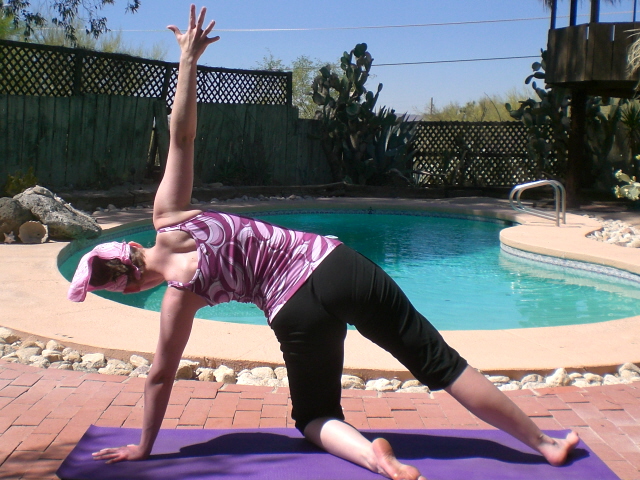
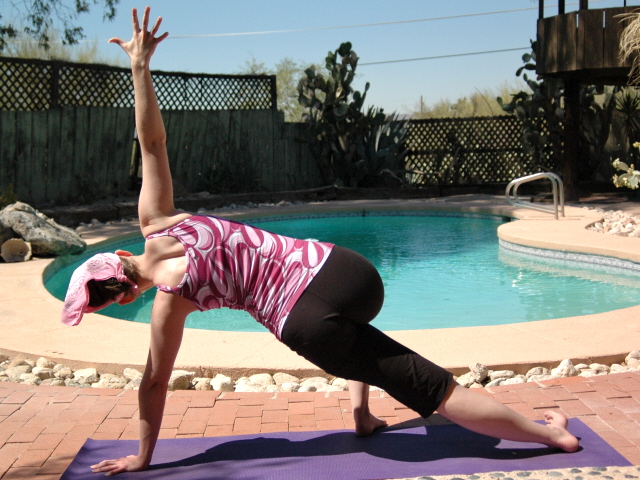
Side Plank - Back View, Unmodified
Side Plank - Back View, Knee DroppedSide Plank - Back View, Foot Planted
Pose Name:Side Plank

Sanskrit Name:

Vasisthasana

Steps:

  1. Begin in downward-facing dog. Shift your weight forward into plank pose.
  2. Place your left hand directly under your face.
  3. Rotate the left foot to press the outside edge of the foot against the floor, and stack the right foot on top of the left.
  4. If this version of the pose is too challenging, there are two variations you can try. Either variation will add stability to the pose.
    • You can drop the left knee to the ground and keep the right leg extended with the inside edge of the right foot on the floor.
    • You could also keep the left leg extended, but bend the right leg and plant the right foot on the floor in front of you.
  5. Once the feet are settled, open your body to the right and extend the right arm straight up overhead, supporting yourself just on the left hand and left foot (or variation as appropriate).
  6. Keep the body straight. Try to make the body one long straight line from the outside edge of the foot to the top of the head. Engage your core muscles to hold yourself up.
  7. Hold the pose and focus on your breath.
  8. To come out of the pose, drop both knees to the mat. Press back into either downward dog or child’s pose if you need a rest.
  9. Repeat the pose on the other side.

Benefits:

Side plank greatly strengthens the arms and core muscles. It’s also helpful for improving balance.

Counterindications:

Those with wrist problems may want to avoid this pose, as it places a lot of pressure on the wrist; working with dolphin pose and dolphin plank, or just resting in child’s pose, may be good alternatives for these students.

My Experience with Side Plank:

Side plank has been challenging for me for some of the same reasons that regular plank is challenging: I have to rely on my arm strength to hold me up. However, side plank is even worse because in this pose I have only two points of contact with the ground (one hand and one foot, instead of both hands and both feet). So in addition to putting pressure on my wrists and wracking my weak arm muscles, side plank requires me to balance precariously on an arm that I know to be untrustworthy. It’s no wonder that side plank is a constant struggle for me. When I try to practice the pose without dropping a knee, my arm shakes and I can rarely hold the pose for more than a few breaths. Even with dropping the knee, the pose requires a strong conscious effort to focus on my breath and keep my breathing slow and even.

With side plank, I don’t feel the disappointment and frustration that I feel when practicing regular plank. Regular plank seems like it should be achievable but stays just beyond my reach, while attaining a solid side plank is clearly pretty far down the road for me. It’ll be a long time before side plank will be a pose where I can find the line between challenge and ease.

Right now, side plank is all work. I try to practice the pose dynamically, dropping a leg down when I need to rest and raising it up again when I feel able. I learned a different modification at an anusara studio last summer – rather than dropping the bottom knee, now I can try bending the top leg and planting the foot out in front, which requires more work than having the knee down but still adds stability. Having a few different techniques for modifying the pose gives me more confidence that I can eventually conquer it.

Side Plank - Front View


Pewww I’m a Rocket Ship! May 28, 2011

Filed under: Miscellaneous,yoga — R. H. Ward @ 2:31 pm
Tags:

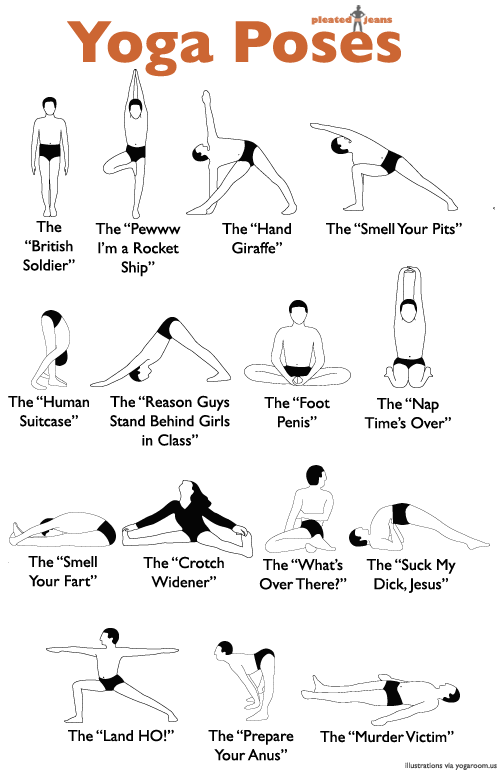
Here’s a hilarious and semi-offensive chart of yoga poses!

Names for Yoga Poses

Re-posted from graphjam.membase.com.


Hangover Sequence May 27, 2011

Filed under: yoga,yoga lifestyle — R. H. Ward @ 2:30 pm
Tags: , , , ,

In honor of the Memorial Day holiday weekend, I present you with a sequence of yoga poses designed to help with hangovers! (Or, if you prefer, to help with headache pain and remove toxins from the body.)

  • begin in child’s pose (briefly! and don’t just stay there!)
  • rabbit pose to start the warm-up
  • come up to all fours for some cat/dog tilt (also called cat/cow)
  • thread-the-needle side stretches
  • step forward and up to standing (yes, really, it will do you good)
  • 2 rounds of half sun salutes
  • 2 classic sun salutations (nice and slow now!)
  • standing sequence: warrior 1, warrior 2, radiant warrior, triangle pose, revolved triangle
  • standing sequence, other side
  • tree pose for balance
  • come to the floor for cobbler pose and paschimottanasana
  • marichyasana and janu sirsasana with a twist (these seated twists will wring the toxins out of your internal organs)
  • if time allows, take another seated twist (for example, adding a twist to a simple cross-legged pose)
  • inversion: legs-up-the-wall (no need to get complicated here, your head’s throbbing enough already)
  • sivasana (and maybe a nap)

I hope this sequence helps you have a terrific weekend! I’ll be trying it out on at least a few friends, so I’ll let you know how it goes!

If you’d like to read more about how yoga can help a hangover and learn why I chose these particular poses for this sequence, check out this article in the New York Times and this post at Elysium Yoga.