Rox Does Yoga

Yoga, Wellness, and Life

Pranayama: Diaphragmatic Breathing May 26, 2011

Filed under: breath — R. H. Ward @ 2:32 pm
Tags: ,

This will be the first in a series of posts describing the different pranayama breathing exercises I’ll be doing all month. First up is diaphragmatic breathing. This technique is just what it sounds like: breathing with your diaphragm.

Take in a deep breath, and let it out. Notice how your body had to work to breathe in, and how you relax as you exhale. This is natural: your lungs’ natural position is to be empty, so it doesn’t take any work to breathe out, but breathing in requires muscular work. If you aren’t paying attention to your breath, your body will do this automatically, but we want to bring some attention to how we breathe, notice any patterns or habits, and cultivate an awareness of how this system works. (After all, it’s what keeps you alive!) There are three main types of breathing: diaphragmatic breathing (which makes your belly pooge out), thoracic or chest breathing (which makes your ribcage expand), and clavicular or upper chest breathing (shallow breaths that make your upper chest and even shoulders move up and down).

The diaphragm is the muscle right under your lungs that helps you to breathe. When your lungs are empty, the diaphragm curves up into the natural space made by your ribcage; when you breathe in, the diaphragm flattens out as the lungs fill with air. By flattening the diaphragm, you draw air all the way down into the bottom of the lungs. This is a good thing! The lungs’ job is to oxygenate the blood, so that oxygen can be carried throughout the body. When we are sitting up or standing, gravity causes the blood to gather at the bottom of the lungs, so by using the diaphragm to pull air to the bottom of the lungs, the air can get the blood more easily and your lungs can do their job more efficiently.

Sit up straight and place one hand on your belly. Breathe in through your nose, concentrating on making your belly puff out. (No one’s watching, and you’re not wearing a bikini, so go ahead.) Don’t expand the ribcage, and don’t let your shoulders lift – just feel the belly puff out. Then breathe out, also through your nose, and feel the belly contract. If you exhale long enough, your belly might even go concave. Then breathe in and puff the belly out again. Do this a few more times until you get the feel of it. Then put your hand on your chest and do some shallow chest breathing: like a dog panting, or like you’re on the treadmill at the gym. Feel your chest go up and down; if you’re near a mirror, you can see this too. Do you feel the difference? You need a lot more of the shallow breaths to equal one long, slow diaphragmatic breath.

Next time, we’ll combine diaphragmatic breath with thoracic and clavicular/shallow breath to form (like Voltron) a three-part breath!

 

Teacher Training Weekend: Saturday Pranayama May 25, 2011

Filed under: breath,teacher training,yoga — R. H. Ward @ 6:45 pm
Tags: , , ,

This month at teacher training is Breath Month! At Saturday’s teacher training session, we started work on pranayama, which are breathing exercises designed to improve the flow of energy in the body. Life energy, or prana, is what enlivens all of us, what makes us alive. Prana courses through the body, giving us energy, helping our cells do their work, and healing any problems. Breath is the mechanism by which prana is able to move in the body, so by deepening the breath, we can increase the flow of prana, and by practicing other breathing exercises, we can affect our energy levels and our mood and even heal illness.

So far in teacher training, we’ve studied the yamas and niyamas (moral practices), and asana (physical postures), all of which I’m completely on board with. Now, though, we’re getting into the realm of New Agey stuff. I don’t know how much I buy into the prana thing, or the concept that by practicing certain breathing techniques we can heal illness. I know the body is capable of many miracles, and so I’m trying to keep my mind open.

I’ve started on this month’s reading in Science of Breath, and one thing so far has made a lot of sense. In chapter 1, the authors point out that breathing is a unique biological function: it’s involuntary, like heartbeat or digestion, so it will happen automatically no matter what, but unlike heartbeat or digestion, breathing is a function that we can also control if we choose. It’s the only involuntary function that we can control. Ancient yogis noticed that breathing is unique in this way and decided that, because breath is the only function that is both voluntary and involuntary, breath might be the link between the body and the mind and controlling it might be the key to controlling other bodily functions. That sort of makes sense to me: breath is already in a special category, so maybe it does other cool stuff too. More to come as I continue with this month’s homework (see below).

We also had teaching practice on Saturday afternoon. We formed one big class together and J tapped each person to teach a part of the class to the whole group, telling us which poses to teach. I was given sun salutations; I taught the classical version with lunges, which I hadn’t taught before, and I think I did well. It was interesting, as always, to see how my classmates teach and what they say versus what they don’t say.

Here’s our homework for this month:

  • Complete an ayurvedic profile, tally the score, and read the results about your body type
  • Read the book Science of Breath by Swami Rama
  • Start on the book Moola Bandha: The Master Key by Swami Buddhananda
  • Practice daily pranayama exercises: diaphragmatic breathing, three-part breathing, and alternate nostril breathing (I’ll define the types of breathing for you in a later post, but what we’re talking about here is ten minutes or so, ideally twice a day)
  • Keep a journal about the pranayama exercises, my reflections and observances; this will evolve into being my paper to hand in next month
  • Do two posture write-ups on standing poses (choose any two)
  • Suggested: recruit friends and family to be yoga guinea pigs and practice teaching

This feels like kind of a crap-ton of homework this month. Luckily, I’ll be on a train for a good 8-9 hours round trip this weekend, which should help with getting the reading done, and I’ll be traveling to visit with friends who are willing yoga guinea pigs.

I had been upset that last month was Asana Month because I was so busy last month and I wanted more time to actually be able to practice the poses, but I honestly think it worked out for the best: being busy, I had to complete the work when I could, and I couldn’t be a perfectionist about it. This month the homework is less active and more thoughtful, and I am almost as busy this month as I was last month, so I predict insanity to come.


Veg-Adventures: No Hot Dogs for Me May 24, 2011

Filed under: reflections,yoga lifestyle — R. H. Ward @ 1:02 pm
Tags:

I survived my first visit as a vegetarian to a hot dog joint. I was in Arizona for a wedding, and one of the wedding events was a trip to a Mexican hot dog place because the groom was dying for a “Sonora Dog”. (In retrospect, my whole AZ trip would have been less problematic and possibly more fun if I hadn’t converted to a meatless diet a few weeks earlier, but c’est la vie.)

This hot dog event actually wasn’t too bad for me – I’m a hot dog purist, so the Sonora Dog, covered with cheese and lord knows what all, didn’t really entice me. What was hard was not being able to participate in what the rest of my group was doing, the group experience of eating this particular food. I got two cheese quesadillas and heaped salsa on them. I found out later from the bride that I could have requested other filling inserts, like avocado and onions, but as it was, I ate what I ate and it was fine. I did get to drink horchata, which is one of my absolute favorite beverages, so that was great. Overall I focused on enjoying how happy my friends and family were to be eating this crazy food, because it makes me happy when the people I care about are happy.

The overall experience reminded me that there are just going to be times when, because of my choice not to eat meat, I’ll feel left out. That’s inevitable, but it’s also okay. Everybody feels left out sometimes. I made this choice for a reason, and a little discomfort doesn’t change that. I can appreciate my friends’ fun without resentment and without guilting them about it. And on future occasions, I can cook good food without meat and have friends over, or when it’s my turn to pick I can suggest vegetarian restaurants where we can all enjoy the meal.


Pose of the Month: Warrior 2 May 23, 2011

Filed under: Pose of the Month,yoga — R. H. Ward @ 12:07 pm
Tags: ,

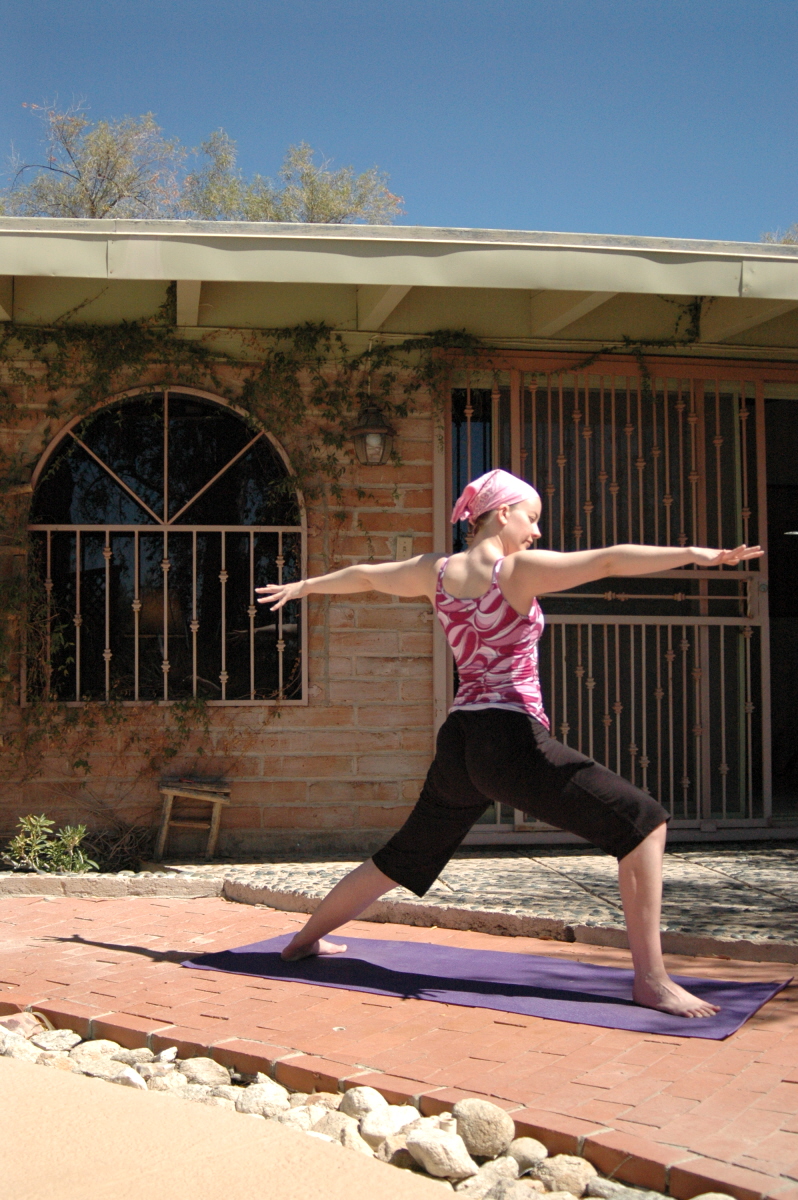
Warrior 2 - Back ViewPose Name:

Warrior 2

Sanskrit Name:

Virabhadrasana 2

Steps:

  1. Begin in mountain pose (tadasana).
  2. Step the right foot back and plant the heel. The distance between your feet should be about the length of one of your legs. Your left foot should face forward; your right foot should be at about a 45-degree angle.
  3. Open the hips to the right so that your body faces the right wall. Raise your arms to shoulder height, parallel to the floor (left arm forward over the left leg, right arm back over the right leg).
  4. Keep your right leg straight and bend the left knee deeply. Ideally, the left knee will form a 90-degree angle just above the left ankle. Don’t let the knee come out past the ankle!
  5. Turn your head to the left and gaze out over your left hand at an unmoving point in front of you.
  6. Keep the left leg in line with the body – don’t let the knee swing out to the side.
  7. Keep your spine straight and your torso centered over your hips. Press your weight not just into the front foot, but also into the outer edge of the back foot.
  8. Keep your breath slow, deep and even. Engage your abdominal muscles and focus on the breath.
  9. Come out of the pose by dropping your hands to the floor on either side of your left foot. Step the left foot back and into downward facing dog. Move through a vinyasa if you wish.
  10. Step the right foot forward to repeat the pose on the other side.

Benefits:

The warrior poses are excellent for building heat, strength, and stamina. Warrior 2 strengthens the thighs and the arms. It can relieve backaches and have a therapeutic effect for carpal tunnel syndrome.

Contraindications:

Contraindications include diarrhea and high blood pressure. Those with poor balance may want to practice this pose near a wall for extra stability.

My Experience of Warrior 2:

I like warrior 2 because it makes me feel strong. When I practice this pose, I feel balanced and rooted. It’s a pose that makes me feel confident and fierce like a warrior; confidence and fierceness aren’t exactly natural to my personality, so I love how warrior 2 brings these qualities out in me. Even on days when the pose is physically more challenging for me, it still inspires these positive feelings of strength, giving me the power to practice tapas and remain in the pose for longer. I like to practice warrior 2 in the mornings, especially on days when I have a big meeting or challenging project at work. Starting my day strong and fierce with warrior 2 helps give me energy and strength to last me through the day.

Warrior 2 - Front View

(Side note on the photos with this post: (1) I don’t know why my head’s tilted forward, but it shouldn’t be, I should be looking straight over my shoulder, and (2) my back leg actually is straight, I’m just curvaceous.)


Pose of the Month: High Lunge May 22, 2011

Filed under: Pose of the Month,yoga — R. H. Ward @ 8:04 am
Tags: ,

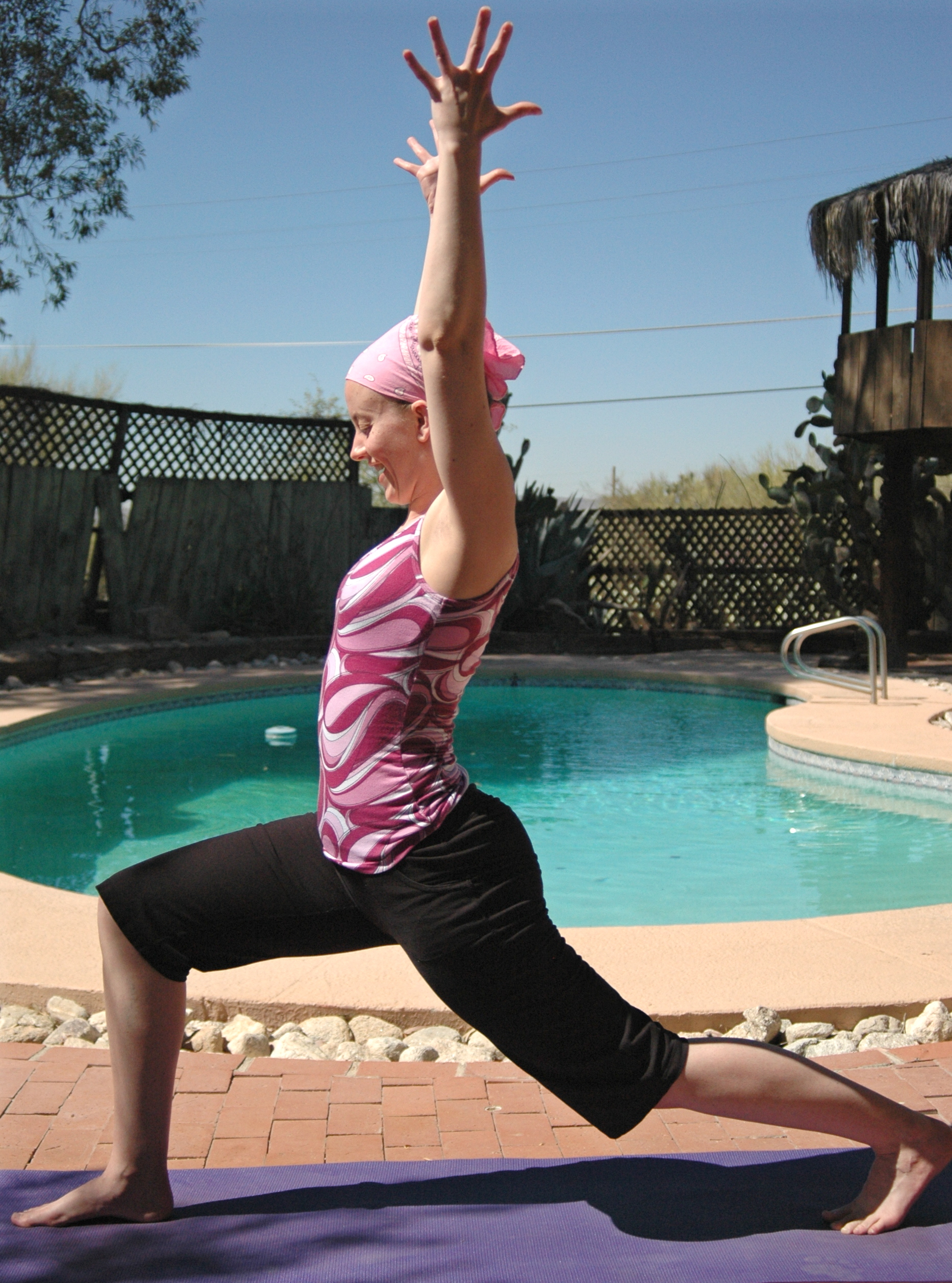
High Lunge - Side ViewPose Name:

High Lunge

Sanskrit Name:

No official Sanskrit name, but it’s sometimes called Ashva Sanchalanasana.

Steps:

(This pose is often practiced as part of a classic sun salutation series. For brevity, these instructions will start with downward-facing dog rather than go through the whole sun salutation.)

  1. Begin in downward-facing dog.
  2. Step the right foot forward and plant it between the hands. Keep the left leg high, left toes pressing down and left heel stretching toward the floor.
  3. Keeping the left leg straight and balanced, bend deeply into the right knee. Bring your hands to the knee and distribute your weight evenly between your front and back feet.
  4. Tuck the chin, keeping the neck long, and gaze at an unmoving point in front of you.
  5. Stay here, or if you feel steady, stretch the arms up straight overhead.
  6. Engage the abdominal muscles and breathe deeply and evenly.
  7. To come out of the pose, bring your hands down to the floor and step the right foot back to downward dog.
  8. Repeat on the other side.

Benefits:

Lunges improve balance, build heat in the body, and build strength in the legs, as well as in the arms when arms are extended. Balancing on the rear foot is good for the foot muscles.

Contraindications:

Those with balance problems may want to modify the pose – practice near a wall for stability, or drop the back knee down to the mat for a low lunge instead. Those with serious knee problems may want to avoid this pose. Those with neck injuries can try looking down at the floor instead of straight ahead.

My Experience with High Lunge:

Before coming to East Eagle Yoga, I rarely practiced lunges. The vinyasa-style yoga classes I attended in the past didn’t include lunges in sun salutations, and I almost never did them as part of my home practice. so when I first came to East Eagle, all the lunges were a huge issue for me: my thighs burned, my arms ached, I couldn’t keep my balance and I wobbled all over the place. Coming from a vinyasa-focused practice, I found it difficult to hold poses for a long time in the classical way, and this made lunges even more difficult. Classical sun salutations quickly became my least favorite part of hatha yoga classes at East Eagle.

I’m happy to say now that my experience with lunges is turning around. With continued practice, both at the yoga center and at home, my balance and stamina have improved tremendously. I’ve been able to find a level of comfort in just holding the pose, and now I’m able to push myself further and deepen into the pose. Having some sense of ease in lunges means that my mind can relax too; I can clear my mind better and focus more on the breath (rather than on the discomfort). Lunges still aren’t my favorite, but I can tell that I’m making progress!


Teacher Training Weekend: Friday Night Anatomy Class May 20, 2011

Filed under: reflections,teacher training,yoga — R. H. Ward @ 10:58 pm
Tags: , ,

Tonight was our May teacher training Friday night class, and I’m too excited to go to bed. Tonight we had an anatomy lesson with a special guest teacher, Jeanne, who is both a yoga teacher and a physical therapist with 20+ years of experience. She gave a talk about the anatomy of the spine and how it applies to yoga. Some of you might be thinking, “Anatomy lesson? On a Friday night?!”, but this may be the best thing that has happened during teacher training yet.

First, some background. My dad is in his 50s. He did hard physical labor all his life, and it took a toll on his body. He’s had knee problems, foot problems, and back problems, most recently resulting in two spinal surgeries in the past year, with another one possible on the horizon. He’s a bigger dude and thinks his weight might not be helping the problem, so since his last surgery he’s been trying hard to get in shape. He goes to the gym every day, does some aqua aerobics classes, swims some laps, puts in time on the stationary bike. This in spite of severe daily pain. I admire his dedication so much and I’m so proud of him.

Last month, Dad offered to be my beginner guinea pig so I could practice teaching, and asked me when I was going to come up and do yoga with him, but I put him off. I was too nervous – I didn’t want to hurt him by accident. My dad’s health is so close to my heart, I couldn’t stand it if I made his pain worse. My aunt and cousin, who are also beginners at yoga and who have a few health problems between them, have also been asking when I’m going to come teach them. Plus, at the middle school where my mother teaches, apparently the entire faculty want me to teach them a class too. The whole thought was just overwhelming.

Tonight at training, we started the evening by doing our group share. Most of us talked about the experience of doing the posture write-ups this month and what we learned, but one woman mentioned that she’d been really nervous about teaching beginner yoga classes, so she experimented on her mom and her husband, and learned a lot. Another classmate chimed in that she’d been teaching her husband too, and J told us that this is our gold, finding family and friends that we can practice teaching on. My first thought was, but how do I work with my dad when I’m afraid I’m going to break him?

And then Jeanne started her lecture. We learned about how the spine is constructed, how each spinal disc sits like a little jelly doughnut in the vertebrae. When you put pressure on the disc wall, it pooges out a little, and presses on the nerves coming out of the spine; depending on where in the spine the pressure is, this can cause pain in the arms or legs, because the nerves going to the extremities all originate in the spine. When you put more pressure on the disc wall, it cracks and the jelly oozes out, which really impinges on the nerves. And I’m having these revelations: this is what is going on in my father’s back! We talked about each section of the spine and the common problems that occur there, and what poses can be used to counter those problems. I’m taking notes like a madwoman and starting a list in the back of my notebook of poses that might work for my dad and poses that we should avoid doing. After class, I approached Jeanne, explained my situation and asked what she might recommend, and we had a good conversation and she gave me some ideas.

After class I felt so incredibly inspired and jazzed up that I tried to call my dad from the car on the way home, but I couldn’t get the speakerphone to work, so I drove home and then called from the parking lot. I had to tell him how excited I was. Now I can work with him without having to worry about hurting him. I’ll still be mindful, of course, and watch him carefully, and I want to see what exercises his physical therapist gave him so I don’t contradict anything, but now I know what to avoid (specifically: lengthy forward bends). I have a short list of poses that shouldn’t hurt his back and might possibly help a little, and when I see what his capacity is, we can go from there.

Having a little bit of confidence that I can try to help my dad gives me some confidence that I can try to work with other beginning students, too. (Apparently that was the key – kind of a weird key, but I’ll take it.) And just the whole night tonight! Jeanne is doing work that I’m really passionate about. She teaches yoga at a retirement center. That is exactly what I want to do. I really want to work with older people, help keep them healthy and flexible. It’s been a dream of mine for a long time now, but the thought of it is a little overwhelming because, well, older people are more fragile and have more health concerns to worry about. There’s so much more I need to learn before I can do it effectively and safely and helpfully. This lesson tonight is only the tip of the iceberg of all I need to know to do any part of what Jeanne does, but I have a little faith now that I have the capacity to understand this work and the enthusiasm to make it happen.

And I may never get to sleep tonight but it’s totally worth it.


Pose of the Month: Pigeon Pose

Filed under: Pose of the Month,yoga — R. H. Ward @ 2:10 pm
Tags: , ,

Pigeon Pose - FoldedPose Name:

Pigeon Pose (One-Legged King Pigeon)

Sanskrit Name:

Kapotanasana (or, more fully, Eka Pada Rajakapotasana)

Steps:

  1. Begin in downward-facing dog.
  2. Step the right foot up toward the hands, and lay the right leg on the mat: right knee behind right hand, right foot in behind left hand. The right heel should be in line with your left hip point.
  3. Lower your body down onto the floor. Straighten the left leg and lengthen it straight behind you; uncurl the left toes and press the top of the left foot into the floor.
  4. Bring your hands back alongside your hips. Pressing your hands into the floor, breathe in and rise up into a gentle backbend.
  5. Lengthen your spine. Make sure your weight is distributed evenly over both hips.
  6. Fold forward over the right leg. Keep your spine straight and don’t hunch your back. You can rest your hands or elbows on the floor in front of you. If you’re able to bend more deeply, rest your forearms on the floor. You can cross your arms and rest your forehead on your hands, or stretch your arms straight out and rest your forehead on the floor.
  7. Breathe slowly and deeply as you relax into the pose. Don’t push yourself – let gravity pull you deeper into the pose.
  8. Press palms into the floor and come out of the pose, pressing back into downward-facing dog. If you are able, curl your left toes under and press back while bringing your right leg straight up into one-legged dog.
  9. Repeat the pose on the other side.

Benefits:

Pigeon pose is a deep hip opener and stretches the thighs, groins, and psoas. Stretching the piriformis muscle can relieve sciatic pain.

Contraindications:

Those with hip or knee problems should practice this pose gently. Those with lower back problems may want to omit the backbend. Pregnant students should take care with any forward-bending pose.

My Experience of Pigeon Pose:

I love pigeon pose. It’s a pose that just feels good! I love the feeling of my hips opening in this pose. When I practice pigeon, I always feel I can just relax and enjoy the pose. My mind feels calm and relaxed in this pose. I also feel a sense of achievement that I can bend forward and rest comfortably in the pose.

Pigeon is also challenging – I’ve been working on the royal pigeon backbending variation, but my hips and low back aren’t quite open enough to move deeply into the backbend. I have a long way to go before I’ll be able to bring the back foot up to my head! I love that pigeon still has challenges in store and provides a deep stretch no matter what the level of the yoga student.


Pigeon Pose - Side


Veg-adventures: can my food touch your food? May 19, 2011

Filed under: reflections,yoga lifestyle — R. H. Ward @ 2:10 pm
Tags:

Last week F and I had a good conversation that clarified things for both of us about my meal choices. The inspiration was a pizza restaurant; the question, could I split a pizza with F if there were meat on his half. My automatic response was that I’d really prefer not to, so we got two separate pizzas and spent the meal talking it over. F thought that it’s a little extreme when vegetarians freak out over meat touching their food; your meal didn’t contribute to an animal’s death just by being near some meat. I explained that, for me, it’s not just about causing the animal’s death, it’s that I don’t want to take any part of that death into my body, so if prosciutto grease got on my side of the pizza, that would bother me. It was interesting to talk over the distinction between “I don’t want my choices to cause another creature’s suffering and death” and “I don’t want to consume any product created by a death”. F understands where I’m coming from a little better now and my choices make more sense to him, and I feel like I’ve clarified my views a little for myself.

We also talked about vegetarian behavior (for lack of a better word). F’s opinions had been formed after an experience he’d had at an Ethiopian restaurant with a group of friends. The server had placed several foods in the center of the table all on a big piece of bread for everyone to share, because that’s what they do at Ethiopian restaurants. It happened that some of the meat was touching some of the veggies, and two of his vegetarian friends got angry and stormed out of the restaurant. That’s a pretty extreme reaction, which explains why F had thought vegetarians were unreasonable on this topic – he had seen vegetarians acting in a pretty unreasonable way. I told him that in that situation I’d just take my scoop of cheese and chunk of bread from the side that wasn’t touching the meat, and moreover, I’d do so without saying anything about it. The different foods weren’t prepared together, so the whole meal isn’t contaminated just by the presence of the meat on the table, and I don’t see a reason to make a big deal of it (unless I specifically asked for separate dishes, or everything was all mixed up together).

Most of us know a “vegetarian saint” type of person: the guy who can’t get through a meal without mentioning his preferences 18 times, or the girl who acts all holier-than-thou about how your dinner killed a cow. Those people are really into being vegetarian, and that’s fine, but I just don’t see a need for all that. My diet choice is for myself; if my friends ask about it, I’m happy to share, but I go out for dinner with my friends to enjoy their company and have fun, not to proselytize. If you’re going to eat out in restaurants and share food with others, you have to kind of go with the flow, and that goes double for ethnic restaurants, where you’re dealing with someone else’s culture. I have the right to order and receive food I can eat, but I don’t need to talk about it all night or go overboard with expressing my needs.


Pose of the Month: Chair Pose May 18, 2011

Filed under: Pose of the Month,yoga — R. H. Ward @ 2:41 pm
Tags: ,

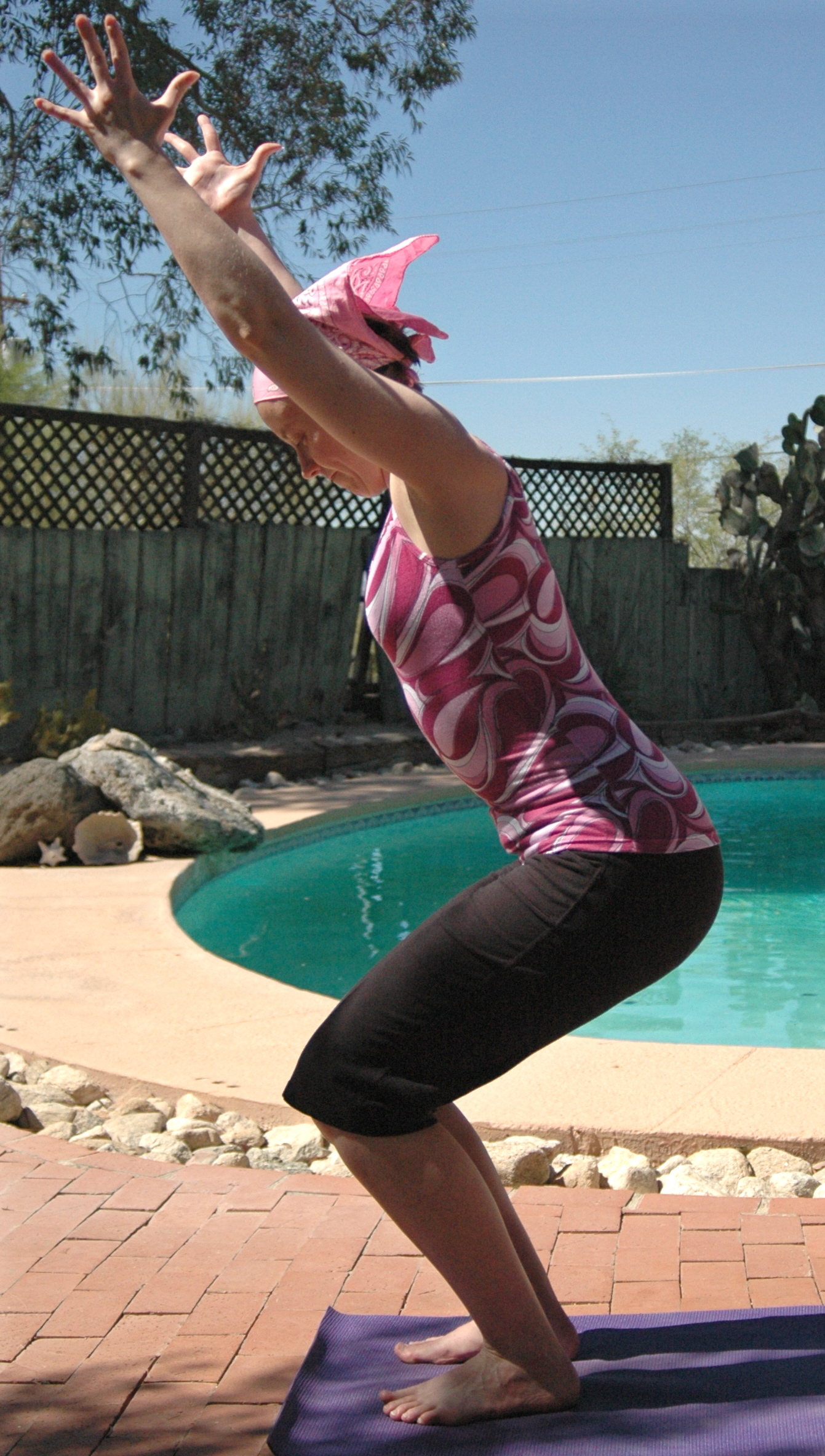
Chair PosePose Name:

Chair Pose (also known as Awkward Pose or Fierce Pose)

Sanskrit Name:

Utkatasana

Steps:

  1. Begin by standing in mountain pose (tadasana) with hands in prayer.
  2. Breathe in and reach the arms overhead. Either keep the arms parallel, palms facing inward, or press the palms together.
  3. Breathe out and bend the knees deeply so that it looks like you’re sitting on a chair. Try to bring the thighs to be parallel to the floor. Press your knees together and keep them facing straight forward – don’t allow them to fall out to the sides.
  4. Tuck your tailbone under (this protects your spine).
  5. Balance your weight evenly over your feet. You should be able to lift and flex your toes – if you’re pressing all your weight into your toes, redistribute!
  6. Tuck the chin slightly; roll the shoulders down the back; keep the spine straight (don’t hunch!). Engage abdominal muscles to help support you in the pose.
  7. Keep your breath steady and even! Bend your knees a little deeper and stretch the arms a little farther.
  8. To come out of the pose, breathe in and straighten the legs, rising up. Breathe out and bring the hands down to prayer in front of the heart.

Benefits:

Chair pose builds heat in the body and works and strengthens the legs, especially the thighs, as well as the extended arms. Chair pose can improve balance and is also good for the feet.

Contraindications:

Contraindications include headache, insomnia, and low blood pressure. Those with knee problems should take care to keep knees aligned properly in this pose to avoid injury.

My Experience in Chair Pose:

Chair is one of my least favorite poses to do. My thigh muscles always burn and it’s very uncomfortable to stay in the pose. In addition to the burning muscles, the pose also makes my ankles hurt. I almost always have these experiences of discomfort, even when I practice the pose regularly, which I find discouraging – it’s nicer when I can see myself improving, even if it’s just a little bit at a time. With chair pose, I often feel defeated before I even begin.

Of course, this pose is awkward to do and it feels awkward to hold. With so many things to remember in the pose, I find it difficult to relax or find any ease in the pose – it’s all work. I also worry that I’m missing something and not doing the pose correctly. In hatha yoga class, I’ll look around and it always seems as though everyone else is bending deeper than I am, and then I feel embarrassed.

I need to remember that it doesn’t matter how anyone else does the pose. Looking at other can inspire me to push myself further, which is good, but it shouldn’t make me feel badly about myself. If I can only bend a little bit that day, that’s okay. Also, I should keep in mind that I am tall, and, practically speaking, someone shorter is going to look as though they’re bending deeper in the pose, since the shorter person already has a head start, so to speak. If I’m looking at the tops of my classmates’ heads in chair pose, it doesn’t necessarily mean that the whole class does the pose better than I do. We all have different bodies and it doesn’t do any good to compare my chair pose with anyone else’s. What matters is staying focused on my own experience of the pose and practicing tapas to stay with the pose, continually working to improve.


Pose of the Month: Hero Pose May 17, 2011

Filed under: Pose of the Month,yoga — R. H. Ward @ 6:17 pm
Tags: , ,

Hero Pose - SeatedPose Name:

Hero Pose

Sanskrit Name:

Virasana / Supta Virasana

Steps:

  1. Begin by kneeling on the floor.
  2. Spread the feet just wide enough apart that your tush can fit between your heels. Keep the inner knees close together, and the tops of the feet flat on the floor. Try to bring your tush to rest on the floor.
  3. If your tush doesn’t hit the floor, just sit up straight and breathe into the pose. Don’t force your tush down – opening the hips is more important than getting down to the floor.
  4. If you feel discomfort in your knees, you can place a pillow or block under your bottom for support. If you feel discomfort in your feet, you can try rolling up the edges of your mat under your feet for more support.
  5. If you can sit in the pose comfortably with your bottom on the floor, you can begin to bend backward. Use your hands for support on the floor. Engage abdominal muscles to avoid overextending your back. If you’re flexible, you may be able to come down on your elbows or even flat on your back.
  6. Work on relaxing into the pose, remembering to breathe.
  7. Come back up to a seated kneeling position. Gently bring your legs around to a cross-legged position.

Benefits:

Hero pose works to stretch and open the knees, hips, and feet. The pose can improve digestion and relieve gas and the symptoms of menopause. The more advanced version adds a deep backbend, which is beneficial for spine health: when done properly, the pose can be helpful for sciatica and lower-back pain. Backbends are heart-opening poses, which decrease depression, improve functioning of the lungs, and improve posture.

Contraindications:

Contraindications include heart problems. Students with knee or ankle problems may want to modify or avoid this pose. Those with back problems should avoid the backbending variation.

My Experience of Hero Pose:

Hero pose has been a favorite of mine for a long time. I liked the challenge of the pose and the stretch through hips and thighs. Over the years it’s been exciting to make progress in this pose – being able to sit my tush on the floor, to increase the backbend I was capable of, and eventually to lie on the floor with my arms extended. It was very satisfying to finally find a sense of ease in this challenging pose, to be able to lie back comfortably and just enjoy the stretch without being limited by pain or pressure. However, with my current schedule, I’ve had less time for yoga, which has led me to focus the time I do have on standing poses and meditation. I began to practice hero pose less frequently, and so I lost some of that flexibility that allowed me to relax deeply into the pose. My knees started to bother me, and I’ve had to work more gently and thoughtfully with the pose than I used to. It’s become a goal of mine to regain that former flexibility and ease and to maintain it as I get older.

Hero Pose - Reclining Version