Rox Does Yoga

Yoga, Wellness, and Life

General guidelines for asana practice: comfortable and steady May 3, 2011

Filed under: breath,teacher training,yoga — R. H. Ward @ 7:19 am
Tags: , ,

N gave us a handout listing general guidelines for a yoga class:

  1. Start with a centering exercise
  2. Breathe in and out through the nose
  3. Engage diaphragmatic breathing (not shallow breathing)
  4. Do not hold the breath; let breath flow
  5. Practice on an empty stomach
  6. Wear loose-fitting comfortable clothing
  7. Always end practice with sivasana and meditation
  8. Stay present and focused on practice
  9. Make sure you are comfortable and steady in every posture
  10. Close the eyes if you are able, or focus on drishti (focal point)
  11. Have no expectations of your practice; remain detached
  12. Each posture has an attitude behind it: acceptance, surrender, balance, strength, heart-opening
  13. Each posture works with subtle body energy and chakras
  14. Time of practice and place of practice are important elements

Many of these are common-sense things or things I’d heard before, but there are a couple that were new to me. One of these is #9, “Make sure you are comfortable and steady in every posture”, which I’d never heard before coming to N & J’s classes. They’re not saying that you should feel as comfortable practicing yoga as you feel sitting on the couch. What they’re saying is that, even in a difficult pose, you should be able to feel comfortable and steady staying in the pose for a while, despite the fact that it’s difficult.

We all know that, when practicing yoga, you need to find a balance between actual pain and the strain of stretching in a new way. If a posture is causing actual pain, you need to get out of that posture or modify it so it doesn’t hurt. However, some strain is natural, the body’s way of letting us know that something is going on here. Feeling strain allows us to practice tapas and use that burning feeling in our arms or legs as fuel to become stronger.

Despite the strain and ache in our muscles, we need to find a way to feel steady in the posture. If we’re wobbling all over the place, we can’t find our balance, and our feet are slipping, then we’re not practicing the pose properly. The best thing to do is to come out of the pose a little bit: change your stance, bend a little less, modifying the pose until you feel steady. If you don’t feel steady, it’s a sign that your body isn’t ready for the most challenging modification, and maybe you should spend a little more time in the basic posture or a in gentler modification. If you feel steady in the posture, then you can allow your body to relax into it a little, and you can hold the posture comfortably for longer.

Similarly, N & J tell us to pay attention to the breath in a difficult pose. Is your breathing ragged and uneven? Are you panting like you just ran a marathon? Or are you holding the breath? Then it’s time to modify the posture. Hatha yoga class isn’t like kickboxing class – the point isn’t just to give the body a good workout. You want to be able to keep your breath deep and even and regular as you hold each pose. Let your breath guide you as you flow from one pose to another. There’s nothing wrong with modifying a pose to make it easier, or with taking a rest if you need one. Get your breath back to a nice even flow and focus on keeping it steady and even as you practice. It will make your practice stronger and you’ll feel better afterwards!

Are any points on the list of general guidelines unfamiliar to you? Do you see any surprises here?


Being zen May 2, 2011

Filed under: reflections,yoga lifestyle — R. H. Ward @ 2:59 pm
Tags: ,

I’ve been slow with blogging lately. My life has been crazy lately – and as J says, everyone’s life is crazy, life is always crazy, it’s never going to be less crazy – but in my defense, life also rarely drops an overnight out-of-state business trip, a leaking kitchen ceiling and flooded kitchen, and a freelance job into a week where I’m trying to buy a house, have opera tickets with my mom, and need to plan and pack for a major trip that will include my only sister’s wedding. All while keeping up my regular work schedule and trying to fit in yoga time. I’m usually busy, but this is a little much even for me.

In all of this activity, my attitude has been to take things one step at a time. In buying a house, we are doing our best to plan for the future, but we can’t possibly plan for everything that could happen. All we can do is to make the best plans we can, and then we just have to take the risk. It’s inevitable that we’ll overlook something or forget something, and there will be plenty of things that don’t go according to plan, but we can’t do anything about those things yet. We can’t even predict which things they might be. But if we stop moving forward because we’re afraid of what could happen, then we’re never going to get anywhere. We do our best to plan and prepare, and then we have to take the leap.

This weekend was stressful and demanding. I tried hard just to focus on where I was and doing what I could do in that moment. There were a lot of things that needed to get done that I could not do while sitting at an airport or on an airplane, so I had to let go of worrying about those things. F felt stressed about our finances and about taking such a big step in buying a house, but it wouldn’t do any good for me to get all worried too, so I focused on being calm and supportive when he needed it. Last night F told me I’d been really zen all weekend, and I was glad to hear it. So often I get worked up over these sorts of things, but this time I was able to approach all the upheaval with a sense of calm.

This week will also be stressful and demanding. There are only so many things that I can do. I will do my best to do those things as well as I can, and then let go of the rest. Sometimes all you can do is just sigh and throw another few towels on the wet kitchen floor.


Yoga teaching voice April 30, 2011

Filed under: reflections,teacher training,yoga,yoga lifestyle — R. H. Ward @ 7:50 pm
Tags: ,

As a writer in grad school, I really struggled with voice, trying to write poems that would stand out as MY poems. My thesis advisor would tell me how important it was for my poems to hang together as a cohesive group, with a voice to unify them; he said he wanted my poems to have a voice so strong that if someone dropped a pile of unattributed poems on his desk, he could pick mine out of the stack. At the time, I was 23. I had no idea really who I was as a poet, and was just beginning to figure out who I might be as a person, so when my advisor talked about voice it was hard really to understand what he meant. I didn’t have as much confidence as my classmates did, and that came through in the poems. In the years since then, I’ve made a lot of progress with developing my voice. The poems I’m writing now (or was writing, before teacher training started) have a much stronger voice, a voice that was influenced by many writers I admire but which is still definitively mine.

This teacher training weekend made me think about my voice as a yoga teacher. I don’t mean my speaking voice (although that’s important too), but who I am and what’s important to me as a teacher. I’ve been practicing yoga for over eight years, and I’ve taken classes with a lot of different yoga instructors, all of whom teach differently. The core poses are all the same, but every teacher is going to phrase things differently, is going to emphasize something different. My favorite teachers all live in my head somewhere: Gene in Boston, my friend Lucia, Jennifer Schelter, Adam and Lisie at Enso, now J & N, even the woman who taught my very first yoga class back in North Carolina. When I practice yoga, and even more when I try to teach a pose, I have their words in my mind to draw upon, but it does no good for me to just regurgitate another teacher’s class. That’s not helpful for me, and it’d be dead boring for the students. What I need to do is to synthesize the different voices I hear in my mind and add my own perspective – make my yoga my own. It doesn’t sound all that difficult, but practicing teaching this weekend, it was incredibly difficult! My classmates and I could all hear J’s voice in our mouths as we taught. Each of us needs to develop our own unique voice.

How? The only way to do it is practice, practice, practice. I need to dive deeper into my own yoga practice, not just doing poses but paying attention to each pose, noticing the little things I do to get my alignment right and figuring out how to tell those little things to someone else, how to describe those things in my own way. And I need to practice teaching. The same way I had to practice writing poetry to find my voice as a poet, or the same way that a student in a public speaking class needs to practice before giving a speech, I need to practice giving yoga instructions, practice hearing my voice in this new way, practice paying attention to what the students are doing and finding ways to guide and correct them. I’ll get a lot of this practice through the teacher training program, but still, I think F’s going to be getting a lot of yoga lectures for a while. This issue of voice is something I’d never really considered before, but it’s critically important to explore if I’m going to follow this path.


April Yoga Weekend: Friday night practice on sun salutations April 27, 2011

Filed under: teacher training,yoga — R. H. Ward @ 3:05 pm
Tags: , ,

On Friday night I found out that this month is… Asana Month! Last month was intensive study on the yamas and niyamas, and this month will be intensive study on poses. Really excited about this, but on the other hand, I do wish this month was something more bookish that could be easily done in a plane, train, or automobile. F and I have a LOT of travel going on in May, which will make time on the mat more difficult to come by. I predict much grumping and whining in my future (but then, that’s pretty much the norm).

After group sharing on Friday, N gave us a handout that covered general guidelines for asana practice (I’ll come back to this in a later post), guidelines for sequencing a yoga class, and notes on each type of yoga posture: sun salutations, backbends, standing postures, twists, etc. On Friday night, we went through sun salutations in detail, papers  and notebooks open next to our mats, practicing and taking notes and practicing some more. I felt so pumped up – yes, this is exactly what I want to be doing! It was really exciting, doing poses and talking through them and asking questions about nitpicky details of alignment.

I’ve been doing sun salutations for over eight years (longer if you count Paul and Caroline teaching me a sun salutation after our college production of Children of Eden). Sun salutations always follow the same basic format – reaching up, folding forward, stepping/jumping back, backbend, downward-facing dog, stepping up, and rising back up – but there are variations in how some teachers teach sun salutations. It seems like something so basic to most people’s yoga practice, but I’ve always wondered about those variations. (For those who aren’t familiar with sun salutations, here’s the Wikipedia page about sun salutations, and I’ve linked a few videos below.)

N & J recommend teaching the “classic” form of sun salutation for a beginner class. This form takes out some of the more difficult elements. Instead of jumping or hopping back, you step one leg back into a lunge, hold for a few breaths, then step the other foot back to plank position. You then lower gently down to the belly (rather than doing a chaturanga push up), and take Sphinx or Cobra pose (rather than upward-facing dog). Press back to down-dog as usual, then step one foot forward to do the lunge on the other side, before stepping both feet up to the hands and completing the sequence.

Other common variations are Sun Salutations A and B. In A, you step or jump both feet all the way back, skipping the lunge, and typically you do chaturanga and upward dog. Sun Salutation B starts with chair pose and also includes Warrior 1.  (Here are videos of an incredibly flexible guy doing Sun Salutation A and  Sun Salutation B.)

I’m more used to doing Sun Salutation A, so it was actually a little challenging for me when I started attending classes at this studio and doing the “classic” sun salutation. The lunges were really hard when I wasn’t used to them! Now, though, I can appreciate it more. In the past, doing A, I was used to moving on every inhale and exhale, while with the classic version, each pose can be held for a few breaths, which can allow for a deeper experience of the pose while still building heat in the body. I find that slowing my sun salutations down this way can also help me to improve my alignment in tiny ways, creating a better experience.

Friday night’s class was useful because we were able to analyze each step of the different Sun Salutation sequences, looking at every option and modification for each step. After having practiced yoga for many years, it was useful to look at this basic sequence from a beginner’s perspective, examining what could be challenging or painful, and seeing how the poses could be interpreted by beginners.


Yoga on a Monday April 26, 2011

Filed under: reflections,yoga — R. H. Ward @ 1:15 pm
Tags: ,

Yesterday, I felt a little sick, but took a tylenol and decided to go to yoga class anyway. I’m really glad I did, because it was the best practice I’d had in a while.

It was a small class – just seven of us, with J teaching. Three of us were more experienced yoga students; four were closer to beginners, and as I was practicing I reserved a corner of my mind to pay attention to how J gave the instructions for each pose, what he said or pointed out to help the less experienced students through the postures. I noted the little moments when J said something outside his usual wording, indicating that those words were a gentle nudge aimed at someone in particular. I was pleased that I remembered to start cultivating that awareness throughout the practice.

I did a little stretching before class started, and found that my legs were loose enough that I could press my forehead to my knees in paschimottanasana; that was my first clue that it was going to be a good practice. I felt strong all through the class. J had us do some poses, like Pigeon, that I hadn’t done in one of his classes before, and it felt good. My low and high lunges during sun salutations were nice and strong, and it occurred to me that just a month or two ago, the sun salutation lunges were killing me because I wasn’t used to them. During the standing poses, when I felt my thighs burning, I consciously whispered “tapas” to myself, lowered a little deeper into the pose, and lengthened my breath. I was able to straighten my right knee in Revolved Triangle (not my left knee, not quite, but I got closer than usual). We did Camel as our backbend, and it felt so good that afterward I lowered back into Hero pose and was able to comfortably get my tush on the floor. J saw me doing Hero (everyone else was doing Child’s pose) and gave me a tip about trying to pull my knees closer together to get a different stretch, so I tried that. At the end of class, I felt ready to do a headstand, which I hadn’t done in a while. I pulled my mat over to the wall, prepared myself, and was able to gracefully lift my legs straight up. J gave me some pointers on lifting my legs away from the wall, so I worked on that, and was able to hold my headstand a good long while.

I wish I could say that my sivasana was perfect and undistracted, but not really. (I can even tell you my train of thought: Hey, I haven’t seen Katrina in a while. I should call her next time I’m in Boston and we should go dancing, it seems like she goes dancing all the time from her Facebook page. I miss going dancing with Kris, too, she should come along, but I bet she’s busy planning her wedding. I’m glad Carlos came to MY wedding. I wish Bobbi and Jon had been able to come to my wedding too, or that I’d been able to go to theirs. I’m so happy they’re having a baby – Hey, sivasana here! My eyes keep flickering, I should get Sarah T to make me an eye pillow, I need to check her prices on etsy – Sivasana!) So yes, I felt some distractions, but I was able to (1) catch myself and come back to sivasana and my breath, and (2) follow my own train of thought. I feel like this is a little bit useful because at least I’m aware enough of the distraction to see where my thoughts are going and where they’ve been, and awareness is a good thing.

Overall, it was a really excellent practice, and afterward I felt relaxed and languid and peaceful and content. I wanted to remember this practice, to look back over it as something special. In the midst of everything going on in my life right now, all the stress I’ve been feeling lately, I needed this practice to remind me that I really love this thing, that there’s a reason I believe in this so much.


April Yoga Weekend: Friday’s group sharing April 25, 2011

Filed under: reflections,teacher training,yoga — R. H. Ward @ 2:19 pm
Tags: , ,

So, Friday night’s teacher training session began with group sharing. What did studying the yamas and niyamas bring up for each of us? We all also had the chance to practice teaching last month, and N & J wanted to see how we were feeling about that. It was really interesting, and also really reassuring, to hear how each of my classmates is doing with the workload. We’re all struggling in different ways, but studying the yamas and niyamas affected each of us. Also, we all have conflicted feelings about the difficulties of actual teaching, which I’ll get into more later.

My sharing moment was interesting. In response to another student, J gave us a speech about how we shouldn’t discuss what we’re doing and feeling in teacher training with people in our regular lives; he feels it’s best not to talk to others about your spiritual practice, because other people might misjudge or misunderstand and it could cause difficulty in your personal life. When he finished, I piped up with, “Well, actually, I started a blog!” I explained that I’m a writer and that’s how I process my experiences best, and that with the TT commitment I wouldn’t have much time to write, so I wanted to channel my writing energy into something that would be helpful for yoga. I described how useful the blog has been for exploring my feelings on the yamas and niyamas, and how committing to regular blog posts has forced me to examine events and emotions I might not otherwise have thought twice about. And I told everyone how wonderfully supportive all of you, dear readers, have been. J looked at me skeptically and said he hopes that works out for me. It was a little awkward, and not exactly how I had envisioned telling them about this project.

I do firmly believe that starting this blog was the right choice for me. I think best on the page, so writing everything out has been incredibly useful for processing all that I’m learning, and for keeping track of my progress. I think the blog is also a good choice for me professionally: I don’t have a lot of by-lines or articles to my name, so when I do want to freelance as a writer in the future, I’ll have this blog to use as an example of what I can do, and it may lead to more and better writing gigs. And finally, I’m really glad I started it because of all the feedback I’ve gotten from readers out there, who have found my words helpful or inspiring, and that really means a lot.

It’s interesting to me how the teacher training process has made me examine all my choices carefully, even choices that seemed easy or obvious, even choices that I’d thought carefully about before. I think too that I’m incredibly lucky in my friends and family and in the abundant support I’ve received. Not everyone is so lucky; becoming a yoga teacher isn’t as obvious a career or lifestyle choice as, say, becoming an accountant, and I’m sure there are many yoga teachers out there who met with difficulty or derision as they embarked on this path. The fact that writing a blog seemed such a natural choice for me possibly says less about me than it does about all of you, and about my parents, who may have loved for me to be a doctor, but who love more the person that I’ve become. They were nothing less than delighted when I told them I’d signed up for teacher training, because I’d wanted to do it for so long. At every new turn, they listen and do their best to understand, and they may think I’m crazy sometimes, but they also know how much thought and work I put into this decision, and they respect that and support my choices. (Not to mention my amazing husband, who is quite frequently too good to be true.) So I do think that I am lucky, incredibly lucky and blessed. If I feel able to write freely about myself and my experiences, that writing at least in part stems from all the support I’ve received, and I’m so very grateful for that.


Allergy and cold prevention April 22, 2011

Filed under: Miscellaneous,reflections,yoga lifestyle — R. H. Ward @ 4:47 pm
Tags: , ,

This has been a pretty slow blog week for me: I finished up all my reading last week, so this week I completed my homework assignments, which involved working backwards from my blog posts to create papers I can hand in. This was kind of challenging, as I’ve been generating an awful lot of content on here. I easily had over 10 single-spaced pages on the yamas and niyamas, and that was after I’d cut some stuff. I had to do a lot of work to edit that down to something reasonable for the assignment. So a lot of my blog energy went toward finishing the homework, and then it was nice to take a mental break from all the yoga. I still practiced this week and went to class, but I also read a romance novel and an Agatha Christie mystery, had a haircut, and went out for dinner with friends. It was nice to have some non-yoga energy to spend on the rest of my life, especially since this is a yoga weekend and I’ll be at the studio tonight and all day tomorrow.

In lieu of your regularly-scheduled yoga post, let’s talk allergies. Spring has come to the R & F household, and both of us have been itchy-eyed and sniffly all week. (We also live across the street from an arboretum, where all kinds of things are joyfully blooming and spewing pollen into the air, so perhaps allergy season hits us a little hard here.) When I get allergies, I’ve found that they’ll often develop into a cold, so in the interest of staying healthy, here are my tips for cold prevention:

  • The Neti pot. Seriously, it works. I got colds all the time last winter; this year, not one cold, and I chalk it up to the Neti pot. It’s like a little teapot. You fill it with warm water, then dissolve in a little packet of powder that turns the tap water into a salt water mixture. Then you lean over the sink and pour the water up your nose! It will flow in one nostril and out the other, cleaning all the gunk out of there. Clean out one nostril, and then switch sides. It sounds totally gross, but Swami Rama actually did advocate for nasal cleaning in The Royal Path (on page 51 in fact). Do this a couple times a week, or more often if you actually feel a cold coming on, and it will help. I hated it at first and now I’m a total addict. You can get a Neti pot in the pharmacy section of Target.
  • I also use Flonase spray. I got a prescription from my doctor because I’m one of those people whose nose just gets clogged up at night. I love the Flonase and use it every morning. Our bedroom gets really dry at night, so I also keep a saline nose spray by the bed so I can moisturize up there. (Now that I think about it, I’m kind of amazed at all the crap I pour in my nose, but it’s obviously working.)
  • For sore throats, try using oil of oregano. You can get this at a natural foods store. Drip 2-4 drops of the oil under your tongue, and hold it there for 30-60 seconds. It will burn. Practice tapas. Then swallow the oil – try to do it in such a way that it hits the sorest spot on your throat. This will also burn, and you will probably flail about making unpleasant noises, but for some reason it really works. Try to do the oil of oregano as soon as you feel even a hint of a sore throat.
  • If the sore throat sets in, give it a burst of vitamin C with cayenne pepper and orange juice! Yeah, you heard me. Fill a juice glass with OJ, and then sprinkle cayenne on top: enough to have a little cayenne lid floating on top of the juice. Then take it like a shot, so the peppered juice will hit your throat. It will burn. You don’t have to drink the whole glass of juice at once, but each sip should be taken in a gulp so the juice hits your throat. I learned this one from the daughter of hippies, and now I swear by it.
  • My eye doctor wrote me a prescription for Pataday eye drops. Put ’em in once a day and they really help with the itchy watery thing! I was never able to try allergy eye drops before because I wear contact lenses (and it’s a bad idea to drip medicine into your eyes while you’re wearing contacts – the medicine will cling to the lens and not get into your eye where you need it). However, the Pataday drops can be used first thing in the morning or even right before bed – you just have to allow 30 minutes before putting your contacts in, to allow your eyes to absorb the drops, and then you’re good to go all day.
  • You’ve probably heard this before, but local honey is supposed to be good for allergies, because the bees in your area are using all that pollen to make their honey, and, theoretically, consuming the pollen in honey can help you build up a resistance. So while you’re at the natural foods store looking for oil of oregano, pick up some local honey to help you ward off the sneezes.
 

Pose of the Month: Paschimottanasana (Seated Forward Bend) April 20, 2011

Filed under: Pose of the Month,yoga — R. H. Ward @ 8:21 pm
Tags: ,

Pose name:

Seated Forward Bend

Sanskrit name:

Paschimottanasana

Steps:

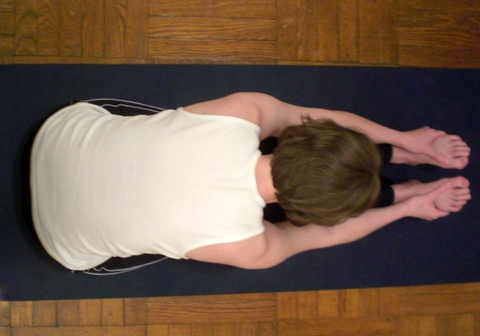
  1. Begin by sitting up straight with legs extended straight out in front of you.
  2. Raise your arms over your head and stretch up, then slowly fold forward over your legs.
  3. Let your hands fall naturally onto your legs – you don’t have to reach your feet.
  4. Relax into the pose: feel the stretch up the backs of your legs. Keep your feet flexed and active. Keep breathing as you surrender into the pose.
  5. To move deeper into the pose, try lengthening the spine on each inhale, and sinking deeper into the fold on each exhale.
  6. To come out of the pose, slowly slide the hands up the legs until you are sitting up straight again.

Benefits:

This pose stretches the hamstrings and calves, helping to lengthen and strengthen tight muscles, as well as the spine, arms, and shoulders. Forward bending can be beneficial for digestion and the internal organs. Forward bends also help to calm the mind and relieve stress.

Contraindications:

Students with back injuries should use caution. Pregnant students should take care in any forward bend.


Pose of the Month: Big Toe Pose, Gorilla Pose April 18, 2011

Filed under: Pose of the Month,yoga — R. H. Ward @ 9:38 pm
Tags: ,

Pose name:

Big Toe Pose (standing forward bend with toe lock), Gorilla Pose

Sanskrit name:

Padangusthasana, Padahastasana

Steps:

  1. Begin by standing in tadasana (mountain pose).
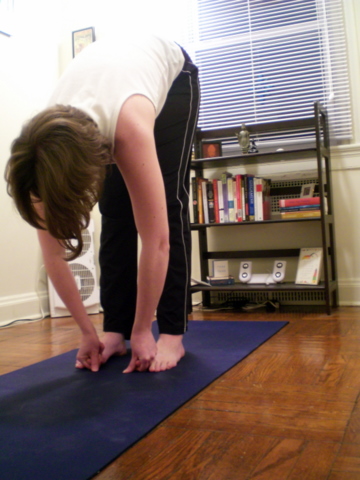
  2. Bend forward, hinging from the hips and keeping a flat back, until your hands can touch your feet. It’s okay to bend your knees if you need to.
  3. Wrap the thumb and first two fingers of each hand around your big toes and squeeze.
  4. Rise up until your elbows are straight; straighten your back, and feel your belly hollow out, as if your belly button were reaching back to touch your spine.
  5. Gently lower forward, gripping the toes and dropping the elbows out to the sides.
  6. If your legs aren’t straight or your hamstrings are tight, keep your front torso long and your back straight, and work on trying to straighten the legs; if your legs are straight, you can deepen into the pose and bring your head towards your knees.
  7. Hold the pose and breathe.
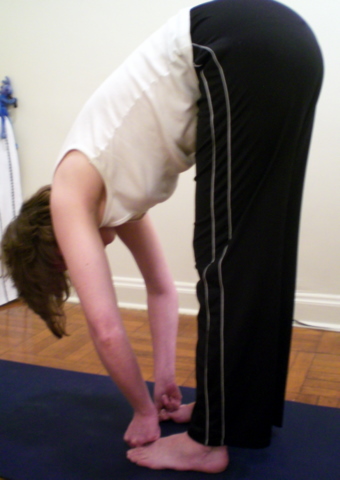
  8. Raise up a little, unhook your fingers, and slide your whole hand underneath your foot, so that each foot is palm-to-palm with each hand. It’s okay to bend your knees if you need to.
  9. Continue trying to straighten your legs, or, if your legs are straight, deepening into the pose.
  10. Hold the pose and breathe.
  11. To come out, release your hands and rest them on the floor for a moment until you feel stable. Bring your hands to your hips; come halfway up to straighten your back, and slowly lift back up to standing.
  12. Take a small backbend if it would feel good: bend back from the heart, not from the waist. Return to tadasana.

Benefits:

This pose stretches the hamstrings and calves, helping to lengthen and strengthen tight muscles. Forward bending can be beneficial for digestion and the internal organs. Forward bends also help to calm the mind. The Gorilla Pose variation can improve circulation in wrists and hands.

Contraindications:

Students with back injuries (particularly lower back injuries) should use caution. Pregnant students should take care in any forward bend. Those with low blood pressure should come out of this pose slowly and carefully to avoid getting dizzy.


Gilgamesh and the Yamas and Niyamas April 17, 2011

Filed under: books,reflections — R. H. Ward @ 6:25 pm
Tags: , , ,

Reading the yamas and niyamas this month, I was reminded of one of my favorite literary passages. Gilgamesh is an ancient epic poem, chronicling the adventures of a long-ago king. Badly shaken and grieving after the death of his best friend, Gilgamesh sets out on a journey in search of the secret to eternal life, but what he learns is that we can’t control life or the future. What he learns is to live the life he has as best he can. Here’s my favorite quote:

“Humans are born, they live, then they die,
this is the order that the gods have decreed.
But until the end comes, enjoy your life,
spend it in happiness, not despair.
Savor your food, make each of your days
a delight, bathe and anoint yourself,
wear bright clothes that are sparkling clean,
let music and dancing fill your house,
love the child who holds you by the hand,
and give your wife pleasure in your embrace.
That is the best way for a man to live.”
– Shiduri the tavern keeper, to Gilgamesh

I see the yamas and niyamas in every line here. If Gilgamesh follows Shiduri’s instructions, he’ll also be following the yamas and niyamas, and he’ll be a better man with a simpler, more joyful, more spiritual life. I love that this wisdom isn’t just in spiritual books like the Yoga Sutras but also in one of the earliest stories known in human culture. I love that this epic isn’t just about adventure and ass-kickery, but about coming home and finding the best way to live.