Rox Does Yoga

Yoga, Wellness, and Life

Thoughts from Last Night’s Class June 15, 2011

Filed under: reflections,yoga — R. H. Ward @ 7:06 pm
Tags: , , , ,

A few miscellaneous thoughts on last night’s yoga class:

  • N’s classes are a pretty amazing workout. I feel challenged in a completely different way than I do in J’s class. It’s kind of humbling, actually, because I think it’s not hard for me to get puffed up about my yoga practice, and N’s class brings me right back down to earth where I belong. It doesn’t matter how bendy or strong you are – what matters is the intention behind the practice – but really, I am not so bendy or strong as I think I am.
  • N’s class also serves to make me feel old. Last night, my back hurt, the backs of my knees hurt, my standing leg hurt all through the balance poses, and my arms hurt and wobbled all over the place. The arms are a strength thing, and clearly I’m working on that just by showing up, but the back and the knees could be age-related. N’s classes, while inspiring me to do more, work harder, and get stronger, also remind me to be careful, be mindful, and not hurt myself.
  • Speaking of the standing leg in balance poses, N had us do another balance sequence that kicked my butt again. I think the issue for me is that we’re going from balance poses where we bent forward (like ardha chandrasana) into balance poses where we’re upright (like crane and tree). Plus, putting that much pressure on the standing leg for several poses in a row without a break is really rough, and N doesn’t give us time to shake it out after we come down. (I say “without a break” but I gave myself several breaks last night, and it was still really tough.) This looks to be just one more area where I need to practice ahimsa and be gentle with myself.
  • When I find myself hurting in yoga class, or unable for whatever reason to keep up and do the pose as everyone else is doing it, I have a tendency to get angry. How long have we been holding this?!, I’ll think to myself, or Down-dog twist again? We’ve done it five times now! Last night it was really hard for me to practice tapas and work through the burn, and really hard to practice ahimsa and counter those negative thoughts with positive ones. Again, I have to turn my brain around and see this as an opportunity: a difficult yoga class is frustrating, but it’s going to make me stronger, and my negative thoughts are natural, but they give me a chance to practice some loving-kindness towards myself. If I need to rest, it’s okay to rest.
  • I hate ardha chandrasana. I really, really do. I’m practicing it more this month and I’m improving, but still. It is just Not Fun.
  • And speaking of Not Fun, someone near me in last night’s class was experiencing a gas problem. Now, I have nothing but sympathy for whoever it was – I’ve been that person before, we’ve all been that person – but it just makes the whole “deep even breathing” thing a little more difficult. Grabbing my lavender-filled eye pillow for savasana was a big relief, let me tell you.
 

Headstand Drama June 5, 2011

Filed under: yoga — R. H. Ward @ 3:34 pm
Tags: , , ,

Yesterday I went to the 10:30 morning yoga class. Class was good and I was feeling great until we got to inversions. I decided to do a headstand (which I rarely do at the yoga center, only when I’m feeling particularly strong and confident). I did my headstand, held for a few minutes, and came down, and then J came over to me. He explained that I had my elbows too wide in the headstand – the elbows shouldn’t be wider than the shoulders, so I should bring them in closer together. He also said I should bring my feet close together, as that would make it easier to balance. Then he told me to try it again.

I had some difficulty lifting back up into headstand – I’d already done it once and was a little tired. Also, the new arm position felt unnatural. J helped me lift my ankles. As soon as I was vertical in the pose, I knew it wasn’t right for me: I felt very uncomfortable and my neck really hurt, which is a major problem in a headstand. Thinking back now, I think that with the new arm position I wasn’t able to press strongly enough through my arms, putting all the pressure on my head and thus my neck. Either the new position made it physically difficult for me to press strongly, or I wasn’t confident enough with it to press strongly, but either way it was a problem. I wanted to come down out of the pose right away, but J was in front of me holding my ankles, so if I had dropped down I would have kicked him in the face. I panicked and didn’t say anything because I was afraid I’d (A) cry or (B) shout, so I just kept my mouth shut. I tried to press down through my arms to alleviate the pressure on my neck, but I don’t think it helped much, and I tried to follow J’s instructions about lifting my hips and keeping my feet together. I have no idea how I did with this. The base for my headstand was so uncertain and uncomfortable that I don’t know how well I held up at all. As soon as J moved aside, I dropped down. I tried to do a few neck stretches, but I was really shaken. Then it was time for sivasana.

I spent most of sivasana alternately being really angry and upset and trying to calm myself down. I felt angry foremost at J for making me do this modification that turned out to be so painful and so scary. But I knew I couldn’t be too angry with him – he’s a yoga teacher, not a mind reader. Also, he knows I’m an experienced student and should be able to trust me not to do something that hurts (while I on the other hand should be able to trust him not to hurt me, but this is a circular argument). I was angry most of all at myself for not being better able to respond to the situation. I know that I can have trouble with my neck in headstand and I could have been more careful; I could have told him I didn’t want to do the pose again; or I could have said something when it hurt, even if it resulted in me crying or shouting. Sticking it out through a tough pose is one thing, but when a pose actually causes pain, you’re supposed to come out of it or modify it right away. I felt angry that I let that situation happen, even though there didn’t seem to be anything else I could do at the time (short of kicking my teacher in the face).

I got myself mostly calmed down by the time we got to meditation. After class, I tried to wait to talk to J, but there was a new student in the class and he always likes to check in with new students after class. I used the rest room, and when I came back upstairs, everyone else was gone except J and the new student, who were talking in the back room, so I left too. I spent the afternoon with my parents and managed to put the bad feelings out of my mind.

I woke up this morning with a really, really sore neck. I still feel upset with J, and with myself. I think I do need to talk to him about this because I don’t want this to affect our working relationship (considering we’re stuck with each other until December) and plus he just deserves to know. Also, I want to talk about the pose itself and why he felt it necessary to modify my headstand in that way. Would keeping my elbows wide eventually lead to some other sort of injury? Right now I’m torn between wanting to practice playing with the new arm position in a safe way at home (after the current soreness heals, of course), wanting to ignore what he told me and keep doing it the old way, and wanting never to do a headstand again. Choosing the last option would mean giving in to the fear that I feel about the pose now, and that’s not a good idea. I also really, really don’t want to have to confront J. I could go to one of N’s classes instead this week but I feel like that would be avoiding the issue.

So, dear readers, what do you think? Tips on practicing headstand safely? Authoritative suggestions on correct arm positioning? Ideas on how to approach J?


Pose of the Month: Side Plank May 29, 2011

Filed under: Pose of the Month,yoga — R. H. Ward @ 6:45 pm
Tags: ,
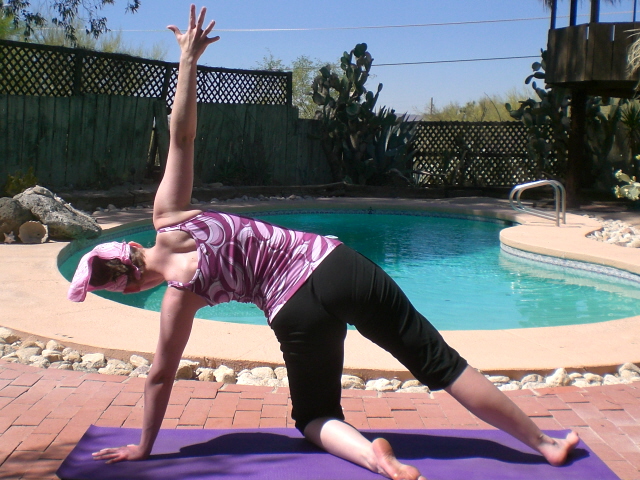
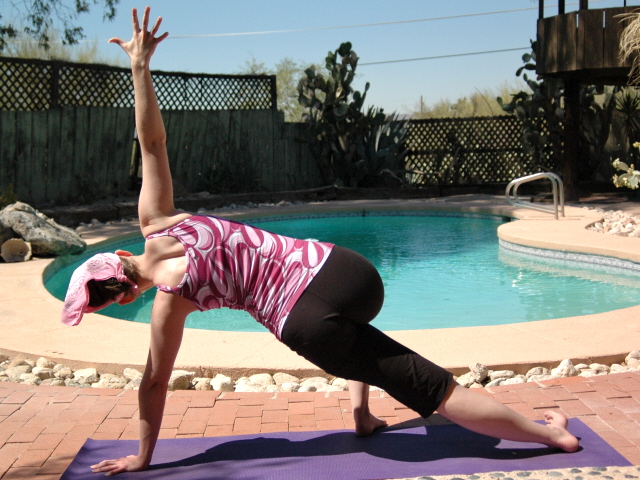
Side Plank - Back View, Unmodified
Side Plank - Back View, Knee DroppedSide Plank - Back View, Foot Planted
Pose Name:Side Plank

Sanskrit Name:

Vasisthasana

Steps:

  1. Begin in downward-facing dog. Shift your weight forward into plank pose.
  2. Place your left hand directly under your face.
  3. Rotate the left foot to press the outside edge of the foot against the floor, and stack the right foot on top of the left.
  4. If this version of the pose is too challenging, there are two variations you can try. Either variation will add stability to the pose.
    • You can drop the left knee to the ground and keep the right leg extended with the inside edge of the right foot on the floor.
    • You could also keep the left leg extended, but bend the right leg and plant the right foot on the floor in front of you.
  5. Once the feet are settled, open your body to the right and extend the right arm straight up overhead, supporting yourself just on the left hand and left foot (or variation as appropriate).
  6. Keep the body straight. Try to make the body one long straight line from the outside edge of the foot to the top of the head. Engage your core muscles to hold yourself up.
  7. Hold the pose and focus on your breath.
  8. To come out of the pose, drop both knees to the mat. Press back into either downward dog or child’s pose if you need a rest.
  9. Repeat the pose on the other side.

Benefits:

Side plank greatly strengthens the arms and core muscles. It’s also helpful for improving balance.

Counterindications:

Those with wrist problems may want to avoid this pose, as it places a lot of pressure on the wrist; working with dolphin pose and dolphin plank, or just resting in child’s pose, may be good alternatives for these students.

My Experience with Side Plank:

Side plank has been challenging for me for some of the same reasons that regular plank is challenging: I have to rely on my arm strength to hold me up. However, side plank is even worse because in this pose I have only two points of contact with the ground (one hand and one foot, instead of both hands and both feet). So in addition to putting pressure on my wrists and wracking my weak arm muscles, side plank requires me to balance precariously on an arm that I know to be untrustworthy. It’s no wonder that side plank is a constant struggle for me. When I try to practice the pose without dropping a knee, my arm shakes and I can rarely hold the pose for more than a few breaths. Even with dropping the knee, the pose requires a strong conscious effort to focus on my breath and keep my breathing slow and even.

With side plank, I don’t feel the disappointment and frustration that I feel when practicing regular plank. Regular plank seems like it should be achievable but stays just beyond my reach, while attaining a solid side plank is clearly pretty far down the road for me. It’ll be a long time before side plank will be a pose where I can find the line between challenge and ease.

Right now, side plank is all work. I try to practice the pose dynamically, dropping a leg down when I need to rest and raising it up again when I feel able. I learned a different modification at an anusara studio last summer – rather than dropping the bottom knee, now I can try bending the top leg and planting the foot out in front, which requires more work than having the knee down but still adds stability. Having a few different techniques for modifying the pose gives me more confidence that I can eventually conquer it.

Side Plank - Front View


Hangover Sequence May 27, 2011

Filed under: yoga,yoga lifestyle — R. H. Ward @ 2:30 pm
Tags: , , , ,

In honor of the Memorial Day holiday weekend, I present you with a sequence of yoga poses designed to help with hangovers! (Or, if you prefer, to help with headache pain and remove toxins from the body.)

  • begin in child’s pose (briefly! and don’t just stay there!)
  • rabbit pose to start the warm-up
  • come up to all fours for some cat/dog tilt (also called cat/cow)
  • thread-the-needle side stretches
  • step forward and up to standing (yes, really, it will do you good)
  • 2 rounds of half sun salutes
  • 2 classic sun salutations (nice and slow now!)
  • standing sequence: warrior 1, warrior 2, radiant warrior, triangle pose, revolved triangle
  • standing sequence, other side
  • tree pose for balance
  • come to the floor for cobbler pose and paschimottanasana
  • marichyasana and janu sirsasana with a twist (these seated twists will wring the toxins out of your internal organs)
  • if time allows, take another seated twist (for example, adding a twist to a simple cross-legged pose)
  • inversion: legs-up-the-wall (no need to get complicated here, your head’s throbbing enough already)
  • sivasana (and maybe a nap)

I hope this sequence helps you have a terrific weekend! I’ll be trying it out on at least a few friends, so I’ll let you know how it goes!

If you’d like to read more about how yoga can help a hangover and learn why I chose these particular poses for this sequence, check out this article in the New York Times and this post at Elysium Yoga.


Pose of the Month: Warrior 2 May 23, 2011

Filed under: Pose of the Month,yoga — R. H. Ward @ 12:07 pm
Tags: ,

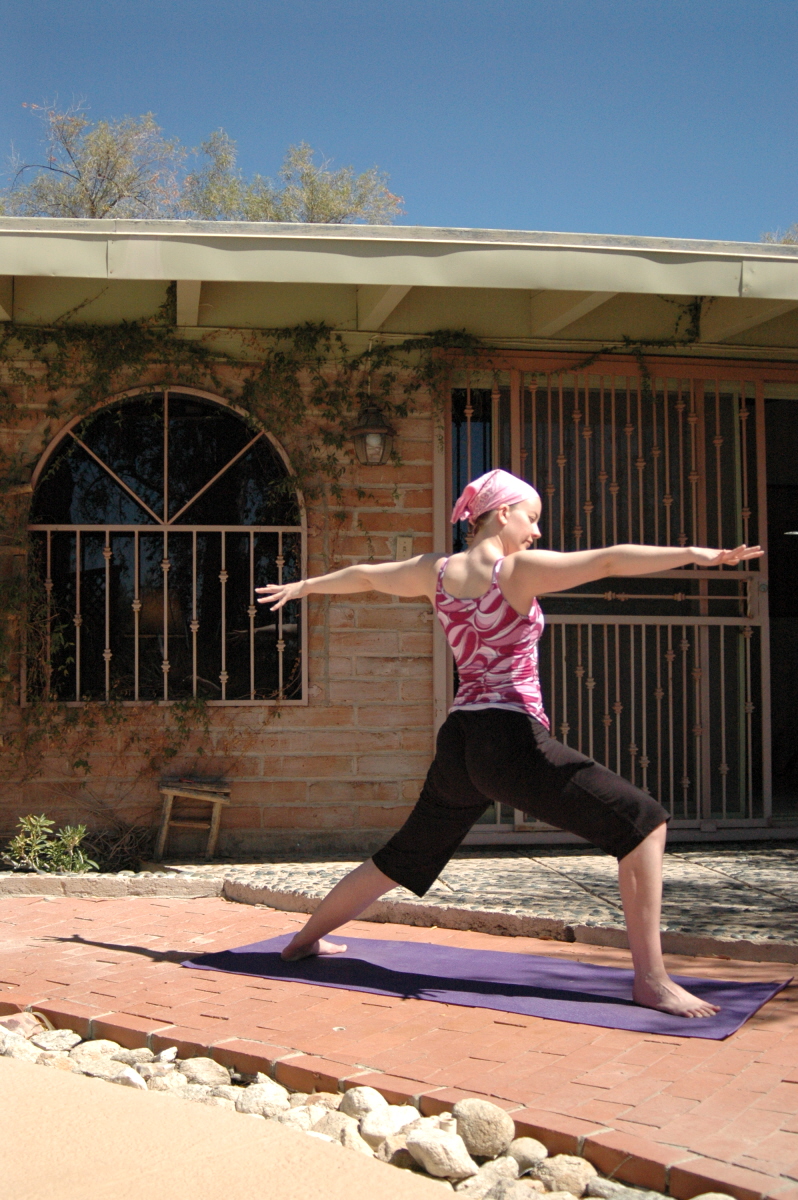
Warrior 2 - Back ViewPose Name:

Warrior 2

Sanskrit Name:

Virabhadrasana 2

Steps:

  1. Begin in mountain pose (tadasana).
  2. Step the right foot back and plant the heel. The distance between your feet should be about the length of one of your legs. Your left foot should face forward; your right foot should be at about a 45-degree angle.
  3. Open the hips to the right so that your body faces the right wall. Raise your arms to shoulder height, parallel to the floor (left arm forward over the left leg, right arm back over the right leg).
  4. Keep your right leg straight and bend the left knee deeply. Ideally, the left knee will form a 90-degree angle just above the left ankle. Don’t let the knee come out past the ankle!
  5. Turn your head to the left and gaze out over your left hand at an unmoving point in front of you.
  6. Keep the left leg in line with the body – don’t let the knee swing out to the side.
  7. Keep your spine straight and your torso centered over your hips. Press your weight not just into the front foot, but also into the outer edge of the back foot.
  8. Keep your breath slow, deep and even. Engage your abdominal muscles and focus on the breath.
  9. Come out of the pose by dropping your hands to the floor on either side of your left foot. Step the left foot back and into downward facing dog. Move through a vinyasa if you wish.
  10. Step the right foot forward to repeat the pose on the other side.

Benefits:

The warrior poses are excellent for building heat, strength, and stamina. Warrior 2 strengthens the thighs and the arms. It can relieve backaches and have a therapeutic effect for carpal tunnel syndrome.

Contraindications:

Contraindications include diarrhea and high blood pressure. Those with poor balance may want to practice this pose near a wall for extra stability.

My Experience of Warrior 2:

I like warrior 2 because it makes me feel strong. When I practice this pose, I feel balanced and rooted. It’s a pose that makes me feel confident and fierce like a warrior; confidence and fierceness aren’t exactly natural to my personality, so I love how warrior 2 brings these qualities out in me. Even on days when the pose is physically more challenging for me, it still inspires these positive feelings of strength, giving me the power to practice tapas and remain in the pose for longer. I like to practice warrior 2 in the mornings, especially on days when I have a big meeting or challenging project at work. Starting my day strong and fierce with warrior 2 helps give me energy and strength to last me through the day.

Warrior 2 - Front View

(Side note on the photos with this post: (1) I don’t know why my head’s tilted forward, but it shouldn’t be, I should be looking straight over my shoulder, and (2) my back leg actually is straight, I’m just curvaceous.)


Pose of the Month: High Lunge May 22, 2011

Filed under: Pose of the Month,yoga — R. H. Ward @ 8:04 am
Tags: ,

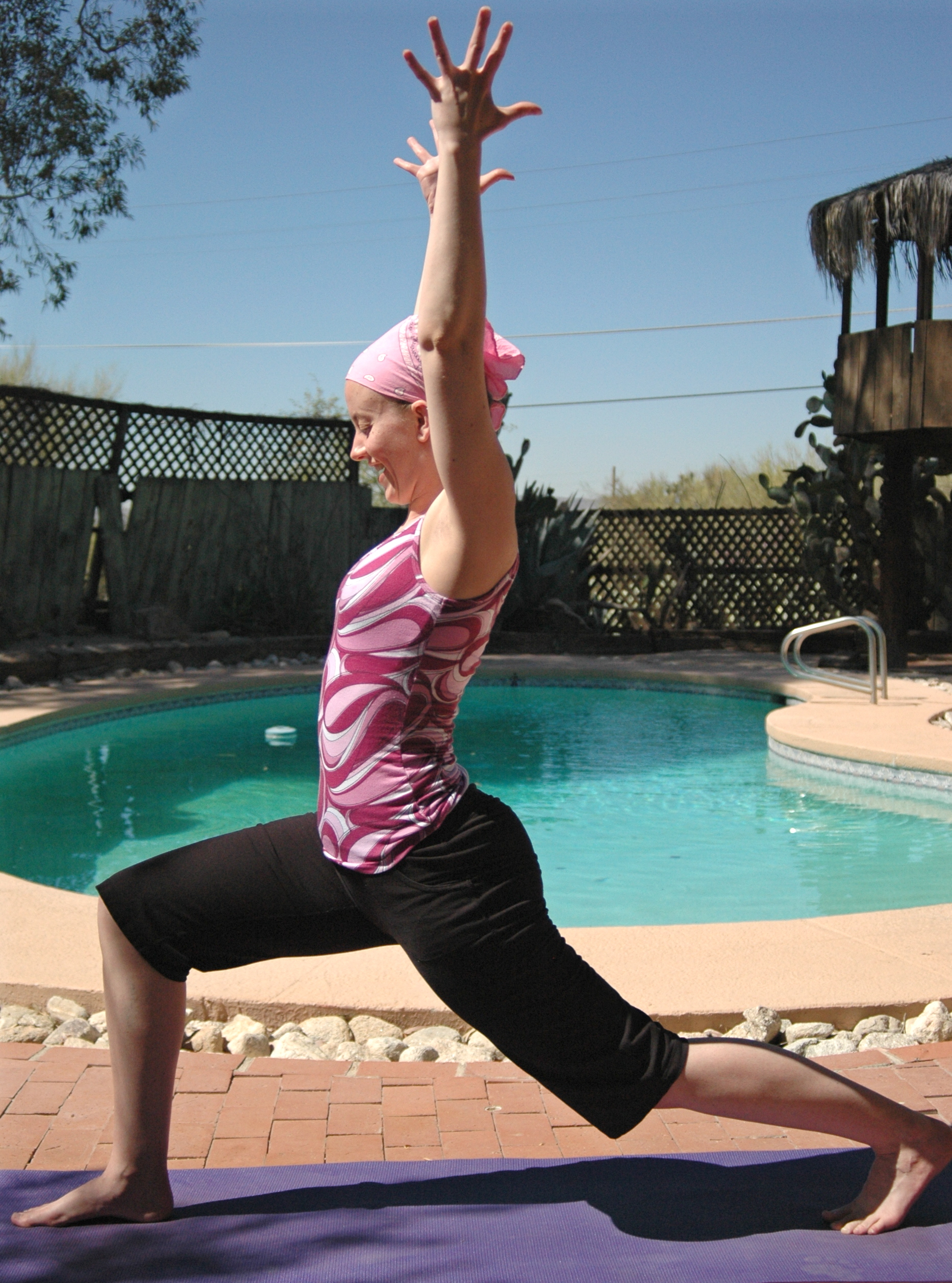
High Lunge - Side ViewPose Name:

High Lunge

Sanskrit Name:

No official Sanskrit name, but it’s sometimes called Ashva Sanchalanasana.

Steps:

(This pose is often practiced as part of a classic sun salutation series. For brevity, these instructions will start with downward-facing dog rather than go through the whole sun salutation.)

  1. Begin in downward-facing dog.
  2. Step the right foot forward and plant it between the hands. Keep the left leg high, left toes pressing down and left heel stretching toward the floor.
  3. Keeping the left leg straight and balanced, bend deeply into the right knee. Bring your hands to the knee and distribute your weight evenly between your front and back feet.
  4. Tuck the chin, keeping the neck long, and gaze at an unmoving point in front of you.
  5. Stay here, or if you feel steady, stretch the arms up straight overhead.
  6. Engage the abdominal muscles and breathe deeply and evenly.
  7. To come out of the pose, bring your hands down to the floor and step the right foot back to downward dog.
  8. Repeat on the other side.

Benefits:

Lunges improve balance, build heat in the body, and build strength in the legs, as well as in the arms when arms are extended. Balancing on the rear foot is good for the foot muscles.

Contraindications:

Those with balance problems may want to modify the pose – practice near a wall for stability, or drop the back knee down to the mat for a low lunge instead. Those with serious knee problems may want to avoid this pose. Those with neck injuries can try looking down at the floor instead of straight ahead.

My Experience with High Lunge:

Before coming to East Eagle Yoga, I rarely practiced lunges. The vinyasa-style yoga classes I attended in the past didn’t include lunges in sun salutations, and I almost never did them as part of my home practice. so when I first came to East Eagle, all the lunges were a huge issue for me: my thighs burned, my arms ached, I couldn’t keep my balance and I wobbled all over the place. Coming from a vinyasa-focused practice, I found it difficult to hold poses for a long time in the classical way, and this made lunges even more difficult. Classical sun salutations quickly became my least favorite part of hatha yoga classes at East Eagle.

I’m happy to say now that my experience with lunges is turning around. With continued practice, both at the yoga center and at home, my balance and stamina have improved tremendously. I’ve been able to find a level of comfort in just holding the pose, and now I’m able to push myself further and deepen into the pose. Having some sense of ease in lunges means that my mind can relax too; I can clear my mind better and focus more on the breath (rather than on the discomfort). Lunges still aren’t my favorite, but I can tell that I’m making progress!


Pose of the Month: Pigeon Pose May 20, 2011

Filed under: Pose of the Month,yoga — R. H. Ward @ 2:10 pm
Tags: , ,

Pigeon Pose - FoldedPose Name:

Pigeon Pose (One-Legged King Pigeon)

Sanskrit Name:

Kapotanasana (or, more fully, Eka Pada Rajakapotasana)

Steps:

  1. Begin in downward-facing dog.
  2. Step the right foot up toward the hands, and lay the right leg on the mat: right knee behind right hand, right foot in behind left hand. The right heel should be in line with your left hip point.
  3. Lower your body down onto the floor. Straighten the left leg and lengthen it straight behind you; uncurl the left toes and press the top of the left foot into the floor.
  4. Bring your hands back alongside your hips. Pressing your hands into the floor, breathe in and rise up into a gentle backbend.
  5. Lengthen your spine. Make sure your weight is distributed evenly over both hips.
  6. Fold forward over the right leg. Keep your spine straight and don’t hunch your back. You can rest your hands or elbows on the floor in front of you. If you’re able to bend more deeply, rest your forearms on the floor. You can cross your arms and rest your forehead on your hands, or stretch your arms straight out and rest your forehead on the floor.
  7. Breathe slowly and deeply as you relax into the pose. Don’t push yourself – let gravity pull you deeper into the pose.
  8. Press palms into the floor and come out of the pose, pressing back into downward-facing dog. If you are able, curl your left toes under and press back while bringing your right leg straight up into one-legged dog.
  9. Repeat the pose on the other side.

Benefits:

Pigeon pose is a deep hip opener and stretches the thighs, groins, and psoas. Stretching the piriformis muscle can relieve sciatic pain.

Contraindications:

Those with hip or knee problems should practice this pose gently. Those with lower back problems may want to omit the backbend. Pregnant students should take care with any forward-bending pose.

My Experience of Pigeon Pose:

I love pigeon pose. It’s a pose that just feels good! I love the feeling of my hips opening in this pose. When I practice pigeon, I always feel I can just relax and enjoy the pose. My mind feels calm and relaxed in this pose. I also feel a sense of achievement that I can bend forward and rest comfortably in the pose.

Pigeon is also challenging – I’ve been working on the royal pigeon backbending variation, but my hips and low back aren’t quite open enough to move deeply into the backbend. I have a long way to go before I’ll be able to bring the back foot up to my head! I love that pigeon still has challenges in store and provides a deep stretch no matter what the level of the yoga student.


Pigeon Pose - Side


Pose of the Month: Chair Pose May 18, 2011

Filed under: Pose of the Month,yoga — R. H. Ward @ 2:41 pm
Tags: ,

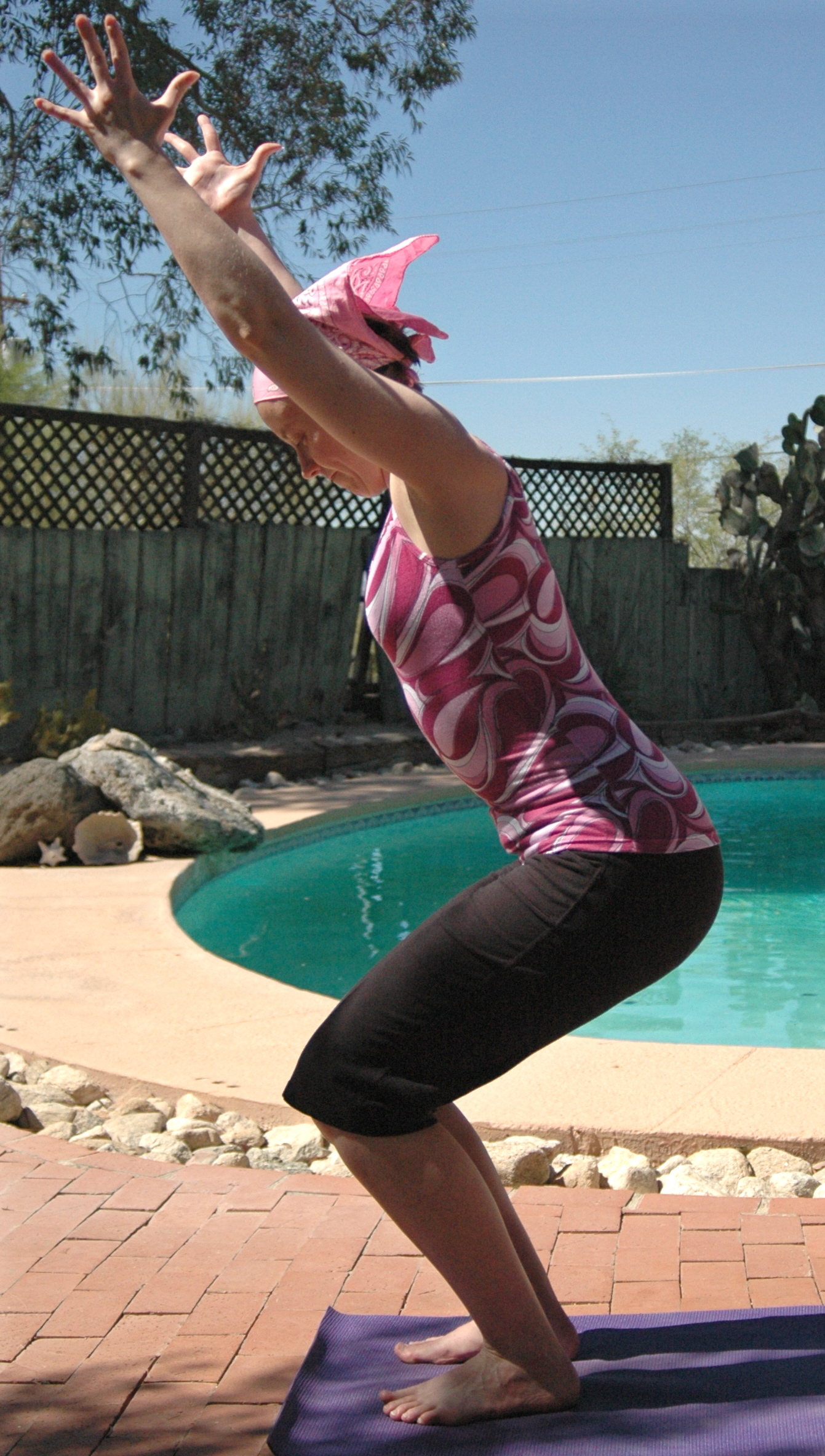
Chair PosePose Name:

Chair Pose (also known as Awkward Pose or Fierce Pose)

Sanskrit Name:

Utkatasana

Steps:

  1. Begin by standing in mountain pose (tadasana) with hands in prayer.
  2. Breathe in and reach the arms overhead. Either keep the arms parallel, palms facing inward, or press the palms together.
  3. Breathe out and bend the knees deeply so that it looks like you’re sitting on a chair. Try to bring the thighs to be parallel to the floor. Press your knees together and keep them facing straight forward – don’t allow them to fall out to the sides.
  4. Tuck your tailbone under (this protects your spine).
  5. Balance your weight evenly over your feet. You should be able to lift and flex your toes – if you’re pressing all your weight into your toes, redistribute!
  6. Tuck the chin slightly; roll the shoulders down the back; keep the spine straight (don’t hunch!). Engage abdominal muscles to help support you in the pose.
  7. Keep your breath steady and even! Bend your knees a little deeper and stretch the arms a little farther.
  8. To come out of the pose, breathe in and straighten the legs, rising up. Breathe out and bring the hands down to prayer in front of the heart.

Benefits:

Chair pose builds heat in the body and works and strengthens the legs, especially the thighs, as well as the extended arms. Chair pose can improve balance and is also good for the feet.

Contraindications:

Contraindications include headache, insomnia, and low blood pressure. Those with knee problems should take care to keep knees aligned properly in this pose to avoid injury.

My Experience in Chair Pose:

Chair is one of my least favorite poses to do. My thigh muscles always burn and it’s very uncomfortable to stay in the pose. In addition to the burning muscles, the pose also makes my ankles hurt. I almost always have these experiences of discomfort, even when I practice the pose regularly, which I find discouraging – it’s nicer when I can see myself improving, even if it’s just a little bit at a time. With chair pose, I often feel defeated before I even begin.

Of course, this pose is awkward to do and it feels awkward to hold. With so many things to remember in the pose, I find it difficult to relax or find any ease in the pose – it’s all work. I also worry that I’m missing something and not doing the pose correctly. In hatha yoga class, I’ll look around and it always seems as though everyone else is bending deeper than I am, and then I feel embarrassed.

I need to remember that it doesn’t matter how anyone else does the pose. Looking at other can inspire me to push myself further, which is good, but it shouldn’t make me feel badly about myself. If I can only bend a little bit that day, that’s okay. Also, I should keep in mind that I am tall, and, practically speaking, someone shorter is going to look as though they’re bending deeper in the pose, since the shorter person already has a head start, so to speak. If I’m looking at the tops of my classmates’ heads in chair pose, it doesn’t necessarily mean that the whole class does the pose better than I do. We all have different bodies and it doesn’t do any good to compare my chair pose with anyone else’s. What matters is staying focused on my own experience of the pose and practicing tapas to stay with the pose, continually working to improve.


Pose of the Month: Hero Pose May 17, 2011

Filed under: Pose of the Month,yoga — R. H. Ward @ 6:17 pm
Tags: , ,

Hero Pose - SeatedPose Name:

Hero Pose

Sanskrit Name:

Virasana / Supta Virasana

Steps:

  1. Begin by kneeling on the floor.
  2. Spread the feet just wide enough apart that your tush can fit between your heels. Keep the inner knees close together, and the tops of the feet flat on the floor. Try to bring your tush to rest on the floor.
  3. If your tush doesn’t hit the floor, just sit up straight and breathe into the pose. Don’t force your tush down – opening the hips is more important than getting down to the floor.
  4. If you feel discomfort in your knees, you can place a pillow or block under your bottom for support. If you feel discomfort in your feet, you can try rolling up the edges of your mat under your feet for more support.
  5. If you can sit in the pose comfortably with your bottom on the floor, you can begin to bend backward. Use your hands for support on the floor. Engage abdominal muscles to avoid overextending your back. If you’re flexible, you may be able to come down on your elbows or even flat on your back.
  6. Work on relaxing into the pose, remembering to breathe.
  7. Come back up to a seated kneeling position. Gently bring your legs around to a cross-legged position.

Benefits:

Hero pose works to stretch and open the knees, hips, and feet. The pose can improve digestion and relieve gas and the symptoms of menopause. The more advanced version adds a deep backbend, which is beneficial for spine health: when done properly, the pose can be helpful for sciatica and lower-back pain. Backbends are heart-opening poses, which decrease depression, improve functioning of the lungs, and improve posture.

Contraindications:

Contraindications include heart problems. Students with knee or ankle problems may want to modify or avoid this pose. Those with back problems should avoid the backbending variation.

My Experience of Hero Pose:

Hero pose has been a favorite of mine for a long time. I liked the challenge of the pose and the stretch through hips and thighs. Over the years it’s been exciting to make progress in this pose – being able to sit my tush on the floor, to increase the backbend I was capable of, and eventually to lie on the floor with my arms extended. It was very satisfying to finally find a sense of ease in this challenging pose, to be able to lie back comfortably and just enjoy the stretch without being limited by pain or pressure. However, with my current schedule, I’ve had less time for yoga, which has led me to focus the time I do have on standing poses and meditation. I began to practice hero pose less frequently, and so I lost some of that flexibility that allowed me to relax deeply into the pose. My knees started to bother me, and I’ve had to work more gently and thoughtfully with the pose than I used to. It’s become a goal of mine to regain that former flexibility and ease and to maintain it as I get older.

Hero Pose - Reclining Version


Beginners’ One-Hour Class Sequence May 16, 2011

Filed under: yoga — R. H. Ward @ 1:12 pm
Tags: , ,

The sequence below would be appropriate for a beginners’ one-hour class. I practiced and timed this sequence earlier this week. For most poses, I held the pose for a count of seven of my breaths (a beginning student would be likely to have shorter breaths than I do; my breath tends to be shorter than N’s or J’s, so they’d probably count each pose at five breaths to my seven, while a beginner might count eight or ten breaths, or just hang on until it’s over!).

  • child’s pose
  • rabbit pose
  • cat/dog tilt
  • side stretches
  • downward dog; transition to standing
  • half sun salutes X 4
  • class sun salutations with lunges X 2
  • mountain pose
  • vinyasa (transition to wide-leg standing poses)
  • warrior 1
  • warrior 2
  • radiant warrior
  • triangle pose
  • revolved triangle
  • head-to-knee pose
  • pigeon pose
  • one-legged downward dog
  • vinyasa
  • repeat wide-legged standing pose sequence (warrior 1 to pigeon) on the other side
  • vinyasa; transition back to mountain pose
  • tree pose
  • paschimottanasana (seated forward fold)
  • if time allows: cobbler pose
  • if time allows: seated twist
  • if time allows: camel or bridge
  • inversion: legs-up-the-wall or shoulderstand
  • fish pose
  • sivasana
  • brief meditation