Rox Does Yoga

Yoga, Wellness, and Life

Pose of the Month: Seated Cross-Legged Twist August 15, 2011

Filed under: Pose of the Month,yoga — R. H. Ward @ 2:06 pm
Tags: ,

Pose Name:

Seated Cross-Legged Twist

Sanskrit Name:

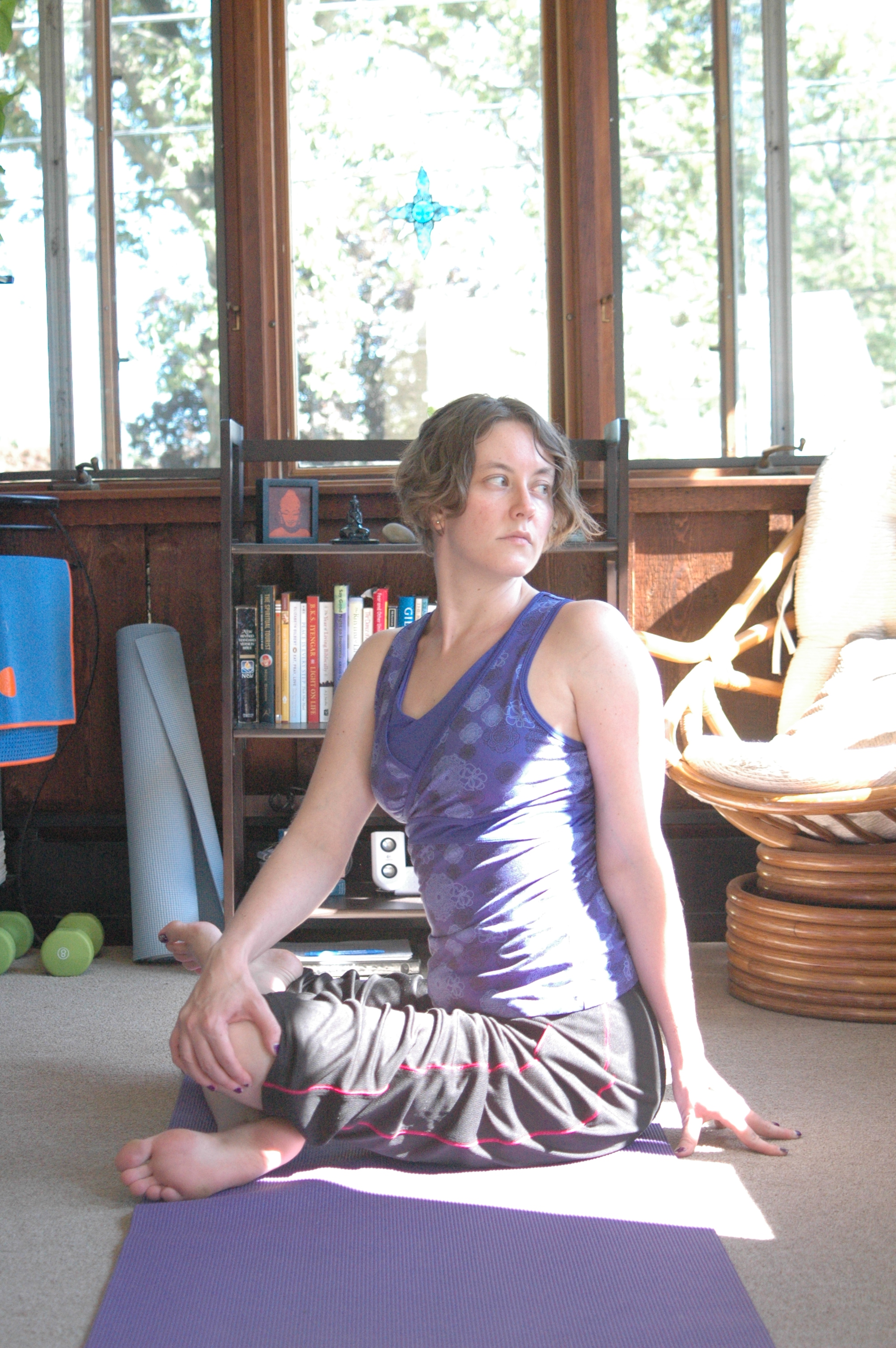
It’s possible to add a twist to Sukhasana (Easy Pose), Agnistambhasana (Fire Log Pose), or Padmasana (Lotus Pose), depending on the ability of the student.

Steps:

  1. Come to a comfortable cross-legged position. (Take Lotus Pose if you’re able, or stack your calves so the ankle of the top leg is directly above the knee of the bottom leg for Fire Log Pose, or simply sit comfortably in Easy Pose.)
  2. Sitting up straight, bring your right hand to your left knee.
  3. Keeping your spine straight, raise your left arm to shoulder height. Lift the arm up and overhead, then turn to drop it down behind you, placing the hand right next to your hip. (Placing the hand too far behind you will have you leaning over backward.)
  4. Turn and look over the left shoulder. Let your eyes rest on a point as far to the left as you can see. Your body will naturally follow your gaze and twist more deeply into the pose.
  5. Continue to breathe smoothly and evenly as you twist.
  6. Inhaling, look toward the front of the room, then lift your left hand and stretch the left arm overhead, reaching toward the front wall for a side stretch. Feel the stretch all down the left side. You may want to grip your right hand into your left knee for leverage to stretch further. Take a slow, deep breath.
  7. On an exhale, drop the left hand to the right knee, and then fold forward over your crossed arms. Breathe into your belly.
  8. Inhaling, release and come back up to seated. Change your legs and repeat the sequence on the other side.

Benefits:

Twisting poses compress the internal organs, releasing toxins and cleansing the body. Twists are beneficial for abdominal health. This pose also incorporates a side stretch that opens the chest and a forward fold which further works the abdomen.

Contraindications:

This pose is contraindicated for students with serious back/spine injuries. Pregnant students should be cautious with any twist and with folds.

My Experience with Seated Cross-Legged Twist:

I first learned this little twisting sequence from a teacher at Yoga on Main in Manayunk and I practice it frequently. I like how it combines a twist with a side stretch and a forward fold, neatly and economically stretching a variety of muscles. I appreciate the simplicity of the leg position that makes the pose accessible to students at any level. My mind stays engaged as I move through the variations, and I find the forward fold at the end gives a feeling of completion.


Seated Cross-Legged Twist 2

Seated Cross-Legged Twist 1


10 Signs Your Yoga Teacher Has a Hangover August 12, 2011

Filed under: yoga — R. H. Ward @ 2:47 pm
Tags: ,

Here’s some yoga humor for your Friday: Ten Signs Your Yoga Teacher Has a Hangover.


Yoga in the News: It’s good for fibromyalgia and orthopedic problems! August 11, 2011

Filed under: yoga,yoga lifestyle — R. H. Ward @ 1:49 pm
Tags: , , ,

Here’s some good news: Yoga Beneficial for Fibromyalgia. Women with fibromyalgia have lower-than-average cortisol levels, which contribute to pain, fatigue and stress sensitivity, but after doing hatha yoga twice a week for eight weeks, the women participating in the study had higher levels of cortisol. They reported that they suffered less from pain and other symptoms after practicing yoga, and further, they experienced psychological benefits: feeling stronger, more accepting, and less overwhelmed by their condition.

And more good news: Yoga Therapy May Help Prevent and Treat Orthopedic Problems. From the article, “Dr. Fishman, a lifelong devotee of yoga who studied it for three years in India before going to medical school, uses various yoga positions to help prevent, treat, and he says, halt and often reverse conditions like shoulder injuries, osteoporosis, osteoarthritis and scoliosis.” The article goes on to describe how a modified yoga headstand can be used to treat painful rotator cuff injuries without expensive surgery or lengthy physical therapy and without recurrence of pain. Dr. Fishman also did a study on yoga for bone disease and found that the patients with osteoporosis who practiced yoga daily for two years had increased bone density.


The Gunas August 10, 2011

Filed under: bhagavad gita,yoga philosophy — R. H. Ward @ 1:42 pm
Tags:

Throughout the Bhagavad Gita, Krishna talks about three gunas and the effects they have on each individual. The word “guna” means “strand” or “quality”; the gunas are qualities that influence and control our actions and even our personalities. Having a working understanding of the three gunas – sattva, rajas, and tamas – can help us to better understand ourselves, our motivations, and our spiritual path.

The first and highest of the gunas, sattva, denotes peacefulness, calm, contentment, and balance. Ideally, after meditation or after yoga asana practice, you’ll be feeling sattvic: the goal of these practices is to bring about a sattvic state. Sattvic foods include fresh fruits and vegetables, whole grains, nuts, beans, and seeds, dairy products, and sweet spices like cinnamon or cardamom.

The second guna, rajas, denotes activity, energy, sensuality, desires, attachments, and enjoyments. Being in a rajasic state can be good for getting a lot done at the office because you’re full of energy and drive. Feeling rajasic can be pleasant, but to make progress on our spiritual path, we need to strive for a sattvic state. Rajasic foods include caffeine, meats, heavy foods, and very spicy foods. From an ayurvedic standpoint, the vata dosha is most rajasic.

The final guna is tamas, which denotes laziness, lethargy, confusion, and ignorance. We all feel tamasic sometimes, but it’s not a state anyone really wants to be in. Tamasic foods include fast foods, old or leftover foods, canned or boxed foods, and foods with lots of preservatives. In ayurveda, kapha is the most tamasic dosha – spicy rajasic foods can help to get kaphas moving!

The three gunas act together to influence our thoughts, words, and actions. In understanding the gunas, we can come to understand our motivations and why we do what we do. Try using the gunas as a system of measuring your mental state. The gunas fluctuate depending on each person and each day, but at any given time one guna is dominant over the others. Which guna is affecting you most right now?

As yogis, when we’re aware of the gunas, we can use that knowledge and our discrimination to make choices that will lead us to a sattvic state. When you first wake up in the morning, you may feel sleepy and tamasic, so what do you do to get yourself moving? If you have six cups of coffee, that will lead to a rajasic state; if instead you do your yoga practice followed by a healthy breakfast, that’s more likely to lead to a sattvic state. (And if you roll over and go back to sleep, you’re giving in to the tamas and you won’t get anything done!) Paying attention to our moods, and to the effect our choices have on our moods, will lead us to make healthier choices, choices that make us happier.

As a yoga teacher, it’s important to be aware of the gunas too. The purpose of yoga class is to bring the students to a sattvic state. This is why most yoga classes begin with a series of active rajasic poses, then lead students to more calming poses and finally to relax in savasana. If the yoga teacher is aware of the gunas, she’ll be careful to preserve the sattvic state of her students at the end of class: talking in a soft voice, making slow movements, and turning the lights up gradually. Loud voices, bright lights, and being rushed out of the room can spoil that yoga high!


So You Want to Try Yoga, Part 3: Tips for Your First Class August 9, 2011

Filed under: yoga — R. H. Ward @ 1:20 pm
Tags: ,

Inspired by this article on how to find the right yoga instructor, I started writing some tips for those new to yoga. Parts 1 and 2 covered deciding what you’re looking for in a yoga class and how to find a class in your area. Now we’ll talk about some tips for your first yoga class.

It’s hard to know what to expect when you’re doing something new for the first time. Once you’ve identified a yoga class you’d like to attend, it’s a good idea to find out as much as you can in advance – this will help you to feel more comfortable on the day of the class. Do you have friends or colleagues who go to classes at this gym or studio? Pump them for information. Does the yoga studio, gym, or yoga teacher have a website? Check it out. Find the phone number and call for more info.

Here are some frequently asked questions about yoga classes. In general, the answers to these questions are applicable to most yoga classes, but it’s always good to confirm with your particular instructor! If the info isn’t on the website, call to double-check.

  • Do I need to bring my own yoga mat?

You don’t need a yoga mat – often the gym or studio will have mats you can borrow or rent for a small fee, and if they don’t, you can use a towel or try practicing right on the floor. Some studios may require that you use a mat, for both cleanliness and liability reasons (i.e., it’s easier to slip and fall on a hard wood floor if you don’t have a mat), so check your location’s policy.

When thinking about the mat question, consider whether you have knee or joint problems that make sitting on a hard floor difficult for you, or if you sweat a lot, or if you have cleanliness concerns (“Put my feet on a mat that other people’s feet have been on? Ew!”). If you want your own mat, you can get one very affordably. Target and Walmart carry yoga mats, and I’ve even seen them at stores like Five Below or the “under ten dollars” store. Extra-tall, extra-wide, and extra-thick mats are available to be ordered online if something like that appeals to you, but you don’t need a fancy mat when you’re just starting out – you can find something serviceable for under $20, no problem. But if you want to wait until you try the class before investing in any equipment, check with the studio to see if you can borrow or rent one there.

  • Do I need to bring anything else?

A bottle of water is always a good idea! Also, not a bad plan to bring a small towel, especially if you’re trying a hot room or athletic-style class, or if you know you sweat a lot. If you’re renting or borrowing a mat, you may want to consider bringing a full-size towel for cleanliness reasons – you can lay the towel over the mat so that the mat will cushion and support you without you actually putting your feet right on it. Also consider: ponytail holders, headbands, and bandannas, to keep your hair out of your face. Some people don’t seem to have an issue with this, but having hair in my eyes drives me nuts.

  • What sort of clothes do I need to wear?

For clothing, wear something comfortable that you can move around in. Some people prefer baggy shirts and shorts; I tend to prefer close-fitting and stretchy. Keep in mind that you may be upside down sometimes, so tuck your shirt in and make sure whatever’s under your shorts covers you adequately so none of your bits fall out. Pants or sweatpants are usually fine, but you probably want shorts for a hot room type class. Also, you don’t want to be overly distracted by your clothing – this isn’t the time to wear that one sports bra you have to adjust fourteen times throughout your workout (or the sports bra you fall out of!). Use your common sense and be comfortable.

Clothing to avoid: anything itchy, and anything restrictive that limits your movement. Jeans are a bad idea for yoga class (trust me, I know!). You may also want to avoid wearing clunky jewelry  – that necklace won’t seem so pretty when it smacks you in the face during downward dog, and big rings can cut into your hands. I usually just wear stud earrings and my wedding band.

Be aware too that yoga is typically done barefoot. Many first-timers don’t know this and get upset when they’re asked to remove their sneakers. Remember that this isn’t aerobics class or a treadmill – in yoga class, you need to be able to move, bend, and flex your feet. Also, the etiquette is different here than at a gym: many yoga studios ask you to leave your shoes at the door to help keep their floors clean. If you are truly uncomfortable having your feet out and proud, you can try practicing in socks, but bare feet will stick better to your yoga mat than socked feet will, and if you don’t have a mat, you will slide around a lot more on a hardwood floor in socks. It can be a big distraction. Be aware in advance that you’ll be asked to bare your toesies, and get used to the idea so you won’t be blindsided with it at your first class. (Really, no one cares what your feet look like, but if it’ll make you feel better, give yourself a little pedicure before class!)

  • How early should I arrive?

You probably want to show up to your first yoga class about 10-15 minutes early. Even just for practical reasons this is a good idea – if you’ve never been to the place before, you could get lost! Arriving early also gives you the opportunity to meet the instructor, sign a release form, pay for the class, and talk over any concerns you might have. If you’re nervous about starting a new thing, give yourself this time – rushing to get there and running in at the last minute will make you even more nervous and worked up. You will feel so much more comfortable if you have plenty of time to get to the studio, look around, check things out, talk to the instructor, and settle in.

Next time: making the most of your yoga class!


A missed meditation August 8, 2011

Filed under: meditation,reflections — R. H. Ward @ 2:45 pm
Tags: ,

This weekend, I missed my regular meditation practice. I managed to meditate 40 days in a row – every day even while I was packing, moving, and hosting out-of-town guests – but I missed this Saturday. It wasn’t on purpose. Some friends were stopping by first thing in the morning, so I got up early, got myself showered and dressed, had some breakfast and made muffins to offer to my friends. My only rule for meditation is that I meditate before I leave the house in the morning, so I planned to meditate after my friends left. But then they ran late getting to my house, then they left later than we’d planned, and I knew I had to leave to go visit my parents, and I just grabbed my things and ran out the door. Completely forgot about my meditation. I didn’t realize until much later in the day, when I was heading home from my parents’ house, and I felt too tired and dispirited to try to meditate then. I felt like a company with a worker’s comp injury, changing the sign from “40 days with no injuries” back down to zero. Total failure.

In his book Passage Meditation, Eknath Easwaran advocates for meditation every day. He states that the only failure in meditation is the failure to meditate faithfully, and he quotes a Hindu proverb that says “Miss one morning, and you need seven to make it up.” He also quotes St. John of the Cross: “He who interrupts the course of his spiritual exercises and prayer is like a man who allows a bird to escape from his hand; he can hardly catch it again.” (pages 61-62) Mr. Easwaran advocates for putting meditation first above everything else, whether you’re on a jet, in a sickbed, or best by personal anxieties and problems.

Of course, knowing me, I started to make myself feel guilty about missing my practice. Clearly I’m not putting my meditation first if I could forget it so easily! 40 days in a row, and I ruined my record; now I’ll practically have to start over at the beginning. But in the grand scheme of things, missing one practice is not the end of the world. I do try to follow Mr. Easwaran’s good advice, but he also advocates for a full half an hour of meditation practice every day. I do five minutes and feel pleased that I managed to fit it in. And Mr. Easwaran also writes that we should be gentle in dealing with the mind during meditation. He writes that the mind “actually wants you to become angry and start scolding, because then it won’t have to return” to the meditation practice (page 45). He’s right – if I keep feeling upset and angry that I missed a practice, that’s going to carry over the next time I sit down to meditate. Instead, I need to be gentle and understanding with myself. I just forgot. It happens. Sure, I could have gotten up extra early to make sure to do meditation before my friends came, but I was tired from being out late the night before. (And why was I out late the night before? Yoga class!)

I’m doing the best I can, and it doesn’t matter how many days in a row I meditate, just like it doesn’t matter how many days in a row I floss. If I floss most days but skip it one night when I’m particularly tired, that doesn’t set me back to the point before I started flossing. And there’s no point to counting the days, really, it just makes me feel worse when I miss. In 2010 I flossed every day for 109 days in a row (see, I get weird about counting stuff like this) and then I ran out of dental floss and forgot to buy more, and I was really upset, but you know what? I bought more the next day, and that was in April of 2010, and I’m still flossing almost every night. I didn’t get a cavity because I missed that one time, and missing that one time didn’t mean that it was over for me and flossing. It’s the same way with meditation. I just need to stop counting, because counting the days when I do a thing puts more emphasis on the times when I miss, and in fact counting becomes almost like a good luck charm, like I’m doing the thing just so I won’t screw up my count. Better to do the thing every day because it’s right to do it every day.

Of course, it’s one thing to think these healthy thoughts to myself, and something else to really believe it. My head will say, here are 114 reasons why it’s okay, and my heart will whisper, you say all that, but we both know I’m really a jackass. I just have to keep working to believe it and keep telling myself the healthy things until I do believe them. I go on self-induced guilt trips all the time: Saturday’s was meditation, Sunday’s was chipping my brand-new manicure, and I’m sure I’ve got another one coming up any time now. And I hate guilt trips. The real truth (satya!) is that if I keep working hard and doing my best, I will make progress, and little failures are only that: little. It’s my overall hard work and attitude that really matter.


Four Paths: Karma Yoga August 5, 2011

In the Bhagavad Gita, Krishna describes the four paths of yoga:

Each of these paths has the potential to lead a yogi to enlightenment, so you choose your path based on your temperament and personality. Choosing the wrong path will make it much more difficult to make progress, because essentially you’re fighting your nature. This month, my assignment is to consider the four paths and decide which one appeals to me the most.

Karma yoga, the path of action, is the path that called out to me right away during our class discussion at the last teacher training session. The nice thing about Karma yoga is that it’s all about action – you don’t have to give up your life in the world or retreat into secluded study or meditation. You still have to read and study and meditate, of course, but your main focus is your secular life. The difference between a Karma yogi and some regular guy, however, is that the Karma yogi seeks to perform the actions of her life with an attitude of selfless service, with no attachment to the results of her actions.

In Karma yoga, you perform your actions because it’s your duty, because it’s the right thing to do – no more and no less. You don’t get caught up in expecting a reward for your efforts. If you receive a reward, that’s nice, but the point is to do the action for its own sake. It’s not that the Karma yogi doesn’t care about what happens: to the contrary, she cares very much and works hard at her work, but she recognizes that she has no control over the results of her actions, so she just does her best and then lets go. She takes an attitude of service, making each action an offering to the Divine. This way, doing the work actually becomes your spiritual practice. (Chapter 3 of the Bhagavad Gita discusses Karma yoga in more detail.)

There are four steps to Karma yoga:

  1. Know your duty, know your life’s purpose (your dharma), and accept it fully
  2. Concentrate and be fully present as you perform your duty
  3. Do the work with excellence, as best you can
  4. Give up any attachment to the results of your actions

For me, this path is very, very appealing. I have always felt like I wanted to do more, to serve more, that there was something I owed to the world in gratitude for the wonderful life that I have. For years I secretly wanted to join the Peace Corps but was too afraid to take the risk. I can’t even talk about the Peace Corps; I get teary. I’m teary just typing about it. The concept of Karma yoga fulfills that need to serve by making everything a form of service. I don’t need to go far away to make my life meaningful or helpful or useful. I can do that right here.

I also like how neatly Karma yoga fits together as a system for running your life. If every action is service, is an offering to the Divine, then you’re pretty much going to stop being a jerk to people, aren’t you? The yamas and niyamas become even more practical guidelines for living. You start wanting to eliminate negativity and nastiness from every action you put out into the world; there’s an inherent kindness to it. I often feel that I am not very kind, and I’d like to be. As a system, it also puts emphasis on personal excellence – doing your best, striving to perform your work in the best possible way – and that resonates with me too because I’ve tried to live my life that way.

The hardest thing for me to imagine is acting without attachment to the results of my actions. And obviously that’s kind of a biggie. But that’s something I feel I need in my life, too. How comforting it would be to stop worrying over things that are beyond my control! To be able to let go of that suffering, and just reside in the fact that I did the best I could do. I’ve been telling myself this for years. Of course, it’s still incredibly hard for me to just do that, but isn’t that the point? To work at it, and to make the work the offering?

I’m getting a little emotional here, but that’s clearly indicative of something. Yesterday, I was thinking about Bhakti yoga and thinking that maybe that might be a good option for me, but Karma yoga is something I really feel passionately about, and something I’ve been trying to practice without even knowing I was doing it. There are many aspects of the other paths that do appeal to me, and there’s no reason I can’t take those things and use them on my journey, but my main path is going to be Karma yoga.


Four Paths: Bhakti Yoga August 4, 2011

Filed under: bhagavad gita,yoga lifestyle,yoga philosophy — R. H. Ward @ 2:20 pm
Tags:

In the Bhagavad Gita, Krishna describes the four paths of yoga:

  • Karma Yoga: the path of action
  • Raja Yoga: the path of meditation
  • Jnana Yoga: the path of wisdom/knowledge
  • Bhakti Yoga: the path of love/devotion

Each of these paths has the potential to lead a yogi to enlightenment, so you choose your path based on your temperament and personality. Choosing the wrong path will make it much more difficult to make progress, because essentially you’re fighting your nature. This month, my assignment is to consider the four paths and decide which one appeals to me the most.

Today I’ll talk about Bhakti Yoga, the path of love and devotion. This is the most emotional path, for yogis who tend to think with their hearts; the Bhakti path encourages yogis to channel those emotions toward the Divine. Unlike Jnana yogis, the Bhakti yogi is happiest worshipping the Divine in a manifested form, such as Jesus, Mary, or Krishna, because it feels like a more personal connection.

Bhakti yogis are assisted in their spiritual practice by a variety of techniques:

  • chanting (such as kirtan music, or the many call-and-response chants in the Catholic liturgy, or even a rosary)
  • imagining or meditating on attributes of the Divine (the holes in Jesus’s hands and feet; Mary’s blue robes; the face of Krishna)
  • rituals (like lighting candles)
  • kneeling or prostration before the image of the Divine (Christians keep those big crosses around for a reason!)

These sorts of actions create a sacred atmosphere that a Bhakti yogi appreciates – they bring the participant into a meditative state where she can feel close to the Divine. The Bhakti yogi is always cultivating that longing to be with the Divine, striving to make her life an offering to her deity. You can read more about Bhakti yoga in chapters 9 and 12 of the Bhagavad Gita.

I was raised Catholic, and the rituals of the church do hold some appeal for me. I love to sing: I sang in church choirs growing up, and raising my voice in song does make me feel closer to my spirit. Sometimes I even feel moved to sing while I’m practicing yoga (it’s really fun, actually), or after my meditation (I learned a great song at my Unitarian church about breathing in peace and breathing out love, it’s perfect). I like having my little shelf set up at home with my little Buddhas all lined up; that’s where I meditate, and I feel like having them around is like having a tiny little support group cheering me on. I can relate to the feeling in Bhakti yoga that the Divine is a personal friend who loves you back. The more I think about this path, the more I think it’s an option for me. However, it’s not the path that called out to me right away (and if you’re keeping track, you’ll have it figured out by now). Next time, I’ll do some reflecting on karma yoga and see how I feel about it.


Veg Adventures: A Weekend With Meg August 3, 2011

Filed under: yoga lifestyle — R. H. Ward @ 2:35 pm
Tags:

I haven’t written anything in a while about my adventures in vegetarianism, mostly because it’s going really smoothly. I’m eating food, I haven’t had any major problems, things are good. But I do have a few little stories to share.

The day we moved our furniture into our new house, we had some friends over to help, and we ordered the requisite pizza to feed them. One of my friends is sensitive to gluten, so we also ordered some chicken fingers and wings so she’d have something to eat too. Everything was out on the table like a big buffet, and we were all happily chowing down. The wings happened to be right in front of me, and they looked really good, so I reached over and grabbed one. My husband F had to had to say “They’re meat. They’re meat. THEY’RE MEAT!” before I realized and put it back. I don’t know what I was thinking. I didn’t even really like wings back when I ate meat, so maybe I just wasn’t making the wing = meat connection in my brain.

That was a few weeks ago. This past weekend, my sister-in-law Meg came to visit. Meg has been a vegetarian since she was maybe eight years old; she’s also a trained chef. Woman knows how to cook. I learned about freezing tofu: F and I already knew that it was good to freeze the tofu, but not why or what to do with it when you wanted to then defrost and cook it. (It’s good because it gets a lot of the excess water out of the tofu, and to defrost it you just stick it in the fridge the night before or put it out on the counter like you would with anything you were defrosting, and then you can just dump it in the stir fry and because it’s not watery it won’t hardly crumble at all!) Now I know. I also made the stir fry sauce from scratch, learned about what to do with the cornstarch to make the stir fry sauce thicker, and learned a better way to prepare couscous than what I had been doing. Bonus: we found a restaurant 2.5 miles from my new house that I am sure F doesn’t know about; I don’t know of any other restaurants in our area who make this sort of cuisine, which is a cuisine that F likes, and the food was damn good, so I’m really psyched to surprise F and take him there.

My other lesson from my weekend with Meg involves protein, and how you should, um, make sure to eat it. I had just been haphazardly planning my meals, figuring that I probably get enough protein and not worrying about it, but Meg sort of made the point that one ought to eat some protein with every meal. We’d be talking about what to eat for dinner, and she’d say what do we have, and I’d rattle off a bunch of items, and she’d say okay what will we have for our protein, and I just kind of looked at her. It just made me think in an obvious sort of way that I should plan for the protein thing and make sure to eat it regularly. And now that I understand about tofu a little better, I feel more confident about that. (We ate all the tofu that was in our freezer, so I got more at the store tonight and cut it up and froze it, although I’m realizing now that I forgot to press the water out of it first so I’m hoping that it’ll freeze okay. Clearly I still have plenty more to learn.)


So You Want to Try Yoga, Part 2: Finding the Right Yoga Class August 2, 2011

Filed under: yoga — R. H. Ward @ 1:21 pm
Tags:

Last time, I gave you some pointers on identifying what you want out of a yoga class. Now let’s figure out how to find the right class!

  • Try different search methods to find an appropriate yoga class in your area.

Once you know what you’re looking for in a yoga class, it’s time to go find one! Yoga classes are held in a variety of places: there are independent yoga studios, of course, but you can also find yoga at a gym or YMCA, or at an unlikely spot like a dance studio, a church, a garden, someone’s home, or even your own workplace!

Gyms and YMCAs are often good, affordable options when you’re just starting out with yoga. These places usually offer yoga classes to their members along with other exercise classes as a part of your monthly membership. Joining a gym can be more cost effective than taking yoga classes at a studio, but you’re likely to get less variety and more emphasis on the physical workout at a gym. Many gyms will offer a trial membership, so you can check it out for a week and see if you like it. Call and ask if this is an option, and if it is, take full advantage!

If you want to try yoga at a yoga studio, there are several ways to find one in your area. Yogajournal.com maintains a directory of yoga studios, which is a good way to get ideas, but not every studio is registered there (I just looked at Pennsylvania, and while there are 101 listings in PA, the two studios where I practice most often aren’t listed). You can also look at local resources like yelp.com, where you can see ratings from other yoga students in your area (and both my favorite studios do show up on yelp). You could even just go to googlemaps and search for “yoga near” your zip code. If you don’t see what you’re looking for under one search, try again on a different site!

Another option is to look for an individual yoga teacher. Yoga Alliance, the national education and support organization for yoga in the United States, maintains a directory of registered yoga teachers (RYTs) who have completed the training requirements (i.e., what I’m doing right now). There may be a yoga teacher in your area who doesn’t teach at a studio or gym but who does private lessons or small home classes. Looking for a teacher might be good for you if you have an irregular schedule and can’t make it to a regular class, or if you have physical problems that make it hard to leave home: bring the yoga to you!

Finally, word of mouth is a great way to find yoga classes. Maybe there’s a yoga class that meets weekly in the basement of the church up the street from you, or maybe your daughter’s dance teacher rents her studio out to a yoga teacher on Sunday mornings. Yoga can crop up in the unlikeliest of places. Look on bulletin boards at the grocery store!

Or maybe some of your colleagues have been wanting to try yoga too – go together to your HR department to see if you could get a class started at your office! Yoga at the workplace can be a nice thing for an employer to do, since it boosts morale and improves fitness (which means fewer injuries and lower health costs!). And sometimes, if enough employees are interested, the employer may subsidize the cost of the classes, leading to cheaper yoga for you. It doesn’t hurt to ask! (And if your employer is willing but you need to find a teacher, check out the Yoga Alliance yoga teacher directory!) If you tell people you want to try yoga, you might be surprised at where it leads you.

Next time: making the most of your first yoga class!