
N gave us a handout listing general guidelines for a yoga class:
- Start with a centering exercise
- Breathe in and out through the nose
- Engage diaphragmatic breathing (not shallow breathing)
- Do not hold the breath; let breath flow
- Practice on an empty stomach
- Wear loose-fitting comfortable clothing
- Always end practice with sivasana and meditation
- Stay present and focused on practice
- Make sure you are comfortable and steady in every posture
- Close the eyes if you are able, or focus on drishti (focal point)
- Have no expectations of your practice; remain detached
- Each posture has an attitude behind it: acceptance, surrender, balance, strength, heart-opening
- Each posture works with subtle body energy and chakras
- Time of practice and place of practice are important elements
Many of these are common-sense things or things I’d heard before, but there are a couple that were new to me. One of these is #9, “Make sure you are comfortable and steady in every posture”, which I’d never heard before coming to N & J’s classes. They’re not saying that you should feel as comfortable practicing yoga as you feel sitting on the couch. What they’re saying is that, even in a difficult pose, you should be able to feel comfortable and steady staying in the pose for a while, despite the fact that it’s difficult.
We all know that, when practicing yoga, you need to find a balance between actual pain and the strain of stretching in a new way. If a posture is causing actual pain, you need to get out of that posture or modify it so it doesn’t hurt. However, some strain is natural, the body’s way of letting us know that something is going on here. Feeling strain allows us to practice tapas and use that burning feeling in our arms or legs as fuel to become stronger.
Despite the strain and ache in our muscles, we need to find a way to feel steady in the posture. If we’re wobbling all over the place, we can’t find our balance, and our feet are slipping, then we’re not practicing the pose properly. The best thing to do is to come out of the pose a little bit: change your stance, bend a little less, modifying the pose until you feel steady. If you don’t feel steady, it’s a sign that your body isn’t ready for the most challenging modification, and maybe you should spend a little more time in the basic posture or a in gentler modification. If you feel steady in the posture, then you can allow your body to relax into it a little, and you can hold the posture comfortably for longer.
Similarly, N & J tell us to pay attention to the breath in a difficult pose. Is your breathing ragged and uneven? Are you panting like you just ran a marathon? Or are you holding the breath? Then it’s time to modify the posture. Hatha yoga class isn’t like kickboxing class – the point isn’t just to give the body a good workout. You want to be able to keep your breath deep and even and regular as you hold each pose. Let your breath guide you as you flow from one pose to another. There’s nothing wrong with modifying a pose to make it easier, or with taking a rest if you need one. Get your breath back to a nice even flow and focus on keeping it steady and even as you practice. It will make your practice stronger and you’ll feel better afterwards!
Are any points on the list of general guidelines unfamiliar to you? Do you see any surprises here?

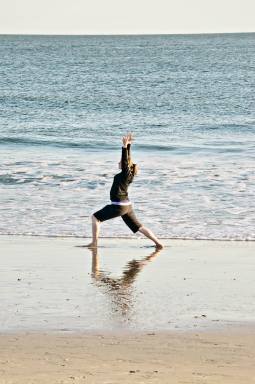
 (Hey, check it out, I added an item of visual interest to my post! Thanks to F, special guest photographer, who somehow managed to climb halfway up the wall to get this shot. I went back and added a photo to my Tree Pose post too!)
 I was torn on which pose to teach. My first thought was Tree Pose, because it’s my favorite and because I know it well and my group practiced teaching it in training a few weeks ago. Then I thought I should challenge myself and do Hand-To-Big-Toe Pose, because that one is challenging for me just by itself before I even think about anyone else. I started running through the steps of Hand-To-Big-Toe Pose in my head, but then I wasn’t sure if I could do it well, and I couldn’t remember if I’d done that pose at this studio and then I worried that they don’t teach that one here or if they do they call it something else, and then I couldn’t think of any other balance poses except Dancer which I know I don’t want to try to teach. So I ended up doing Tree, and it went okay. J said I did well, and I checked with Sarah after class to see if she could hear me in the back of the room and she said she could. It was still hard, though, even though it’s the easiest balance pose for me to teach – I’ve heard it taught so many times before and yet, doing it myself, I didn’t know where to work in that your gaze should find an unmoving spot to rest, and I didn’t mention the neat little trick I learned at the anusara studio last summer because I figured I should keep it simple. Here is basically what I said:


 Rox Does Yoga