Rox Does Yoga

Yoga, Wellness, and Life

So You Want to Try Yoga, Part 5: How Often Should I Do Yoga? August 23, 2011

Filed under: yoga — R. H. Ward @ 2:22 pm
Tags:

As an addendum to my series on tips for new yoga students (see the full series here), I thought I’d comment on not just the technical aspects of finding a yoga class and what to bring to it, but how often to practice. Last week in my teacher training session, J mentioned that this question, “How often should I do yoga?”, is one of the most frequent questions he gets. The answer, of course, is different for every person (much to the dismay of J’s questioners, who all wanted a specific answer!).

How often should you practice yoga? It mostly depends on what you hope to get from your yoga practice, and on your other commitments and responsibilities as well. If you want to make real changes in your physical health or in your spirituality, you should practice as often as possible. Physically, yoga can have real benefits on the body, such as increased strength, flexibility, and stamina, but you have to practice regularly to reap those benefits. Similarly, if you’re using yoga as a part of your spiritual practice, perhaps with meditation, you should also try to practice as often as possible – you’re training your mind to be calmer and more focused, the same way you’re training your body to be more flexible, and the results will only come with continued practice and work.

If you really want to make progress with yoga, you’ll find a way to practice yoga every day – with daily practice you’ll see results much more quickly. For those of us with busy schedules (for example, me, and pretty much everyone else), this can be really hard to do. If you want to make yoga a part of your life, it’s important to make room in your day to do it; on the flip side, practicing yoga all the time and letting your other obligations slide is no good either. Personally, I don’t try to force myself into a full hour-long yoga practice every day (although it would be wonderful if I could – when I do practice yoga more frequently, I feel stronger and more energetic). Instead, I try to balance my yoga practice with the rest of my life. Some days I can fit in a big practice, some days I manage 25 minutes, some days I do a few quick sun salutations, and other days I’m proud I can squeeze in a five-minute meditation. What’s important is deciding to stick with it and then making some room for yoga somewhere!

In the past, when I was practicing yoga more casually, I attended vinyasa yoga classes twice a week on Tuesdays and Thursdays, for a good two years. During that time I definitely did notice that my flexibility and strength were improving, as was my technical ability to do the physical poses. Twice or three times a week seems like it could probably be a good compromise for beginning yoga students. Then, later on, you might choose to deepen your practice.

If you’re truly busy (and I’ve been there this year!), you want to try to get to yoga class once a week. Say to yourself, “Monday! Monday is yoga night!”, and then build a little wall around Mondays in your schedule. Make it a big defensive wall with a moat, even. If you’re that swamped, you need that little sliver of time to yourself, and if you don’t defend it, nobody will and you’ll lose it. Set your alarm to remind you to practice, schedule the time in Outlook and set up email reminders so you’ll leave the house on time – whatever you need to do to make it happen. Remember that this is for yourself, to keep you healthy so you can keep on giving to all the people you love. At this point, maybe yoga becomes less a fitness thing than a sanity thing, or a social “the one night I see my friends” thing, and that’s okay. Just keep it going, and keep it regular. If you have that sliver of regular practice in your life, it will be easier to expand that into a larger practice later on when things calm down.

The last answer, the answer that people don’t want to hear, is that if you don’t keep a regular practice, you won’t make progress with yoga. Period. It’s just like lifting weights or kicking soccer balls or practicing ballet dancing or even going to Bible study: if you want to make progress, to deepen your skill and knowledge, you have to practice. Maybe right now your life is so hectic that you can’t think about a regular yoga practice; maybe you’re moving to a new city and now isn’t the time for you. Heck, since starting to practice yoga eight years ago, I’ve moved six times, and three of those moves were interstate. I feel you. But if it’s important to you, find the time. Make the time for yourself. The longer you let your practice go, the harder it will be to pick it back up and get back into a regular rhythm.

When you ask, “How often should I do yoga?”, the answer should be, “As often as is practical for you.” Think through your commitments and your schedule and find a time that you can dedicate to your yoga practice, and then stick with it!

Here’s another yoga teacher’s viewpoint on how often to practice.


Pose of the Month: Kneeling Twist / Thread-the-Needle August 22, 2011

Filed under: Pose of the Month,yoga — R. H. Ward @ 2:12 pm
Tags: ,

Thread the Needle 1 - Side StretchPose Name:

Kneeling Twist / Thread-the-Needle

Sanskrit Name:

I can’t find a specific Sanskrit name for this one.

Steps:

  1. Begin on hands and knees with a neutral spine. Make sure that the knees are right below the hips and that the wrists, elbows, and shoulders are in a straight line.
  2. Inhaling, life your right arm up to the ceiling. Keeping hips centered, stretch up.
  3. Exhaling, bring the right arm down, under the body, and out under the left arm. Rest the right arm and shoulder and the right temple on the floor.
  4. Rest here, or if you want a deeper stretch, extend the left arm to the ceiling.
  5. Relax into the pose, breathing deeply.
  6. When you’re ready, bring the left arm down and plant the hand on the floor. On an inhale, unwind, lifting the right arm and stretching up toward the ceiling.
  7. Release and return to a neutral tabletop pose. Repeat the twist on the other side.

Benefits:

Twisting poses compress the internal organs, releasing toxins and cleansing the body. Twists are beneficial for abdominal health. This pose also incorporates a side stretch that opens the chest.

Contraindications:

This pose is contraindicated for students with serious back/spine injuries. Pregnant students should be cautious with any twist and may want to consider doing Cat/Cow instead.

My Experience of Kneeling Twist / Thread-the-Needle:

Before coming to my current yoga center, I rarely did this pose, but now I practice it regularly both in class and at home. J often uses this pose as part of his warm-up sequence in class, and so I’ve really come to like the pose. The twisting action and side stretch begin to wake the body up for practice and also calm the mind, readying it for practice as well. The pose is refreshing by itself and makes a good warm-up too.

Thread the Needle 2 - Twist


Home Yoga Class # 1 August 19, 2011

Filed under: reflections,yoga — R. H. Ward @ 2:10 pm
Tags: ,

This week I taught my first of a regular series of free yoga classes held at my home. Our house has  a nice big enclosed front porch that’s perfect for yoga: we can fit up to six mats lined up two by two, and it’s a tight fit but it works. For the first class I had five students, a good mix – a couple of brand-new beginners and a few more experienced people who hadn’t practiced in a while.

Overall I think the class went well. There were a few logistical problems. We started late because several people had traffic trouble, but that’s easily fixed for next time – we’ll just plan to start 15 minutes later to give people more time to get here after work. One person got stuck in really bad traffic and then got so lost that she missed two-thirds of the class and had to call for directions, which was unfortunate and a little disruptive but wasn’t something we could have foreseen or avoided. Starting later next time will help, and we looked at a map together after class to make sure she knows some alternate routes to get here. I put on music at the beginning of class, but I found it distracting, and my little ipod speakers weren’t loud enough to really project to the whole room, so I won’t use music next time. We’re thinking about getting a new stereo anyway so I’ll just see how I feel about it then.

In terms of my actual teaching, I was definitely nervous. I didn’t walk around the room at all and spent more time than I’d planned demonstrating poses myself, which we didn’t have much room for. On the other hand, one of my beginners was at the front of the room and I wanted to show her what to do. Next week, I think I will arrange people more consciously, both to use the space better and to make sure the beginners have someone they can see (because if we end up with six students instead of five, there will definitely not be room for me to demonstrate poses). I still struggle with timing – how long to leave students in a pose? – but that will improve with time. There were things I neglected to mention in each pose: alignments and cues, and info about what the pose is actually stretching and why that’s good. At the end of class, several students mentioned that they’d like to be adjusted more – I was definitely holding back there, not wanting to do too much and trying to focus more on verbal cues. So adjustment is something to work on in the future, since it’s something my students want more of and something I need to practice doing.

On the positive side (see how I saved this for the end!), I think it was not a bad class at all and would have been passable if it had been taught at a real studio to paying customers. I have my “yoga teacher voice” down, and I feel like everyone could hear me well. I did give good verbal alignment cues on many poses, and I did talk about the benefits of some poses. I mentioned breathing pretty frequently (although I need to walk around more and teach ujjayi breath, because I can’t actually HEAR anyone breathing, which would help me to know that they are in fact doing so). I think I did my best teaching, surprisingly, in savasana relaxation, which is the one part I had not planned at all. I did a guided relaxation, which felt right to do in the moment, and which at least one person commented was helpful. I plan to do this again next week.

The best sign is that my students seemed to enjoy the class and feel positive about it afterwards. One of my beginners said that she really enjoyed the half sun salutes, that it seemed to flow really nicely, so that made me happy (since half salutes are becoming one of my own favorite things to do). Another person is coming to my house (west of Philly) from his office in center city, and after class will be taking the train back to center city and then catching another train home to Trenton, and seemed to judge the long commute for yoga to be abundantly worth his time. I didn’t realize that this person was coming from so far, and his excitement and commitment are really inspiring for me.

So, to sum up: I am already learning a lot from my five students! I’m excited about trying again next week!


So You Want to Try Yoga, Part 4: Making the Most of it! August 16, 2011

Filed under: yoga — R. H. Ward @ 2:14 pm
Tags:

Inspired by this article on how to find the right yoga instructor, I started writing some tips for those new to yoga. Parts 1, 2, and 3 covered deciding what you’re looking for in a yoga class, how to find a class in your area, and tips for a successful first yoga class. Now we’ll move on to making the most of your yoga class.

  • Speak up.

Don’t be afraid to talk to the instructor! When you arrive  early for your first class, let the teacher know of any concerns you might have. Tell her about your lower back pain or your bad knee. This will help the instructor a lot! If the yoga teacher knows that there’s a brand-new student in the room, she may teach differently, choose different poses to teach, or describe the poses in different ways. She may keep an eye on you to make sure that your alignment is right, so you don’t do anything that will hurt that bad knee. Good communication with your yoga teacher will reassure you, help her plan her class better, help her help you better!, and make the class a better experience all the way around.

  • In any yoga pose, try to be comfortable and steady.

In all of the Yoga Sutras, this is pretty much the one thing that the sage Patanjali had to say about physical poses: be comfortable and steady. And yet this is something that most yoga instructors don’t think to mention. If you are unsteady, wobbling all over the place in a yoga posture, you’re not going to be doing anything valuable for your body, and you’re more likely to cause yourself an injury. Yoga is about finding the middle path: not doing too much, and not doing too little. In any pose, you want to find the spot where you are steady but still working hard. If a pose makes you wobbly, it’s okay to take an easier variation of the pose, drop a hand or knee to the ground, or just sit down and rest.

  • Pay attention to your breath.

Your breathing is a key indicator of how you’re doing in a pose. Nice steady deep even breaths? You’re doing fine and could maybe push a little harder. Quick shallow panting breaths? Something may not be right – you may be doing too much in a pose, or you might need a rest. You should strive to keep your breath steady and even. Focusing on your breath gives you a barometer of sorts of how you’re doing in your practice, and it gives your mind something to focus on. Of course, in a more athletic style of yoga class, you may end up breathing harder, but continue to be aware of your breath, and know what the difference is for you between hard working breathing and needing a rest.

  • Understand the difference between discomfort versus pain.

It’s normal to feel discomfort during yoga class, especially as you bend in ways you might not have bent in years, and as you discover muscles you never knew you had! Stretching it out can be uncomfortable. However, there’s a difference between discomfort and pain. Yoga should never hurt you. If something genuinely hurts, then stop doing it and take a step back: maybe your body isn’t ready for that pose or that variation, or maybe you just need a rest. There’s nothing wrong with that. It’s your yoga practice – take care of yourself!

  • Adjustments: okay or no-go?

The yoga instructor may ask if she can touch or adjust you during the class. Be honest about how you feel about this. Being adjusted by the yoga instructor can be really helpful in understanding the correct alignment of a pose; however, it’s okay to say no if you don’t want to be touched, and the teacher should just give you verbal instructions instead. If the instructor adjusts you in a way that hurts at all, tell her right away! This can be scary, but don’t be afraid to speak up. In general, a teacher’s adjustment should be helpful, such that when she gets you in the right spot, you go “Oh!” and things click into place.

  • Try lots of classes – and don’t give up.

If you go to one yoga class and you don’t like it, try another class. This is the #1 most important thing I want to say in this post, so I’ll say it again: If you try one yoga class and don’t like it, try another yoga class. If you have a bad or uncomfortable experience, that’s a shame, but it doesn’t mean that yoga isn’t for you – it just means that that one class or that one teacher isn’t for you.

Maybe you were looking for a beginners class but the vinyasa class fit your schedule better – then you find out that, yup, you should be learning basics just like you thought! So try to make time for the beginners class. Or maybe you went to the beginners class but the teacher moved too fast. Try another class with a different teacher, or try another yoga studio. Remember that yoga studios are independently owned small businesses, so the style of yoga taught, the schedule, and the pricing scale will vary greatly from one studio to another – what you can’t find at one studio might be present in abundance on the other side of town.

There have been plenty of times when I’ve talked to someone about yoga and the person says, “Yoga? Oh, I tried that once. It wasn’t for me.” Or “That yoga class was okay, but we kept falling asleep, so I don’t think we’ll go back.” (Yes, seriously.) Remember that one yoga class does not represent all the variety that’s available. If you have a genuine interest in yoga, try lots of different classes so you can get a sense of what’s out there!

I truly believe that yoga can be beneficial for everybody. That’s why I’m training to become a yoga teacher! I hope that this series of yoga tips for beginners has been helpful for you. (Anything I didn’t cover? Just ask!)


Pose of the Month: Seated Cross-Legged Twist August 15, 2011

Filed under: Pose of the Month,yoga — R. H. Ward @ 2:06 pm
Tags: ,

Pose Name:

Seated Cross-Legged Twist

Sanskrit Name:

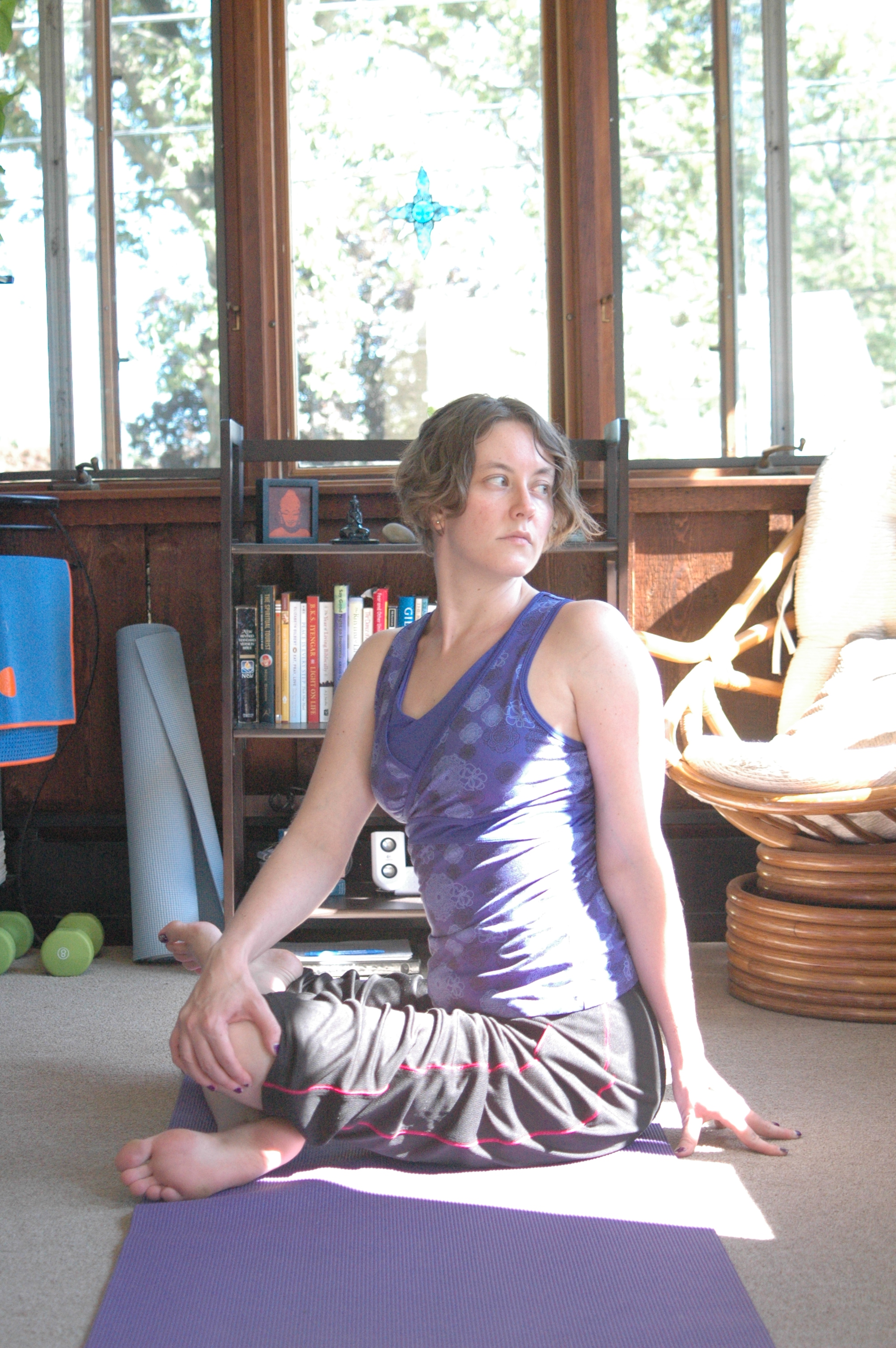
It’s possible to add a twist to Sukhasana (Easy Pose), Agnistambhasana (Fire Log Pose), or Padmasana (Lotus Pose), depending on the ability of the student.

Steps:

  1. Come to a comfortable cross-legged position. (Take Lotus Pose if you’re able, or stack your calves so the ankle of the top leg is directly above the knee of the bottom leg for Fire Log Pose, or simply sit comfortably in Easy Pose.)
  2. Sitting up straight, bring your right hand to your left knee.
  3. Keeping your spine straight, raise your left arm to shoulder height. Lift the arm up and overhead, then turn to drop it down behind you, placing the hand right next to your hip. (Placing the hand too far behind you will have you leaning over backward.)
  4. Turn and look over the left shoulder. Let your eyes rest on a point as far to the left as you can see. Your body will naturally follow your gaze and twist more deeply into the pose.
  5. Continue to breathe smoothly and evenly as you twist.
  6. Inhaling, look toward the front of the room, then lift your left hand and stretch the left arm overhead, reaching toward the front wall for a side stretch. Feel the stretch all down the left side. You may want to grip your right hand into your left knee for leverage to stretch further. Take a slow, deep breath.
  7. On an exhale, drop the left hand to the right knee, and then fold forward over your crossed arms. Breathe into your belly.
  8. Inhaling, release and come back up to seated. Change your legs and repeat the sequence on the other side.

Benefits:

Twisting poses compress the internal organs, releasing toxins and cleansing the body. Twists are beneficial for abdominal health. This pose also incorporates a side stretch that opens the chest and a forward fold which further works the abdomen.

Contraindications:

This pose is contraindicated for students with serious back/spine injuries. Pregnant students should be cautious with any twist and with folds.

My Experience with Seated Cross-Legged Twist:

I first learned this little twisting sequence from a teacher at Yoga on Main in Manayunk and I practice it frequently. I like how it combines a twist with a side stretch and a forward fold, neatly and economically stretching a variety of muscles. I appreciate the simplicity of the leg position that makes the pose accessible to students at any level. My mind stays engaged as I move through the variations, and I find the forward fold at the end gives a feeling of completion.


Seated Cross-Legged Twist 2

Seated Cross-Legged Twist 1


10 Signs Your Yoga Teacher Has a Hangover August 12, 2011

Filed under: yoga — R. H. Ward @ 2:47 pm
Tags: ,

Here’s some yoga humor for your Friday: Ten Signs Your Yoga Teacher Has a Hangover.


Yoga in the News: It’s good for fibromyalgia and orthopedic problems! August 11, 2011

Filed under: yoga,yoga lifestyle — R. H. Ward @ 1:49 pm
Tags: , , ,

Here’s some good news: Yoga Beneficial for Fibromyalgia. Women with fibromyalgia have lower-than-average cortisol levels, which contribute to pain, fatigue and stress sensitivity, but after doing hatha yoga twice a week for eight weeks, the women participating in the study had higher levels of cortisol. They reported that they suffered less from pain and other symptoms after practicing yoga, and further, they experienced psychological benefits: feeling stronger, more accepting, and less overwhelmed by their condition.

And more good news: Yoga Therapy May Help Prevent and Treat Orthopedic Problems. From the article, “Dr. Fishman, a lifelong devotee of yoga who studied it for three years in India before going to medical school, uses various yoga positions to help prevent, treat, and he says, halt and often reverse conditions like shoulder injuries, osteoporosis, osteoarthritis and scoliosis.” The article goes on to describe how a modified yoga headstand can be used to treat painful rotator cuff injuries without expensive surgery or lengthy physical therapy and without recurrence of pain. Dr. Fishman also did a study on yoga for bone disease and found that the patients with osteoporosis who practiced yoga daily for two years had increased bone density.


So You Want to Try Yoga, Part 3: Tips for Your First Class August 9, 2011

Filed under: yoga — R. H. Ward @ 1:20 pm
Tags: ,

Inspired by this article on how to find the right yoga instructor, I started writing some tips for those new to yoga. Parts 1 and 2 covered deciding what you’re looking for in a yoga class and how to find a class in your area. Now we’ll talk about some tips for your first yoga class.

It’s hard to know what to expect when you’re doing something new for the first time. Once you’ve identified a yoga class you’d like to attend, it’s a good idea to find out as much as you can in advance – this will help you to feel more comfortable on the day of the class. Do you have friends or colleagues who go to classes at this gym or studio? Pump them for information. Does the yoga studio, gym, or yoga teacher have a website? Check it out. Find the phone number and call for more info.

Here are some frequently asked questions about yoga classes. In general, the answers to these questions are applicable to most yoga classes, but it’s always good to confirm with your particular instructor! If the info isn’t on the website, call to double-check.

  • Do I need to bring my own yoga mat?

You don’t need a yoga mat – often the gym or studio will have mats you can borrow or rent for a small fee, and if they don’t, you can use a towel or try practicing right on the floor. Some studios may require that you use a mat, for both cleanliness and liability reasons (i.e., it’s easier to slip and fall on a hard wood floor if you don’t have a mat), so check your location’s policy.

When thinking about the mat question, consider whether you have knee or joint problems that make sitting on a hard floor difficult for you, or if you sweat a lot, or if you have cleanliness concerns (“Put my feet on a mat that other people’s feet have been on? Ew!”). If you want your own mat, you can get one very affordably. Target and Walmart carry yoga mats, and I’ve even seen them at stores like Five Below or the “under ten dollars” store. Extra-tall, extra-wide, and extra-thick mats are available to be ordered online if something like that appeals to you, but you don’t need a fancy mat when you’re just starting out – you can find something serviceable for under $20, no problem. But if you want to wait until you try the class before investing in any equipment, check with the studio to see if you can borrow or rent one there.

  • Do I need to bring anything else?

A bottle of water is always a good idea! Also, not a bad plan to bring a small towel, especially if you’re trying a hot room or athletic-style class, or if you know you sweat a lot. If you’re renting or borrowing a mat, you may want to consider bringing a full-size towel for cleanliness reasons – you can lay the towel over the mat so that the mat will cushion and support you without you actually putting your feet right on it. Also consider: ponytail holders, headbands, and bandannas, to keep your hair out of your face. Some people don’t seem to have an issue with this, but having hair in my eyes drives me nuts.

  • What sort of clothes do I need to wear?

For clothing, wear something comfortable that you can move around in. Some people prefer baggy shirts and shorts; I tend to prefer close-fitting and stretchy. Keep in mind that you may be upside down sometimes, so tuck your shirt in and make sure whatever’s under your shorts covers you adequately so none of your bits fall out. Pants or sweatpants are usually fine, but you probably want shorts for a hot room type class. Also, you don’t want to be overly distracted by your clothing – this isn’t the time to wear that one sports bra you have to adjust fourteen times throughout your workout (or the sports bra you fall out of!). Use your common sense and be comfortable.

Clothing to avoid: anything itchy, and anything restrictive that limits your movement. Jeans are a bad idea for yoga class (trust me, I know!). You may also want to avoid wearing clunky jewelry  – that necklace won’t seem so pretty when it smacks you in the face during downward dog, and big rings can cut into your hands. I usually just wear stud earrings and my wedding band.

Be aware too that yoga is typically done barefoot. Many first-timers don’t know this and get upset when they’re asked to remove their sneakers. Remember that this isn’t aerobics class or a treadmill – in yoga class, you need to be able to move, bend, and flex your feet. Also, the etiquette is different here than at a gym: many yoga studios ask you to leave your shoes at the door to help keep their floors clean. If you are truly uncomfortable having your feet out and proud, you can try practicing in socks, but bare feet will stick better to your yoga mat than socked feet will, and if you don’t have a mat, you will slide around a lot more on a hardwood floor in socks. It can be a big distraction. Be aware in advance that you’ll be asked to bare your toesies, and get used to the idea so you won’t be blindsided with it at your first class. (Really, no one cares what your feet look like, but if it’ll make you feel better, give yourself a little pedicure before class!)

  • How early should I arrive?

You probably want to show up to your first yoga class about 10-15 minutes early. Even just for practical reasons this is a good idea – if you’ve never been to the place before, you could get lost! Arriving early also gives you the opportunity to meet the instructor, sign a release form, pay for the class, and talk over any concerns you might have. If you’re nervous about starting a new thing, give yourself this time – rushing to get there and running in at the last minute will make you even more nervous and worked up. You will feel so much more comfortable if you have plenty of time to get to the studio, look around, check things out, talk to the instructor, and settle in.

Next time: making the most of your yoga class!


So You Want to Try Yoga, Part 2: Finding the Right Yoga Class August 2, 2011

Filed under: yoga — R. H. Ward @ 1:21 pm
Tags:

Last time, I gave you some pointers on identifying what you want out of a yoga class. Now let’s figure out how to find the right class!

  • Try different search methods to find an appropriate yoga class in your area.

Once you know what you’re looking for in a yoga class, it’s time to go find one! Yoga classes are held in a variety of places: there are independent yoga studios, of course, but you can also find yoga at a gym or YMCA, or at an unlikely spot like a dance studio, a church, a garden, someone’s home, or even your own workplace!

Gyms and YMCAs are often good, affordable options when you’re just starting out with yoga. These places usually offer yoga classes to their members along with other exercise classes as a part of your monthly membership. Joining a gym can be more cost effective than taking yoga classes at a studio, but you’re likely to get less variety and more emphasis on the physical workout at a gym. Many gyms will offer a trial membership, so you can check it out for a week and see if you like it. Call and ask if this is an option, and if it is, take full advantage!

If you want to try yoga at a yoga studio, there are several ways to find one in your area. Yogajournal.com maintains a directory of yoga studios, which is a good way to get ideas, but not every studio is registered there (I just looked at Pennsylvania, and while there are 101 listings in PA, the two studios where I practice most often aren’t listed). You can also look at local resources like yelp.com, where you can see ratings from other yoga students in your area (and both my favorite studios do show up on yelp). You could even just go to googlemaps and search for “yoga near” your zip code. If you don’t see what you’re looking for under one search, try again on a different site!

Another option is to look for an individual yoga teacher. Yoga Alliance, the national education and support organization for yoga in the United States, maintains a directory of registered yoga teachers (RYTs) who have completed the training requirements (i.e., what I’m doing right now). There may be a yoga teacher in your area who doesn’t teach at a studio or gym but who does private lessons or small home classes. Looking for a teacher might be good for you if you have an irregular schedule and can’t make it to a regular class, or if you have physical problems that make it hard to leave home: bring the yoga to you!

Finally, word of mouth is a great way to find yoga classes. Maybe there’s a yoga class that meets weekly in the basement of the church up the street from you, or maybe your daughter’s dance teacher rents her studio out to a yoga teacher on Sunday mornings. Yoga can crop up in the unlikeliest of places. Look on bulletin boards at the grocery store!

Or maybe some of your colleagues have been wanting to try yoga too – go together to your HR department to see if you could get a class started at your office! Yoga at the workplace can be a nice thing for an employer to do, since it boosts morale and improves fitness (which means fewer injuries and lower health costs!). And sometimes, if enough employees are interested, the employer may subsidize the cost of the classes, leading to cheaper yoga for you. It doesn’t hurt to ask! (And if your employer is willing but you need to find a teacher, check out the Yoga Alliance yoga teacher directory!) If you tell people you want to try yoga, you might be surprised at where it leads you.

Next time: making the most of your first yoga class!


The Four Duties of a Yogi August 1, 2011

Filed under: yoga,yoga lifestyle,yoga philosophy — R. H. Ward @ 8:23 am
Tags:

At our last teacher training session, we talked about the four duties of a yogi. These duties are not for renunciates or monks but for householder yogis, yogis in the world like us. Here they are, in order:

  1. Yourself.
  2. Family.
  3. Work.
  4. Community/society/nation.

What do you think about that order? Does it seem selfish to put yourself first? This is something that many people struggle with. “My family has to come first in everything,” someone might say. But really think about it. Putting others first is a concept that many of us, especially women, have taken to heart as our duty. We’re constantly giving everything we’ve got – driving kids to soccer practice, staying late at the office, making time to help your husband with a project or to visit your in-laws, but never making time for yourself. And when you don’t make time to take care of yourself, you can get burnt out or even sick. It doesn’t have to be a lot of time. It can be something as simple as making sure you get to yoga class once a week, getting up early for some private time in the morning, getting to bed early to get a good night’s sleep, or treating yourself to a pedicure or a bubble bath. It could be scheduling that long overdue doctor’s appointment, getting your teeth cleaned, going for a massage: taking care of your own health so you don’t get sick or hurt. Whatever it is for you, it will help you to relax, recharge, and stay healthy. And when you’re healthy and you have a lot of energy, you have so much more to give to your family, work, church or community. If you take care of yourself first, you’ll be able to serve others with more energy and joy.

Compare that to when you’re feeling burnt out – how long does it take you to get back on an even keel? We can rarely give up our duties entirely for a vacation (and even a vacation away from home involves making travel plans, caring for the kids, worrying over the budget, etc). Sometimes, when we keep on putting others before ourselves, we get so run down that we become sick, our bodies forcing us to take a break, and even then we’ll still keep pushing on, going to the office instead of getting the rest we need. And really, what’s so important at the office? Things at the office will go on without you just fine, or things will wait until you’re feeling better. There are few things so important that you need to attend to them while you’re sick. Give both your body and your ego a rest and take care of yourself.

By caring for ourselves first, we can stay healthier, avoiding getting sick and rundown in the first place. By taking care of ourselves, we have more energy, more balance, and are happier and fuller in ourselves, meaning we have more to give to the people we love. The ancient yogis realized that when you take care of yourself first, everybody wins.