Rox Does Yoga

Yoga, Wellness, and Life

Graduation December 9, 2011

Filed under: checking in,reflections,teacher training,yoga,yoga lifestyle — R. H. Ward @ 7:26 am
Tags:

This weekend, I’ll be graduating from my yoga teacher training program. We have a short session tonight, followed by a little party at the Thai restaurant next door to the yoga center, and then a full day tomorrow, and then I’m done! Ten months of work and learning and growing. I’m a little sad for it to end: I’ve really gotten to love my classmates, and I’ll miss seeing them all the time. I will also miss having the time set aside specifically to work on my yoga and my spirituality. (And of course I’ll miss the unlimited hatha yoga class pass that comes with the program – I’m going to have to start PAYING to go to yoga classes again!)

But I really feel like I’m ready. I’ve learned so much, and really come so far since I started training in March. I feel like I’ve gotten out of this program what I wanted to get out of it: I have the confidence to teach yoga, first of all, and most of the expertise necessary to do so, and more will come with more teaching experience. I also really wanted to explore the spiritual aspects of yoga and meditation, and this program definitely gave me the time and support I needed to do that. I’d like to look into teaching meditation on its own, actually. I think that, combining both the yoga teaching confidence and the time spent on spirituality, I’ve grown as a person and I feel much more confident and happy and comfortable in myself. That’s the sort of thing I couldn’t expect or predict, but only hope for, at the start of the training.

The ten months of this program felt like forever at times, but looking back, I’m really glad I chose such a long-term training. I’ve talked to friends who’ve had shorter training programs, and it seems like in order to get all the hours in, they have to cram a lot of information into a short amount of time. In my program, I really had a chance to absorb everything I was learning. Now it’s hard for me to separate some of the things I’ve learned or point to specific things that I learned, because it’s all a part of me. I feel like the ten months was transformative in that way: I wasn’t a yoga teacher before, and I am one now, not just because I finished a program but in some indefinable way that has to do with who I am. I’m not saying that teachers who choose short or intensive programs get less of this; I just know that if I’d done a program like that, I would still feel like I had a lot of work to do afterwards. I really wanted that spiritual growth piece in my teacher training, and you just can’t cram that into a short amount of time. (On the other hand, you can’t cram it into ten months either, and I’ll be working on my meditation practice for the rest of my life – but I feel like I have a good firm foundation to build on.)

Overall, I feel really proud of what I’ve accomplished. I’m going to enjoy the heck out of this weekend, and then do some relaxing and unwinding over the holidays, and then see what happens next.


Books: Karma-Yoga, by Swami Vivekananda December 8, 2011

Filed under: books,yoga philosophy — R. H. Ward @ 1:15 pm
Tags: ,

Swami Vivekananda lived from 1863 to 1902 and is best known for his address at the Parliament of Religions in 1893, which helped to bring Hinduism to the modern world as a major religion. Vivekananda wrote a number of books, some of which are based on his lectures, and Karma-Yoga is one of these. Karma-Yoga has been reprinted many times over the past hundred years; the copy that I read,  borrowed from a college library, is a tiny little book, maybe 4″ x 5″, and only 143 pages. Because the book was published so long ago, you can read the whole thing online, so feel free to check it out! If you’re interested in the topic, this book is well worth the time.

In this book, Vivekananda expands on the concept of Karma yoga as set out in the Bhagavad Gita. Vivekananda covers a variety of topics related to karma, including work, action, character, motivation, morality, duty, and non-attachment. While Vivekananda’s explication of Karma yoga really moved me and helped me to understand how the path of Karma yoga can work in my life, I’ll try to keep this post focused on what Vivekananda writes, and I’ll follow up with another post on my personal response to the text.

Vivekananda begins by providing an introduction to the concept of Karma and work. For Vivekananda, a person’s character reflects that person’s will, which is shown through their work. He states,

Watch a man do his most common actions; those are indeed the things which will tell you the real character of a great man. Great occasions rouse even the lowest of human beings to some kind of greatness, but he alone is the really great man whose character is great always, the same wherever he be (5).

Karma, or work/action, is the means by which we each build our character. Our actions, our work, build us into who we become: doing good works reinforces good character, and constantly doing evil work builds a bad character. Therefore it’s possible for someone to change his character through his actions.

Vivekananda also discusses the motive for work: one shouldn’t work for money or fame or even the results of our work, but simply for the work’s sake. Removing selfish motives from our work builds self-control and character. He describes how the ideal person can find balance between a quiet, solitary spiritual practice and life in the world. Such a person can be in the middle of the densest city traffic and his mind will be as if he’s in a cave by himself; whether in a city or a cave, he’s intensely working at all times.

Vivekananda describes how the concept of morality and duty varies greatly depending on the country or culture: what’s considered right and moral in one country can be thought wrong and evil in another. Vivekananda argues that for this reason there can’t be a universal morality or sense of duty, but that each person must act according to what is deemed right and good in his or her own culture. Vivekananda recommends that we try to view each person’s actions through their own eyes rather than judging that person by our own standards of duty, especially when meeting people from another culture. If we view them by our standards, we may think they are acting wrongly or strangely, but if we try to understand their actions in the context of that person’s culture, we may see that the person’s actions are right and good to him. Every person should work to accomplish his own ideal, according to his own skills and abilities; if you take up someone else’s ideals, you can never hope to make progress. He then explains that one person’s duty isn’t higher or lower than another person’s; even working at hard physical labor can count towards spiritual progress if it’s approached with the right attitude.

Vivekananda also discusses the idea of non-attachment. Each person must constantly work, because it’s in our nature as human beings, but the only way to truly make our work count is to be unattached to the results of the work. Vivekananda compellingly describes how attachments affect the mind as well as how non-attachment relates to love, self-sacrifice, and charity, and how all of these come together: being able to love perfectly, without attachment, we are able to give freely of ourselves to others without worrying about how it will affect us. Vivekananda uses the powerful image of the grumbling worker: if you’re grumbling and complaining about your work, that means you’re attached to it; all your duties will seem distasteful and you’ll never be satisfied. However, if you’re able to do the work for the work’s sake, without attachment, you’ll find satisfaction and freedom.

Vivekananda states that no action can ever be completely good or completely bad: even the most kindly meant action can have negative consequences, and even the foulest evil act can result in some good. Because Karma results from every action, there’s no way to attain perfection simply by doing good works, because each good work will also have some negative effect. This is where non-attachment comes in: you continue to work and strive to do good, but free yourself from attachment to the results of the action. You set yourself aside, removing all selfish wish for praise or reward, and do your duty because it’s right to do your duty.

At the end of the book, Swami Vivekananda sums up his views on Karma yoga:

Karma-Yoga, therefore, is a system of ethics and religion intended to attain freedom through unselfishness and by good works. The Karma-Yogi need not believe in any doctrine whatever. He may not believe even in God…. He has got his own special aim of realising selflessness; and he has to work it out himself. Every moment of his life must be realisation, because he has to solve by mere work, without the help of doctrine or theory, the very same problem to which the Jnani applies his reason and inspiration and the Bhakta his love (131-2).


Pose of the Month: Head-to-Knee Pose December 7, 2011

Filed under: Pose of the Month,yoga — R. H. Ward @ 1:10 pm
Tags:

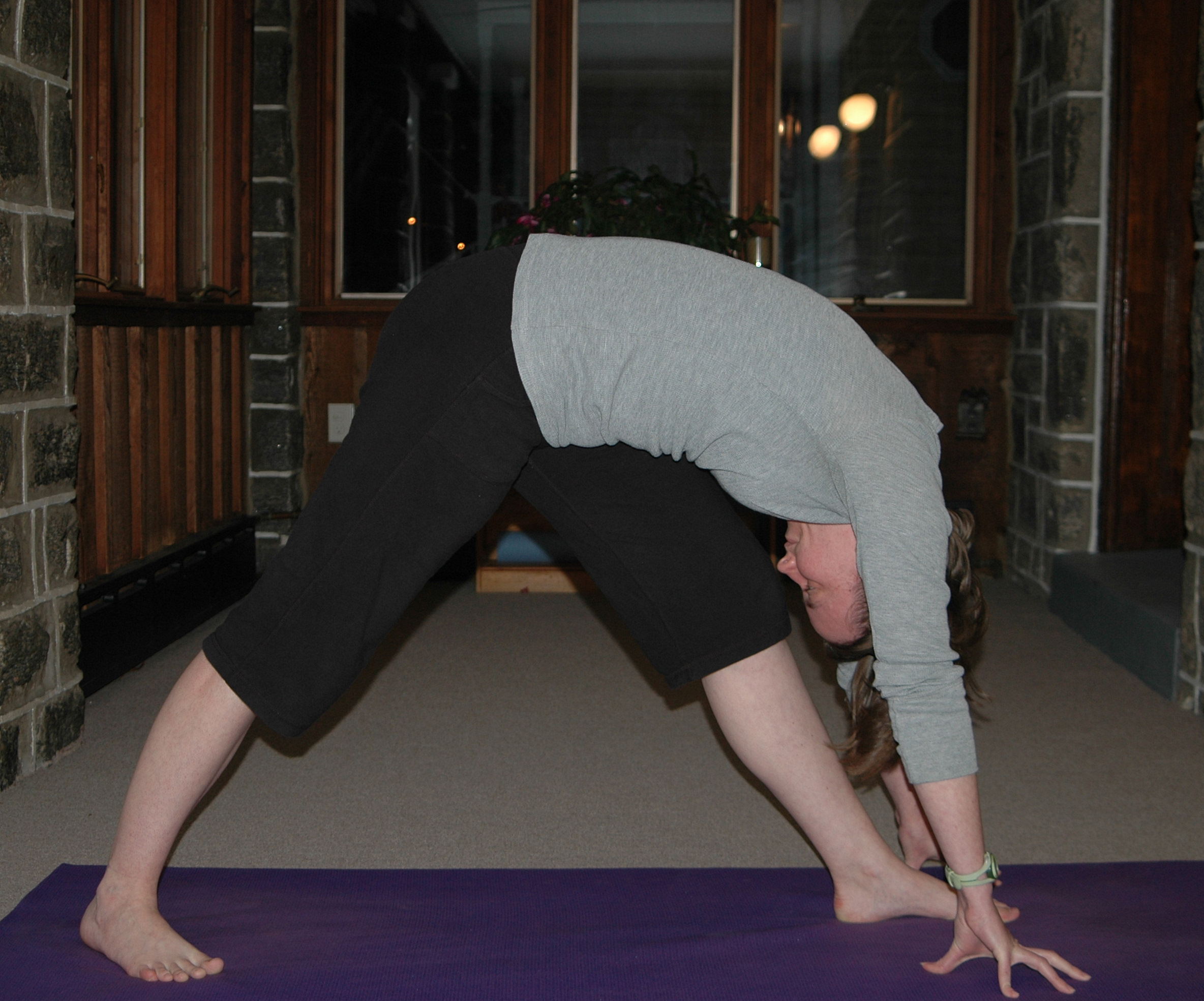
Pose Name: Head-to-Knee Pose (also known as Pyramid Pose or Intense Side Stretch Pose)

Sanskrit Name: Parshvottanasana

Steps:

  1. Begin in a wide-legged stance. Turn your right toes forward to face the top of your mat; place your left foot at a 45 to 60 degree angle, and turn your hips to face front. (This is the same basic stance as Warrior I Pose.)
  2. Reach your arms up overhead and stretch. Fold forward, bringing your fingertips to rest on the floor on either side of your front leg. (Less flexible students can place their hands on a pair of blocks if they can’t quite touch the floor; more advanced students can bring their hands into reverse prayer behind their backs before bending forward, or can simply cross the arms behind the back and grasp opposite elbows if reverse prayer is too much.)
  3. Keep the back leg straight and firm. Work on straightening the front leg. If you can’t quite get the front leg straight, it’s okay to bend it slightly.
  4. At first, keep the torso parallel to the floor. Then, if you have the flexibility, you can bend further while keeping the hips aligned and the spine straight.
  5. Although this is called “Head to Knee” pose, don’t focus on trying to bring your head to your knee. Instead, work on bringing your chin toward your shin – this will help to keep you aligned properly.
  6. Check in with your torso alignment: the midline of the torso should be above the line of the inner thigh. More flexible students can rotate to bring the midline of the torso over the midline of the thigh.
  7. Keep breathing. Work on lengthening the spine as you inhale and folding deeper on your exhales.
  8. Press strongly through the back leg to return to standing. Rise up slowly to avoid getting dizzy. Repeat the pose on the other side.

Benefits:

Head-to-knee pose really stretches out the front leg, which is great when the backs of the knees or calves are tight. The pose also stretches the spine, improves posture and balance, and stimulates the abdominal organs.

Contraindications:

Those with knee injuries may want to avoid this pose. Those with a back injury or high blood pressure can try a modified form of the pose: practice facing a wall, and instead of bending all the way forward, bend just enough so that the torso is parallel to the floor and then press your palms into the wall for support.

My Experience with Head-to-Knee Pose:

I never practiced this pose before coming to my current yoga studio, and I’ve struggled for a long time to figure out exactly what should be going on in this pose – which way are the hips facing? Should I feel so uncomfortable in this pose; am I doing it right? It seems like such a simple pose, but I continue to struggle with it. After working on asanas during October’s teacher training weekend, I understood this pose better, but I still feel some confusion when I try to teach it, so I wanted to spend a little more time learning about this pose.


Yoga and Christianity, Part 3: No, We’re Not Satanists December 6, 2011

Filed under: yoga lifestyle,yoga philosophy — R. H. Ward @ 1:19 pm
Tags: , ,

My husband gleefully sent me the following link: Vatican Exorcist Specialist Says Yoga Is The Devil’s Exercise. The Devil? Seriously? I had to go look up more information on this one. Here’s an article in the Telegraph and another from the Vatican Insider, both of which include more information and responses from the yoga community in Italy.

Since there are only a few direct quotes from Father Amorth in this article, I’ll go ahead and refute them, on both logical grounds and on “you don’t have the first idea what yoga is about” grounds. First of all, Father Amorth says that practicing yoga leads to Hinduism, but doing one thing does not ever automatically lead to another. If I have one beer, that doesn’t automatically lead me to alcoholism; for people who have natural tendencies toward alcoholism, having one beer might lead them in that direction, but it wouldn’t do so for everyone. Practicing yoga doesn’t automatically lead anyone to Hinduism (nor can Hinduism be compared to something negative like alcoholism in any way, I was just using that as an example, since that’s the sort of mindset Father Amorth seems to be imagining). Most people who practice yoga, especially in the US, have very little connection to yoga’s Hindu roots besides learning a few Sanskrit words.

Father Amorth also states that “all eastern religions are based on a false belief in reincarnation”. First of all, way to generalize: I find it inadvisable ever to make claims about “all” of anything. Also, while it’s one thing to disagree with the concept of reincarnation, it’s something else entirely to respect the beliefs of other cultures and peoples – to say “I disagree” is a far better statement than “You’re wrong”. And finally, what on earth does Hinduism or reincarnation have to do with the Devil or Satanism? It seems that Father Amorth is really saying that people who practice faiths other than Catholic Christianity are going straight to hell. Official Vatican communications do tend to be respectful of other faiths, so I think we can assume that Father Amorth is not speaking on behalf of the Pope. It’s just troubling that there will be some people out there who read what Father Amorth has said and think that it’s official Catholic policy.

The Telegraph article does reference some of Cardinal Ratzinger’s writings on yoga from before he became Pope, and this I find interesting. Apparently, in 1999, Ratzinger warned of “the dangers of yoga, Zen, transcendental meditation and other ‘eastern’ practises” (as described by the Telegraph), and how these practices can “degenerate into a cult of the body”. I could actually see that as a valid warning as regards the sort of yoga practiced in the US today: most yoga is very focused on the body and doesn’t spend any time at all on meditation or the mind. Further, yoga trends like “power yoga”, competitive yoga, and even just practicing yoga using mirrors can reinforce that yoga is only about the physical. However, there are a lot of other fitness practices and techniques that could encourage a “cult of the body”. What does Cardinal Ratzinger have to say about bodybuilding, aerobics, and pilates? Does he frown on modern dance too, or ballet, or, heck, sports in general? Further, to imply that Zen or other meditation practices could lead to a cult of the body is completely wrong: meditation is all about the mind. I can only assume that the writer of the Telegraph article is misquoting or misunderstanding the original document, because it seems like a very weird statement to make about meditation, and I’d expect Ratzinger to be better educated than that. (And I don’t have the time today to try to look up the original document, so if anyone wants to investigate this further, feel free.)

One thing I like is the response from Giorgio Furlan, founder of the Academy of Yoga in Rome, quoted in the Vatican Insider article. He said that his yoga practice helped to bring him back to his Catholic roots. This is the sort of thing that Christians should be paying attention to, but of course, the exorcist is the one getting all the press!


Pose of the Month: Downward-Facing Dog December 5, 2011

Filed under: Pose of the Month,yoga — R. H. Ward @ 1:30 pm
Tags:

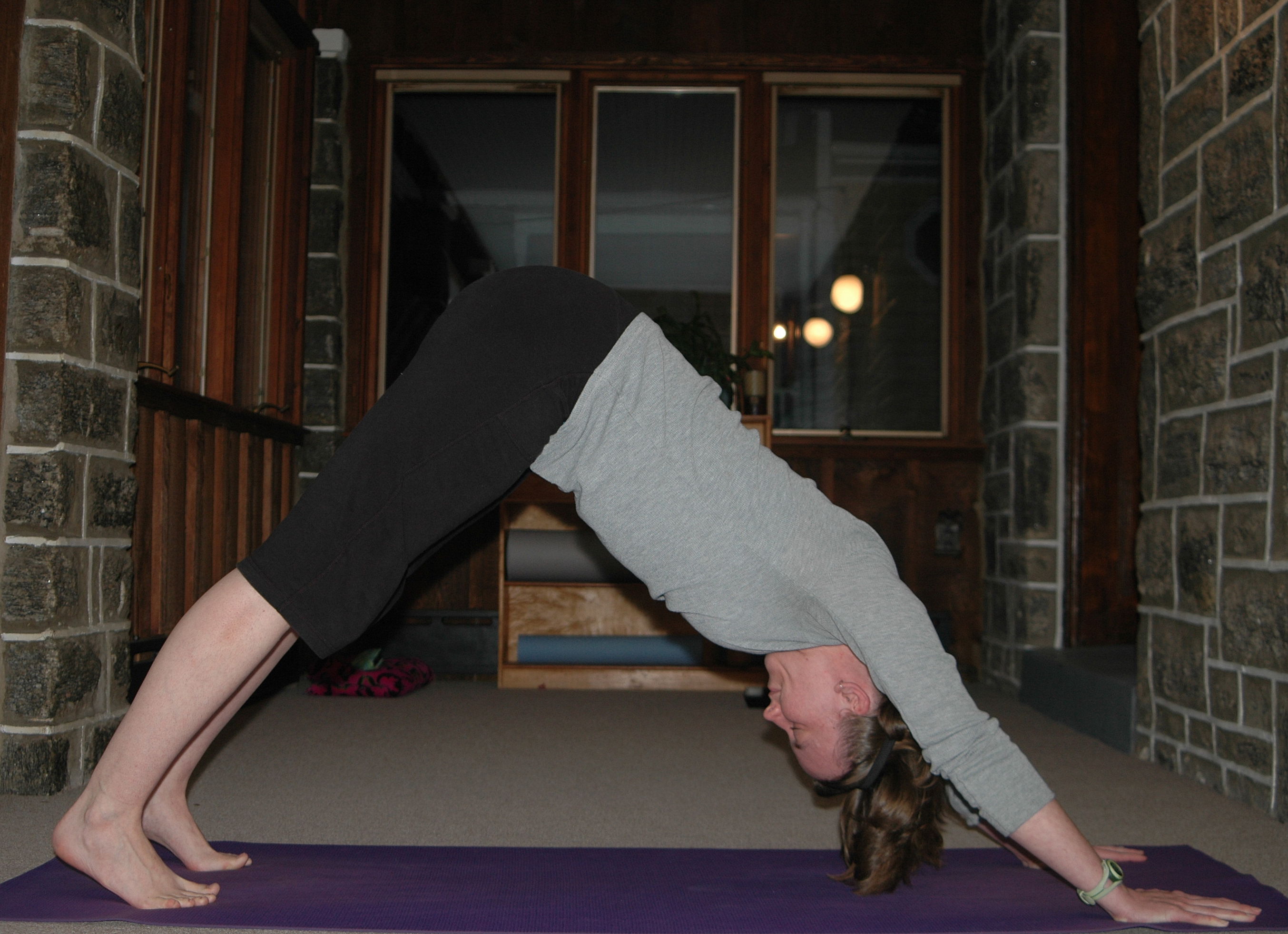
Pose Name: Downward-Facing Dog

Sanskrit Name: Adho Mukha Svanasana

Steps:

Downward dog is usually done as part of a sun salutation sequence – the instructions here tell how to get into the pose on its own.

  1. Begin on hands and knees, with a neutral spine and knees directly below the hips.
  2. Curl the toes under. Exhaling, pressing into the hands and balls of the feet, lift the knees off the floor and press the hips into the air.
  3. Lengthen your tailbone away from the back of your pelvis, and lift the sitting bones toward the ceiling. Lengthen the spine; lengthen the waist.
  4. Check in with your body. The back and legs should be straight, as if you’re forming a big triangle with your body: straight lines from hip to heel and from head to tailbone. Knees are straight, but don’t lock them; let them be soft.
  5. The feet should be hip-width apart, with the weight on the balls of the feet. Press your heels down towards the floor, stretching the backs of the calves.
  6. Your hands should be shoulder-width apart, with fingers spread wide. Press your weight down through your whole hand, not just your palm, so the whole hand is active. However, rather than pressing the whole hand completely flat, give yourself a little bend through your finger knuckles – this will give you a little more leverage. Make sure your weight is balanced between hands and feet so your feet aren’t taking the whole load.
  7. Extend strongly through the arms so that your elbows are straight. Stretch and press through your inner arms, gently revolving your elbow creases forward. You don’t want a deep bend at the wrist, so take a look and see if you have a crease on the top of the wrist, and if you do, press back more strongly.
  8. Stretch and open the shoulder blades, drawing them toward the tailbone.
  9. Hold here for five long, deep, even breaths, or longer if you feel comfortable.
  10. To come out, drop your knees to the floor to return to a neutral tabletop pose. Or you can walk your feet up to your hands to come into a standing forward fold.

Benefits:

Downward dog is an important core posture in yoga. It stretches and strengthens the entire body. Down dog warms and energizes the body, calms the brain, and relieves stress.

Contraindications:

Those with carpal tunnel syndrome or other wrist problems may have difficulty and pain in downward dog and should consider dolphin pose instead. Downward dog should not be practiced in the late stages of pregnancy.

My Experience with Downward Dog:

I’ve practiced yoga for almost nine years, so I do downward dog all the time. Recently one of my students asked for some guidance on down dog, and it was difficult for me to respond helpfully because this pose is so automatic for me now. As we talked together about the pose, I realized I didn’t have all the answers to her questions (tilt of the pelvis? orientation of the elbows?), so I wanted to look into the pose more closely to better understand the alignment and what’s going on. As my student pointed out, we do downward dog all the time, but we rarely look at exactly what we’re doing in this pose, and yoga teachers don’t usually give detailed instructions on doing the pose, assuming that any non-beginners understand it already. It was good to look more closely at this pose so that I can guide students with different body types into practicing the pose correctly.

Yoga Journal has some nice videos about performing downward-facing dog, which you can view here and here.


Humor: Yoga Girl December 2, 2011

Filed under: Miscellaneous,yoga — R. H. Ward @ 1:30 pm
Tags: ,

All my posts this week have been pretty heavy on the spirituality, so let’s take a little break. I bring you “Yoga Girl”. I love this video for mostly-accurate use of and hilarious rhyming with yoga terminology!


(And if you haven’t seen this guy’s Whole Foods Parking Lot video, it’s just as funny.)


Books: The Upanishads, translated by Eknath Easwaran December 1, 2011

Filed under: books,upanishads,yoga philosophy — R. H. Ward @ 1:30 pm
Tags: ,

The Upanishads, translated by Eknath EaswaranThe Upanishads are a group of ancient wisdom texts. Each individual upanishad is named for the sage who delivered its teaching, long ago; each one describes in flashes of insight how to explore your own consciousness, how to come closer to the Divine. Some of the upanishads take the form of a story: a student (or a wife, or even a king) implores a great sage (or even Death itself) to share holy secrets. Most of the upanishads rely on classic natural images – birds, trees, water – that make the metaphors timeless and appealing even thousands of years after they were written.

It’s impossible to write an unbiased book review of a cherished spiritual text  – how could I possibly critique the writing style or the structure of a book like this? So this review will be a little more personal. I loved The Upanishads. They called out to me in a way other spiritual books, including the Bible, just haven’t. I expect to keep The Upanishads by my bed, read them again and again, consult different translations, flip through seeking guidance. It can be a difficult book, and I don’t ever expect to understand it fully, but I loved it.

While the text itself is beyond critique, the translation and the version I can comment on. I really like Eknath Easwaran’s translations (I also read his version of the Bhagavad Gita). Easwaran is well-versed in Sanskrit and in Hindu spirituality, and before becoming a spiritual teacher was an English professor, so he has all the tools to create both a beautiful and accurate rendition. Easwaran also writes the introduction, which I found helpful for putting The Upanishads in their historical context and setting the stage for the sort of text I was about to read (since when I started I really had no idea what I was getting into). This volume also includes a brief 2-3 page introduction before each upanishad, written by Michael Nagler. These I also found informative, and it was helpful to look as I read for the points that Nagler had called out as being important, but I think I would have preferred to read the upanishad first and then read Nagler’s summary of it. Nagler also writes a lengthy afterword, which I did not find very useful. The end matter includes a glossary and a section of notes, which I didn’t realize were there as I was reading the upanishads, and I think I’m glad I didn’t know they were there – I’m the sort of person who will flip back and forth consulting the notes, and I’m glad I was able simply to experience the upanishads on this first read rather than analyzing them academically. There will be plenty of time to look at the notes and read other translations. The glossary might have been helpful a few times, though, and I imagine it would be very useful to someone who hasn’t spent the past ten months up to her ears in yoga philosophy.

Overall, I would say that if you’re new to Hindu spirituality, I wouldn’t recommend starting with The Upanishads – the Bhagavad Gita is a much more accessible book for most people. For me, though, The Upanishads was more inviting, more enthralling than the Gita, and more accessible too. The first time I read the Gita I walked away thinking that it was nice and all but nothing great, and I needed the lectures and discussion of my yoga teacher training course to put the Gita’s systems in context and help me understand what I was reading. With The Upanishads, I felt like I could really hear the sages speaking directly to me: faraway, murky, blurred voices, sure, but I could hear it. I look forward to listening again and again.


Yoga and Christianity, Part 2 November 30, 2011

Filed under: yoga lifestyle,yoga philosophy — R. H. Ward @ 1:10 pm
Tags: ,

Yesterday I talked about a few articles that denounce yoga as being inappropriate for Christians to practice. I don’t agree with that assessment, and I think that those who believe that way are taking a far too narrow view. Today I want to talk about just a few of the reasons why I think yoga can be used by and helpful to anyone regardless of their religious background.

One thing that has struck me in my own practice and reading was how similar the Bhagavad Gita is to the Gospels. A LOT of what Krishna tells Arjuna could have been said by Jesus to Peter and have made perfect sense. I would actually love to hear from someone who has read both the Gita and the Gospels closely, because to me the parallels seem numerous and meaningful.

To say that “attaining enlightenment through Krishna” is different from “reaching the kingdom of heaven through Jesus” is to quibble over vocabulary and culture, I think, and to argue over what face you want to put on your version of the divine. Christians put one face on the divine, Hindus another, Muslims still another, but at heart, we’re talking about the same guy here. In practical terms, the emotion and feeling that a Christian puts in to worshipping Jesus is going to be very similar to the emotion and feeling that a Hindu or a Bhakti yogi puts in to worshipping Krishna. The rituals may be different, but they’re doing the same thing.

Over the past year, yoga has helped me realize just how similar the major religions are in many ways. On a technical theological level, the core beliefs of Buddhism or Hinduism aren’t going to be compatible with the core beliefs of Christianity, but on a moral and ethical level, they’re nearly identical, and on a spiritual level, we’re all striving for the same thing: to become closer to our version of God. Whether “God” means Yahweh or Jesus or Krishna or the universal consciousness, it doesn’t matter. There are many names for God and many metaphors for God. We’re all blind men touching a different part of the elephant, but it’s all the same elephant: the trunk, ears, feet, and tail are all parts of the same thing, no matter how different they seem individually.

While yoga has a strong and beautiful background in Hindu tradition, that doesn’t necessarily define it as a Hindu practice. The tools set out in the yoga texts are, I feel, applicable to any sort of spiritual searching – and I believe that Christians and all people should take part in spiritual searching to become closer to their God. All of my reading this year has helped me to confirm for myself that I’m not a Christian, but that wasn’t due to the yoga – I pretty much knew that already. Yoga could have the complete opposite effect on a devout Christian, helping her to come into a deeper communion with her faith. For example, people in many different religious faiths practice meditation – a Buddhist practicing meditation doesn’t become a Hindu or vice versa, because the meditation simply brings the practitioner closer to her own concept of the divine. If you look at the definition of meditation, saying the rosary is actually a meditation practice – the chanting and repetition of certain words or prayers to bring one closer to God. There are many ways to meditate, many ways to seek, many ways to pray.

I welcome thoughtful discussion on this topic, as well as links to articles or further information. I may come back to this again, since I really feel like I’m only skimming the surface here.


Yoga and Christianity, Part 1 November 29, 2011

Filed under: yoga lifestyle,yoga philosophy — R. H. Ward @ 1:15 pm
Tags: , ,

My friend Birdmaddgirl recently posted a link to an article by Pastor Mark Driscoll, a long and thoughtful discussion of why yoga is an inappropriate practice for Christian people. Pastor Driscoll cites yoga’s roots in Hinduism to denounce it as demonic, by which he means that yoga is a spiritual act of devotion to beings other than the God of the Bible. You can read Pastor Driscoll’s article here. My friend Birdmaddgirl responds to it here. You may not be surprised to learn that I disagree with Pastor Driscoll and agree with Birdmaddgirl. After reading Driscoll’s article carefully, I think that his research is incomplete and his logic is fundamentally flawed. To my view, it looks as though Driscoll set out with an agenda and did only the research he needed to prove his agenda right. That sort of approach is antithetical to the concepts of open-mindedness and true intellectual inquiry.

Pastor Driscoll has some fundamental misconceptions in his research on yoga; those misconceptions, combined with his strict Christian perspective, would certainly make yoga seem incompatible with Christianity, but some deeper searching would reveal those misconceptions to be false. If you look at his reference citations, he has read one article by Elliot Miller, a fellow Christian, about yoga history, and one book by a yoga historian (and looking at the page numbers cited, perhaps he read just the introduction to that book). Driscoll doesn’t claim to have read Patanjali, the Bhagavad Gita, or any other historical yoga or Hindu texts, nor does he claim to have read any material on modern yoga practice. Even his Bikram Choudhury quote is cribbed directly from Miller’s article. Now, I’m not saying that Driscoll should have done exhaustive research just to write a blog post, but I would have preferred him to have read a little more widely on the subject before making such negative conclusions. While I understand some of what informs his viewpoint, it seems to me that he’s trying to make his article seem deeply researched to better support his agenda.

I read over the article by Miller that Driscoll cites, and overall Miller presents the material in an unbiased way and he seems to have read Patanjali carefully. However, Miller (and Driscoll also) includes discussion of tantra, which seems to me to be a purposeful inclusion to raise prurient and negative feeling, since tantra is incredibly far removed from much yoga practiced in the US today, particularly the kinds of tantra that involve “black magic” or “child sacrifice”. To me, this seems akin to including mention of abortion clinic bombers in a general discussion of Christianity, when in reality the vast majority of Christians would want no connection with such violent behavior. There are crazies and zealots in every religion, and Hinduism has some too. However, Miller doesn’t denounce yoga and generally keeps a neutral tone. This article is the first in a three-part series, and this first part only covers history and definitions, with promises to examine carefully modern yoga and its implications for Christians later in the series. Pastor Driscoll draws his conclusions from reading only Part One of Miller’s explorations, without seeing how Miller goes on to look at modern yoga practice or what conclusions he draws. (Miller does eventually conclude that yoga is inappropriate for Christians to practice – see Parts Two and Three. I fail to understand why prana can’t be understood as the Holy Spirit moving in the body, or why saying Namaste, “I honor the divine in you”, is necessarily an affirmation of pantheism rather than an acknowledgment that each of us is one of God’s children. But Miller puts a lot more work and thought into it than Driscoll does, which I respect.)

This topic is important to me. I was raised Catholic and attended 13 years of Catholic school, so I do know something about Catholic Christianity; I also deeply believe that the practice of yoga, and the values that go along with it, can be beneficial to any human being regardless of religious background. And many devout Catholics think so too, as evidenced in this fantastic article about yoga as Christian spiritual practice. I am glad to see that not every Christian believes as Driscoll and Miller do.

This is getting to be a very long post, so tomorrow: some of my own thoughts on how the spirituality behind yoga can be applicable no matter what religion the yogi practices.


Meditation and Emotions November 28, 2011

We spent a lot of time last month talking about how yoga can help us deal with strong emotions. Meditation is another great tool we can use to work with and through strong emotions, and we can even use those emotions to strengthen and deepen a meditation practice. Positive emotions, such as love, compassion, forgiveness, and friendship, can naturally help to put us in a state of mind conducive to meditation. After all, these are the sorts of emotions we want to use our meditation practice to cultivate! On the other hand, there are negative emotions like fear, anger, sadness, jealousy, or shame that tend to weaken the mind and distract us from meditation. However, we cans till find ways to channel these emotions into something useful.

Yongey Mingyur Rinpoche advises us (in The Joy of Living, pp. 168-9) that with positive emotions, we can focus on both the object of the emotion and on the emotion itself: for example, if we’re experiencing love for a child, we can picture the child in our minds and concentrate on the feeling of love. The image of the child keeps us feeling love, while the feeling of love helps us to focus on the image – the emotion and its object serve to support each other in our meditation.

With negative emotions, though, its best to place our attention only on the emotion. If a coworker makes you angry, don’t picture your coworker: it’ll just make you more angry. Instead, rest your attention on the feeling of the anger. Try to detach it from its source; forget about your coworker’s stupid face and the extra work he dumped on you and just look at the anger. Don’t analyze the emotion, don’t try to hold onto it or block it or do anything with it – just observe the anger, by itself, separate from the person/event that caused you to feel that way. Observing the emotion on its own will probably serve to shrink it down, so that the anger won’t see as big or powerful as it did before (p. 169).

Looking at the anger, fear, sadness, or anxiety this way, we begin to see it for what it is: not an all-encompassing emotion, not an insurmountable obstacle, but just a series of images, sensations, and thoughts, and we can notice how other thoughts come along and interrupt the emotion easily. (For example, imagine a thought pattern like this: ANGRYANGRYANGRY hey let me email George ANGRYANGRY what’s for dinner tonight? ANGRYANGRYANGRY…) If we’re aware of those little interruptions, we can try to look for them, finding the spaces between the moments of anger and focusing on those instead of on the anger itself. In this way, we grant our emotions less power over us.

According to Rinpoche, there’s an old proverb that goes, “Peacocks eat poison, and the poison they eat is transformed into beautiful feathers” (170). Often we can’t help eating poison – unhappy evens, frustrations, and annoyances come into our lives every day and inspire strong emotions in us. But like the peacock, we can learn to use that poison to grow, and turn it into something lovely.