Rox Does Yoga

Yoga, Wellness, and Life

Pose of the Month: Cobbler Pose October 20, 2011

Filed under: Pose of the Month,yoga — R. H. Ward @ 1:34 pm
Tags: , ,

Pose Name: Cobbler Pose or Bound Angle Pose

Sanskrit Name: Baddha Konasana

Steps:

  1. Begin by sitting up straight in a cross-legged position.
  2. Press the soles of the feet together and bring the heels close to the body.
  3. Sit up tall on your sitting bones and use your hands to pull any flesh away from the sitting bones.
  4. Make a basket with your hands and clasp them around your feet.
  5. Sit up nice and tall. If that’s as far as your hips can work today, that’s okay – just focus on sitting up nice and tall and opening up the hips.
  6. If your body allows, bend forward over the feet while keeping a flat back. Don’t hunch your back to get your head to your feet – your goal should be to bring the navel towards the feet.
  7. Engage the mula bandha, the muscles of the pelvic floor, to move deeper into the pose.
  8. As you inhale, lengthen the spine; as you exhale, bend a little deeper. Walk your hands forward on the ground if you wish.
  9. Relax and let gravity pull you forward. Take several slow, deep breaths.
  10. Come up slowly and return to a comfortable cross-legged position.

Benefits:

Cobbler pose opens the hips and promotes greater flexibility in the hips. It increases blood flow to the pelvis and opens the root chakra, which helps to energize and cleanse the sexual organs.

Contraindications:

Those with hip problems should work gently in this pose. Pregnant students should take care in any forward bend and modify as needed.

My Experience of Cobbler Pose:

This month, working on my presentation about yoga and sex, I learned a lot about cobbler pose, so I thought I’d feature it as a Pose of the Month. Practicing this pose can really pay off in the bedroom, since it opens the hips and really engages the pelvic floor muscles.

I’ve always liked this pose, and over the years I’ve made a lot of progress with how far I can bend forward. Still, some days I can’t get very far, so this pose always reminds me to work gently with wherever my body is today.

Cobbler Pose


Wake-Up Yoga, Incorporating Dance Warmups for the Neck September 29, 2011

Filed under: yoga — R. H. Ward @ 1:45 pm
Tags: , , ,

The past few mornings, I’ve been doing a fun little wake-up yoga routine that only takes about 10 minutes. Sometimes it can be hard to get my yoga on first thing in the morning, so I’ve tried to find ways to get myself moving that aren’t too strenuous and won’t seem like a lot of work pre-coffee. This little practice can be done entirely while seated (and in pajamas) and incorporates some basic stretches, some yoga moves, and a series of neck warmups that I learned in African dance class. The neck warmups in particular really help to relieve tension, so I thought I’d share the love. A little practice like this is a great way to trick your grumpy sleep-deprived self into doing some yoga, and afterwards you’ll feel refreshed.

As you move through this warmup, always be careful to move gently and not too quickly, and don’t push past your natural range of motion. As you practice, you’ll probably be able to turn farther and move deeper, but if not, don’t worry about it: just gently work with where your neck happens to be today.

  • Put on some music you like: something with a good beat but not too fast. It’s fun to do this warmup in time with music, but moving your neck too quickly could hurt! Don’t let the music distract you; it’s just there for the rhythm and to add some fun. You should always practice with awareness, especially any stretch involving your neck.
  • Sit comfortably, either in a chair or on the floor, with your back straight. If you’re on a chair, you probably want to sit on the edge of the chair; if on the floor, straighten your spine and sit up nice and tall.
  • Start off with some gentle neck circles, slowly circling your head around as if you’re trying to trace a giant circle in the air with your nose. Do eight circles clockwise, then eight circles counterclockwise.
  • Come back to a neutral neck, then drop your chin down to your chest and look down. Then lift your head, dropping it back, and look up. Repeat this for eight counts: down, up, down, up.
  • Next, turn your head and look to the right. Then turn your head and look to the left. Repeat for eight counts: right, left, right, left.
  • Drop your right ear toward your right shoulder, tilting your head. Then drop your left ear toward your left shoulder. Repeat for eight counts: side, side, side, side.
  • Now combine them together: down, up, right, left, side, side. That’s one. Do the full series eight times. If it feels good, do it another eight!
  • Next, jut your chin forward and then tuck it back, like a bird pecking. We call this “the funky chicken”. Repeat for eight counts: peck, peck, peck.
  • Shake your head, as if your neck is a spring and your head is going boi-oi-oing. (This is a small motion, like the side-side tilt above – not a full side-to-side shake or a headbang, just enough to shake out the kinks.) We call this “the bobblehead”. Shake it for eight counts.
  • Alternate the Funky Chicken move and the Bobblehead move, eight counts each, repeating each move three or four times.
  • Come back to a neutral neck. Stretch it out a little more by dropping right ear to right shoulder, then use your right hand to press your head gently down, stretching through the left side of the neck. Repeat this stretch by dropping the head to the left, and then drop the head forward and use both hands to apply gentle pressure, stretching down the back of the neck (make sure you’re sitting up straight for these stretches, and be cautious as you apply the pressure!).

I love this neck warmup at any time of day, but it seems especially refreshing first thing in the morning when my neck is stiff from sleep.

I also work in some arm stretches, which is great for a morning practice – I always want to stretch my arms first thing in the morning anyway. Stretch straight up overhead, then grasp one wrist and pull, then switch and grasp the other wrist, getting a nice stretch down each side.

Here’s one nice stretch that I just learned from Better Sex Through Yoga: lift your right arm to shoulder height out to the side, and flex your wrist so that your whole arm is engaged and your right palm is facing away from you like you’re stopping traffic. Turn your head and look to the left, away from the outstretched arm. Then do the other side. I was floored when I tried this – if you sit in an office typing all day, this stretch is amazing!

If you’re practicing on the floor, try beginning the practice in child’s pose and then move into rabbit pose to get the shoulders involved too. If you’re in a chair, you can get the same effect by bending forward, clasping your hands behind your back, and stretching up as you continue to bend.

Work in a twist or two as well, turning your body to one side, then the other, using a hand on the opposite knee for leverage as you look over your shoulder.

After a 10-15 minute practice, all the stiffness of sleep has dissolved away and I’m ready to face the day! And all without doing a single standing posture!


Pose of the Month: Legs Up The Wall September 15, 2011

Filed under: Pose of the Month,yoga — R. H. Ward @ 1:32 pm
Tags:

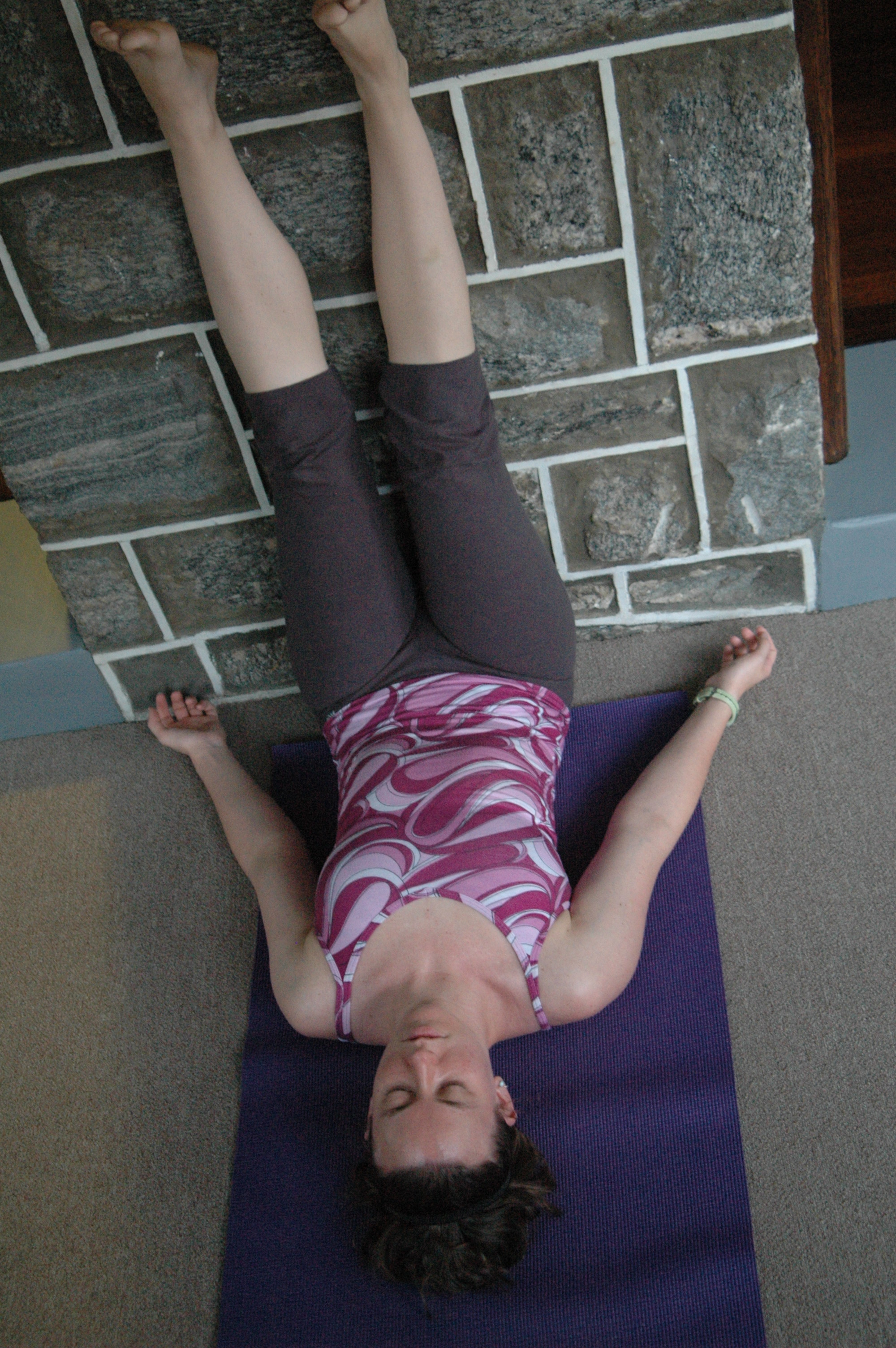
Legs Up The Wall 1Pose Name:

Legs Up The Wall

Sanskrit Name:

none

Steps:

  1. Move your mat to be perpendicular to a wall. Lie on your back on the mat.
  2. Draw your knees in and drop your legs over to one side.
  3. Skootch your tush up as close to the wall as you can.
  4. Lift and extend your legs, letting the backs of the legs rest against the wall.
  5. Rest your arms flat on the floor. Close your eyes. Relax here for a few minutes, letting the breath grow deep and even.
  6. To come out, drop the legs off to one side and skootch backwards until you’re able to roll up to a seated position.

Benefits:

This relaxing pose bestows the benefits of any inverted pose – inversions alter the flow of blood in the body, calming the mind, helping with depression, and stimulating the thyroid gland. Placing the body in an inverted pose also works the internal organs and the abdomen, aiding digestion. However, legs-up-the-wall doesn’t require the strength or stamina needed for other inversions like headstand or shoulderstand. Most students can accomplish this pose.

Contraindications:

Inversions are contraindicated for headache and high blood pressure. Some sources say not to practice inversions while menstruating.

My Experience with Legs Up The Wall:

When I was taking vinyasa yoga classes, I had never heard of this pose, so I only began practicing it in the past few years. I love how relaxing the pose feels, how I’m able to let my mind rest. I also love the simplicity of it – I’m able to achieve this pose no matter how I feel that day. As a teacher, my only frustration with legs-up-the-wall is that my front porch doesn’t have enough wall space for all the students in my little class to be able to do this pose at once!

Legs Up The Wall 2


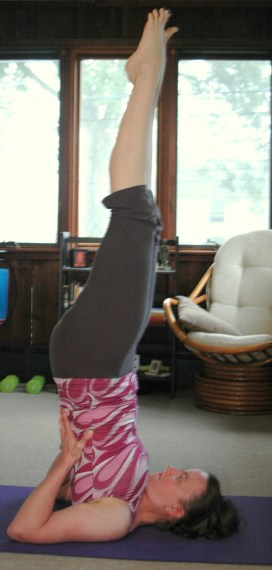
Pose of the Month: Shoulderstand September 12, 2011

Filed under: Pose of the Month,yoga — R. H. Ward @ 8:28 pm
Tags:

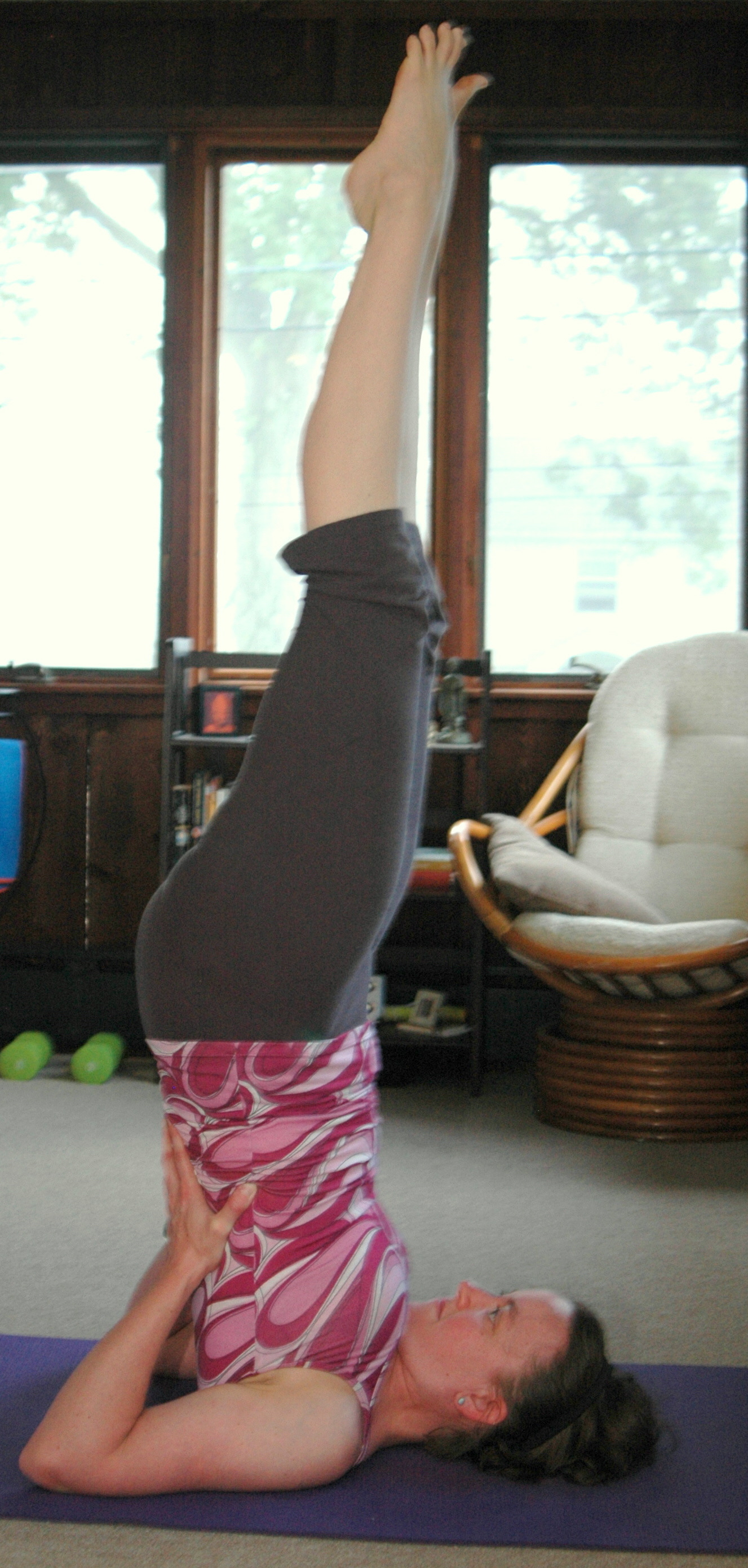
Shoulderstand 1Pose Name:

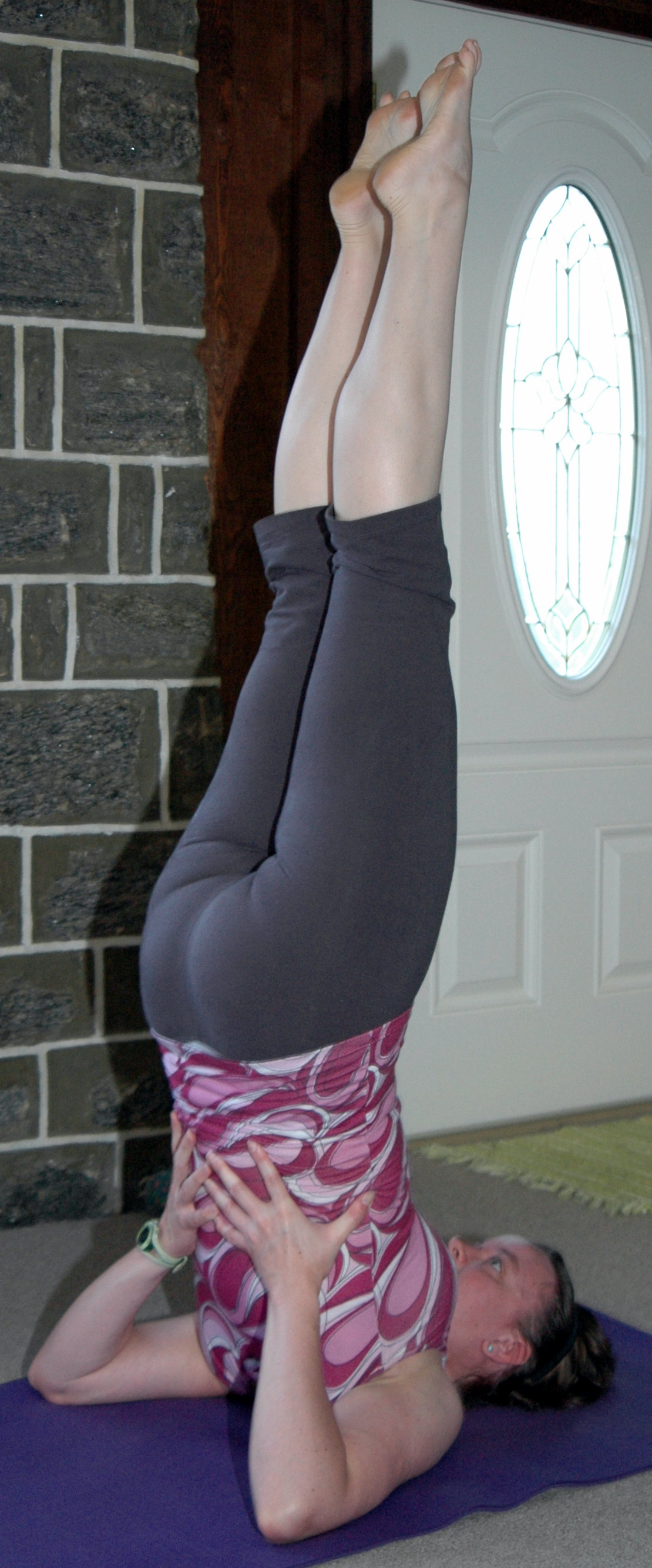
Shoulderstand

Sanskrit Name:

Salamba Sarvangasana (“salamba” means “supported”; there are other forms of shoulderstand practiced without arm support)

Steps:

  1. Begin by lying flat on your back on the mat. Bend your knees and walk your feet close to your sitting bones.
  2. Pressing your arms into the mat, lift your legs, curling your thighs in to your chest and your knees toward your face, lifting your pelvis and back off the floor.
  3. Shimmy your shoulders together underneath you. Place your palms against your back for support. Press your upper arms into the floor and lift the pelvis to be over the shoulders, so that the torso is perpendicular to the floor.
  4. Try to work the elbows closer together so that the upper arms are parallel. As you lift, walk the hands up your back (towards the floor) – this will give you more support as you lift your hips. (It may help to put your palms against the skin of your back; if you find your hands slipping, try lifting your shirt and placing the hands against your skin.)
  5. Begin to lift the legs into the air. Bring the thighs and finally the lower legs in line with the torso, so the whole body is a long, straight line perpendicular to the floor.
  6. Find your balance here. Your weight should be in your upper arms, your shoulders, and a little on the back of your head – there should be no weight or pressure on the neck.
  7. Press the legs together. Press the balls of the feet toward the ceiling. Activate your thighs, buttocks, and abdominal muscles to help hold you up.
  8. Keep breathing. Keep the body active throughout the pose; press through the upper arms and keep the shoulders engaged.
  9. To come down, gently lower the legs, bringing the knees down to rest on the forehead.
  10. If you wish, take plow pose: lower your toes to the floor above and beyond your head, extending the legs and keeping the torso perpendicular to the floor. Clasp the hands behind your back and press the arms into the floor.
  11. Coming out, keep your head resting on the floor and press your fingertips into the floor while you gradually roll out on a curved spine. Follow shoulderstand with fish pose as a counterpose.

Shoulderstand 2Benefits:

Shoulderstand is known as the queen of yoga postures (headstand is the king). Inversions alter the flow of blood in the body; this can calm the mind, help with depression, and stimulate the thyroid gland. The muscle control needed to hold the body in an inverted pose works the internal organs and the abdomen, aiding digestion, and builds strength, toning the legs and buttocks. Shoulderstand, when done properly, stretches the neck (when not done properly, it can turn into neckstand, which hurts the neck, so care is needed!).

Contraindications:

Those with serious neck injuries should not practice shoulderstand, or should do so only under the supervision of an experienced instructor. Using a stack of folded blankets to support the shoulders will help those with neck problems to practice the pose.

Shoulderstand is contraindicated for headache and high blood pressure. Some sources say not to practice inversions while menstruating. If the student is experienced, shoulderstand can be practiced until late in pregnancy, but if you don’t already practice the pose, you shouldn’t begin practicing shoulderstand after becoming pregnant.

My Experience of Shoulderstand:

When I was a teenager, I didn’t have a phone in my room, so I always used the one in my parents’ room. The second floor of the house had been converted from an attic into bedrooms, so on one side of my parents’ room the ceiling slanted all the down to about two feet off the floor. As a teenage girl spending long hours on the phone, I sometimes got bored and would lie on the bed and walk my feet up the ceiling. So, when I attended my first yoga class years later, I had no trouble doing shoulderstand – it was just like talking on the phone in my mom’s room! Being a silly teenager had paid off for once; I’d been doing a supported shoulderstand for years and was comfortable with both the mechanics of the pose and with being upside down in general.

As I progressed through my yoga practice, my shoulderstand has improved even more, especially recently as I began paying close attention to the logistics of each pose with an eye to teaching. Now my husband says that my shoulderstand looks kind of freakish, like my head isn’t attached to my body, which I think means that I’m doing it right.

Unfortunately, not everyone grew up in my parents’ house, and for many people shoulderstand is really challenging. I’m discovering this firsthand by teaching a small weekly class at my home. Teaching shoulderstand for the first time was hard for me, and a few of my beginning students just couldn’t do it. One person will need to work on her core strength to make this pose achievable. I want to try teaching the pose with blankets for additional support, and I also want to teach some other inversions so that students who can’t manage shoulderstand yet will have some other options.

Back to my own practice, I really enjoy shoulderstand: how strong I feel in the pose, and the feeling of being upside down. For right now I am taking a break from doing headstand because of neck pain, so coming back to shoulderstand feels good and helpful.


Pose of the Month: Kneeling Twist / Thread-the-Needle August 22, 2011

Filed under: Pose of the Month,yoga — R. H. Ward @ 2:12 pm
Tags: ,

Thread the Needle 1 - Side StretchPose Name:

Kneeling Twist / Thread-the-Needle

Sanskrit Name:

I can’t find a specific Sanskrit name for this one.

Steps:

  1. Begin on hands and knees with a neutral spine. Make sure that the knees are right below the hips and that the wrists, elbows, and shoulders are in a straight line.
  2. Inhaling, life your right arm up to the ceiling. Keeping hips centered, stretch up.
  3. Exhaling, bring the right arm down, under the body, and out under the left arm. Rest the right arm and shoulder and the right temple on the floor.
  4. Rest here, or if you want a deeper stretch, extend the left arm to the ceiling.
  5. Relax into the pose, breathing deeply.
  6. When you’re ready, bring the left arm down and plant the hand on the floor. On an inhale, unwind, lifting the right arm and stretching up toward the ceiling.
  7. Release and return to a neutral tabletop pose. Repeat the twist on the other side.

Benefits:

Twisting poses compress the internal organs, releasing toxins and cleansing the body. Twists are beneficial for abdominal health. This pose also incorporates a side stretch that opens the chest.

Contraindications:

This pose is contraindicated for students with serious back/spine injuries. Pregnant students should be cautious with any twist and may want to consider doing Cat/Cow instead.

My Experience of Kneeling Twist / Thread-the-Needle:

Before coming to my current yoga center, I rarely did this pose, but now I practice it regularly both in class and at home. J often uses this pose as part of his warm-up sequence in class, and so I’ve really come to like the pose. The twisting action and side stretch begin to wake the body up for practice and also calm the mind, readying it for practice as well. The pose is refreshing by itself and makes a good warm-up too.

Thread the Needle 2 - Twist


Pose of the Month: Seated Cross-Legged Twist August 15, 2011

Filed under: Pose of the Month,yoga — R. H. Ward @ 2:06 pm
Tags: ,

Pose Name:

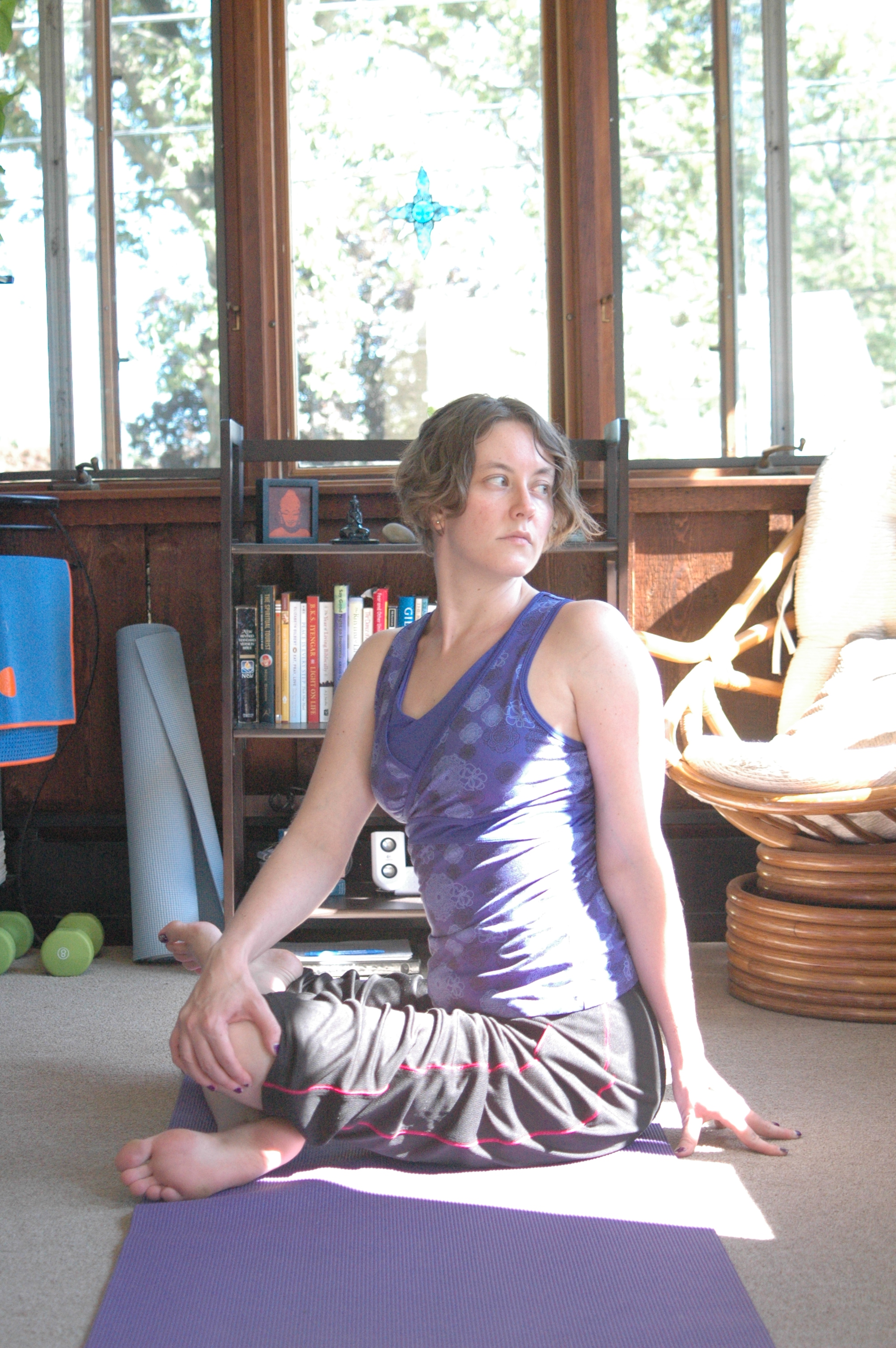
Seated Cross-Legged Twist

Sanskrit Name:

It’s possible to add a twist to Sukhasana (Easy Pose), Agnistambhasana (Fire Log Pose), or Padmasana (Lotus Pose), depending on the ability of the student.

Steps:

  1. Come to a comfortable cross-legged position. (Take Lotus Pose if you’re able, or stack your calves so the ankle of the top leg is directly above the knee of the bottom leg for Fire Log Pose, or simply sit comfortably in Easy Pose.)
  2. Sitting up straight, bring your right hand to your left knee.
  3. Keeping your spine straight, raise your left arm to shoulder height. Lift the arm up and overhead, then turn to drop it down behind you, placing the hand right next to your hip. (Placing the hand too far behind you will have you leaning over backward.)
  4. Turn and look over the left shoulder. Let your eyes rest on a point as far to the left as you can see. Your body will naturally follow your gaze and twist more deeply into the pose.
  5. Continue to breathe smoothly and evenly as you twist.
  6. Inhaling, look toward the front of the room, then lift your left hand and stretch the left arm overhead, reaching toward the front wall for a side stretch. Feel the stretch all down the left side. You may want to grip your right hand into your left knee for leverage to stretch further. Take a slow, deep breath.
  7. On an exhale, drop the left hand to the right knee, and then fold forward over your crossed arms. Breathe into your belly.
  8. Inhaling, release and come back up to seated. Change your legs and repeat the sequence on the other side.

Benefits:

Twisting poses compress the internal organs, releasing toxins and cleansing the body. Twists are beneficial for abdominal health. This pose also incorporates a side stretch that opens the chest and a forward fold which further works the abdomen.

Contraindications:

This pose is contraindicated for students with serious back/spine injuries. Pregnant students should be cautious with any twist and with folds.

My Experience with Seated Cross-Legged Twist:

I first learned this little twisting sequence from a teacher at Yoga on Main in Manayunk and I practice it frequently. I like how it combines a twist with a side stretch and a forward fold, neatly and economically stretching a variety of muscles. I appreciate the simplicity of the leg position that makes the pose accessible to students at any level. My mind stays engaged as I move through the variations, and I find the forward fold at the end gives a feeling of completion.


Seated Cross-Legged Twist 2

Seated Cross-Legged Twist 1


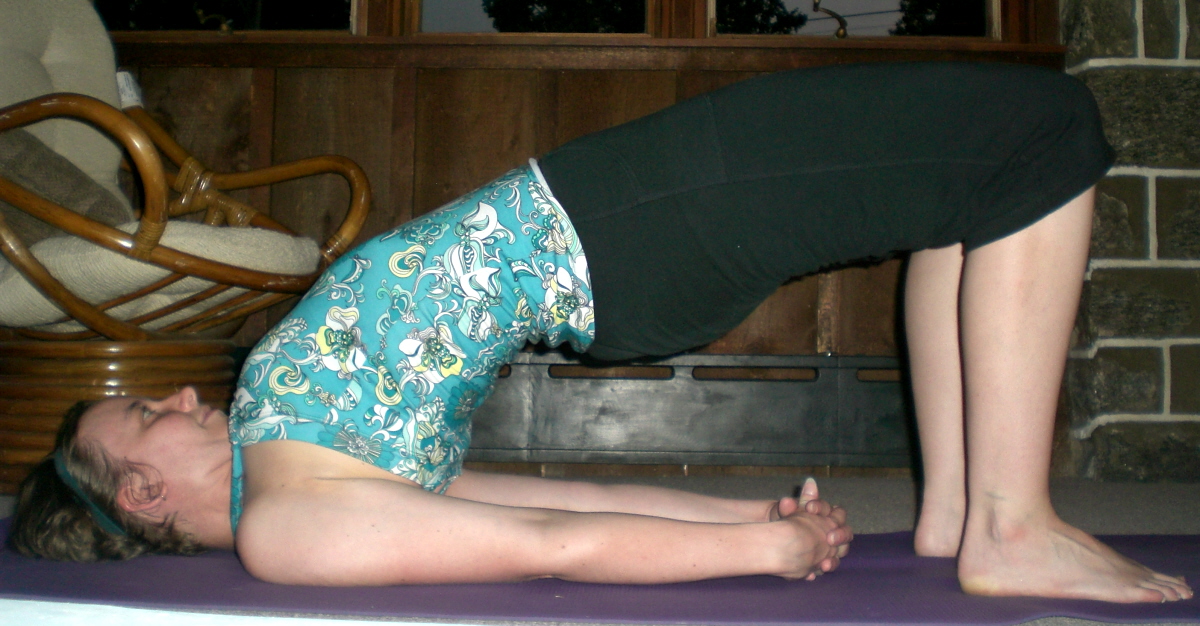
Pose of the Month: Bridge Pose July 25, 2011

Filed under: Pose of the Month,yoga — R. H. Ward @ 2:35 pm
Tags: , ,

Pose Name:

Bridge Pose

Sanskrit Name:

Setu Bandha Sarvangasana

Steps:

  1. Begin by lying on your back on the floor.
  2. Bend your knees and place your feet flat on mat. Skootch your heels as close to your tush as you can.
  3. Tuck your chin.
  4. On an inhale, press your arms and feet into the floor and lift your hips into the air.
  5. If you wish, you can grab the edges of your mat with your hands, or you can clasp your hands under your back, rolling your shoulders under to open the chest even more. You can also lift your hands to support your lower back, pressing your upper arms into the floor.
  6. Continue lifting and extending the hips as high as you can. Keep the legs and feet parallel. Don’t forget to breathe!
  7. Exhaling, unclasp your hands and gently lower down to the floor. Hug your knees into your chest.

Benefits:

Bridge pose is a backbend, stretching back muscles and helping to relieve back pain, as well as a chest opener, stretching the muscles of the chest, which can improve and expand breathing. Bridge also works the muscles in the tush and abdomen. The pose stimulates abdominal organs and can improve digestion.

Counterindications:

Those with back injuries may want to avoid this pose. Those with neck injuries may want to place a folded blanket under the shoulders to protect the neck and should only practice the pose under an experienced teacher’s supervision.

My Experience of Bridge Pose:

I’ve practiced bridge pose for many years now, and my practice has grown and changed with time. When I lived in Boston, my teacher there emphasized working with the pose dynamically, coming into and out of it repeatedly. We would often do 20-30 repetitions, as if we were doing situps or pushups. Since moving to Philly and taking up a classical hatha practice, I’ve now learned to hold Bridge pose for several breaths. The two practices lead to very different experiences of the pose! I enjoyed working with Bridge athletically, and at first I resisted staying in the pose for a longer time; now I can appreciate settling in to the pose and feeling the stretch through my chest and back. I enjoy the calm, pleasant feeling I get when I practice Bridge pose.

Bridge Pose


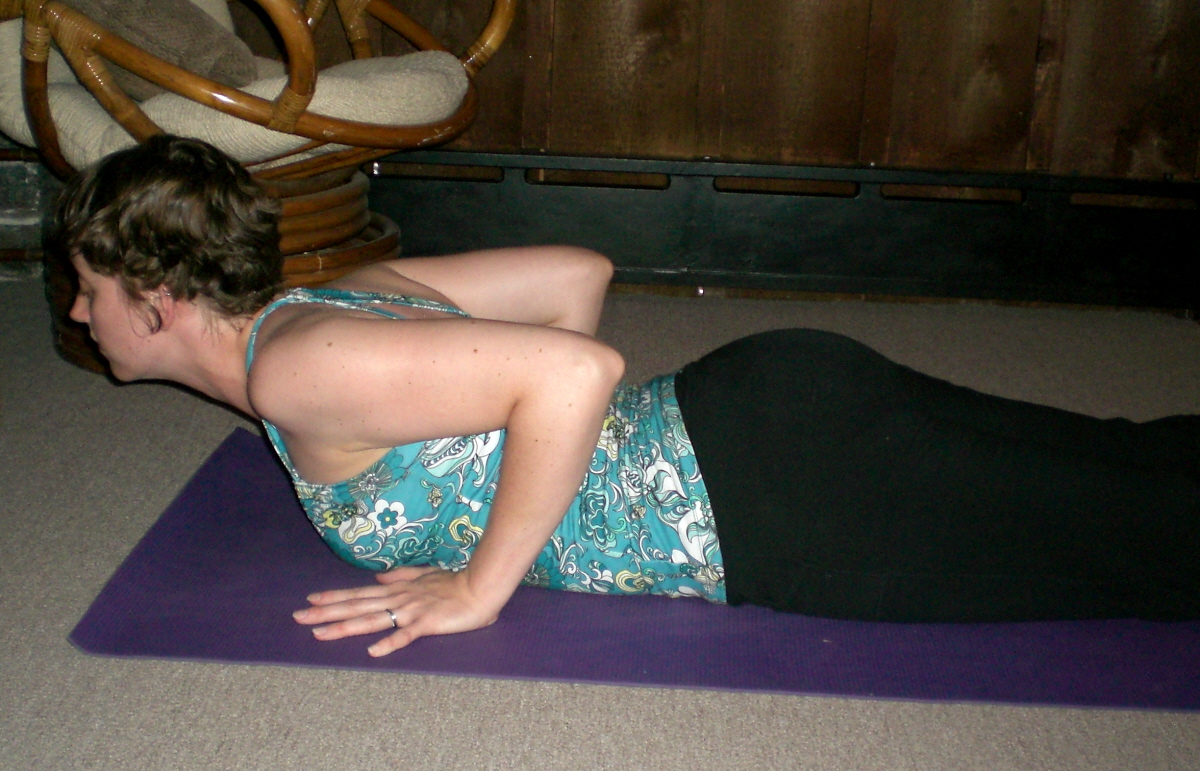
Pose of the Month: Cobra Pose July 17, 2011

Filed under: Pose of the Month,yoga — R. H. Ward @ 2:14 pm
Tags: ,

Pose Name:

Cobra Pose

Sanskrit Name:

Bhujangasana

Steps:

Cobra pose is frequently practiced as part of the classic sun salutation sequence. If you are practicing cobra during sun salutation, you’d move through the sequence until you come to plank pose, then gently lower your belly down to the floor. Cobra can also be practiced independently: begin by lying on the floor on your belly.

  1. Place the hands lightly on the floor, palm down, under the shoulders. Hug the elbows against the body. Legs are active but relaxed, with the tops of the feet resting on the floor.
  2. Press the legs firmly into the floor. Using only your back and abdominal muscles, lift your head and shoulders off the floor.
  3. Press your shoulders back, opening your chest. Check on your elbows, making sure they are tucked back, keeping your forearms parallel to each other. Close the eyes or gaze at an unmoving point on the floor in front of you.
  4. All the effort of the pose should be in the back, not the arms – you should be able to lift the hands up off the floor.
  5. For a deeper variation, press through the hands, begin to straighten the arms, and lift yourself into a deeper backbend. Extend the neck and stretch the crown of your head toward the ceiling.
  6. Breathe deeply, extending further into the pose on each inhalation.
  7. To exit the pose, gently lower yourself down to rest fully on the ground. If you’re practicing sun salutations, exhale and press back to downward-facing dog.

Benefits:

Cobra pose is a backbend and chest opener. It keeps the spine healthy and expands the chest.

Counterindications:

Those with lower back problems should be very gentle with this pose, practicing only the basic pose and not pressing with the arms. Those with wrist problems may want to practice a different backbend like sphinx that puts less pressure on the wrists.

My Experience of Cobra Pose:

The vinyasa yoga classes I attended in the past emphasized practicing upward-facing dog during sun salutations, so I rarely practiced either sphinx or cobra before coming to East Eagle Yoga, and never really understood before that these poses could substitute for upward dog in a sun salutation. Since beginning my practice at East Eagle, I’ve really enjoyed playing with these poses, especially because upward dog tends to make my back hurt if I hold it too long. At first I felt like I was taking a step backward by choosing cobra over up dog, but now cobra pose has become a really good alternative for me – as a gentler backbend, it allows me to work my back muscles without my arms forcing me into an uncomfortable posture. Also, practicing cobra at the beginning of my practice warms my back up and prepares it for more intensive stretches later on. I like the feeling of opening in my chest that I get when I do cobra pose. Even more, I like the feeling that I’m protecting and strengthening my spine.

Cobra Pose


Pose of the Month: Wide-Legged Standing Forward Fold June 26, 2011

Filed under: Pose of the Month,yoga — R. H. Ward @ 1:59 pm
Tags: , ,

Wide-Legged Standing Forward Fold 1

Wide-Legged Standing Forward Fold 2

Wide-Legged Standing Forward Fold 3

Pose Name:

Wide-Legged Standing Forward Fold

Sanskrit Name:

Prasarita Padottanasana

Steps:

  1. Begin in mountain pose (tadasana). Step your right foot back into a wide-legged stance. Your feet should be approximately 3-4 ft. apart – about the length of one of your legs.
  2. Point both feet towards the side wall and face the wall. The feet can be parallel or slightly pigeon-toed, but should not angle outwards.
  3. Placing hands on hips, come into a slight backbend, extending the front line of the body. Then keep your front torso long while bending forward from the hips.
  4. As your torso begins to come parallel to the floor, drop your hands to the floor right below your shoulders. Begin to walk your fingertips back  between your feet. If you have the flexibility, walk your hands back until your forearms are perpendicular to the floor and your upper arms parallel. Be sure to keep the arms parallel and don’t let your elbows wing out to the sides. If it’s comfortable, rest the top of your head on the floor.
  5. For an alternate stretch, you can grab the big toes with the first two fingers and thumb of each hand; wrap hands around ankles; or clasp hands behind your back and lift the arms up.
  6. Press your weight into the whole foot: don’t let the weight rest in the outside edges of the feet but press through the inner foot, and keep your weight balanced between ball and heel. Breathe deeply, continuing to extend and bend deeper, keeping the back flat and the front of the body long.
  7. Bring your hands back to center, right under your shoulders. Slowly walk your feet in until they’re hip-width apart. Bend the knees, clasp your hands around opposite elbows, and relax, shaking your head to release tension in your neck.
  8. Slowly roll up to standing, one vertebrae at a time, keeping knees bent. Your head should be the last thing to come up. Close your eyes and breathe here for a moment before returning to your practice.

Benefits:

Prasarita increases strength in legs and feet and stretches inner legs and the backs of the knees. Forward folds are beneficial for digestion and the internal organs, and can help to calm the mind. The pose can also be helpful for mild backaches and headaches.

Counterindications:

Students with lower back problems or knee problems should take care and work very gently with this pose. Pregnant students should be careful in any forward bend. Those with balance problems may want to practice at the wall and should come up slowly; those with low blood pressure should move very slowly into and out of the pose to avoid getting dizzy.

My Experience with Wide-Legged Standing Forward Fold:

Prasarita has always been difficult for me – I find it painful on my outer calves and outer ankles, and also on the backs of my knees. Because of this discomfort, I don’t usually practice prasarita at home, so I decided to challenge myself by choosing this pose to work on this month.

I was surprised to find another source of discomfort in this pose that I hadn’t known about: I realized that the pose makes me uncomfortable because my head is so close to the floor. I know that many yogis come into headstand from this posture, and I don’t yet have the confidence to do headstand away from the wall. I think prasarita makes me uncomfortable for this reason, because it brings me close to a pose that makes me nervous.

Practicing prasarita this month more intensively hasn’t caused any great changes in my experience of the pose – I still feel pain in my legs, and I still feel uncomfortable in the pose. However, I think I have a better understanding of my feelings now and can work more mindfully on the pose in the future.


Pose of the Month: Ardha Chandrasana / Half Moon June 24, 2011

Filed under: Pose of the Month,yoga — R. H. Ward @ 1:42 pm
Tags: ,

Pose Name:

Half Moon Pose

Sanskrit Name:

Ardha Chandrasana

Steps:

  1. Begin in a wide-legged stance, right foot facing toward the front of the room, arms spread wide. (For example, it can flow nicely to go from a wide-legged pose like Warrior 2 or Triangle pose into Half Moon.)
  2. Cartwheel the arms down so that the hands come to the floor on either side of the front right foot. Walk the hands forward a bit, about 6-12 inches in front of the foot.
  3. Press into the hands and the right foot, straighten the right leg, and lift the back foot off the floor. Try to lift the left leg to hip height.
  4. Extend actively through the left foot to keep the left leg raised up strongly, but don’t lock the left knee.
  5. When you feel steady, lift the left hand off the floor. You can bring the hand to your left hip and open the chest; to go deeper, raise the left arm straight into the air.
  6. Now you’re balancing on your right foot and right hand, with your left leg and left arm making the shape of a half moon. Most of your weight should be on the right foot, with your hand just providing balance as you need it.
  7. Breathe here. Focus your gaze on a point in front of you, and use your ujjayi breath to help balance. If you feel steady, you can raise your eyes up to look at your left hand.
  8. Bring the left hand down to the floor, then gently bring the left leg down. You can come back into your wide-legged stance, or you can bring the left foot together with the right foot at the top of the mat.
  9. Come back up to standing, bringing hands to a prayer at your heart.
  10. Complete the pose on the other side.

Benefits:

Ardha Chandrasana is excellent for improving balance. Because it works the standing foot strongly, it’s good for the health of the foot. The pose also benefits the core muscles and improves strength in the raised arm and leg. Half moon pose can also help with conditions like indigestion, constipation, menstrual pain, fatigue, and backache.

Counterindications:

Half moon pose may be quite difficult for someone with balance problems. Such students can try to practice the pose at the wall for added stability. This pose also puts some strain on the standing leg, so those with leg injuries should take care. If you have neck problems, keep the gaze focused on the floor and keep the neck long and even. Low blood pressure is another counterindication for this pose.

My Experience with Half Moon Pose:

I’ve hated half moon pose for years. I tend to dislike all the forward-bending balance poses: half moon, warrior 3, and standing split are all very uncomfortable, so this month I decided to challenge myself and practice half moon regularly. I’ve even been practicing the pose in the kitchen while cooking dinner! In addition to my home practice, I also attended N’s Tuesday night class several times this month, where she had us do a series of balance poses strung together, including half moon. These sequences were really difficult for me – when doing one or two balance poses and then coming down, I can do well, but several all at once without a rest was challenging.

I think that one thing I don’t like about poses like half moon is that the forward bending action makes me feel off-balance. In poses like tree or dancer, I’m standing up tall and can see what’s going on around me, but in a forward-bending balance, I’m relying on just my leg, and if I fall, my head is a lot closer to the ground. I wobble much more in half moon than I do in an upright pose like tree, even though in half moon I have two points of contact with the floor. I think the change in my center of gravity, plus the discomfort of trying to balance while bent over with my head close to the ground, have combined to make me dislike half moon pose and the other poses like it.

Working on half moon pose this month, I feel like I’ve identified why I don’t like the pose as well as the areas where I feel physical discomfort – the pose seems to put a lot of strain on my standing leg, for example. After practicing the pose frequently this month, I do feel stronger and more balanced in it. I want to cultivate a feeling of lightness and ease in the pose. Before this month, I didn’t like the pose so it was never a part of my home practice; from now on, I want to continue to practice the pose regularly and see where it takes me.

(Photo artistry by F. The yoga room is too small for him to fit all of me in one shot, so he took a bunch and collaged me together.)