Rox Does Yoga

Yoga, Wellness, and Life

Every Day May 3, 2012

Filed under: reflections,yoga lifestyle — R. H. Ward @ 3:02 pm
Tags: , ,

Lately I feel like I’ve been getting hit with a lot of requirements and tasks that I should be doing “every day”. Being pregnant, there are a whole slew of things that I’m supposed to do: eat healthy foods, take vitamin supplements, watch my protein intake, get plenty of sleep, do prenatal exercises. I’m supposed to do daily “kick counts” to keep track of the baby’s activity level at different times of day, so I’ll know if suddenly he or she is less active, since that could be a bad sign. And now that I’m farther along, I have a host of tasks I’m supposed to accomplish every day for my childbirth class, like listening to my joyful pregnancy affirmations CD and practicing my hypnosis techniques. And all the pregnancy daily tasks are in addition to the things I do regularly and have a passionate interest in. I want to practice my yoga and my meditation every day, write in this blog, keep up with reading to improve myself as a yogini and as a teacher. And then there’s my writing – I should certainly be doing that every day, especially if I don’t want to lose track of myself as a writer in all this motherhood stuff. I need to be reading poetry, writing new poems, revising my poems. I need to go to work every weekday, too, commuting there on the train and then completing all the variety of tasks that make up the job for which they pay me. And all of that is in addition to the regular tasks of daily life, like fixing breakfast, washing dishes, doing laundry, and keeping the house tidy. My husband was just away traveling for a full week, and all of those duties somehow took up most of my time when I had to do them alone. And that’s just the daily stuff. I also need to make progress on long-term projects like preparing the baby’s room, keeping up with friends and family, someday putting together our honeymoon album, sending my writing out to journals, trying to build my portfolio as a freelance writer and sending out book review and article queries to magazines, then writing the book reviews and articles. And I have to be doing all of these things, every day, while I am more consistently tired than I’ve ever been in my life, while I am metaphorically carrying around two bags of groceries at all times, while I am moving much slower than I’m used to doing.

The only thing I don’t have to do every single day is shampoo my hair, because with the preggo hormones, my hair has become thick and shiny and lustrous and for the first time since I was a kid I can go a good three days without washing it and it still looks great. And I feel so overloaded with everything else that not needing to wash and dry my hair every morning has been a gigantic relief. Two weeks ago I told F that I wanted to take a bath that night, but then said it seemed like too much work. He asked, like what, and I said, you know, like filling the tub and stuff. He looked at me like I was insane; he’d thought I was going to say something about cleaning the tub first (as it needed to be cleaned, which I’d forgotten about, and which made the prospect of my pleasant bath even more intimidating). But that’s how tired I was.

The result, of course, has been that I just ain’t getting shit done. Most days, in addition to routine life maintenance, commuting, and work, I can manage to do one extra thing. Sometimes it is a yoga thing, like teaching on Tuesday nights. Sometimes it’s a writing thing – I have a packet of poems I’ve been carrying with me on the train and I’ve been working on them slowly. Sometimes it’s cooking a fancier-than-usual meal, or paying bills, or clearing a box of crap out of the room we eventually want to put a baby in. Occasionally it’s taking a nap, but not nearly as often as my body would like. Sometimes I can do two things at once, like reading or working on poems while I’m on the train, or listening to my childbirth hypnosis stuff while I’m sleeping (which they swear works anyway). But I just can’t seem to manage doing more than the one extra thing, at least not on a week night.

My usual instinct is to get upset with myself for failing as a wife or mother or friend or independent woman. But that’s not going to do anyone one iota of good. I’m trying to practice ahimsa and satya, my two favorite yamas. Satya: The truth is that I am slow and tired and heavy, and there are many things on my plate. The truth is that I can only do what I can do. Ahimsa: There’s no use beating myself up about the things I can’t manage to do. Instead of getting upset and angry, it will be far more beneficial to me to practice kindness and love and give that to myself instead. If I’m supposed to be eating healthy foods so the baby gets good nutrition, it’s got to be at least as important to feed myself healthy emotions so the baby gets a good daily dosage of love instead of sadness.

Here are the things that I commit to doing every day:

I eat.
I sleep.
I brush my teeth.
I tell my husband I love him.
I tell the contents of my uterus that I love him or her.
I do the best I can with everything else.

And that bath two weeks ago? I cleaned the tub, I filled up the tub, and I took the bath anyway. With bubbles, and chocolate truffles. It was lovely.

 

Thoughts on Natural Childbirth April 10, 2012

Filed under: reflections,yoga lifestyle — R. H. Ward @ 2:02 pm
Tags: , ,

Recently I read a fantastic article about natural childbirth that really excited me and made me glad to be planning one: The Most Scientific Birth Is Often the Least Technological Birth. Then I scrolled down to view the comments, which I don’t recommend doing, because it left me feeling frustrated, disgusted, and honestly quite shaken by the strength and depth of people’s vitriol. To sum up quickly, some people strongly feel that all birth should happen in a hospital with an epidural and supervised by a medical doctor, while others strongly feel that all births should happen naturally at home. The whole long comment string bothered me enough that I wanted to respond.

For thousands – heck, millions – of years, women have been giving birth naturally. This is a fact, because otherwise we wouldn’t be here talking about it. Before the advent of modern medical technology, childbirth was a dangerous endeavor: there was always a percentage of women who could give birth naturally and healthfully, and a percentage who had serious trouble. These percentages vary depending on the region and culture, but overall, childbirth was feared because you never knew until you got there whether you’d die. And what modern technology has done is to remove that fear and uncertainty by making childbirth safe for those for whom it would otherwise be dangerous. This is an amazingly wonderful thing. However, there is still, as there always has been, a percentage of women for whom a natural childbirth isn’t dangerous, and to insist on applying the same technology to this group, simply because it helped the others, is to introduce costly medical procedures that may not be needed, won’t necessarily help anything, and might introduce complications. That isn’t to say that the women who need those things shouldn’t get them – I have friends who are alive today with healthy alive children because of modern medicine, which I’m incredibly grateful for. But for some women, if it’s working all by itself, why change it?

I’ve been lucky enough to have a completely normal pregnancy so far – very low-risk. Considering that I’m a vegetarian yoga teacher who practices meditation, it probably won’t surprise you to learn that I’ve planned for a natural childbirth with a midwife. I still worry about the birth – what first-time mom wouldn’t? – but I have confidence in my caregivers, in the birth center facility I’ve chosen, and in myself that I can deal with the pain. I honestly feel less scared by the idea of doing it naturally than I do about the idea of having an epidural. Personally, I feel like a natural birth is the right choice for me; yogically (because this after all is a yoga blog), I feel like a natural birth fits in well with my other life choices. In a natural birth setting I’ll be able to be in touch with my body, to move around as I need to, to let my body lead the process, and I’ll be able to control my responses to pain and manage my pain with my own mind. This path seems to fit in well with the yamas and niyamas and other tenets of yoga, which I truly believe in and follow as best I can.

However, believe me, if there’d been any indication whatsoever that a natural birth could harm me or my baby, I’d be making different plans. What’s more, my birth center would immediately refer me to a specialist if any complications came up. My birth center has a very good record (approximately 500 births per year with a c-section rate of only 10% or so), but they know their target audience (healthy women with uncomplicated pregnancies), as well as their strengths and limitations. The health of mother and baby is most important, so my midwife won’t hesitate to send me to someone else for my care if a complication arises, or, if something happens during the birth, to transfer me to a hospital. That’s why my birth center is located right across the street from a major hospital with an excellent record of maternity care, so that if any problems arise during the birth, I can be transferred quickly and efficiently for whatever services I might need. The idea of a home birth really made me nervous – for trivial reasons (like worrying that I’d spend the whole birth worrying about who’s going to clean up the mess) and for more substantial reasons (that our home is 10-15 minutes away from the nearest hospital, which is not a hospital known for maternity care). Using a birth center seems like the perfect choice for me, because it will allow me to have a natural birth in a comfortable setting, attended by experienced professionals, with proximity to all the wonders of modern technology if I need them.

So, going back to that original article, I think that the people making virulent comments about the cult of natural childbirth are not exactly accurate. My experience so far has been that my midwives and nurse practitioners are all eminently reasonable people, knowledgeable and well educated in their field, and worthy of being trusted to put my and my baby’s health and safety above anything else. No, natural childbirth isn’t for everyone – and two months from now, depending on the circumstances, it may even turn out that natural childbirth isn’t for me. But technological interventions aren’t for everyone, either, and each woman should be able to decide for herself in conjunction with her caregiver about what path is best for her.

(In commenting, please remember that this is a personal blog and I reserve the right to delete any comment that I feel is rude or derogatory. Thank you.)


Reading Yoga Journal March 27, 2012

At the end of my teacher training (and beginning of my pregnancy), I started to get a little burned out on my yoga reading, so I have a pile of Yoga Journal back issues sitting around that I’ve been trying to work my way through. I recently read the December 2011 issue and was pleased to find some articles related to things I’ve been blogging about here lately, so I thought I’d share.

The first thing that really caught my attention was a short article about teaching yoga to Deaf students, since that’s a topic I’d never really thought about, but a Deaf person could walk into my yoga class anytime. There are some simple things a yoga teacher can do to make a class more accessible for a Deaf student, like making eye contact, demonstrating poses, and using touch to guide. These are easy things to do that wouldn’t disrupt my usual teaching rhythm at all but that I wouldn’t have thought of on my own, so I was grateful that this article broadened my awareness. Definitely tore that one out for future reference, and in the future I’d be really interested to learn more – the DeafYoga Foundation offers trainings and presentations on how to make simple adjustments that really help Deaf students, and I’d love to attend one.

There was an article on Chair Pose that I really appreciated, since Chair is one that I struggle with a bit (see the comments here and my write-up from last year here). They describe the alignment bit by bit – getting the top half of the body aligned correctly, then getting the lower half aligned, and then putting the two together for the full pose, which is an interesting bit of yoga dissection. I can see myself coming back to this article for reference later, since they give some good tips.

This issue of YJ also includes a moon salutation sequence as an alternate to sun salutations, which I found really interesting. I haven’t tried it yet, and it could end up being a little flowy for me, but it’s definitely something I want to try. I’ll keep you posted!

I was also really interested in the article on yoga and religion. Regular readers will recall that this is an issue I’ve done some serious thinking about here on the yoga blog. I really appreciated that YJ put together a panel to discuss this. After reading the article, I went back to the March 2012 issue that I’d read a few weeks earlier, and there were several letters from readers about this article, some of whom really liked it. One reader noted that the article might have had more depth if the panel had included some actual religious leaders (priests, nuns, rabbis), rather than just yogis, which was an interesting point. I was glad, though, that Brooke Boon, the founder of Holy Yoga, a Christian ministry group, was included on the panel. I’m really interested in the intersections of yoga with personal faith, and the article gave me some new perspectives and talking points. I wish YJ made its back issues available online.


Yoga in the News: Ashtanga Article in Vanity Fair March 19, 2012

Filed under: reflections,yoga — R. H. Ward @ 1:15 pm
Tags: ,

I just read this interesting and detailed article on Vanity Fair’s website: Whose Yoga Is It, Anyway? Kind of a fascinating look at the inner circle(s) of the Ashtanga community, especially after the recent Anusara blow-up. It sounds like the combination of lots of money, commercialization, yoga superstardom, passion about the core teachings, and the passing of a revered teacher is making a lot of waves. Overall I found it interesting to learn more about the Ashtanga lineage and wider community, even if that community is feeling some tension of late.

I know that many people really value having a deep connection to a special teacher or guru. I do know my lineage as a yoga teacher – who my teacher J studied with in India, and who that teacher studied with, rooting the yoga that I teach in a tradition that I’m proud to carry on. But at times like this, I think I’m glad not to have a personal connection with a guru. As we’ve all seen with John Friend and others like him, even revered yoga teachers are still fallible humans, and even when the teacher is as kind and lovely as Ashtanga’s Jois seems to have been, his successors won’t necessarily have the same qualities or goals. I don’t intend to demean the personal and spiritual connection of working directly with a guru or being part of that sort of close-knit yoga community; not having experienced it, I don’t want to pretend to understand how enlightening or intense that could be. What I do have, though, is my yoga. Because I’m a generation or two removed from the renowned teachers, I can always find strength and comfort in the yoga I practice and in passing that tradition on to my students, without having to worry about personal drama or community upheaval, and that’s something I appreciate.


Yoga and Sex Scandals March 2, 2012

Filed under: reflections,yoga,yoga lifestyle,yoga philosophy — R. H. Ward @ 1:30 pm
Tags: ,

Did anyone see this recent New York Times article about yoga and sex scandals? On one hand, it’s interesting to see collected in one place a listing of yogis who’ve been involved with such scandals – I’d heard about Swami Rama, but not Satchidananda, and I hadn’t heard about John Friend yet. (I guess I was more interested in reading their works on yoga and spirituality than in what they might have done behind closed doors – which is the perspective that I think most educated yogis will have – although I cannot imagine being part of a close-knit spiritual community when such a horrid act is suspected of someone so admired and trusted.)

On the other hand, sexual scandals can occur when any individual is put up on a pedestal. Tiger Woods, anyone? Too much power can go to anyone’s head. Of course such a thing is only compounded when it occurs in a spiritual community. I’ve read about Tibetan monks who let themselves get out of hand, even giving up their vows to get married, and typically we think of them as above that sort of thing. There are also countless stories of Christian preachers who took advantage where none should have been taken, and we won’t even discuss Catholic priests. William J. Broad, the NYT author, makes sex scandal out to be something unique to yoga, and in no way is that true.

Broad also suggests that, in addition to sex scandal being a yoga thing, it’s due to yoga’s roots in tantric theology. He really manages to dumb down (or sex up) tantra and the theories behind it. Having written an entire book about yoga, one would assume that Broad has read the Yoga Sutras of Patanjali and hopefully the Bhagavad Gita, which are the books that I was taught are the foundation of yoga. I’ve read them too, and read two different translations of each, and I found no kinky sex stuff. And believe me, if there is kinky sex stuff to be found, I’m somebody who will notice it (see my review of Moola Bandha: The Master Key, a review which I know I wrote but somehow seems to have been infiltrated by a 13-year-old boy there at the end). There ain’t no kinky stuff in the Yoga Sutras, so I must make one of the following conclusions: (1) Broad is mistaken that tantra is the founding system that produced yoga, and yoga arose out of just plain ol’ Hinduism, or (2) tantra is a much wider system, encompassing much more than the sex Broad so readily brings up. Either way, he’s doing his readers, and the NYT readers, a disservice.

On a related subject, wait a sec, wasn’t William J. Broad the same guy who wrote the inflammatory article “How Yoga Can Wreck Your Body“? Why is the New York Times accepting multiple articles from this biased author? Because controversy sells, I guess? (And apparently because he’s won some Pulitzers? 🙂 ) It’s not selling to me, I can tell you that; I won’t be buying Broad’s book and one would think I’d be in his target audience. I heard an interview with him on NPR not long ago and was struck by how different he seemed “in person” over the radio than he did in the body-wrecking article; he talked candidly and thoughtfully about how an injury made him rethink and restructure his yoga practice, but these articles make him seem like an anti-yoga crusader. That sucks because based on the NPR interview I have the feeling I’d have some good conversations with Broad in person (I tuned in mid-way through and was frankly surprised at the end when they announced his name – “Wait, that‘s the yoga-will-wreck-your-body guy?!”), but if these articles are examples of the sort of writing in his book, I feel offended and will never read it. Here’s a summary of the NPR interview and a link to listen to it – I’m struck by how different Broad’s tone is in these quotations compared with his own writing in the NYT. Anyway, if Broad’s a science writer, why is he writing articles about yoga and sex scandal anyway? Writing one book about yoga and science doesn’t make one an expert in all aspects of yoga, especially not in yoga spirituality. If you’re looking for a semi-to-non-expert, you might as well hire me, New York Times. (Psst, I’m available.)

Here’s another response to the sex scandal article (the punctuation and grammar are less than stellar, but the writer is clearly coming from a passionate interest in yoga and spirituality, and I happen to think (although it hurts me to do so) that the finer nuances of apostrophes are not an essential component of a yoga education). Anyway, just another set of thoughts from someone who appears to know a little more about tantra than I do. (Believe me, I’ve got some tantra books on my reading list for this year!)


2012 goal update February 22, 2012

Filed under: checking in,reflections,yoga lifestyle — R. H. Ward @ 1:03 pm
Tags: , ,

Back in January, I did some thinking about my plans and expectations for the coming year. I thought it might be useful to check in and see how I’m doing with all the various goals I came up with.

  • Get registered with Yoga Alliance.(Check!)
  • After registering, look into yoga teacher insurance. (Still need to do this.)
  • Turn this blog into an official website with a schedule and more information about me.(I feel good on this one – if you look around and think I’m missing anything, let me know!)
  • Start a Facebook page for RoxDoesYoga separate from my personal FB to make it easier for yoga friends and potential students to find me. (Done!)
  • Keep up my ties with EEY, the yoga center where I completed my training, by attending hatha yoga class there at least once per month. (January and February: check.)
  • I also hope to attend any special events or workshops that come up at EEY, and teach as a sub there as opportunities arise. (See below…)
  • Reach out to new studios and make connections with other local yoga teachers by attending at least one new yoga class per month. I’d love to start building a new yoga community a little closer to home than EEY and look into teaching opportunities with other yoga centers. (This is such a hard one. I’ve gotten it done for January and February, hitting classes at Enso and Awaken respectively, but I’m not sure how much more reaching out I’ll be able to do. The teaching opportunities have been fast and furious, however.)
  • Keep teaching my weekly Front Porch Yoga class for private students at my home, at least for the next few months. This class will continue to be free, since these students are my friends and their interest in yoga and continued dedication to showing up at my house has provided me with invaluable teaching experience. For now, I really want to stay in practice as a teacher and not lose my confidence, and continuing the free Front Porch class will help me do that.(Front Porch Yoga is now canceled so I can focus on my yoga teaching in other venues.)
  • Begin exploring other yoga teaching opportunities. This is a little more vague, since I’m not sure what’s out there. Some ideas include teaching a discounted class for my neighbors at our town community center, or seeing if the dance studio in the next town over might be interested in starting a yoga program. (I think this resolution will need to be postponed to much later this year, if at all – there’s only so much teaching I can do with a day job!)
  • Continue to challenge myself with reading books on yoga and meditation, with a goal of one yoga-related book per month. (I didn’t succeed with this, although I managed to read the current issue of Yoga Journal and I’m almost done a meditation book. This isn’t turning out to be a good time in my life for reading.)
  • Contact Yoga Journal and other related magazines to look into writing book reviews for publication. (Still need to do this.)
  • Maintain my personal yoga practice. My goal is to fit in some sort of practice every day, whether it’s an hour-long class or three sun salutations. I want to work on practicing pranayama and meditation daily. (This is probably the hardest goal on this list. I am really, truly trying. Sometimes I’m too tired, and sometimes I just forget.)
  • Continue this blog by posting 2-3 times per week. I figure all the goals and plans I’ve listed here will give me plenty to write about! (I missed the end of January/beginning of February due to travel, but otherwise I’ve kept up with the 2-3 times per week goal.)
  • Look into and begin researching prenatal yoga.

That last one is taking off a bit, not entirely through my own initiative. It turns out that the person who has been teaching the prenatal yoga class at EEY has moved to Florida; N needed someone to fill in, and of course she thought of her pregnant former student! I’ll be picking up the 10:30 am Sunday morning prenatal class until at least the end of March and possibly for the foreseeable future.

Although I don’t have any formal training in prenatal yoga, I do have some solid experience considering that all the yoga I do right now is prenatal, and I have firsthand knowledge of how pregnant bodies feel and move. I feel pretty solid about teaching this class, mostly because my body has been very up-front and communicative about what I should and shouldn’t be doing in my yoga practice. (My digestive system needs more work on communication, but my muscles and ligaments are quite chatty.) I’m going to continue to research prenatal yoga as best I can, which right now involves watching videos online and will hopefully involve me picking up and reading a few books. I’m looking forward to learning more as I work with my students and continue on my yoga teaching journey.


Vegetarianism and Pregnancy February 16, 2012

Filed under: reflections — R. H. Ward @ 1:38 pm
Tags:

I haven’t done a vegetarian update in a while, and some of you may be wondering how I’m doing with being vegetarian (or pescatarian, more accurately) while I’m pregnant. The quick answer is, so far so good – my midwifes (midwives?) have all been supportive, my appetite is good and overall I feel good.

The biggest issue has been making sure I get enough of certain nutrients. I need lots of protein, so I’ve been eating a hard-boiled egg with lunch every day. I was worried about iron being a problem, even before my pregnancy, so for a while I was taking extra iron supplements in addition to my prenatal vitamins. My iron levels were great, but it resulted in clogging up my system pretty badly, so I had to stop the extra supplements. Now I’m just making sure to eat plenty of leafy greens to keep my iron up – the iron from greens seems easier to digest. We put spinach in just about everything, and Trader Joe’s has a southern greens blend that I love sauteed up with onions. We also eat salads once or twice a week, and we’ll often top a salad with a vegetarian chick’n patty or burger, which helps with the protein count too.

One of my new favorites is almond butter. Trader Joe’s has one that includes omega 3’s and flax seed oil, and while it has a little less protein than peanut butter, it also has less fat and sodium and more of pretty much everything else. And I think it tastes better than peanut butter too. We whipped through our first jar of almond butter in less than five days.

At this point in my pregnancy, the baby needs a lot of omega 3’s and calcium, so I picked up some extra supplements of those. The Viactiv-style chocolate calcium chews are tasty and easy to eat during the day. For omega 3, we got a bottle of kids’ gummy vitamins – they were cheaper than the grownup version and included more grams of omega 3’s, and they taste like candy. On our vacation last week we also ate tons of fish, with almost every meal, so hopefully baby is getting plenty of material to work with.

I have been having some trouble with beans. My system seems more prone to digestive issues now that there’s less room in there for digesting, and I was getting gas so bad that my belly would be visibly larger a full day post-beans. One of my pregnant friends suggested the obvious – and Beano seems to be helping. Sometimes I’m amazed at my ability to have a problem’s solution in my house, stored right in the dining room even, and not think of it.

No crazy cravings yet. My thought on cravings is this: if I am desperate for a hot dog (or some meat loaf, or whatever) and can’t stop thinking about it such that it’s obviously a hormonal thing, I’m not going to deprive myself of that thing. I don’t plan to start eating meat again, but I’m willing to be flexible depending on what my body wants, and that includes onion-flavored jello or whatever. Honestly, I think onion jello would be less gross to me than meat at this point, but if my body’s craving it and it’s generally accepted to be food, I’ll eat it. Overall, though, I’ve been really happy with my decision to continue not eating meat and keep up healthy eating habits even while my body has extra nutrition needs.


Hips Square to the Ocean February 7, 2012

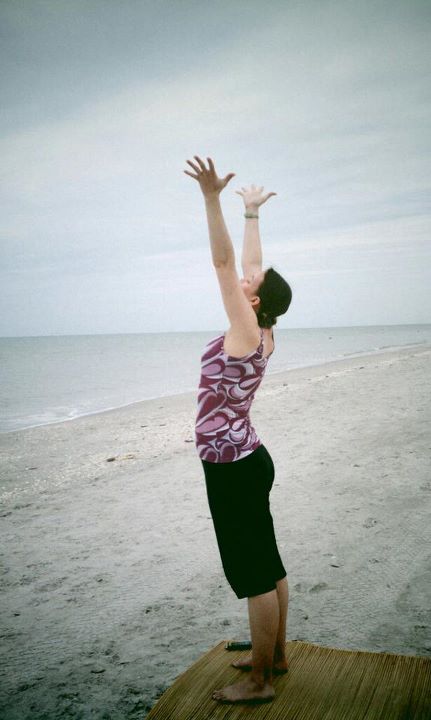
Beach Sun SalutationPros and Cons of Practicing Yoga on the Beach

Cons:

  1. Sand gets everywhere.
  2. Passerby feel welcome to chat with you about your yoga, which can be distracting and annoying.
  3. Sand shifts under your mat as you move. After your warrior sequence, the patch of firm even sand you picked out won’t be nearly as comfortable to sit on.
  4. If the beach is breezy, you’ll have to weigh down the corners of your mat if you don’t want to spend half your practice fixing it when it blows over.
  5. You don’t need to apply sunscreen before yoga class in a studio.
  6. Sand really gets everywhere!
  7. It’s easy to get distracted by all the birds, people, shells, boats, and other items you see at the beach.

Pros:

  1. Practicing yoga outdoors can be a welcome change to enhance your practice.
  2. Your beach yoga practice can be a conversation starter with people you might otherwise never have talked to.
  3. Shifting sand underfoot can actually help to stabilize you in postures where you tend to wobble – for example, you can wiggle your feet more deeply into the sand for extra support during balance poses.
  4. The ocean breeze can refresh you and cool you off as you practice. Weighing down your mat with shells adds an element of beauty to your plain ol’ mat, and finding the shells can be a fun preparation for practice.
  5. Once you’re sunscreened up properly, sun salutations to the actual sun add meaning to your yoga practice and remind us of where this sequence of movements came from in the first place.
  6. On the beach you have plenty of room to spread out so you won’t be touching (or bumping, or smelling) your yoga partners like you might in a studio class.
  7. Although the beach brings a whole set of distractions, it can also bring new vitality to your practice. The sounds of the birds and the waves can center us and bring us back to our true selves.

(We had a wonderful vacation! Now back to your regularly scheduled blog posts, with more beach yoga photos to follow.)


Spreading some love January 17, 2012

Filed under: reflections,yoga lifestyle — R. H. Ward @ 2:01 pm
Tags: ,

Not long ago, I read this blog post: I’m Christian, Unless You’re Gay. It’s a little long, but the heartfelt emotion behind it makes it well worth reading. I really appreciated Dan’s honesty and boldness, and my heart goes out to his friend Jacob and some of the people who responded to Dan’s post.

For me here on the yoga blog, Dan’s post meant a lot to me, because it fits right in with what I’ve been talking about regarding yoga and Christianity. (Yes, it does, just hang on a sec.) There are a lot of people who are all too ready to judge. One of the people who responded to Dan’s post explained that mindset: that she felt called by her faith to judge others harshly for their sins as a form of tough love. I’m sure you’re unsurprised that I agree with Dan on this one. Many people are all too ready to judge, all too ready to cast the first stone, forgetting that Jesus said “love thy neighbor” and “judge not, lest ye be judged” (emphasis mine). We all make mistakes, and we all do things wrong sometimes. If we judge other people harshly, then we’re likely to be judged harshly too. Yoga philosophy teaches compassion, just like Jesus did.

So often people who call themselves Christians spend most of their time talking about how Jesus died to save them from sin, and not enough time talking about all the smart things Jesus said and told us to do. People get so caught up in the story of his death that they don’t think enough about his life! And when I think about examples to follow, I don’t know that I can think of a better example of how to live than Jesus. He was kind to everybody! He loved children, he had a lot of friends, he made sure everybody had plenty to eat and drink and he threw a good party. He was sensitive to the pain and grief of other people and tried to help them. He worked to heal sick people and befriend lonely people and feed hungry people. He didn’t care what people looked like on the outside; he cared about who you were inside and whether you were good and honest and kind. He didn’t blame other people for the things that happened to him. He put his faith in something beyond himself. There are probably many more things that can be said about what an exemplary guy Jesus was. And the people who talk about gays (or whoever) going to hell have read the books about Jesus, haven’t they? Haven’t they read these stories about his life? I don’t understand how someone can read those stories and claim to be a follower of Jesus and still fill his heart and mouth with hate. Jesus was not about hating.

My point is, Jesus was all about compassion, and so is yoga. There’s nothing in what the yoga philosophies tell you to do that contradicts anything Jesus tells you to do. Not on a practical “here’s how to live your life as a good person” kind of way. I’m a yogini and maybe a Buddhist too, and I try to be true to the things that my special books tell me to do. I think that if you’re a Christian, you should try to live according to the things Jesus said to do. And Jesus didn’t say “punish sinners” or “don’t do yoga”, and I’m pretty sure he never said anything about whom you go to bed with. Jesus said to love everybody. I think that’s a pretty fine foundation to use to build a way to live.


Avoiding Injuries Through Mindfulness January 12, 2012

A lot of people have read the recent NYT article about how yoga will “wreck your body”. As a brand-new yoga teacher, I obviously disagree with a lot of what the writer says: I mean, I just spent a significant amount of time and money dedicating myself to learning about yoga, which would be kind of a waste if this guy is right. Here are my thoughts.

Of course many people have injured themselves doing yoga. It’s not difficult to do – I’ve done it myself, and so has almost anyone who’s practiced yoga with any dedication over an extended period of time. You can injure yourself hiking or dancing or playing video games or gardening, too, but that doesn’t mean that we stop hiking and dancing and gardening. These are things that feed our spirits, and so is yoga. To single out yoga as an activity that can wreck your body doesn’t make sense, because there are so many other activities that can wreck your body! We humans are equal opportunity wreckers. Accidents can happen no matter what you’re doing.

The key thing, for me, is to keep in mind what the true purpose of yoga is. According to the ancient texts, yoga is a way to get the body healthy so you can then sit in meditation. The point is not to sculpt the body or lose weight or to get a great workout, and people who approach yoga with that attitude (or, with that attitude only) may in the long run be more likely to injure themselves. The point is to be healthy: whatever healthy happens to be for your particular body. And the point of being healthy ultimately isn’t the body at all – we’re working on the body so that we can sit comfortably in meditation. A healthy body won’t be aching and complaining when you sit still for ten minutes. That’s the point we’re trying to get to: improving the body so we can focus on more important things.

Keeping your focus off the body and on the mind can actually help yoga practitioners not to injure themselves. You want to be aware of what’s going on in the body, certainly, and it’s really important to cultivate that awareness of how the body feels and the difference between work and pain. Being mindful of your body is crucial, but it doesn’t do any good to be looking in the mirror or comparing yourself to other students and forcing your body toward something you’re not capable of. And don’t think ahead to what this yoga class is doing for you; keep your mind right in the moment, on your own mat. Stay present and focused on the pose you’re doing right now.

When you take part in any activity, you do your best to be careful and to be mindful of what you’re doing. When you go hiking or ride your bike, you watch where you’re going, but if your mind wanders, your foot can slip or your bike can veer off the path. It’s the same thing in yoga. Staying present and mindful and focused on what you’re doing will help you to avoid inadvertently causing an injury.

Here are a few other responses to the article by nvnehi and anytimeyoga and Michael Taylor. I think it’s interesting to see the very different, thoughtful ways that different yogis have reacted.