Rox Does Yoga

Yoga, Wellness, and Life

It’s official January 24, 2012

Filed under: Miscellaneous,yoga — R. H. Ward @ 1:09 pm
Tags:

I got my paperwork in the mail addressed to “Roxanne H. Ward, RYT”. It’s official: I’m a registered yoga teacher!

You can even go look me up on the Yoga Alliance website. YA maintains a directory of all registered yoga teachers. Visit this page, and search for yoga teachers named Roxanne. There aren’t that many: I’m the last one on the list. I’m also apparently the only yoga teacher in my entire tri-state area named Roxanne, which is interesting to know. I won’t even need to use my last name!


Gentle/Prenatal Yoga Sequence January 23, 2012

Filed under: yoga — R. H. Ward @ 1:02 pm
Tags: ,

A pregnant friend asked me what stretches she could do to help her lower back. I consulted the “Workout for Healthy Moms” handout* my midwife gave me and found that the exercises listed only needed a little organizing and fleshing out to constitute a full yoga sequence. This routine should be appropriate for most expectant moms, and it also makes a good gentle routine for non-preggos.

Standing

  • Begin standing with feet hip-width apart.
    • Breathing in, stretch the arms up overhead; exhaling, bend forward, allowing your hands to come down toward the floor.
    • Be gentle with this forward fold – allow your knees to bend just a little (instead of locking them), and let your upper body hang. Don’t force yourself to try to touch your toes or bend farther; the bending isn’t the point. We just want to release any tension in the lower back.  You can let your arms dangle or bring your hands to the opposite elbows.
    • Shake your head yes or no, and if it feels good, let your upper half wiggle around, releasing tension in your lower back.
    • When you’re ready, come up slowly: roll the spine one vertebrae at a time, and let your head roll up last. Stand up nice and tall.
  • Next we’ll come down to the floor. Step your feet more widely apart and come down in a squat.
    • Squats work the hips and thighs as well as the pelvic floor muscles.
    • Work on balancing here; try to fold your hands in prayer while using your elbows to press back your knees.
    • If you need a little extra support, it’s okay to put your palms on the floor.
    • When you’re ready to be done, just sit your tush down.
  • Alternate options for standing:
    • For a more vigorous practice, complete four half sun-salutes after the initial forward fold before coming to the floor.
    • For a gentler practice, or if standing forward bends are uncomfortable for you, just skip the standing and start out on the floor.

Sitting

  • Come into a comfortable seated position. If you can, cross your legs, but if that’s awkward, just get as comfy as you can. Try elevating your tush with a cushion or folded blanket.
  • Neck rolls
    • Begin by gently dropping your chin down toward your chest and then rolling your head around in a circle. Pretend that you’re drawing a big circle in the air with the tip of your nose. Go nice and slowly; after a few circles, roll your head the other way.
    • Neck rolls can help relieve stress and tension in the neck.
  • Shoulder circles
    • Lift your shoulders up toward your ears. Rotate them backwards and let them drop down low, then bring them forward and back up. After a few backward circles, change direction and rotate them forward.
    • Shoulder circles can help to relieve stress and tension. They also improve posture and expand the muscles of the chest, both of which are helpful when you’re pregnant.
  • Arm stretches
    • Inhaling, lift your left arm up by your ear, and exhaling, lean over to the right. This will stretch out the whole left side of your body. If your right hand touches the floor, you can press the fingertips or palm down for support. Repeat on the other side.
    • You can also do the “stopping traffic”/”talk to the hand” move here: lift your right arm to shoulder height out to the side, and flex your wrist so that your whole arm is engaged and your right palm is facing away from you like you’re stopping traffic. Turn your head and look to the left, away from the outstretched arm. Then do the other side. This is great for your wrists if you work in an office.
    • Arm stretches help to open the chest. They can also reduce swelling in the hands.
  • Next, open your legs out wide. Let your legs be active, with toes pointing up.
    • Reach your left arm up by your ear. Let your right hand rest on your right thigh, and, exhaling, lean over the right leg. You should feel a stretch all down the back of your leg as well as down your left side. Come up gently and repeat on the other side.
    • Stretch your arms forward and reach straight out, hold for three breaths, and release.
    • If it’s comfortable for you, you can rest your hands on the floor and bend gently forward. As with the standing forward fold, don’t push yourself to bend any more than what’s comfortable for you – we’re just looking for some release and stretch in the back. When you’re finished, rise slowly back up, letting your head roll up last.
  • Lift each leg and bring it back to center. 

Reclining

  • Leg lifts
    • First, come down to lie on your side. The lower leg should be bent, and the lower arm can support your head.
    • Extend your top leg. Lift it up, hold a breath, and release. Do a few repetitions, then repeat the stretch on the other side.
    • This is a great exercise for stretching out the hips – very important during pregnancy!
  • Next, come to lie on your back, knees bent and feet flat on the floor.
    • Depending on where you are in your pregnancy, talk to your healthcare provider about whether lying on your back is appropriate for you: if you feel uncomfortable or dizzy, don’t do it. In later stages of pregnancy, lying flat on your back can restrict the flow of oxygen to your baby, so be careful with this. In general, don’t lie on your back for more than five minutes or so.
  • Pelvic tilts
    • Rest your hands on the floor or on your belly. Notice how, as you lie on your back, your lower back naturally curves up and doesn’t touch the floor. Now tilt your pelvis and tighten your abdominal muscles to press your low back against the floor. Release, and repeat a few times. This simple little exercise can do a lot to relieve your lower back discomfort. (If you’re avoiding lying on your back, try this exercise with your back against the wall while sitting, standing, or lying on your side.)
    • Return to a neutral position. Press into your feet, and lift your pelvis a few inches off the floor. Hold for a breath, then release, and repeat a few times. This move helps to strengthen the pelvic floor muscles.
  • Head lifts
    • From the same reclining position with knees bent, brace your arms across your abdomen as if you’re hugging yourself. Then gently lift just your head off the floor, then relax. Repeat. This exercise can relieve backache and strengthen abdominal muscles, helping to support the baby.
  • Lift your feet and curl your knees in to your chest (as much as you comfortably can). Roll around a little on your lower back – this can nicely relieve some tension. Do some “happy baby” pose by grabbing your feet, letting your legs fall open, and rocking around. You can also widen your legs to get some nice hip stretch in. Just do what’s comfortable for you.
  • Finish up with a gentle inversion, like legs-up-the-wall.

* Some exercises taken from “A Workout for Fit Moms”, by Cheryl Appel, in 1992 Lamaze Parents’ Magazine, page 36. Sequence of exercises is my own.


First Prenatal Yoga Class January 16, 2012

Filed under: yoga,yoga lifestyle — R. H. Ward @ 11:25 am
Tags: ,

Yesterday I went to my first prenatal yoga class: the Sunday 10:30 class at EEY. Unfortunately, the regular teacher was really sick, so there was a sub. Maureen did a decent job teaching the class, I thought, especially considering that she was kind of on the spot and was picking it up last minute. Since this was my first prenatal yoga class, I’m not sure what I was expecting, but it seemed to me that she taught the class more like a “gentle yoga” than a “prenatal yoga”. All the ladies in the room seemed to be in the 3-6 month range, and able to handle a more vigorous class than she gave us. Maureen definitely understood using prenatal yoga to improve emotional balance and calm in the face of all these bodily changes, but for me another important aspect of prenatal yoga is strengthening my body to stay healthy and prepare for the birth. It was still a good yoga class, and I’m glad I attended (and man were my hips and tush sore today!), but I want to go back and try the class again with the regular teacher.

I’ve been looking around for other prenatal yoga classes in my area, and here’s what I’ve found:

What’s with these schedules? I understand that the Creative Living Room, at least, offers a whole lot of stuff other than yoga, so I’m honestly just glad they’re offering prenatal at all, but I’m pregnant, not unemployed. (However, they also offer a post-natal mom-and-baby class, which I really hope to attend as soon as the baby is mobile and I’m back on my feet.) For the studios with Sunday morning classes, I understand that prenatal yoga has a limited audience and a studio might not want to spend their prime evening hours on a class that won’t bring in a ton of people. But I do like to sleep in on Sundays, since it’s one of the few days I have when I can do that, and sleep is pretty important right now. I’m also trying to go to church more often, which is pretty much completely incompatible with a Sunday morning yoga class. I feel a lot more motivated to go to church now that I’m pregnant, because we have a church we like with a good religious education program for my future kid; there are lots of other families with small kids at our church who could be good friends/resources for us; and getting involved now would probably make it easier to stay involved and keep attending once the baby arrives. So that makes Sunday mornings really inconvenient for yoga. It’s just possible I could hit the 9:15 service at my church and then rush out the door to get to a yoga class, but that kind of defeats the purpose of going to church. I’d rather have a class on Sunday at 2pm, honestly: church, lunch, then yoga sounds like a great day.

I did find a few other options that are less ideal:

  • The Yoga Garden in Narberth, PA offers prenatal yoga on Tuesdays at 6pm and Saturdays at 9:30am. However, it’s a good half-hour away, on a road busy enough to easily increase the travel time. It looks like the studio is close to the train station, so for the Tuesday class I could take the train there after work, but then poor F would have to drive out to pick me up after class, and that would eat up an hour of his evening just in the car. Saturday mornings could possibly work, though, so I’ll keep this in mind.
  • Belly Pilates in Bryn Mawr, PA seems to be specifically for expecting and new mothers, which sounds great. However, I don’t do pilates now because it’s prohibitively expensive (I’ll spend $15 or, tops, $17 on one activity class, but not $25, sorry.) They do offer some yoga classes, but they’re priced almost as high as the pilates. The prenatal yoga is Tuesdays at 9:30am, and again, not unemployed. The postpartum yoga is Tuesdays at 1:30pm, which I could possibly do on my maternity leave, but the same teacher does the Creative Living Room post-natal classes, and TCLR is less than ten minutes from my house and much more affordable, so not sure why I’d hike all the way to Bryn Mawr. So Belly Pilates is off the list for now. (Plus I hate to say it but their website is ugly and difficult to navigate, and that turns me off big time.)

That leaves Thursday nights at Enso as my best option for a regular prenatal yoga class, so I’m going to try to check that out this week or next week. I’ll keep you posted!


Avoiding Injuries Through Mindfulness January 12, 2012

A lot of people have read the recent NYT article about how yoga will “wreck your body”. As a brand-new yoga teacher, I obviously disagree with a lot of what the writer says: I mean, I just spent a significant amount of time and money dedicating myself to learning about yoga, which would be kind of a waste if this guy is right. Here are my thoughts.

Of course many people have injured themselves doing yoga. It’s not difficult to do – I’ve done it myself, and so has almost anyone who’s practiced yoga with any dedication over an extended period of time. You can injure yourself hiking or dancing or playing video games or gardening, too, but that doesn’t mean that we stop hiking and dancing and gardening. These are things that feed our spirits, and so is yoga. To single out yoga as an activity that can wreck your body doesn’t make sense, because there are so many other activities that can wreck your body! We humans are equal opportunity wreckers. Accidents can happen no matter what you’re doing.

The key thing, for me, is to keep in mind what the true purpose of yoga is. According to the ancient texts, yoga is a way to get the body healthy so you can then sit in meditation. The point is not to sculpt the body or lose weight or to get a great workout, and people who approach yoga with that attitude (or, with that attitude only) may in the long run be more likely to injure themselves. The point is to be healthy: whatever healthy happens to be for your particular body. And the point of being healthy ultimately isn’t the body at all – we’re working on the body so that we can sit comfortably in meditation. A healthy body won’t be aching and complaining when you sit still for ten minutes. That’s the point we’re trying to get to: improving the body so we can focus on more important things.

Keeping your focus off the body and on the mind can actually help yoga practitioners not to injure themselves. You want to be aware of what’s going on in the body, certainly, and it’s really important to cultivate that awareness of how the body feels and the difference between work and pain. Being mindful of your body is crucial, but it doesn’t do any good to be looking in the mirror or comparing yourself to other students and forcing your body toward something you’re not capable of. And don’t think ahead to what this yoga class is doing for you; keep your mind right in the moment, on your own mat. Stay present and focused on the pose you’re doing right now.

When you take part in any activity, you do your best to be careful and to be mindful of what you’re doing. When you go hiking or ride your bike, you watch where you’re going, but if your mind wanders, your foot can slip or your bike can veer off the path. It’s the same thing in yoga. Staying present and mindful and focused on what you’re doing will help you to avoid inadvertently causing an injury.

Here are a few other responses to the article by nvnehi and anytimeyoga and Michael Taylor. I think it’s interesting to see the very different, thoughtful ways that different yogis have reacted.


My Home Practice, Winter 2012 January 11, 2012

Filed under: yoga,yoga lifestyle — R. H. Ward @ 1:25 pm
Tags:

I took a break from yoga for about a week and a half over the holidays. After teacher training I needed the break, and it allowed me to relax, do holiday things, and visit with family and friends without worrying over when I’d be able to fit in my practice. During this break, though, I noticed some changes in myself. Physically, I was more achy, less flexible – I could feel the difference in my body. (I was also more tired and stuffy, although that could be due either to the cold I had or to my pregnancy rather than the lack of yoga.) Emotionally, I felt unsettled. My mind felt much busier and less calm without my meditation practice. I think it was really valuable to take a break just to remind myself that I feel better in just about every way when I’m practicing yoga. F and I made sure to fit in a yoga practice on New Years Day, and it felt great!

Now that we’re back to a normal daily schedule, I thought it might be helpful to write about my current home practice, in the interest of keeping up my practice and improving it while still making allowances for my body’s needs right now while I’m growing a new person.

I typically practice in the mornings. We eat breakfast first thing – I’ve always been the sort of person who needs to eat right after waking up, and now with the baby on the way, mama’s gotta eat. After we clean up the dishes, it’s time for yoga. I need to make my yoga fit in between breakfast and showering so I can get out the door on time for work, so how much time I spend on yoga depends on a number of factors: how late we were up last night, how many dozens of times I had to pee and whether I was able to fall asleep again afterward, how much I overslept when the alarm went off, how long we lingered over breakfast, how well my stomach’s feeling (I’m past my morning sickness now but things are still pretty weird in there, and if my digestive system and I disagree on how to spend this time, then my “seated meditation” will be happening on the john and I just need to accept that). On a good day, I can clock a 30-minute asana practice plus time for pranayama breathing and meditation; on a different day, I might manage two sun salutations and a quick meditation. It is what it is, and I’m doing the best I can.

My yoga practice itself varies. Lately, because it’s chilly in my house in the mornings, I’ve been practicing yoga in pajamas, socks, and my fuzzy pink bathrobe, which isn’t ideal but isn’t as uncomfortable as you might think. I’ve been focusing mostly on sun salutations, because they’re active and they hit most of the major ways of stretching, and they help build strength, which is a big focus for me right now. I do standing and balance poses if I have the time, but I always make sure to fit in some squats, since those are important for my pelvic floor muscles. For seated work, I’ll usually do some of the poses I talked about here. No twists, and really gentle with any forward folds. I like bridge pose for strength but I’m careful with it since my abs don’t want much extra stretching right now. I still do shoulderstand but more often lately I do legs-up-the-wall. I’m looking forward to playing with inversions for as long as I feel able. I usually finish with a short savasana, but sometimes I’ll just hang out in legs-up-the-wall during that time instead.

After my asana practice, I like to do some alternate nostril breathing to prepare for meditation, although with it being winter this is becoming more difficult for my stuffy nose. Then I do a brief meditation, maybe five minutes. I don’t do the same meditation every day but instead choose what seems to resonate with me at that moment.

I still have trouble making my yoga practice happen on the weekends. I like to sleep in a little and then we usually have a busy day planned, so it’s hard to make sure I get my practice in without the routine of the weekday. If anyone has any advice on this, let me know.

I hope this post was helpful to those of you who imagine me as SuperYogaGirl. I try to have some sort of practice every day, but I’m not nearly as regular about it as I wish I was, and I definitely am not SuperYogaGirl, although I wish I could be. And now you can picture me flopping around doing downward dog in my scuzzy bathrobe, which is a lot more realistic than what you might have imagined before!


Yoga Book Recommendation List December 22, 2011

Filed under: books,yoga — R. H. Ward @ 2:17 pm

At our last yoga teacher training session, each trainee shared a brief review of a book we’d read. Here for your reading pleasure, then, is a yoga book recommendation list! (Please note, I haven’t yet read any of these books myself – my notes and descriptions are based on my colleagues’ reviews.)

The End of Sorrow: The Bhagavad Gita for Daily Living, Volume 1, by Eknath Easwaran: This version of the Bhagavad Gita includes Eknath Easwaran’s commentary on each verse. My friend found it to be very relatable.

The Bhagavad Gita with commentary by Mahatma Gandhi: Gandhi loved the Gita and strove to live his life according to its principles. The commentary collected here is very detailed, intellectual, and comprehensive, but written such that it’s understandable for ordinary people too. (My friend noted that her edition was published in India and didn’t seem to have been edited or even glanced at by a native speaker of standard English, but once she got past the typos she couldn’t stop reading.)

The Ramayana: The ancient epic poem of Rama, a story of love, duty, and dharma, was another of Gandhi’s favorites, and was recommended by one of my teachers.

The Pure Heart of Yoga, by Robert Butera: A good overall look at yoga. Topics covered include the eight limbs of yoga, a nice summary of the chakras, and some interesting discussion of yoga psychology complete with case studies.

Job’s Body, by Deane Juhan: This is a bodywork text required by many schools for massage therapy, acupuncture, etc., but the detailed anatomy is also useful from a yogic perspective. My friend was really impressed with this book.

Yoga Bitch, by Suzanne Morrison: A cute and funny memoir about a woman who undertakes a yoga retreat that wasn’t what she was expecting.

Be Young with Yoga, by Richard Hittleman: My friend chose this book to read simply because it had been sitting on her family’s bookshelf for as long as she could remember. Originally published in 1962, Hittleman was ahead of his time in promoting the physical and spiritual benefits of yoga in the US. He wrote many books, and it looks as though some of these are still being reprinted today.

Goddess to the Core, by Sierra Bender: This book explores spiritual, emotional, mental, and physical aspects of the body, particularly in relation to healing. It includes yoga asanas and pranayama breathing but discusses many other tools as well. My friend described this book as intense, deep, and woman-centric.

Living Your Yoga, by Judith Lasater: The goal of this book is to help people live yogically 24/7, in touch with the benefits of yoga not just on the mat but in every moment of life. The book includes practical strategies for keeping up the drive and discipline to practice yoga day to day.

Happiness is Your Creation, by Swami Rama: Two of my classmates happened to read this book, and it’s highly recommended by one of my teachers as well. Swami Rama (also author of The Royal Path) discusses the yamas, niyamas, and meditation here as well. This book teaches that happiness shouldn’t depend on successes or failures but is real and vibrant within each of us. (My friends talked about this book so effusively and enthusiastically that their sheer joy in it almost made me skeptical that it could be that good – as if they’d been drinking the Swami Rama Kool-Aid – especially since I was not all that hot about The Royal Path. However, each person gave several real examples of how the book had helped her in her life, which convinced me enough that I think reading it will be worthwhile.)

God Makes the Rivers to Flow, by Eknath Easwaran: This is an anthology of sacred poetry and prose from around the world. Inspirational in itself, this is also a great book to have on-hand if you’re looking for a meaningful passage to use in meditation.

Inner Quest, by Pandit Rajmani Tigunait: Another one highly recommended by my teacher N.

If you still want more book recommendations, check out this amazon list compiled by the teacher of my friend Rambling Yogini! Some great and completely different selections there! (Personally, I really want to look up The Hindus: An Alternative History, and Donna Farhi’s book on Teaching Yoga has been on my list for a while now.)


Graduation December 9, 2011

Filed under: checking in,reflections,teacher training,yoga,yoga lifestyle — R. H. Ward @ 7:26 am
Tags:

This weekend, I’ll be graduating from my yoga teacher training program. We have a short session tonight, followed by a little party at the Thai restaurant next door to the yoga center, and then a full day tomorrow, and then I’m done! Ten months of work and learning and growing. I’m a little sad for it to end: I’ve really gotten to love my classmates, and I’ll miss seeing them all the time. I will also miss having the time set aside specifically to work on my yoga and my spirituality. (And of course I’ll miss the unlimited hatha yoga class pass that comes with the program – I’m going to have to start PAYING to go to yoga classes again!)

But I really feel like I’m ready. I’ve learned so much, and really come so far since I started training in March. I feel like I’ve gotten out of this program what I wanted to get out of it: I have the confidence to teach yoga, first of all, and most of the expertise necessary to do so, and more will come with more teaching experience. I also really wanted to explore the spiritual aspects of yoga and meditation, and this program definitely gave me the time and support I needed to do that. I’d like to look into teaching meditation on its own, actually. I think that, combining both the yoga teaching confidence and the time spent on spirituality, I’ve grown as a person and I feel much more confident and happy and comfortable in myself. That’s the sort of thing I couldn’t expect or predict, but only hope for, at the start of the training.

The ten months of this program felt like forever at times, but looking back, I’m really glad I chose such a long-term training. I’ve talked to friends who’ve had shorter training programs, and it seems like in order to get all the hours in, they have to cram a lot of information into a short amount of time. In my program, I really had a chance to absorb everything I was learning. Now it’s hard for me to separate some of the things I’ve learned or point to specific things that I learned, because it’s all a part of me. I feel like the ten months was transformative in that way: I wasn’t a yoga teacher before, and I am one now, not just because I finished a program but in some indefinable way that has to do with who I am. I’m not saying that teachers who choose short or intensive programs get less of this; I just know that if I’d done a program like that, I would still feel like I had a lot of work to do afterwards. I really wanted that spiritual growth piece in my teacher training, and you just can’t cram that into a short amount of time. (On the other hand, you can’t cram it into ten months either, and I’ll be working on my meditation practice for the rest of my life – but I feel like I have a good firm foundation to build on.)

Overall, I feel really proud of what I’ve accomplished. I’m going to enjoy the heck out of this weekend, and then do some relaxing and unwinding over the holidays, and then see what happens next.


Pose of the Month: Head-to-Knee Pose December 7, 2011

Filed under: Pose of the Month,yoga — R. H. Ward @ 1:10 pm
Tags:

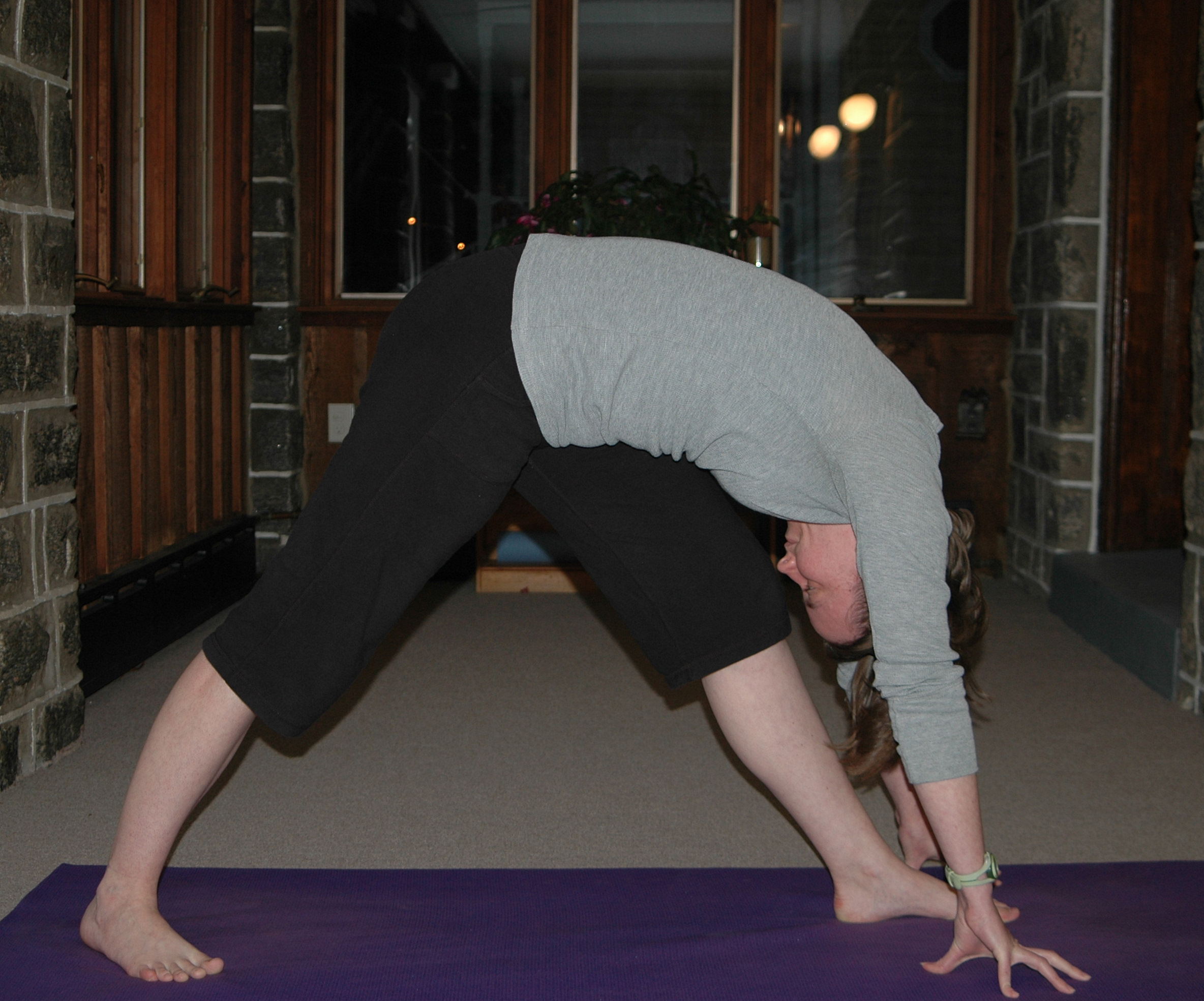
Pose Name: Head-to-Knee Pose (also known as Pyramid Pose or Intense Side Stretch Pose)

Sanskrit Name: Parshvottanasana

Steps:

  1. Begin in a wide-legged stance. Turn your right toes forward to face the top of your mat; place your left foot at a 45 to 60 degree angle, and turn your hips to face front. (This is the same basic stance as Warrior I Pose.)
  2. Reach your arms up overhead and stretch. Fold forward, bringing your fingertips to rest on the floor on either side of your front leg. (Less flexible students can place their hands on a pair of blocks if they can’t quite touch the floor; more advanced students can bring their hands into reverse prayer behind their backs before bending forward, or can simply cross the arms behind the back and grasp opposite elbows if reverse prayer is too much.)
  3. Keep the back leg straight and firm. Work on straightening the front leg. If you can’t quite get the front leg straight, it’s okay to bend it slightly.
  4. At first, keep the torso parallel to the floor. Then, if you have the flexibility, you can bend further while keeping the hips aligned and the spine straight.
  5. Although this is called “Head to Knee” pose, don’t focus on trying to bring your head to your knee. Instead, work on bringing your chin toward your shin – this will help to keep you aligned properly.
  6. Check in with your torso alignment: the midline of the torso should be above the line of the inner thigh. More flexible students can rotate to bring the midline of the torso over the midline of the thigh.
  7. Keep breathing. Work on lengthening the spine as you inhale and folding deeper on your exhales.
  8. Press strongly through the back leg to return to standing. Rise up slowly to avoid getting dizzy. Repeat the pose on the other side.

Benefits:

Head-to-knee pose really stretches out the front leg, which is great when the backs of the knees or calves are tight. The pose also stretches the spine, improves posture and balance, and stimulates the abdominal organs.

Contraindications:

Those with knee injuries may want to avoid this pose. Those with a back injury or high blood pressure can try a modified form of the pose: practice facing a wall, and instead of bending all the way forward, bend just enough so that the torso is parallel to the floor and then press your palms into the wall for support.

My Experience with Head-to-Knee Pose:

I never practiced this pose before coming to my current yoga studio, and I’ve struggled for a long time to figure out exactly what should be going on in this pose – which way are the hips facing? Should I feel so uncomfortable in this pose; am I doing it right? It seems like such a simple pose, but I continue to struggle with it. After working on asanas during October’s teacher training weekend, I understood this pose better, but I still feel some confusion when I try to teach it, so I wanted to spend a little more time learning about this pose.


Pose of the Month: Downward-Facing Dog December 5, 2011

Filed under: Pose of the Month,yoga — R. H. Ward @ 1:30 pm
Tags:

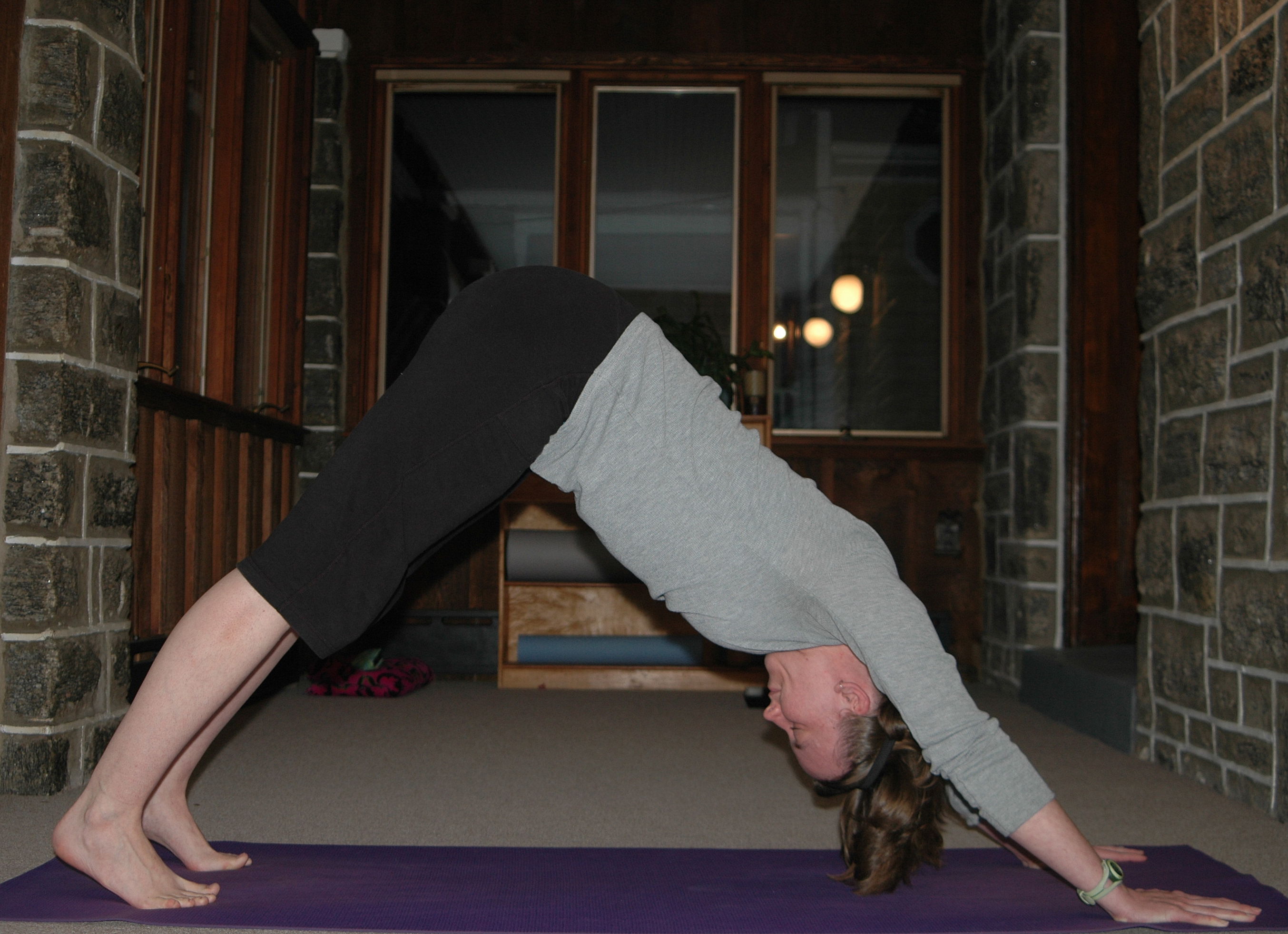
Pose Name: Downward-Facing Dog

Sanskrit Name: Adho Mukha Svanasana

Steps:

Downward dog is usually done as part of a sun salutation sequence – the instructions here tell how to get into the pose on its own.

  1. Begin on hands and knees, with a neutral spine and knees directly below the hips.
  2. Curl the toes under. Exhaling, pressing into the hands and balls of the feet, lift the knees off the floor and press the hips into the air.
  3. Lengthen your tailbone away from the back of your pelvis, and lift the sitting bones toward the ceiling. Lengthen the spine; lengthen the waist.
  4. Check in with your body. The back and legs should be straight, as if you’re forming a big triangle with your body: straight lines from hip to heel and from head to tailbone. Knees are straight, but don’t lock them; let them be soft.
  5. The feet should be hip-width apart, with the weight on the balls of the feet. Press your heels down towards the floor, stretching the backs of the calves.
  6. Your hands should be shoulder-width apart, with fingers spread wide. Press your weight down through your whole hand, not just your palm, so the whole hand is active. However, rather than pressing the whole hand completely flat, give yourself a little bend through your finger knuckles – this will give you a little more leverage. Make sure your weight is balanced between hands and feet so your feet aren’t taking the whole load.
  7. Extend strongly through the arms so that your elbows are straight. Stretch and press through your inner arms, gently revolving your elbow creases forward. You don’t want a deep bend at the wrist, so take a look and see if you have a crease on the top of the wrist, and if you do, press back more strongly.
  8. Stretch and open the shoulder blades, drawing them toward the tailbone.
  9. Hold here for five long, deep, even breaths, or longer if you feel comfortable.
  10. To come out, drop your knees to the floor to return to a neutral tabletop pose. Or you can walk your feet up to your hands to come into a standing forward fold.

Benefits:

Downward dog is an important core posture in yoga. It stretches and strengthens the entire body. Down dog warms and energizes the body, calms the brain, and relieves stress.

Contraindications:

Those with carpal tunnel syndrome or other wrist problems may have difficulty and pain in downward dog and should consider dolphin pose instead. Downward dog should not be practiced in the late stages of pregnancy.

My Experience with Downward Dog:

I’ve practiced yoga for almost nine years, so I do downward dog all the time. Recently one of my students asked for some guidance on down dog, and it was difficult for me to respond helpfully because this pose is so automatic for me now. As we talked together about the pose, I realized I didn’t have all the answers to her questions (tilt of the pelvis? orientation of the elbows?), so I wanted to look into the pose more closely to better understand the alignment and what’s going on. As my student pointed out, we do downward dog all the time, but we rarely look at exactly what we’re doing in this pose, and yoga teachers don’t usually give detailed instructions on doing the pose, assuming that any non-beginners understand it already. It was good to look more closely at this pose so that I can guide students with different body types into practicing the pose correctly.

Yoga Journal has some nice videos about performing downward-facing dog, which you can view here and here.


Humor: Yoga Girl December 2, 2011

Filed under: Miscellaneous,yoga — R. H. Ward @ 1:30 pm
Tags: ,

All my posts this week have been pretty heavy on the spirituality, so let’s take a little break. I bring you “Yoga Girl”. I love this video for mostly-accurate use of and hilarious rhyming with yoga terminology!


(And if you haven’t seen this guy’s Whole Foods Parking Lot video, it’s just as funny.)