Rox Does Yoga

Yoga, Wellness, and Life

Books: Yoga Anatomy, by Leslie Kaminoff November 22, 2011

Filed under: books,yoga — R. H. Ward @ 1:36 pm
Tags: , ,

Leslie Kaminoff’s Yoga Anatomy is a fantastic reference and guide to the way the body moves during yoga. The drawings are incredibly detailed and really help to increase understanding of how each pose works. The introductory sections on breathing and the spine are clearly written and really helpful for comprehending how breathing functions and how the spine develops and moves. The remainder of the book is organized by categories of postures: standing, sitting, kneeling, supine, prone, and arm support poses. Each pose gets detailed coverage with at least one drawing, often two or more showing the pose from different angles. For each pose, the text describes relevant joint actions and structures and muscles that are working, lengthening, or stretching, and provides any notes on or significant obstacles to practicing the pose as well as notes on breathing. Common variations on certain key poses are described in detail as well.

I started out trying to read this book from start to finish, which was fine in the early chapters on breath and spine, but less fine when I got into the specific postures. Eventually I began to use the book more as it was intended, as an on-the-spot reference guide. The biggest problem I’ve had with the book is that of vocabulary: I’m just not familiar enough with the names of bodily structures to be able to follow along with some of the text. For example, the text will often go into detail describing how a muscle is stretching, but the drawing won’t have those structures labeled. I have a very vague sense that the obturator externus is somewhere in my leg, but telling me that it’s lengthening in a seated wide-leg forward fold doesn’t help me identify it. I wouldn’t expect the drawing for each pose to have every single active muscle labeled, since that could easily become overwhelming, but I could have really benefited from a chart somewhere with all muscles labeled that I could flip to for quick reference. I also had trouble keeping straight exactly what sort of action is occurring with words like “flexion” and “extension”, particularly because one part of the body can be flexed while another is extended, and if you add to this my anatomic vocabulary confusion, I have no idea what’s going on. Sometimes I would have to perform the pose while I read so I could literally feel what the author was talking about, and that did help. In general, though, the descriptions really lost something for me, which is a shame because the book is very thorough and detailed and I could have really gotten a lot out of it if there had been more help included for less scientific minds. Overall, this is an excellent reference, but I’m going to be looking for another anatomy book to accompany it on my reference shelf.


November Teacher Training Weekend November 21, 2011

Filed under: reflections,teacher training,yoga — R. H. Ward @ 1:08 pm
Tags: ,

Sorry for the posting gap last week. I needed a little time off from the blog to recharge and deal with some non-yoga things. Now I’m planning to get right back to our regularly scheduled 3-5 posts per week!

We just had our second-to-last teacher training weekend. We’re all starting to feel a little bit sad that it’s almost over – it’s been such a journey. At the same time, I do feel ready to move on, get my certificate, and start on the next big project (because of course there are several big projects in the works). My poetry manuscript ain’t going to revise itself, nor will my poems send themselves out to journals or book contests. I’ve already learned that my house doesn’t clean itself (to my great dismay). And I’m really looking forward to reading some books that aren’t related to yoga, spirituality, or meditation. Don’t get me wrong, I have a lot more yoga reading to do, and during this year my To Read list has just grown exponentially for books I want to read in this field, but I’ve done very little literary reading this year, or poetry reading, or archaeology reading, or even sci fi reading (I don’t think I’ve made any progress at all in 2011 on my “Read Everything That’s Won a Hugo Award” project). There are a lot of ways to challenge my mind, and I miss the ones I haven’t been doing.

In any case. On Friday night, we started off with a discussion with N about the Upanishads. (Haven’t posted a book review/description here yet because I’m still finishing up the Afterword.) We also did teaching practice with Kate, another teacher at the studio, and it was good to hear someone else’s voice.

On Saturday, we had our morning hatha yoga class, and then some of us went to the Thai restaurant next door for lunch, which was delicious: lemongrass soup and a spring roll and tofu pad thai. We’ve made plans to go back there for a little celebration next month after our last YTT session.

Once lunch was over, we headed back to the yoga center for some Upanishads talk with J. We covered some of the same topics that we covered with N, but J always has a different perspective, and we covered some other topics too. I’m sorry to say that I was so sleepy that I totally dozed off mid-discussion, but I don’t think anyone but Joanna really noticed, although Nancy commented later that I looked sleepy. At our mid-afternoon break, some of the girls ran across the street for coffee and picked me up a hot tea, which helped a lot.

We spent the later part of the afternoon reflecting on our teacher training journey. J asked us to think about who we were when we first started YTT nine months ago: where were we with our yoga practice, what were our hopes for what we’d get out of YTT? And then, to look at where we are now: how have we grown and changed? What’s different about our yoga practice now? And where do we see ourselves taking this in the future once YTT is over?

I really feel that I’ve changed in some subtle but important ways. My personal practice has changed greatly: as I’ve written about here before, I’m much less interested in vinyasa style yoga, doing advanced poses, and getting a great workout. I’m less interested in teaching only advanced students. I really like the slower, classical hatha that we practice, and I really want to teach beginners. In my personal life, I’ve seen a lot of changes too. Before, I struggled with a lot of fear and depression, and that’s greatly lessened for me. I feel that I’m calmer, more content, better able to roll with what life doles out. I feel a lot more comfortable living in my own skin. As for the future, I started this YTT knowing that I wanted to teach, and I still do. I feel like the next few months could bring a lot of changes for me. The simplest thing is that I’d like to find some local places besides my front porch where I could teach yoga once or twice a week. I can envision much bigger changes (like trying to teach and freelance full time), but I’m not sure what’s even possible. I know what I’d like to be possible, but I don’t know if I have the courage and drive (and time!) to make those bigger changes a reality. I’ve worked really hard this year, and I see a lot of payoff to that hard work; I need to finish up where I am right now and then see where my path takes me next.


Pose of the Month: Partner-Assisted Wide-Legged Forward Fold November 7, 2011

Filed under: Pose of the Month,yoga — R. H. Ward @ 1:32 pm
Tags: , , ,

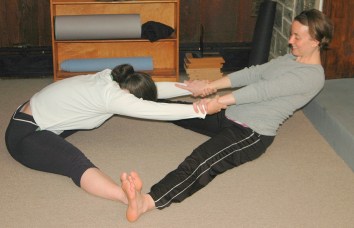
Partner-Assisted Wide-Legged Forward Fold 2Pose Name: Partner-Assisted Wide-Legged Forward Fold

Sanskrit Name: Upavistha Konasana

Steps:

  1. Sit facing your partner. Lift your legs and stretch them out wide on the floor.
  2. Rest your feet or ankles against your partner’s feet or ankles – this will be different for everyone depending on your and your partner’s leg length and degree of flexibility in the hips and groin.
  3. Reach out and clasp your partner’s hands or wrists. Clasping hands may be easier if you’re farther apart; clasping wrists will give more stability and will be better if you’re able to be closer together.
  4. Bend forward with a straight spine, keeping your legs active and engaged. Your partner will lean back, helping to pull you further into the bend.
  5. If you have difficulty bending forward, you can bend your knees a little bit, and even put a rolled-up blanket under the knees for support, but as you bend, make sure the kneecaps are facing up towards the ceiling.
  6. Come up gently, then switch – you lean back while your partner bends forward.
  7. Work dynamically, allowing each partner to move in and out of the forward bend. See if you can bend a little deeper each time.
  8. On the last round, come up slowly and release your hands and feet.

Benefits:

Wide-legged forward fold stretches the insides and backs of the legs, stimulates the abdominal organs and detoxes the kidneys, strengthens the spine, calms the brain, and, most importantly for our yoga and sex series, it releases the groins and opens and stretches the hips and thighs. It also opens the root and sacral chakras and increases blood flow to the pelvic region. Working on this pose with a partner can be a lot of fun and can help you to bend further into the pose.

Contraindications:

Those with lower back injuries should take care, sitting on a folded blanket and staying mostly upright. Pregnant students should take care with any forward bend.

My Experience in Wide-Legged Forward Fold:

This is a pretty simple pose that I’ve been practicing for many years, even before I tried practicing yoga. I was really surprised to see how much further I could move into the pose with the help of a partner!

Partner-Assisted Wide-Legged Forward Fold 1


Aerial Yoga: closer to home in Skippack, PA November 3, 2011

Filed under: yoga — R. H. Ward @ 2:50 pm
Tags: , ,

Last month I posted about anti-gravity yoga classes in NYC. Then last week, my mom sent me a newspaper clipping showing people doing “Unnata Aerial Yoga” right around the corner from her, at Moyo Yoga Studio in Skippack, PA.

From their description, Unnata Aerial Yoga sounds a lot like the anti-gravity yoga in NY, and the photo from the newspaper article looks very similar, but their description sounds a lot more yogic than that NY studio’s description.  Unfortunately they don’t have a photo of their aerial yoga class on their website, and I searched the newspaper’s website but they didn’t post the photo either. But, even better, there’s a video of the class on youtube!

After watching that, now I totally want to try this. Seeing it in action is a lot different from seeing a photo where it just looks intimidating. Maybe this would help me get past my headstand/handstand fears. And Saturday at 12:30pm would actually be a doable time for me to get up there (especially if I were going to visit my mom anyway). I’m very tempted to check it out!


Yoga for Better Sex Sequence November 2, 2011

Filed under: yoga,yoga lifestyle — R. H. Ward @ 1:41 pm
Tags: , ,

This sequence of poses will get you moving and warm up all the necessary places for a great time in the bedroom! For each pose, I’ve included a brief explanation of what it does and how it can improve your sex life.

child’s pose relaxing, centering
cat/cow tilt

This pose wakes up the spine, stimulating the natural flow of energy through the chakras and strengthening the pelvic floor muscles. Also, being familiar with the subtle movements of the pelvis will help in the bedroom.
downward dog Downward dog stretches and strengthens the entire body!
forward fold Forward folds open up the back and massage the internal organs.
5 half-salutes Half-salutes are meditative, promoting focus and awareness of the present moment.
2 full salutations The sun salutation is a series of poses linked together gracefully. Sun salutations serve to limber up the body for yoga practice. The poses in the sun salutation alternately stretch, expand, and contract the entire body, making it great for overall health, fitness, and stamina.
goddess pose Standing poses are good for overall fitness, strengthening the entire body, especially the legs, and building heat in the body. These poses really stretch and work the thighs and hips, as well as toning the extended arms, and standing poses help to improve stamina too.
warrior 1
warrior 2
triangle
side angle
half moon Half moon pose opens the hips and includes a balancing element.
Repeat standing sequence, other side
crane pose Balancing poses encourage a calm, focused mind, improve concentration, and remind us to stay in the present moment.
tree pose
squat (transition to seated) Squatting is excellent work for the pelvic floor muscles and also opens the hips.
cobbler pose This pose increases blood flow to the pelvis and opens the root chakra, which helps to cleanse and energize the sexual organs. The pose opens up and promotes greater flexibility in the hips.
boat pose This pose warms up the core and gets blood flowing in the pelvic region.
wide-legged forward fold This pose works and stretches the hips, thighs, and groin and opens the root and sacral chakras, and it increases blood flow to these regions.
locust pose This pose opens the chest and heart center, and the act of lifting and squeezing the legs stimulates the sexual core.
bridge pose This pose stretches and elevates the pelvis, hips, and thighs. It’s also a chest and heart opener.
reclining spinal twist Twisting wrings out the toxins from our internal organs, promoting good health.
savasana Savasana is the most important yoga pose for healthy sex. In savasana we learn how to relax, how to be in the present moment, and how to be comfortable with the stillness within yourself, which is what will allow you to connect deeply with another person.
 

Pose of the Month: Double Boat Pose October 31, 2011

Filed under: Pose of the Month,yoga — R. H. Ward @ 1:06 pm
Tags: , ,

Since we’re talking about yoga and sex this month, I’ll be bringing you a few fun poses you can do with a partner!

Pose Name: Double or Partner-Assisted Boat Pose

Sanskrit Name: Navasana

Steps:

  1. Sit facing your partner with your knees bent. Reach out and clasp your partner’s hands or wrists (clasping hands will give you a little more room to work with your legs, but clasping wrists gives a little more stability).
  2. Lift your right foot off the ground while your partner lifts her left foot off the ground. Press the soles of your foot against the sole of your partner’s foot. (It will help if you’re able to keep your right knee inside your arms.) Begin to straighten the right knee.
  3. Repeat on the other side, lifting your left foot and pressing it against your partner’s right foot.
  4. Once both feet are up, you can work on straightening the legs. Make sure to use your core muscles to hold you up as you would in regular boat pose.
  5. Work playfully with the pose, have fun, and don’t forget to breathe.
  6. Come down slowly, one foot at a time, and release your hands.

Benefits:

Boat pose really strengthens the core muscles and stimulates the abdominal organs. In terms of our ongoing yoga and sex series, boat pose is great because it warms up the core and gets your energy flowing!

Practicing boat pose with a partner can give you added stability and support to straighten the legs while you work the core. Plus it’s fun!

Contraindications:

Contraindications for boat pose include asthma, insomnia, diarrhea, heart problems, low blood pressure, and pregnancy. Those with neck problems may want to practice boat pose at the wall (so you can lean your head back and rest it against the wall).

This isn’t a contraindication, but if you’re practicing double boat with a partner, it will be trickier to do if the two of you have different leg lengths (i.e., someone short practicing with someone very tall). See the photo below: my legs are longer than Stacey’s, so my knees are slightly bent. However, I can still move much further into the pose with a partner than I can on my own! If you and your partner are differently proportioned, try the pose anyway and just have fun with it. Be ready to laugh!

My Experience with Boat Pose:

Long have I hated boat pose. It’s one of those poses where I just never seem to improve. My core isn’t strong enough, it’s hard to straighten the legs, and even my arms get sore. So I was excited to find this fun modification of boat that can be practiced with a friend. You still get a core workout, but without all the disappointment. Instead, it’s a great way to share yoga with your partner and get warmed up together!


Partner-Assisted Boat Pose

Thanks to Stacey for helping me model this pose!


Yoga for Great Sex, Part 2 October 27, 2011

Filed under: yoga,yoga lifestyle — R. H. Ward @ 1:30 pm
Tags: , , ,

Last time, we talked about yoga’s physical benefits for your sex life. Today we’ll talk about the mental, emotional, and spiritual benefits of yoga and how they can help improve your connection with both your partner and with yourself.

First, yoga opens the heart. Practicing yoga increases our capacity for love and compassion. Having a more open heart allows you to connect more deeply with your partner. It also allows you to be more compassionate with yourself. Many people, especially women, are overly critical of themselves in sexual situations, constantly thinking about their bodies in a negative way, worrying about whether they’re doing it “right”, but developing more compassion can help such people to let go of that negativity and worry and just enjoy themselves.

For many people, yoga leads to increased confidence. You have a healthier, stronger, fitter body, so you feel more confident and more attractive. Yoga also helps us become emotionally stronger and more in touch with our true Selves, leading to an inner confidence that shines forth. And confident people are sexy!

Yoga and meditation teach us about awareness and mindfulness, and help us develop the ability to be present right now. This is a really important skill in the bedroom, too. For the person who has a tendency to worry about how she looks or what she’s doing during sex, focusing on being present right now can help her to set those worries aside and just enjoy the moment. And for the person who is easily distracted (who finds her mind wandering off, thinking about what she needs to get at the store tomorrow), cultivating that mindful awareness can bring her attention back to the present moment where it belongs.

Yoga also reduces stress by helping us to truly relax. Stress is one of the major factors that keeps us from wanting to have sex in the first place, and from fully enjoying it when we do have it. But in yoga, we consciously relax the body and release tension. When we’re able to do this in the bedroom, that enables us to have more fun and build a better connection with our partner.

Later on, I’ll post about some specific yoga poses that have hidden power to benefit our sex lives (I’ve already covered Cobbler Pose), as well as a sample sequence you can do to get warmed up for a fantastic romantic evening. For now, here’s a quick sampling of some common types of yoga poses and what they can do for us:

  • Heart-opening poses, like cobra, camel, or bridge, help us to develop compassionate hearts
  • Standing poses, like the warriors or triangle, contribute to the overall health of the body and help to build strength, heat, and energy
  • Balance poses help us learn to focus on mindfulness and being present
  • Poses that involve squatting strengthen the pelvic floor
  • Relaxing poses like child’s pose or legs-up-the-wall help us learn to calm our minds and relax
  • Savasana, of course, is the most important pose in yoga as well as for improving your sex life, because savasana teaches us how to relax, how to be in the present moment, and how to be comfortable with the stillness within yourself, which is what will allow us to connect deeply with another person

In yoga, we learn that true happiness comes from within. When you’re practicing yoga, you’re in touch with your spirit and able to open your heart and share yourself with another person. Sex then becomes much more than an experience of momentary physical enjoyment, when two people are able to share not just their bodies but their true Selves.


Yoga for Great Sex, Part 1 October 26, 2011

Filed under: yoga,yoga lifestyle — R. H. Ward @ 1:41 pm
Tags: ,

It should come as no surprise to my readers here that yoga can improve your sex life (after all, it improves just about everything else!). But what might be surprising is just how many of yoga’s many benefits do translate to the bedroom. It’s not just about flexibility and physical fitness: there are a myriad of other physical benefits, along with mental, emotional, and spiritual benefits. The truth is that all the things in yoga that prepare us for meditation also prepare us for great sex and for connecting deeply with another person. This blog series will discuss the many benefits of yoga for sex and examine how some familiar yoga poses can pay off in the bedroom.

First, let’s look at the physical benefits.

  • We all know that yoga improves the body’s strength, flexibility, coordination, muscle control, and overall health and physical fitness. People who are physically healthy, strong, and flexible will be able to perform better and have more stamina in the bedroom.
  • In addition to overall fitness, yoga specifically targets core strength and works the muscles of the pelvic floor, which are the muscles used during sex (see my recent post about the pelvic floor to learn more about how these muscles work and why they’re important). Having strong, flexible pelvic floor muscles will lead to a good sexual experience for both partners!
  • Doing yoga also gives you more energy. When you’re holding a difficult yoga pose, powering through it even though you’re struggling, you’re using tapas, which builds heat and energy in the body. Also, yoga opens and balances the chakras throughout the body, which leads to a better flow of energy. And more energy equals more passion!
  • The flip side of having more energy during the day is getting better sleep at night. Studies have shown that people who practice yoga do sleep better. Getting the sleep your body needs means that you’ll be well-rested and ready to do other things in the bedroom besides sleep.
  • Yoga also promotes self-knowledge, including a better knowledge of your own body. There are two consequences of this:
    • First, you become more aware of physical sensations in the body, which can lead to just plain enjoying sex more!
    • You also develop a better understanding of subtle physical movements. When we learn how to make tiny adjustments in the body in order to perfect our alignment in a yoga posture, we can then use that knowledge to make the same sorts of small movements during sex, which can turn a good sexual experience into a great one!

Next time, we’ll start talking about the mental, emotional, and spiritual benefits of yoga and how they apply in the bedroom (or, as was suggested to me during my presentation, wherever you might choose to get frisky!).


October Teacher Training Weekend October 24, 2011

Filed under: teacher training,yoga — R. H. Ward @ 1:22 pm
Tags: , ,

Teacher training this weekend was a lot of fun. This was presentation month, so each trainee gave a presentation on the topic of our choice. My topic was “yoga for great sex”, and my presentation went really well – everyone had a good time and a lot of laughs, and I got to share a lot of good information. Over the next few weeks, I’ll be posting all that info here for you!

Other presentation topics included yoga for natural childbirth, yoga for lower back pain, yoga for athletes, yoga for children, devotional music, yoga for anxiety and depression, yoga for post-traumatic stress disorder, yoga for martial artists, and the chakras. Everyone did a really fantastic job of researching each topic and presenting what they’d learned. Each of us could easily have done a 30- or 60-minute presentation instead of just 15 minutes!

At the end of Saturday’s session, we spent some time going over specific yoga asanas and talking about proper alignment, common problems, and how to help a student with those problems. We did this once before, last spring, and it was just as helpful this weekend as it was back then. I’ve practiced yoga for over eight years but there are still poses I don’t fully understand, and even for the poses I do know well, I don’t necessarily know the problems that a beginning student or student with limited mobility might have. These things are really important to know! Now I feel a lot more comfortable teaching basic poses like wide-legged standing forward fold or head-to-knee pose.

Our homework for this next month is to read the Upanishads and to keep track of any questions we might have as we read. N says that we shouldn’t try to sit down and read a bunch of them; it’ll be more effective to read just one upanishad and then take a break. They’re not thematically linked (well, other than they’re all about experiences of higher consciousness) so we don’t need to read them all at once, and it’s better not to, to give the material more time to sink in. We also have to do two posture write-ups this month, just on any pose we want to learn more about.

Since I probably won’t have a lot of posts to make about the Upanishads until later in the month, this works out well for the blog – I’ll finish up our series on yoga and emotions and also get started on all the fabulous yoga and sex material! I’m so excited to share this with you!


Pose of the Month: Cobbler Pose October 20, 2011

Filed under: Pose of the Month,yoga — R. H. Ward @ 1:34 pm
Tags: , ,

Pose Name: Cobbler Pose or Bound Angle Pose

Sanskrit Name: Baddha Konasana

Steps:

  1. Begin by sitting up straight in a cross-legged position.
  2. Press the soles of the feet together and bring the heels close to the body.
  3. Sit up tall on your sitting bones and use your hands to pull any flesh away from the sitting bones.
  4. Make a basket with your hands and clasp them around your feet.
  5. Sit up nice and tall. If that’s as far as your hips can work today, that’s okay – just focus on sitting up nice and tall and opening up the hips.
  6. If your body allows, bend forward over the feet while keeping a flat back. Don’t hunch your back to get your head to your feet – your goal should be to bring the navel towards the feet.
  7. Engage the mula bandha, the muscles of the pelvic floor, to move deeper into the pose.
  8. As you inhale, lengthen the spine; as you exhale, bend a little deeper. Walk your hands forward on the ground if you wish.
  9. Relax and let gravity pull you forward. Take several slow, deep breaths.
  10. Come up slowly and return to a comfortable cross-legged position.

Benefits:

Cobbler pose opens the hips and promotes greater flexibility in the hips. It increases blood flow to the pelvis and opens the root chakra, which helps to energize and cleanse the sexual organs.

Contraindications:

Those with hip problems should work gently in this pose. Pregnant students should take care in any forward bend and modify as needed.

My Experience of Cobbler Pose:

This month, working on my presentation about yoga and sex, I learned a lot about cobbler pose, so I thought I’d feature it as a Pose of the Month. Practicing this pose can really pay off in the bedroom, since it opens the hips and really engages the pelvic floor muscles.

I’ve always liked this pose, and over the years I’ve made a lot of progress with how far I can bend forward. Still, some days I can’t get very far, so this pose always reminds me to work gently with wherever my body is today.

Cobbler Pose