Rox Does Yoga

Yoga, Wellness, and Life

Yoga & Sex: Article Round-Up October 14, 2011

Filed under: yoga,yoga lifestyle — R. H. Ward @ 2:28 pm
Tags: , ,

In the course of my research for my presentation, I’ve found a lot of articles about how yoga can benefit your sex life. Many of these articles lean towards the prurient (“The 10 Poses That Will Make Him Ooh!” sort of thing), but despite that most of them have some really good content. Here’s what I’ve read so far:

Improve Your Sex Life with Yoga, on Gaiam’s website, by Kate Hanley:

A nice overview of how yoga can improve your sex life, discussing many of the specific benefits (sensuality, confidence, energy, intimacy, better orgasms), and describing two specific yoga poses that help boost sexual enjoyment.

Yoga Positions for Better Sex, in Prevention, by Nora Isaacs:

This article starts off by criticizing ancient yogis for practicing abstinence, which really turned me off. There’s no need to start the article by belittling another culture’s spiritual practice. I don’t think anyone should ever belittle anyone else’s spiritual practice, there’s just no excuse for that. However, once Isaacs got past being a shallow Westerner, she got into some of the important physical benefits of doing yoga: increased flexibility (particularly in the hips), strengthening the pelvic floor/root lock, getting in good physical shape just in general, recharging and relieving stress, and yoga breathing. She describes each benefit and then gives instructions for a pose that provides that benefit. Isaacs uses quotes from a yoga studio owner in California and from Jacquie Noelle Greaux, the author of Better Sex Through Yoga, so she’s consulted some experts. The article ends with the assertion that doing yoga with your partner will deepen your intimacy, get your energy flowing, and spark your creativity in the bedroom. (See, good content! Why’d she have to start off with that nonsense?)

Want Better Sex? Do Yoga, in Psychology Today, by Michael Castleman:

A good discussion of why yoga is good for sex, suggesting that yoga may help to treat sex problems where Western medicine (such as psychological counseling, sex therapy, and medication) falls short. Castleman focuses on relaxation, anxiety/stress relief, and improved blood flow, citing studies that have shown yoga to help in these areas. Recommended for Castleman’s more scientific approach to the subject.

Yoga for Better Sex: 9 Yoga Moves to Put Your Mind and Body in the Mood, in Prevention, no author listed:

Despite the silly title, there’s actually some good content in this one. The writer cites Ellen Barrett (author of Sexy Yoga) repeatedly, but as we’ve already seen, Barrett knows her stuff. This article lists the promised nine poses, with photos and descriptions for each detailing why each pose helps in the bedroom. I particularly like that the last pose listed is savasana!


Hip-centric Sequence October 13, 2011

Filed under: yoga — R. H. Ward @ 1:40 pm
Tags: , ,

One of the students in my little yoga class has tight hips despite a lot of flexibility elsewhere, so I came up with this sequence to challenge that student a bit. (And then, of course, he got stuck at work and couldn’t make it to class, but we went ahead and did the sequence anyway last night, and I liked it well enough that I’ll pull it out again later!)

  • child’s pose
  • cat/cow and curving side stretches
  • down dog
  • down dog twist
  • 5 half salutes
  • 2 full sun salutations (first time, regular high/low lunge; second time with lunge twist)
  • standing sequence:
    • warrior 1
    • warrior 2
    • radiant warrior
    • triangle pose
    • half moon
    • wide-legged standing forward bend
    • goddess pose
  • standing sequence other side
  • tree pose
  • seated poses:
    • squat
    • cradle
    • cobbler
    • forward bend
    • seated twist
    • pigeon
  • bridge pose
  • savasana

I particularly loved doing goddess pose last night. It was fun to teach, and it just feels empowering to do. I think I’ll be pulling this out more often!


Yoga and the Pelvic Floor October 10, 2011

Filed under: yoga — R. H. Ward @ 1:10 pm
Tags: , ,

I keep seeing the pelvic floor muscles come up throughout my research on yoga and sex. We rarely think about these muscles, and don’t use them often (although they sure come in handy on an emergency run to the bathroom). However, the pelvic floor muscles are incredibly important for sex, for childbirth, and just in general for keeping our internal organs where they’re supposed to be.

The pelvic floor is just that: the muscles at the bottom of the torso, supporting the internal organs and the spine. These muscles control the passage of waste matter out of the body; they also include the muscles lining the vagina, so having a healthy pelvic floor can increase pleasure during sex for both partners. A healthy, strong, flexible pelvic floor can also really help a woman during childbirth. As women age and enter menopause, the hormone balance in the body changes, which can cause the pelvic floor to thin and weaken, which is why June Allyson sells Depends. This is why it’s important to keep the pelvic floor healthy throughout your lifetime!

The best plan is to keep the pelvic floor muscles in good shape, so you don’t ever have to worry about incontinence or the health problems that could occur if these muscles are weakened or torn. This means not just toning and strengthening, but making sure the muscles are flexible. However,the pelvic floor can be stretched out, weakened, or torn during childbirth; it could also be affected by a variety of other issues like obesity, hysterectomy, or even just constant straining on the toilet. Whether your pelvic floor is healthy or not, exercise can really help to get it in shape or keep it that way.

Most of us have heard of Kegel exercises. Named for Dr. Arnold Kegel, these are simple exercises in which you squeeze and relax your pelvic floor muscles. You can read more about Kegel exercises here or here. An even simpler exercise to work your pelvic floor is just squatting. The action of squatting is great for these muscles.

Of course yoga and pilates both include exercises and stretches that really help the pelvic floor. In yoga, the mula bandha or root lock can be employed to strengthen and stretch the pelvic floor. In a pose like Goddess or Chair, for example, if you’re doing the pose properly you’ll probably be activating your mula bandha, and it can be used in many other poses. To learn more about mula bandha, this book is a pretty exhaustive review of the topic, covering the benefits of employing mula bandha along with several techniques for doing so.

One simple pose that’s good for the pelvic floor is Cobbler or Bound Angle pose. Sitting on the floor, bend your knees, bring the soles of your feet together, and cup your hands around your feet. Just sitting like that is good, or you can bend forward. This pose stretches the hips and soothes menstrual or urinary problems, and helps with anxiety and fatigue too.

For more information on the pelvic floor, check out the wikipedia article or this really informative article written by a midwife. Or check out this excellent post on finding and moving your pelvic floor, complete with a video, over at anytimeyoga.


Books: Sexy Yoga: 40 Poses for Mind-Blowing Sex & Greater Intimacy, by Ellen Barrett October 6, 2011

Filed under: books,yoga,yoga lifestyle — R. H. Ward @ 2:31 pm
Tags: ,

Sexy Yoga, by Ellen BarrettIn this book, Ellen Barrett uses yoga to help couples access the poses of the Kama Sutra. Both yoga and the Kama Sutra originated in ancient India, and Barrett relates each to the other to show how, with yoga practice, the difficult sexual poses of the Kama Sutra can be achievable (and pleasurable!). The book contains over 100 black and white photographs, illustrating both the yoga asanas and the Kama Sutra poses.

Barrett begins the book with an introduction describing the origins of both yoga and the Kama Sutra and how they relate. She covers yoga breathing, the chakras, and auras. The second section, “Glowing Solo”, is a guide to the yoga poses Barrett feels will be most helpful in opening the body for enhanced sexual pleasure. For each pose, Barrett provides instructions on how to get into the pose, how long to stay there, the benefits of the pose, ways to modify it, a meditation to consider while practicing the pose, and a photograph of what the pose looks like.

In the third section, “Divine Duets”, Barrett provides a guide to yoga asanas for couples – using yoga poses to mimic their counterparts from the Kama Sutra to give couples a workout and a good stretch before heading to the bedroom in section 4, “Sacred Sex”. In this last section, the models in the photographs take off their clothes to demonstrate the Kama Sutra poses hands-on.

Sexy Yoga would be a great book to keep in the bedroom for quick reference or inspiration at bedtime. However, with its large photographs, Sexy Yoga is not a book you can read on the train. Even throughout the introduction, photographs of bare nipples and buttocks abound – great for a bedroom guide but not for reading in a public place. Overall it’s not the sort of book that people will use by reading it cover to cover; readers will likely want to flip through looking at the photos to get ideas, only reading more deeply when something catches the eye.

Where Better Sex Through Yoga is in essence a yoga book with sex in it, Sexy Yoga is ultimately a Kama Sutra sex manual with some yoga in it. This isn’t necessarily a bad thing. The combination of yoga and the Kama Sutra does make sense: for example, a man doing camel pose and a woman doing cow tilt combine to create the Kama Sutra’s congress of the cow. By practicing yoga asanas, one can build the strength and flexibility to be better able to utilize the Kama Sutra pose and get more enjoyment out of it in the bedroom. However, readers should note that this book is by no means a complete guide to yoga, as Barrett really only gives coverage of 20 solo yoga asanas, and recommends that the asanas be practiced in the order she presents them. Better Sex Through Yoga gives a wider variety both of poses and of routines/sequences. However, the poses discussed in Sexy Yoga are covered thoroughly and well, including modifications for those with physical limitations. This feature makes the book more accessible than BSTY, which generally assumes its reader to be physically fit. Barrett’s sections on pose benefits are more in-depth than those in BSTY, and the meditations for each pose are a nice touch. Barrett does give attention to the spiritual and emotional aspects of yoga, and acknowledges the Kama Sutra as a sacred text.

One downside of Sexy Yoga is the fact that the author seems to scrimp on some of the yogic content, leading to inaccuracies. For example, Barrett describes hatha yoga as having three parts: asana, pranayama, and pratyahara, which she mistranslates as “meditation”. It wouldn’t have taken too much more effort to list the eight parts of classical hatha yoga correctly and then say that she’d focus on three of them. Also, Barrett conflates several pranayama techniques together into one, which she calls ujjayi breathing. I just don’t see a need for presenting this material inaccurately. In BSTY, the authors leave a lot out, but the material they do present is given accurately and correctly. Still, while Barrett’s omissions may annoy experienced yoga practitioners, they won’t hurt a beginner.

On the whole, Barrett’s Sexy Yoga is a fun and frisky guide for couples who want to bring some Kama Sutra adventure and yoga strength and flexibility to the bedroom.


Yoga Humor: Top 15 Yogi Excuses for Not Getting That Thing Done at Work September 30, 2011

Filed under: yoga — R. H. Ward @ 1:40 pm
Tags: ,

In lieu of actual generated-by-me content today, please check out this hilarious post from RecoveringYogi. Funny because (1) it’s so true and (2) we wish we could actually say this stuff at the office… #1 and #2 are my favorites, but I also love #15.


Wake-Up Yoga, Incorporating Dance Warmups for the Neck September 29, 2011

Filed under: yoga — R. H. Ward @ 1:45 pm
Tags: , , ,

The past few mornings, I’ve been doing a fun little wake-up yoga routine that only takes about 10 minutes. Sometimes it can be hard to get my yoga on first thing in the morning, so I’ve tried to find ways to get myself moving that aren’t too strenuous and won’t seem like a lot of work pre-coffee. This little practice can be done entirely while seated (and in pajamas) and incorporates some basic stretches, some yoga moves, and a series of neck warmups that I learned in African dance class. The neck warmups in particular really help to relieve tension, so I thought I’d share the love. A little practice like this is a great way to trick your grumpy sleep-deprived self into doing some yoga, and afterwards you’ll feel refreshed.

As you move through this warmup, always be careful to move gently and not too quickly, and don’t push past your natural range of motion. As you practice, you’ll probably be able to turn farther and move deeper, but if not, don’t worry about it: just gently work with where your neck happens to be today.

  • Put on some music you like: something with a good beat but not too fast. It’s fun to do this warmup in time with music, but moving your neck too quickly could hurt! Don’t let the music distract you; it’s just there for the rhythm and to add some fun. You should always practice with awareness, especially any stretch involving your neck.
  • Sit comfortably, either in a chair or on the floor, with your back straight. If you’re on a chair, you probably want to sit on the edge of the chair; if on the floor, straighten your spine and sit up nice and tall.
  • Start off with some gentle neck circles, slowly circling your head around as if you’re trying to trace a giant circle in the air with your nose. Do eight circles clockwise, then eight circles counterclockwise.
  • Come back to a neutral neck, then drop your chin down to your chest and look down. Then lift your head, dropping it back, and look up. Repeat this for eight counts: down, up, down, up.
  • Next, turn your head and look to the right. Then turn your head and look to the left. Repeat for eight counts: right, left, right, left.
  • Drop your right ear toward your right shoulder, tilting your head. Then drop your left ear toward your left shoulder. Repeat for eight counts: side, side, side, side.
  • Now combine them together: down, up, right, left, side, side. That’s one. Do the full series eight times. If it feels good, do it another eight!
  • Next, jut your chin forward and then tuck it back, like a bird pecking. We call this “the funky chicken”. Repeat for eight counts: peck, peck, peck.
  • Shake your head, as if your neck is a spring and your head is going boi-oi-oing. (This is a small motion, like the side-side tilt above – not a full side-to-side shake or a headbang, just enough to shake out the kinks.) We call this “the bobblehead”. Shake it for eight counts.
  • Alternate the Funky Chicken move and the Bobblehead move, eight counts each, repeating each move three or four times.
  • Come back to a neutral neck. Stretch it out a little more by dropping right ear to right shoulder, then use your right hand to press your head gently down, stretching through the left side of the neck. Repeat this stretch by dropping the head to the left, and then drop the head forward and use both hands to apply gentle pressure, stretching down the back of the neck (make sure you’re sitting up straight for these stretches, and be cautious as you apply the pressure!).

I love this neck warmup at any time of day, but it seems especially refreshing first thing in the morning when my neck is stiff from sleep.

I also work in some arm stretches, which is great for a morning practice – I always want to stretch my arms first thing in the morning anyway. Stretch straight up overhead, then grasp one wrist and pull, then switch and grasp the other wrist, getting a nice stretch down each side.

Here’s one nice stretch that I just learned from Better Sex Through Yoga: lift your right arm to shoulder height out to the side, and flex your wrist so that your whole arm is engaged and your right palm is facing away from you like you’re stopping traffic. Turn your head and look to the left, away from the outstretched arm. Then do the other side. I was floored when I tried this – if you sit in an office typing all day, this stretch is amazing!

If you’re practicing on the floor, try beginning the practice in child’s pose and then move into rabbit pose to get the shoulders involved too. If you’re in a chair, you can get the same effect by bending forward, clasping your hands behind your back, and stretching up as you continue to bend.

Work in a twist or two as well, turning your body to one side, then the other, using a hand on the opposite knee for leverage as you look over your shoulder.

After a 10-15 minute practice, all the stiffness of sleep has dissolved away and I’m ready to face the day! And all without doing a single standing posture!


Subbing at the yoga center! September 28, 2011

Filed under: reflections,yoga — R. H. Ward @ 1:37 pm
Tags: ,

Last night N wasn’t feeling well, so she sent out a call for subs for the evening classes. I volunteered to sub for the 6:15 class. This marks the first time that people paid money for yoga taught by me! I was nervous during the afternoon, but when I thought about it, I was less nervous about actually teaching yoga than I was about the logistical things like filling out the paperwork properly and using the credit card machine and the stereo.

I arrived around 6pm and N showed me what to do: how to log the students who come in, where to put the money, how to run credit cards, how to work the stereo, and she helped me pick out music for the class. Six people came to class: one of them also teaches at EEY, a few were more experienced students I knew, and one person was brand-new. It was a smaller class, so I rolled out my mat and taught while doing poses myself, which is what N & J usually do. At my home classes I walk around more and I’m working on making adjustments to people, but last night I just wanted to give them a standard EEY class.

Overall I was pretty happy with the class I taught. Usually at home I teach a one-hour class, but classes at EEY are an hour and fifteen minutes, so I did feel like my timing was a little off: I felt like I moved faster through the standing poses than I should have and ended up with more time at the end than I wanted, so it felt like I was stretching out the seated poses. A couple of extra sun salutations would have helped a lot, I think, but we still did good seated stuff too: camel and bridge and cobbler and forward fold plus some twists. I don’t think I shorted the standing stuff, though: I was definitely sweating a bit by the end of the standing poses and some of the students seemed to be puffing a little too. (I reminded everyone to lengthen and calm the breath while we stood in mountain pose, and I immediately heard breaths calming and lengthening! It really works when you say that!)

One thing I did mess up is that I started the standing poses with the right leg stepped back, and then stepped my left leg back to mirror what the students were doing, only then I forgot I had done that and was verbally cuing the poses on the wrong side (i.e., “lift your left hand” because I was lifting my left hand, when the students were all lifting their right hands). No one seemed to get off track, though. When we started on the other side, I realized what I had done and started cuing poses as front/back instead of left/right to keep myself from getting mixed up again.

I ended class with a guided relaxation that I thought went well. I really worked on slowing it down and waiting a few breaths between lines. The class started a little late because someone needed to pay with a credit card; we ended right on time just after 7:30pm, so I guess I cut it a little short, but by that point everyone had savasanaed and was ready to go.

Since it was my first time really teaching a full class, I couldn’t help thinking, “oh god oh god they hate me”, which I am sure is not true, but it’s impossible not to think it. I had some very experienced people in the class and some who were brand new, and so I taught to the middle as best I could – I worry that the class may have been boring for some people. I hope it wasn’t, but I taught the best class I could teach, and that’s all that’s in my power to do. Teaching yoga isn’t about me: I’m not going to get feedback on my teaching at the studio the way I do from students at my home classes, because that’s not what the purpose is! The students who go to the studio are there for themselves, the same way I am when I attend classes there, and I gave them the best class I could. I know I can do better next time, but I feel good about my teaching last night and satisfied with what I did.


Books: Better Sex Through Yoga, by Jacquie Noelle Greaux with Jennifer Langheld September 26, 2011

Filed under: books,yoga,yoga lifestyle — R. H. Ward @ 1:30 pm
Tags: ,

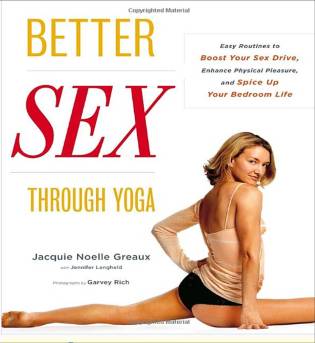
Better Sex Through Yoga, by Jacquie Noelle GreauxIn Better Sex Through Yoga, Jacquie Noelle Greaux and Jennifer Langheld discuss in detail how yoga can make your sex life better by boosting your sex drive and enhancing physical pleasure. For those who already practice yoga, this concept is a no-brainer: yoga makes you physically stronger and more flexible, it improves your stamina and muscle control, gives you more energy, and helps you develop a thorough knowledge of how your own body works, all of which can lead to improved physical performance in the bedroom. Further, yoga practice often leads to increased self-confidence and a more open and compassionate heart, and yoga is proven to relieve stress, so practicing yoga can help with the emotional and spiritual side of sex as well.

In the first few chapters, Greaux and Langheld discuss all of these benefits, going into detail about why both yoga and sex are good for you and how practicing one can benefit the other. In chapter 3, they embark on a yoga primer for those who’ve never practiced it before, including coverage of yoga breathing and the chakras.

The bulk of the book is in chapter 4, which offers a detailed breakdown of each pose Greaux and Langheld use in the Better Sex Through Yoga program. There’s a brief description of each pose, detailed instructions on how to perform the pose, notes on which chakras benefit, which areas of the body are worked, and which sexual positions work the same muscles, followed by a “hot tip” for improving your posture in the pose and/or your sexual use of the pose. In addition to yoga poses, Greaux and Langheld also pull from pilates and dance moves to provide a full body workout. Duo-assisted poses are offered, as well as poses you can do at your desk at work. There are photographs of each and every pose, often demonstrating step by step how to accomplish the pose.

In chapters 5 and 6, the individual poses are pulled together into a series of routines. There are three core routines and eight quickie routines, which offers the reader some flexibility in her yoga practice depending on how much time she has available. The routines vary widely, and there are routines specially designed for being stuck in a chair at the office, calming down after a stressful day, or stretching out quickly before joining a partner in the bedroom. Chapter 7 ties it all together by giving a list of sexual positions, with an illustration and a description for each telling how your yoga practice will deepen your sexual satisfaction.

I have some conflicted feelings about this book, so I’ll get the negative stuff out of the way first. Greaux and Langheld obviously have a target audience in mind: straight women (lesbians could certainly use this book to improve their sex lives too, but they’re clearly not the target audience), women who probably work in offices, and who are already in fairly good physical shape and are already physically active. I think this book would be difficult to use for someone who was overweight or someone limited in their flexibility. That’s not to say that yoga wouldn’t help those people, or that those people can’t have hot sex, just that the book seems geared toward women who resemble Greaux herself, as Greaux models all the poses (there’s a male model as well, credited in the back of the book as the “Living Male Work of Art” – he’s good at yoga poses but I’d almost rather see him on a naughty birthday card). You can see Greaux on the book’s cover, doing a split. Photographs of less flexible people might have been more helpful for those who are true yoga beginners.

The routines are definitely intended to be vinyasa style: each routine includes a lot of poses, with instructions that you should work up to practicing for 30-45 minutes. They expect you to move fast through these routines, and that’s not necessarily what beginners can or should do, unless they’re already very used to exercise. From my perspective as a yoga teacher, I didn’t appreciate how the routines would bounce you up and down: you do some standing poses, then some seated poses, then you stand up again, then you get back down to the floor. That sort of thing is more difficult for beginners or those with limited mobility, and it’s also contrary to my understanding of the purpose of practicing yoga (but then again, practicing yoga to prepare the mind and body for meditation is different from practicing yoga to prepare the body for hot sex, so really there is a different purpose here). Finally, the writing style is really sensationalist – I think they must have had a rule in place to make sure they used the word “sexy” at least twice per page. That’s the sort of thing that drives me nuts.

But, all that aside, the content here is really very good. The section on poses is great because it’s quite thorough and it does tell you exactly what part of the body you’re working in each pose and how that helps you in bed. The authors don’t shy away from detail. In some cases the authors have altered the traditional pose, but it’s clear to me (as a yoga teacher, anyway) why they’ve done it and what the sexual benefit of doing the pose a different way would be. They’ve incorporated moves from pilates and dance, but the ones I’ve tried so far are easy and clearly have some bedroom benefits. The routines get you up and down and up and down, but they’re otherwise well structured to be full body workouts. Finally, the “sexy secretary” sections, which modify poses so they can be done from a desk chair, are brilliant. I’ll be photocopying these and surreptitiously doing them at the office.

The sexysexy language, while troubling, is the maple syrup on the vegetables: the real message here is the idea that yoga isn’t just good for your sex life, it’s good for you as a person. The authors don’t leave out the emotional, mental, and spiritual benefits of doing yoga. In fact, when they list the reasons why yoga improves your sex life, the very first thing on the list is compassion, the ability to love and be loved. The language used sounds shallow, but the core message is not, and I really think the authors want to reach a wide range of readers and improve their lives. I liked the book a lot and would recommend it to anyone with a working knowledge of yoga who can take the sexysexy talk with a grain of salt and move on to the practical stuff.


Home Yoga Class, September 21 September 22, 2011

Filed under: yoga — R. H. Ward @ 3:34 pm
Tags: , ,

Last night’s yoga class was possibly my best yet. (I really like this thing where every class I teach is my best one yet. If I keep this up, pretty soon I’ll be a yoga superstar.) I taught a sequence I came up with a few weeks ago that focuses on breath and on thighs, with the idea that poses that are tough on the thighs are an opportunity to lengthen and deepen the breath. Everyone seemed to enjoy the class even though it was hard work.

I started out by teaching ujjayi breathing (which apparently I did only partially successfully, since I ended up really confusing my husband, so I’m planning to go over it again next week in case anyone else was confused and didn’t say so). Then we went through the following sequence of postures:

  • child’s pose
  • thread the needle
  • downward dog shifting to plank
  • locust
  • lifting to plank and back to downward dog
  • forward fold
  • 4 half salutes
  • 2 classic sun salutations (low lunge the first time, high lunge the second time)
  • chair pose (everyone was so excited!)
  • standing sequence:
    • warrior 1
    • warrior 2
    • radiant warrior
    • side angle pose
    • triangle
  • standing sequence on the other side
  • crane pose, transitioning directly to eagle pose
  • camel
  • hero
  • cobbler
  • seated forward fold
  • bridge pose
  • savasana

Everyone commented that it was both a challenging class and a really good class. I was glad that it was challenging both for my beginner and for my more experienced students.


September Teacher Training Weekend Summary September 20, 2011

Filed under: teacher training,yoga — R. H. Ward @ 1:53 pm
Tags: ,

This month, our scheduled teacher training weekend was complicated by the Haverford Music Festival. The yoga center is a Havertown local business so N and J wanted to participate in the festival (which could attract new yoga students), but we couldn’t reschedule our TT weekend either, so we crammed it all in: teacher training 6-11 PM on Friday and 9:00-10:30 AM on Saturday morning, then some of us helped to set up our table at the festival, and we all took shifts working at the table during the day. It was a good weekend, but a very full one.

On Friday night, we had our usual monthly check-in, then a lecture on yoga and emotions. We did some activities on this topic, and I got to work in a pair first with Sarah and then with Tonny, which was interesting and fun. After that we learned about the four primitive urges or fountains (which I’ll discuss in a future post), and then we had teaching practice (also a future post). A long night.

On Saturday morning we gathered to watch a video of a lecture by Swami Rama at the Himalayan Institute. The topic of the lecture was finding inner peace in a troubled world, and Swami Rama talked about the four primitive urges/fountains in the video, so it coordinated well with our lecture the night before. While Swami Rama seems to respect women highly, he also seems to think that a woman’s main job is to raise the children – which he acknowledges as the most important job in the world, but still. I may change my mind when I have a child, but I think working outside the home is important for women as well. Overall, though, the video was informative, and Swami Rama was definitely an interesting and charismatic guy – there are more videos of him on youtube that I’d like to check out sometime when I get a chance.

After the video, we were off to the festival. We helped set up by carrying boxes and tables and chairs from the studio over to our designated spot on the street, then we all took one-hour shifts to staff the table all day. We talked to people about yoga, handed out copies of the current yoga class schedule and passes for a free class, got people to enter a raffle for a free ten-class card, and I even sold a lavender neck pillow. It was fun and different to talk to people about yoga, and handing out the free class passes felt like I was giving out candy because people were so excited.

Our homework this month is to write up an intermediate level sequence of postures, which shouldn’t be a problem at all. Otherwise, no other homework except preparing for our presentations next month. My topic is yoga and sex – not in a Tantric way or a creepy way, but in a helpful practical way. I ordered two books online a few weeks ago and started reading one this morning – I’m halfway through the second chapter and so far, while the writing isn’t spectacular, the content is really good, matches up with what I think, and confirms what I’d been suspecting. I’m really excited to read further and look at the specific poses they discuss. So, dear readers, you can look forward to lots of information this month about how yoga can improve your sex life!