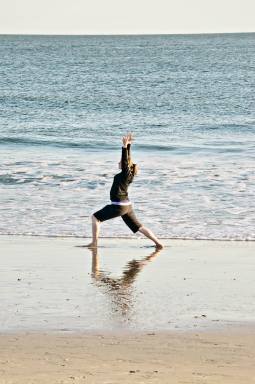
Rox Does Yoga

Yoga, Wellness, and Life

books: Soloing, by Harriet Rubin April 20, 2012

Filed under: books — R. H. Ward @ 1:15 pm
Tags: ,

book cover for Soloing: Realizing Your Life's Ambition, by Harriet RubinI read Soloing: Realizing Your Life’s Ambition with the hope that it would help me plan out how to transition from an unsatisfying full-time job to a freelance career. After all, most yoga teachers are freelancers, or “soloists” in Rubin’s terms. While Rubin has some good advice about following your passion, it ultimately wasn’t useful in answering the questions I had, and because the book was published in 1999, some of the information came across as a bit dated.

Rubin spends much of the book discussing how to reinvent yourself and your identity outside of the corporate model, how to discover the work that truly inspires you, and how to generate the courage to pursue that work. While there’s some great content here, it’s not as useful to someone like me – I know my passions (writing, editing, teaching yoga and teaching writing), I just need to figure out how, financially, to build those passions into a viable career. In this area Rubin is lacking. The cover blurb notes that Rubin, a high-powered publishing executive for many years, now works with “leading CEOs” in her solo career, and this comes through in the content. Although Rubin strives to interview a wide variety of professionals in researching this book (including a master bonsai gardener and a corporate guy turned race car driver), her target audience is the dissatisfied exec looking to build a consulting career (and with a lot more cash in the bank than I have). For example, Rubin states that, when leaving your corporate job, you should be able to negotiate a retainer, exit package, or continued Cobra health insurance, which just sounds laughable to any average cubicle jockey. In general, employees in the lower echelons of the corporate world just don’t have that kind of bargaining power, and Rubin doesn’t seem to know it.

Rubin states repeatedly that a soloist can make far more on her own than her previous corporate salary, and with only a few clients, but Rubin never addresses the practical concerns of how to identify and market yourself to your client base and find those lucrative clients. As a yoga teacher, I guess “clients” in this case would mean starting my own yoga studio and identifying private clients, but that’s not as feasible for a brand-new teacher just starting out when there are plenty of more experienced yoga teachers around. Making ends meet as a yoga teacher just doesn’t seem possible at first, letting alone turning a profit, and how do you get through the months or years of financial struggle to get to the point where the ends meet? I did appreciate some of the practical information Rubin provides – how to calculate expected business expenses and the income needed to pay the bills, what legal advice and insurance you should invest in. I also liked Rubin’s discussion of proposals, which will be directly useful to me as a writer/editor and possibly also as a yoga teacher (proposals could be useful if I do want to start my own studio, if I want to propose a special workshop or class, if I want to sell myself to a corporate client that wants to offer yoga to its employees, as a few examples). But overall I wanted more on the practical side of things.

Rubin spends a long chapter discussing how to set up and structure a website and what sort of content to post there, and here’s where we see how far technology has come in the past 10+ years. No longer must you pay a web design firm to create a site for you (again, an expense the little folks can’t really afford) now that there are plenty of websites that help you easily design a professional-looking personal site and blog for free. It’s also cheap and easy to buy, register, and use your own personalized domain name. Rubin details the conversations she had with her web designer about how her site should be structured, and while it’s interesting, most of this just isn’t applicable anymore.

Overall, Rubin gives some great advice to the soloist, and the book is still valuable and worth reading. However, it didn’t have everything I was hoping for, and I never really felt like I was the target audience.


Today’s Link: Half Moon Pose and the Writer’s Split Consciousness April 19, 2012

Filed under: yoga,yoga lifestyle — R. H. Ward @ 2:56 pm
Tags: , ,

Today I was impressed by this beautiful nonfiction/memoir piece over on the Ploughshares website: Half Moon Pose and the Writer’s Split Consciousness. As many of you know, I’m not only a yoga teacher, I’m also a writer and poet, so I’m especially interested by the intersections of yoga with creative writing (and creativity, period). I think Jamie Quatro has done some interesting work here in relating the way she thinks about half moon pose to the way she thinks about her writing and her life.


Yoga Teaching Update April 11, 2012

Filed under: yoga — R. H. Ward @ 1:37 pm
Tags: ,

I realized I haven’t talked about my yoga teaching here for a while. I’m still teaching at Awaken in Media, PA, now on Tuesday nights at 6:30. Two weeks ago I hit my highest turnout with five students; last week I had two students; and last night I just had one, but that’s okay because it was Stacey and she really really needed some yoga. Kyle is still working on improvements and upgrades in the yoga space – every week something new happens (this week: marker board in the stairwell, folder holder for the yoga binder, and major progress in the third massage room). The space looks better and better every week! I’m looking forward to when he feels ready to do a grand opening and start getting some more people in the door, although if that happens in May, I won’t have a ton of teaching time left before Yoga Baby’s arrival. Last night’s odd moment: when a young woman opened the door mid-class looking for the doula training workshop. I sent her downstairs to the Wellness Center, but it must have been pretty odd from her perspective to be looking for a doula workshop and to find a pregnant lady doing yoga. I hope she comes back for yoga class sometime, I tried not to be scary.

My tenure teaching prenatal yoga has now come to an end: the person who was teaching the class at EEY has now returned, so she’ll be resuming the class this week. I really loved teaching prenatal, but I have to admit I’m relieved. The Sunday morning timeslot wasn’t ideal for me, and the fact that a teacher was needed in March/April also wasn’t ideal, since I had pre-existing plans for three out-of-town weekends (friends in NJ, a business trip to AZ, and family in Pittsburgh). N was very understanding but all the travel meant that I only had the chance to teach the class three times. I was also so busy last month that I didn’t have time to research prenatal yoga nearly as much as I would have liked, and ended up relying on (1) how my own body feels during yoga right now, (2) things I have heard from my midwife, other pregnant ladies, or other yoga teachers, and (3) some things I picked up in the few prenatal classes I’d taken as a student. I’m incredibly grateful to have had this experience, though! At some point in the future, I’d really like to get some training specifically in prenatal yoga and have the chance to teach it properly. In the meantime, now that original teacher is back, I’m looking forward to taking the class with someone who actually knows what she’s doing! I’m also looking forward to going to church more often, and occasionally sleeping in and eating a leisurely breakfast with F in our jammies, neither of which is possible when I had to teach at 10:30.

I’ll be really interested to see what happens to my teaching after Yoga Baby arrives. I definitely don’t want to push myself to do too much too soon, or to teach when I’m exhausted and sleep-deprived (which I’m sure will be the case for at least the first month of YB’s life). On the other hand, I don’t want to lose my confidence as a teacher, I think it would be nice to have one reason a week to leave the house, and I know that picking up my yoga again will help me get back in shape after the birth. Overall I just want to be sure to be kind to myself and not to push it if what I really need is rest.


Thoughts on Natural Childbirth April 10, 2012

Filed under: reflections,yoga lifestyle — R. H. Ward @ 2:02 pm
Tags: , ,

Recently I read a fantastic article about natural childbirth that really excited me and made me glad to be planning one: The Most Scientific Birth Is Often the Least Technological Birth. Then I scrolled down to view the comments, which I don’t recommend doing, because it left me feeling frustrated, disgusted, and honestly quite shaken by the strength and depth of people’s vitriol. To sum up quickly, some people strongly feel that all birth should happen in a hospital with an epidural and supervised by a medical doctor, while others strongly feel that all births should happen naturally at home. The whole long comment string bothered me enough that I wanted to respond.

For thousands – heck, millions – of years, women have been giving birth naturally. This is a fact, because otherwise we wouldn’t be here talking about it. Before the advent of modern medical technology, childbirth was a dangerous endeavor: there was always a percentage of women who could give birth naturally and healthfully, and a percentage who had serious trouble. These percentages vary depending on the region and culture, but overall, childbirth was feared because you never knew until you got there whether you’d die. And what modern technology has done is to remove that fear and uncertainty by making childbirth safe for those for whom it would otherwise be dangerous. This is an amazingly wonderful thing. However, there is still, as there always has been, a percentage of women for whom a natural childbirth isn’t dangerous, and to insist on applying the same technology to this group, simply because it helped the others, is to introduce costly medical procedures that may not be needed, won’t necessarily help anything, and might introduce complications. That isn’t to say that the women who need those things shouldn’t get them – I have friends who are alive today with healthy alive children because of modern medicine, which I’m incredibly grateful for. But for some women, if it’s working all by itself, why change it?

I’ve been lucky enough to have a completely normal pregnancy so far – very low-risk. Considering that I’m a vegetarian yoga teacher who practices meditation, it probably won’t surprise you to learn that I’ve planned for a natural childbirth with a midwife. I still worry about the birth – what first-time mom wouldn’t? – but I have confidence in my caregivers, in the birth center facility I’ve chosen, and in myself that I can deal with the pain. I honestly feel less scared by the idea of doing it naturally than I do about the idea of having an epidural. Personally, I feel like a natural birth is the right choice for me; yogically (because this after all is a yoga blog), I feel like a natural birth fits in well with my other life choices. In a natural birth setting I’ll be able to be in touch with my body, to move around as I need to, to let my body lead the process, and I’ll be able to control my responses to pain and manage my pain with my own mind. This path seems to fit in well with the yamas and niyamas and other tenets of yoga, which I truly believe in and follow as best I can.

However, believe me, if there’d been any indication whatsoever that a natural birth could harm me or my baby, I’d be making different plans. What’s more, my birth center would immediately refer me to a specialist if any complications came up. My birth center has a very good record (approximately 500 births per year with a c-section rate of only 10% or so), but they know their target audience (healthy women with uncomplicated pregnancies), as well as their strengths and limitations. The health of mother and baby is most important, so my midwife won’t hesitate to send me to someone else for my care if a complication arises, or, if something happens during the birth, to transfer me to a hospital. That’s why my birth center is located right across the street from a major hospital with an excellent record of maternity care, so that if any problems arise during the birth, I can be transferred quickly and efficiently for whatever services I might need. The idea of a home birth really made me nervous – for trivial reasons (like worrying that I’d spend the whole birth worrying about who’s going to clean up the mess) and for more substantial reasons (that our home is 10-15 minutes away from the nearest hospital, which is not a hospital known for maternity care). Using a birth center seems like the perfect choice for me, because it will allow me to have a natural birth in a comfortable setting, attended by experienced professionals, with proximity to all the wonders of modern technology if I need them.

So, going back to that original article, I think that the people making virulent comments about the cult of natural childbirth are not exactly accurate. My experience so far has been that my midwives and nurse practitioners are all eminently reasonable people, knowledgeable and well educated in their field, and worthy of being trusted to put my and my baby’s health and safety above anything else. No, natural childbirth isn’t for everyone – and two months from now, depending on the circumstances, it may even turn out that natural childbirth isn’t for me. But technological interventions aren’t for everyone, either, and each woman should be able to decide for herself in conjunction with her caregiver about what path is best for her.

(In commenting, please remember that this is a personal blog and I reserve the right to delete any comment that I feel is rude or derogatory. Thank you.)


Quote of the Day: What Good is Discontent? April 9, 2012

Filed under: yoga lifestyle — R. H. Ward @ 1:54 pm
Tags: ,

Today, just a quote to share:

“If there is a cure, what good is discontent? If there is no cure, what good is discontent?”

– Shantideva, 8th century master, quoted in Mathieu Ricard’s Happiness, page 72

I love this quote because it really emphasizes what’s important. If you have a problem that can be fixed, there’s no use worrying about it, because you can fix it. If you have a problem that cannot be fixed, there’s also no need to worry, because it is what it is – better to spend time learning how to deal with, move forward from, or otherwise overcome the problem than with worrying about something that can’t change. There’s really no situation where worry or discontent is helpful, but we still spend so much time on these things! I hope this quote inspires you to leave your worries aside today, just for a few minutes, and do something you value instead, like taking a walk, calling a friend, or reading a good book.


Swami Vivekananda featured in WSJ April 3, 2012

Filed under: yoga philosophy — R. H. Ward @ 1:32 pm
Tags: , ,

My father-in-law pointed me towards this great article in the Wall Street Journal Magazine: What Did J.D. Salinger, Leo Tolstoy, Nikola Tesla and Sarah Bernhardt Have in Common? Answer: Swami Vivekananda!! I was really excited to see such nice coverage of Vivekananda in such a major venue. The article describes Vivekananda’s history and the many people he influenced. Lots of photos, too – definitely worth the read!


Reading Yoga Journal March 27, 2012

At the end of my teacher training (and beginning of my pregnancy), I started to get a little burned out on my yoga reading, so I have a pile of Yoga Journal back issues sitting around that I’ve been trying to work my way through. I recently read the December 2011 issue and was pleased to find some articles related to things I’ve been blogging about here lately, so I thought I’d share.

The first thing that really caught my attention was a short article about teaching yoga to Deaf students, since that’s a topic I’d never really thought about, but a Deaf person could walk into my yoga class anytime. There are some simple things a yoga teacher can do to make a class more accessible for a Deaf student, like making eye contact, demonstrating poses, and using touch to guide. These are easy things to do that wouldn’t disrupt my usual teaching rhythm at all but that I wouldn’t have thought of on my own, so I was grateful that this article broadened my awareness. Definitely tore that one out for future reference, and in the future I’d be really interested to learn more – the DeafYoga Foundation offers trainings and presentations on how to make simple adjustments that really help Deaf students, and I’d love to attend one.

There was an article on Chair Pose that I really appreciated, since Chair is one that I struggle with a bit (see the comments here and my write-up from last year here). They describe the alignment bit by bit – getting the top half of the body aligned correctly, then getting the lower half aligned, and then putting the two together for the full pose, which is an interesting bit of yoga dissection. I can see myself coming back to this article for reference later, since they give some good tips.

This issue of YJ also includes a moon salutation sequence as an alternate to sun salutations, which I found really interesting. I haven’t tried it yet, and it could end up being a little flowy for me, but it’s definitely something I want to try. I’ll keep you posted!

I was also really interested in the article on yoga and religion. Regular readers will recall that this is an issue I’ve done some serious thinking about here on the yoga blog. I really appreciated that YJ put together a panel to discuss this. After reading the article, I went back to the March 2012 issue that I’d read a few weeks earlier, and there were several letters from readers about this article, some of whom really liked it. One reader noted that the article might have had more depth if the panel had included some actual religious leaders (priests, nuns, rabbis), rather than just yogis, which was an interesting point. I was glad, though, that Brooke Boon, the founder of Holy Yoga, a Christian ministry group, was included on the panel. I’m really interested in the intersections of yoga with personal faith, and the article gave me some new perspectives and talking points. I wish YJ made its back issues available online.


Yoga Tips for Beginners: 5 Myths About Yoga Teachers March 21, 2012

Filed under: yoga — R. H. Ward @ 4:14 pm
Tags: ,

Loving this post today from Rambling Yogini: 5 Myths About Yoga Teachers. When we find a yoga teacher we like, it can be very easy to put that person up on a pedestal and forget that he or she is a normal human being. I know I’ve gotten caught up in some of these myths before – when they’re dispelled, it can be heartening (like learning that J loves hockey almost as much as yoga), but it can also be painful when you expect something of your yoga teacher than he or she can’t provide. It can even be physically painful if the advice or adjustments aren’t what your body needs. Thanks to Rambling Yogini for putting some of these myths out there and setting the record straight.


Prenatal Yoga and Modifying Postures March 20, 2012

Filed under: yoga — R. H. Ward @ 12:45 pm
Tags: ,

So far I’ve taught prenatal yoga at EEY three times, and I’ve learned a lot from every single class. I try to focus on poses that anyone in the class can do, but that’s a difficult task. At 12 weeks, a pregnant woman is likely to have most of her usual mobility and flexibility, and it’s possible she feels great and has lots of energy, but she may also be feeling tired or sick. At 38 weeks, a pregnant woman’s mobility is much more limited and she’s likely to be moving more slowly and getting tired more easily. And every pregnant woman is different and has different needs. At my current 25 weeks, I definitely move more slowly and tire more easily than I did a month ago, so I’m finding that the yoga I need is changing: a vinyasa class used to invigorate me, but now it just wears me out. I’m still capable of a lot of what I could do before, but as a yoga teacher my pre-pregnancy baseline is a little different from most women’s, so I can’t assume that my students can achieve certain poses just because I still can. I also can’t assume that my students, many of whom are new to yoga, will be able to catch when a pose isn’t quite right for their bodies to do. I’ve had a lot of experience and a lot of training and even I still occasionally do too much or press on through a pose that doesn’t feel right; I can’t expect a student in my class, especially a student new to yoga, especially a pregnant student dealing with her body feeling all kinds of different lately, to be able to make those calls with the level of accuracy and safety that I can for myself.

My experience as a pregnant yogini really brings home to me the importance of giving my students options for modifying postures. I feel like I spend a lot of my class talking through different options. For example, in a lunge, you can leave your hands on the floor, bring them to your knee or hips or heart center, or raise them to the sky. Depending on how I feel on a particular day, I’ve taken every one of those options at least once in the past few weeks, whereas before my pregnancy I’d almost always lift my arms overhead. I try to emphasize to my students that they should do whatever feels right for their bodies today, regardless of what I or the others in the class may be doing; I remind them to focus on their breath and to rest whenever they need to. I try to remember to tell them that if they need to run downstairs to the bathroom at any time during class, they should go ahead. And I try to give them tidbits of knowledge about what their bodies are doing during pregnancy, things that I’ve read or learned from my midwife or experienced myself. Here’s why it’s helpful to stretch the pelvic floor muscles; here’s what’s going on with our joints right now and why it’s important not to overstretch; here’s a pose that will give you some relief if you get leg cramps during the night like I do. But mostly, I try to give them options. Lots and lots of options.

And I think that these experiences will make me a better yoga teacher overall. Most of the time, the students who come to my regular hatha yoga classes are fit and able to practice at or near my level, but that won’t always be the case. I never know when a new or older or differently abled student might show up, and I want to be able to give that student options too. I never know when one of my regular students may be feeling extra tired or have a cold coming on and want to take it easy. I never know when a pregnant student may show up for a regular hatha class. Part of the challenge is being able to think on my feet and adapt to a particular group’s needs, but the real challenge is to be able to provide options to my students in a regular class, any regular class at any time, while still engaging the more advanced students. That’s pretty hard to do, but it’s an essential part of my job. My yoga is not about making every person do each pose exactly the same way; my yoga is about helping each student to find what his or her own yoga is.

(Unrelated to the main content of this post, I just wanted to let folks know that Awaken Massage and Yoga has moved to a new location and my teaching schedule has switched from Wednesdays to Tuesdays. Check out Awaken’s website or my Schedule page for details!)


Yoga in the News: Ashtanga Article in Vanity Fair March 19, 2012

Filed under: reflections,yoga — R. H. Ward @ 1:15 pm
Tags: ,

I just read this interesting and detailed article on Vanity Fair’s website: Whose Yoga Is It, Anyway? Kind of a fascinating look at the inner circle(s) of the Ashtanga community, especially after the recent Anusara blow-up. It sounds like the combination of lots of money, commercialization, yoga superstardom, passion about the core teachings, and the passing of a revered teacher is making a lot of waves. Overall I found it interesting to learn more about the Ashtanga lineage and wider community, even if that community is feeling some tension of late.

I know that many people really value having a deep connection to a special teacher or guru. I do know my lineage as a yoga teacher – who my teacher J studied with in India, and who that teacher studied with, rooting the yoga that I teach in a tradition that I’m proud to carry on. But at times like this, I think I’m glad not to have a personal connection with a guru. As we’ve all seen with John Friend and others like him, even revered yoga teachers are still fallible humans, and even when the teacher is as kind and lovely as Ashtanga’s Jois seems to have been, his successors won’t necessarily have the same qualities or goals. I don’t intend to demean the personal and spiritual connection of working directly with a guru or being part of that sort of close-knit yoga community; not having experienced it, I don’t want to pretend to understand how enlightening or intense that could be. What I do have, though, is my yoga. Because I’m a generation or two removed from the renowned teachers, I can always find strength and comfort in the yoga I practice and in passing that tradition on to my students, without having to worry about personal drama or community upheaval, and that’s something I appreciate.