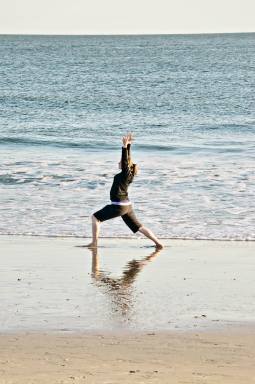
Today I wanted to post a shout-out to the world’s oldest yoga teacher: Bernice Mary Bates, called Bernie, who is 91 years old. Bernie’s been teaching yoga since 1960 and continues to teach yoga in her retirement community in Florida. How inspirational is that? Look at that beautiful navasana!
Yoga and the Mind/Body Connection: On Being’s Interview with Matthew Sanford May 6, 2012
It’s Sunday morning, and after F and I had just woken up, he turned on the radio. I was a little annoyed at first because I’d been thinking I might go back to sleep, but we heard the most remarkable story on NPR, an interview with Matthew Sanford, a yoga teacher and writer who’s just published a memoir, Waking: A Memoir of Trauma and Transcendence. In the interview, he had so much energy and joy, and everything he had to say really resonated with me. And about ten minutes into our listening, we found that Sanford is also in a wheelchair because he’s been paralyzed from the chest down since he was 13 years old.
Sanford was talking about the mind/body connection, and we missed the first part of the interview, but I think he was saying that it’s possible and good for anyone to deepen the connection between mind and body. He mentioned how, before he found yoga, he thought of himself as a disconnected torso, but now he’s totally rooted in his body, even the parts he can’t feel. His work on the mind/body connection has led him to some interesting realizations.
The interviewer read a line from Sanford’s book about how he’s never met a person who, after deepening his or her mind/body connection, didn’t become more compassionate. This was one of the things that really resonated for me, because it’s something that I’ve thought about and experienced, just not in those terms. Just a few months ago I was thinking about how I’m less able to tolerate violence in TV and movies. At the time I attributed the shift to the fact that, being immersed in yoga study and yoga philosophy, that the concept of non-violence and being one with all beings was seeping into my consciousness, bringing my spirituality forward in a different way. Sanford would say that I’d been deepening my connection with my body – he feels that when a person is truly present and connected to the body, that person feels more connected to others as well. And it’s true, throughout my yoga teacher training I became much more aware of and connected with my body. What an interesting way of looking at it.
Sanford seems to be really good at reversing common modes of thought. The interviewer asked about how people will often say things like “My body is failing me”, particularly as they age and find their skin sagging, vision blurring, and muscles not working the same way anymore. Sanford looks at it in a completely different way. For him, the body isn’t a machine that fails and needs repair – a classic concept we use to separate our minds from our bodies. For him, the body is always working, always striving to keep you alive. The body will keep on living and healing, even through the worst injury or illness, for as long as it possibly can. From this viewpoint, the body is your partner and your friend, capable of remarkable things.
I was so inspired by what I heard that I pretty much had to get up and write a blog post right away to share this with you. Sanford is truly inspirational in so many ways, and I can’t wait to read his book. Hearing this interview also deepened my desire to work with differently abled people. As a yoga teacher, Sanford teaches able-bodied people and also adapts yoga for those with disabilities and injuries, military veterans, everyone. And he does it from a wheelchair, or from a mat where he can’t move around. Sanford talked about the adaptive power of yoga, how yoga can be modified and adapted so that anyone can do it. It’s not about doing the “perfect” pose, it’s about doing the pose you can do and learning from it. There’s just so much power in yoga to help and to heal.
You can hear the entire interview here at On Being’s website, and learn more about Matthew Sanford and the work he’s doing.
Swami Vivekananda featured in WSJ April 3, 2012
My father-in-law pointed me towards this great article in the Wall Street Journal Magazine: What Did J.D. Salinger, Leo Tolstoy, Nikola Tesla and Sarah Bernhardt Have in Common? Answer: Swami Vivekananda!! I was really excited to see such nice coverage of Vivekananda in such a major venue. The article describes Vivekananda’s history and the many people he influenced. Lots of photos, too – definitely worth the read!
Yoga in the News: Ashtanga Article in Vanity Fair March 19, 2012
I just read this interesting and detailed article on Vanity Fair’s website: Whose Yoga Is It, Anyway? Kind of a fascinating look at the inner circle(s) of the Ashtanga community, especially after the recent Anusara blow-up. It sounds like the combination of lots of money, commercialization, yoga superstardom, passion about the core teachings, and the passing of a revered teacher is making a lot of waves. Overall I found it interesting to learn more about the Ashtanga lineage and wider community, even if that community is feeling some tension of late.
I know that many people really value having a deep connection to a special teacher or guru. I do know my lineage as a yoga teacher – who my teacher J studied with in India, and who that teacher studied with, rooting the yoga that I teach in a tradition that I’m proud to carry on. But at times like this, I think I’m glad not to have a personal connection with a guru. As we’ve all seen with John Friend and others like him, even revered yoga teachers are still fallible humans, and even when the teacher is as kind and lovely as Ashtanga’s Jois seems to have been, his successors won’t necessarily have the same qualities or goals. I don’t intend to demean the personal and spiritual connection of working directly with a guru or being part of that sort of close-knit yoga community; not having experienced it, I don’t want to pretend to understand how enlightening or intense that could be. What I do have, though, is my yoga. Because I’m a generation or two removed from the renowned teachers, I can always find strength and comfort in the yoga I practice and in passing that tradition on to my students, without having to worry about personal drama or community upheaval, and that’s something I appreciate.
Yoga in the News: A Yoga Room at the SFO Airport! January 27, 2012
Now this is exciting: SFO unveils world’s first (?) dedicated yoga room within an airport. I think it’s a fantastic idea. On airplanes we get crammed into these tiny seats and aren’t allowed to get up and move around or even stretch our legs. In airports we can sit for hours waiting for a late flight. A little yoga before or after a flight or during a layover would be a great way to stretch out and feel better. I’m excited for the next time I fly into SFO so I can check this out!
Avoiding Injuries Through Mindfulness January 12, 2012
A lot of people have read the recent NYT article about how yoga will “wreck your body”. As a brand-new yoga teacher, I obviously disagree with a lot of what the writer says: I mean, I just spent a significant amount of time and money dedicating myself to learning about yoga, which would be kind of a waste if this guy is right. Here are my thoughts.
Of course many people have injured themselves doing yoga. It’s not difficult to do – I’ve done it myself, and so has almost anyone who’s practiced yoga with any dedication over an extended period of time. You can injure yourself hiking or dancing or playing video games or gardening, too, but that doesn’t mean that we stop hiking and dancing and gardening. These are things that feed our spirits, and so is yoga. To single out yoga as an activity that can wreck your body doesn’t make sense, because there are so many other activities that can wreck your body! We humans are equal opportunity wreckers. Accidents can happen no matter what you’re doing.
The key thing, for me, is to keep in mind what the true purpose of yoga is. According to the ancient texts, yoga is a way to get the body healthy so you can then sit in meditation. The point is not to sculpt the body or lose weight or to get a great workout, and people who approach yoga with that attitude (or, with that attitude only) may in the long run be more likely to injure themselves. The point is to be healthy: whatever healthy happens to be for your particular body. And the point of being healthy ultimately isn’t the body at all – we’re working on the body so that we can sit comfortably in meditation. A healthy body won’t be aching and complaining when you sit still for ten minutes. That’s the point we’re trying to get to: improving the body so we can focus on more important things.
Keeping your focus off the body and on the mind can actually help yoga practitioners not to injure themselves. You want to be aware of what’s going on in the body, certainly, and it’s really important to cultivate that awareness of how the body feels and the difference between work and pain. Being mindful of your body is crucial, but it doesn’t do any good to be looking in the mirror or comparing yourself to other students and forcing your body toward something you’re not capable of. And don’t think ahead to what this yoga class is doing for you; keep your mind right in the moment, on your own mat. Stay present and focused on the pose you’re doing right now.
When you take part in any activity, you do your best to be careful and to be mindful of what you’re doing. When you go hiking or ride your bike, you watch where you’re going, but if your mind wanders, your foot can slip or your bike can veer off the path. It’s the same thing in yoga. Staying present and mindful and focused on what you’re doing will help you to avoid inadvertently causing an injury.
Here are a few other responses to the article by nvnehi and anytimeyoga and Michael Taylor. I think it’s interesting to see the very different, thoughtful ways that different yogis have reacted.
Okay, People, Monkeys Can Do It November 10, 2011
Fascinating news today: Marmosets can meditate. Apparently researchers have been working with a technique of showing people what their brain waves look like when they meditate, to help people to recreate that state, and it worked for marmosets too – they were able to get the marmosets into a state of meditation, show them what their brain waves looked like, and then the marmosets could do it again. The marmosets want marshmallows to do it, but who cares? If we all gave ourselves a marshmallow after meditation practice, we’d still be doing ourselves way more good than harm.
Aerial Yoga: closer to home in Skippack, PA November 3, 2011
Last month I posted about anti-gravity yoga classes in NYC. Then last week, my mom sent me a newspaper clipping showing people doing “Unnata Aerial Yoga” right around the corner from her, at Moyo Yoga Studio in Skippack, PA.
From their description, Unnata Aerial Yoga sounds a lot like the anti-gravity yoga in NY, and the photo from the newspaper article looks very similar, but their description sounds a lot more yogic than that NY studio’s description. Unfortunately they don’t have a photo of their aerial yoga class on their website, and I searched the newspaper’s website but they didn’t post the photo either. But, even better, there’s a video of the class on youtube!
After watching that, now I totally want to try this. Seeing it in action is a lot different from seeing a photo where it just looks intimidating. Maybe this would help me get past my headstand/handstand fears. And Saturday at 12:30pm would actually be a doable time for me to get up there (especially if I were going to visit my mom anyway). I’m very tempted to check it out!
Yoga & Sex: Article Round-Up October 14, 2011
In the course of my research for my presentation, I’ve found a lot of articles about how yoga can benefit your sex life. Many of these articles lean towards the prurient (“The 10 Poses That Will Make Him Ooh!” sort of thing), but despite that most of them have some really good content. Here’s what I’ve read so far:
Improve Your Sex Life with Yoga, on Gaiam’s website, by Kate Hanley:
A nice overview of how yoga can improve your sex life, discussing many of the specific benefits (sensuality, confidence, energy, intimacy, better orgasms), and describing two specific yoga poses that help boost sexual enjoyment.
Yoga Positions for Better Sex, in Prevention, by Nora Isaacs:
This article starts off by criticizing ancient yogis for practicing abstinence, which really turned me off. There’s no need to start the article by belittling another culture’s spiritual practice. I don’t think anyone should ever belittle anyone else’s spiritual practice, there’s just no excuse for that. However, once Isaacs got past being a shallow Westerner, she got into some of the important physical benefits of doing yoga: increased flexibility (particularly in the hips), strengthening the pelvic floor/root lock, getting in good physical shape just in general, recharging and relieving stress, and yoga breathing. She describes each benefit and then gives instructions for a pose that provides that benefit. Isaacs uses quotes from a yoga studio owner in California and from Jacquie Noelle Greaux, the author of Better Sex Through Yoga, so she’s consulted some experts. The article ends with the assertion that doing yoga with your partner will deepen your intimacy, get your energy flowing, and spark your creativity in the bedroom. (See, good content! Why’d she have to start off with that nonsense?)
Want Better Sex? Do Yoga, in Psychology Today, by Michael Castleman:
A good discussion of why yoga is good for sex, suggesting that yoga may help to treat sex problems where Western medicine (such as psychological counseling, sex therapy, and medication) falls short. Castleman focuses on relaxation, anxiety/stress relief, and improved blood flow, citing studies that have shown yoga to help in these areas. Recommended for Castleman’s more scientific approach to the subject.
Yoga for Better Sex: 9 Yoga Moves to Put Your Mind and Body in the Mood, in Prevention, no author listed:
Despite the silly title, there’s actually some good content in this one. The writer cites Ellen Barrett (author of Sexy Yoga) repeatedly, but as we’ve already seen, Barrett knows her stuff. This article lists the promised nine poses, with photos and descriptions for each detailing why each pose helps in the bedroom. I particularly like that the last pose listed is savasana!
Yoga in the News: Yoga, Annoying? Surely Not! September 10, 2011
Just spotted this article: Annoying? Yoga? Surely Not! I feel like I ought to be offended but instead I think it’s hilarious. Because we yoga people do all of this stuff. We hug too much and use yoga vocabulary that sounds silly and talk about how the universe has plans for us. Definitely keep your flip flops handy, but keep coming back too.
(Tagging this post with my “yoga for beginners” tag, because this is stuff that beginners should know in addition to the useful things I posted about before!)